
Latest News
Ministers meet with ICC prosecutor to discuss crimes against Afghans

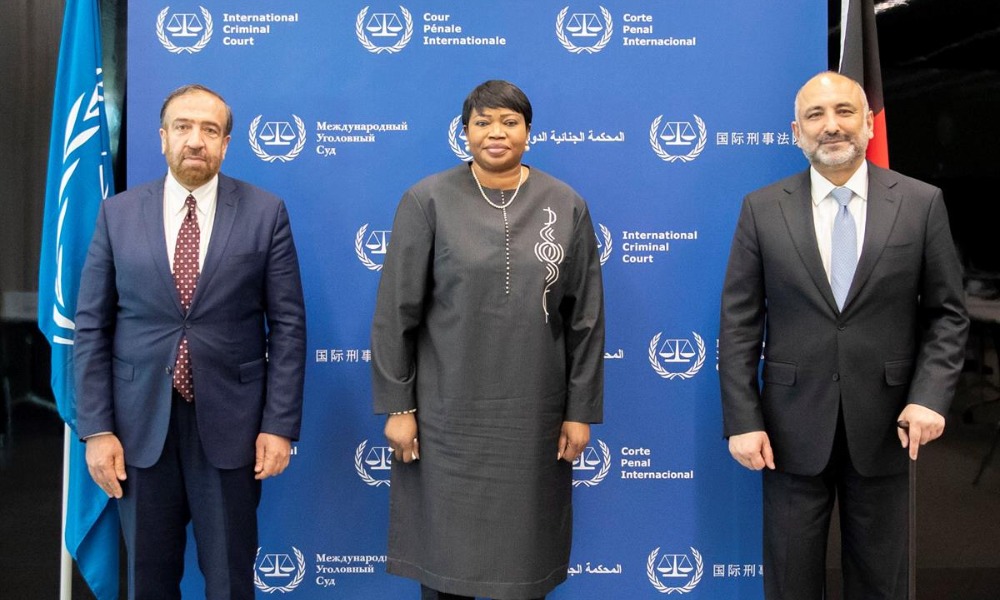
The Prosecutor of the International Criminal Court (ICC) Fatou Bensouda and her team met a high-level delegation from Afghanistan, including Foreign Minister Haneef Atmar, in a bid to achieve justice for the Afghan people by holding perpetrators of “atrocity crimes” accountable.
According to a statement issued by the ICC, a full day of discussions were held with officials from the foreign ministry, the justice ministry, the Attorney General’s Office, the Supreme Court and the National Security Department.
At the meeting, detailed presentations provided further insights into investigative steps taken or planned by the Afghan authorities and an opportunity for the ICC to seek clarifications on a number of discussion points, the statement read.
Bensouda and Atmar pledged to work together.
“I have great admiration for the courage and resilience of the people of Afghanistan who have withstood tremendous adversity through decades of conflict and violence. They deserve tangible justice without delay”, stated Bensouda.
“I look forward to continuing our constructive exchanges with the Government of Afghanistan, which was exemplified by today’s discussions, as we work towards determining how justice may best be served through joint collaborative efforts with full commitment to our respective independent duties and responsibilities under the Rome Statute”, she added.
Atmar in turn said “this was a historic and very constructive meeting. The Government of Afghanistan is grateful to the ICC Prosecutor for hosting our high-level delegation to address the investigation and prosecution of all international crimes in Afghanistan”.
He also said that “at this decisive moment for our country’s future, we have made encouraging progress in charting the way forward to ensure that no crimes will go unpunished. With our government’s unwavering commitment to human rights and justice, we are confident that with full cooperation with the Prosecutor, we can jointly advance the cause of justice for all of the victims of the long and devastating conflict.”
Zabihullah Karimullah, Afghanistan’s Attorney General who also participated at the meeting added: “Our meeting with the ICC Prosecutor was very useful for discussing the constructive ways in which we can cooperate with the Office of the Prosecutor and for sharing information about the cases that Afghanistan is investigating and prosecuting at all levels. We look forward to continuing our positive exchanges and collaboration to guarantee that there will be no impunity for international crimes.”
The ICC meanwhile said it was appreciative of Afghanistan’s expressed commitment and the steps taken towards addressing accountability for atrocity crimes and securing justice for victims in Afghanistan in close collaboration with the ICC.
The ICC conducts independent and impartial preliminary examinations, investigations and prosecutions of the crime of genocide, crimes against humanity, war crimes and the crime of aggression.
Since 2003, the Office has been conducting investigations in multiple situations within the ICC’s jurisdiction, namely in Uganda; the Democratic Republic of the Congo; Darfur, Sudan; the Central African Republic (two distinct situations); Kenya; Libya; Côte d’Ivoire; Mali; Georgia, Burundi; Bangladesh/Myanmar, Afghanistan and Palestine.
The Office is also currently conducting preliminary examinations relating to the situations in Bolivia; Colombia; Guinea; the Philippines; and Venezuela; and has recently completed its preliminary examinations of the situations in Ukraine and Nigeria, which are pending requests to seek authorisation to proceed to investigation.












Kazakhstan’s Foreign Minister Mukhtar Tileuberdi has called for pragmatic and coordinated international engagement with Afghanistan, saying the country’s long-term stability is closely linked to the security and sustainable development of Central Asia.
Speaking during the general debate of the 81st session of the United Nations General Assembly in New York on Friday, Tileuberdi said humanitarian assistance to Afghanistan remains essential but alone cannot break the cycle of poverty, displacement and dependency.
He said Kazakhstan supports a “pragmatic, coordinated and step-by-step” approach to international engagement with Afghanistan, with the United Nations playing a central role.
Tileuberdi also said Kazakhstan is working with the UN to operationalize the United Nations Regional Centre for the Sustainable Development Goals for Central Asia and Afghanistan in Almaty.
He said the success of the centre should be measured by the results and assistance it delivers to the region.


Abu Muslim Farah defeat Khurasan Faryab 2-0 in ACL season six

Saar: Concerns over Pakistan’s political crisis discussed

Afghanistan Champions League: Omar Zawak Herat beat Toofan Herat 1-0

Blast in Pakistan’s Dera Ismail Khan kills 11, injures 30

Ariana Afghan Airlines increases Kabul-Delhi cargo flights

Saudi energy group signs major Afghanistan deals covering gas exploration and pipeline plans

Trump floats idea of renaming Atlantic or Pacific Ocean

US hits Egyptian bank branches with Iran sanctions as war marks six months

Nepal flood rescue mission enters critical phase as thousands remain missing

Iranian clubs to face Gulf opponents at neutral venues in Asian Champions League Elite
Saar: Concerns over Pakistan’s political crisis discussed

Exclusive interview with Abdul Latif Mansoor, Minister of MRRD

Tawsia: Overview of Afghanistan’s iron mines

Tahawol: Discussion on fresh Pakistani airstrikes on Afghanistan

Saar: Calls for international support for Afghanistan discussed
-

 World5 days ago
CNN, MS NOW and Politico sue Trump, challenging White House ban
-

 Latest News3 days ago
Ariana Afghan Airlines ranks seventh among 45 Central Asian airlines
-

 Latest News5 days ago
UN reiterates call for respect for international law after Kunar airstrikes
-

 Regional4 days ago
US and Iran hold first talks since June after Trump’s ‘annihilation’ threat
-

 Latest News3 days ago
Silk Road highway in Wakhan corridor now reaches the China border
-

 Latest News5 days ago
Afghan Official: Pakistan’s airstrikes will not go unanswered
-

 Sport4 days ago
Afghan boxing referee heads to China for international festival
-
 Regional5 days ago
G7 foreign ministers call on Iran to stop arming Houthis