
Latest News
Gen McKenzie to recommend post-withdrawal plan for Afghanistan

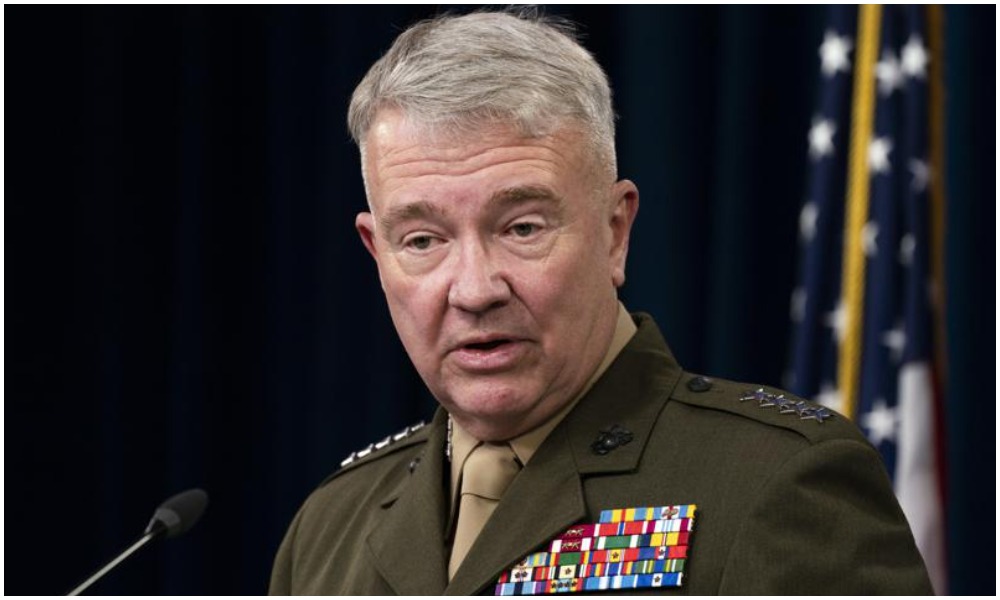
General Frank McKenzie, the Middle East commander of US Central Command (CENTCOM) said Wednesday he will make recommendations to Defense Secretary Lloyd Austin in early June on how to monitor and fight terrorist groups in Afghanistan from beyond its borders after all American forces withdraw.
McKenzie said negotiations with Afghanistan’s neighbors for overflight rights and troop basing are “moving forward” but will take time.
As a result, he said, the way the United States keeps an eye on the terrorist threat and aids the Afghan military will evolve as agreements are reached or security conditions on the ground change, The Associated Press reported.
He cautioned that this will be a “taxing time” for the Afghan military and “the risk is high.”
Speaking to reporters from The Associated Press and ABC News traveling with him to the Middle East, McKenzie declined to provide details about the recommendations he will make to Austin.
He said he will also provide cost estimates for keeping surveillance aircraft over Afghanistan regularly enough to keep track of terrorist groups after the U.S. pullout is completed.
McKenzie has made it clear that without any bases in neighboring countries, it will require far more aircraft to keep watch over Afghanistan because they will have to fly for four hours to six hours from other U.S. military installations in the Middle East.
The flight distance severely limits the amount of time the aircraft can spend in the air over Afghanistan, AP reported.
Military leaders are grappling with how best to carry out President Joe Biden’s order to withdraw all American troops from Afghanistan by September while still providing support to the Afghan forces and monitoring the threat that prompted the U.S. invasion of the country after the attacks of September 11, 2001.
Commanders have said they will monitor threats from “over the horizon,” to ensure that terrorists cannot again use Afghanistan as a base to launch attacks against the U.S. But they have acknowledged that the U.S. does not yet have any agreements for basing or overflights from any of the neighboring countries.
McKenzie said he is confident the U.S. will get the access it needs. But as yet, there are no firm solutions or decisions.
At the same time, Pentagon leaders and Congress members have expressed concerns that once the U.S. leaves, the Afghan government and its military will be quickly overrun by the Taliban.
The Afghan military, particularly its air force, has been heavily dependent on the U.S. for maintenance and training, as well as for combat air support when its troops are under attack. McKenzie said he believes the Afghans have a “fighting chance” to be successful and defend themselves.
“It’s time for the Afghan military to stand up and show that they can fight alone,” said McKenzie.
“I think it’s going to be a very taxing time for them. I think certainly there is a path for them to preserve what they have now. The risk is high. I don’t want to minimize that.”
He said that while the Taliban have not been attacking the U.S. or coalition troops, the violence against the Afghan people and the country’s military forces has been very high.
U.S. lawmakers have said they believe there is no chance the Taliban will abide by the commitments their leaders made in a February 2020 agreement with the Trump administration, which included engaging in sustained peace negotiations and severing all forms of cooperation with and support for al-Qaeda. Members of Congress also worry that al-Qaeda and the Islamic State group (Daesh) will take advantage of the chaos and regroup, with a goal of attacking the U.S. again.
McKenzie said that both al-Qaeda and IS have been degraded, AP reported.
“Our concern would be that ungoverned spaces open in Afghanistan and they are able to reassert themselves,” he said. “This would not be immediate. I don’t think anybody (thinks) this is something that will happen next month or even in the next six months. But eventually they will gather their strength again and they’ll be a threat to our homeland.”
Washington’s special envoy to Afghanistan, Zalmay Khalilzad, told a House hearing Tuesday that it is unduly pessimistic to predict that the Kabul government or Afghan military will be quickly overrun by the Taliban once U.S. and coalition forces withdraw.
He said the Taliban have reason not to push for a military victory and instead pursue a negotiated political settlement that could give them international legitimacy and removal from certain American and United Nations sanctions. He recently met with Taliban representatives in Doha, Qatar, as part of a round of consultations with interested parties.












Kazakhstan’s Foreign Minister Mukhtar Tileuberdi has called for pragmatic and coordinated international engagement with Afghanistan, saying the country’s long-term stability is closely linked to the security and sustainable development of Central Asia.
Speaking during the general debate of the 81st session of the United Nations General Assembly in New York on Friday, Tileuberdi said humanitarian assistance to Afghanistan remains essential but alone cannot break the cycle of poverty, displacement and dependency.
He said Kazakhstan supports a “pragmatic, coordinated and step-by-step” approach to international engagement with Afghanistan, with the United Nations playing a central role.
Tileuberdi also said Kazakhstan is working with the UN to operationalize the United Nations Regional Centre for the Sustainable Development Goals for Central Asia and Afghanistan in Almaty.
He said the success of the centre should be measured by the results and assistance it delivers to the region.


Abu Muslim Farah defeat Khurasan Faryab 2-0 in ACL season six

Saar: Concerns over Pakistan’s political crisis discussed

Afghanistan Champions League: Omar Zawak Herat beat Toofan Herat 1-0

Blast in Pakistan’s Dera Ismail Khan kills 11, injures 30

Ariana Afghan Airlines increases Kabul-Delhi cargo flights

Saudi energy group signs major Afghanistan deals covering gas exploration and pipeline plans

Trump floats idea of renaming Atlantic or Pacific Ocean

US hits Egyptian bank branches with Iran sanctions as war marks six months

Nepal flood rescue mission enters critical phase as thousands remain missing

Iranian clubs to face Gulf opponents at neutral venues in Asian Champions League Elite
Saar: Concerns over Pakistan’s political crisis discussed

Exclusive interview with Abdul Latif Mansoor, Minister of MRRD

Tawsia: Overview of Afghanistan’s iron mines

Tahawol: Discussion on fresh Pakistani airstrikes on Afghanistan

Saar: Calls for international support for Afghanistan discussed
-

 World5 days ago
CNN, MS NOW and Politico sue Trump, challenging White House ban
-

 Latest News3 days ago
Ariana Afghan Airlines ranks seventh among 45 Central Asian airlines
-

 Latest News4 days ago
UN reiterates call for respect for international law after Kunar airstrikes
-

 Regional3 days ago
US and Iran hold first talks since June after Trump’s ‘annihilation’ threat
-

 Latest News3 days ago
Silk Road highway in Wakhan corridor now reaches the China border
-

 Latest News4 days ago
Afghan Official: Pakistan’s airstrikes will not go unanswered
-

 Sport4 days ago
Afghan boxing referee heads to China for international festival
-

 Regional5 days ago
G7 foreign ministers call on Iran to stop arming Houthis