
Science & Technology
Billionaire Branson soars to space aboard Virgin Galactic flight

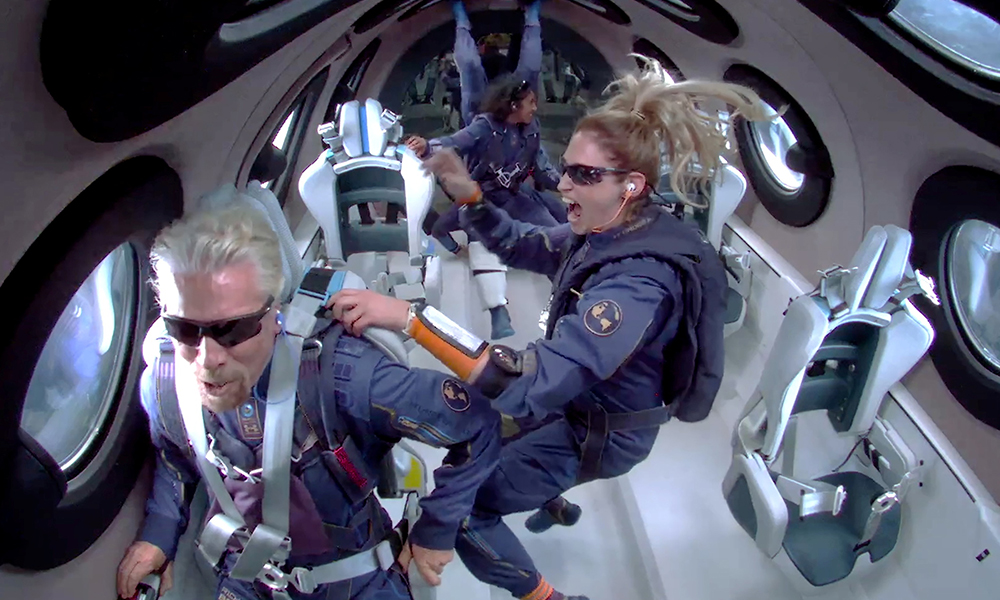
British billionaire Richard Branson on Sunday soared more than 50 miles above the New Mexico desert aboard his Virgin Galactic rocket plane and safely returned in the vehicle’s first fully crewed test flight to space, a symbolic milestone for a venture he started 17 years ago.
Branson, one of six Virgin Galactic Holding Inc employees strapped in for the ride, touted the mission as a precursor to a new era of space tourism, with the company he founded in 2004 poised to begin commercial operations next year.
“We’re here to make space more accessible to all,” an exuberant Branson, 70, said shortly after embracing his grandchildren following the flight. “Welcome to the dawn of a new space age.”
The success of the flight also gave the flamboyant entrepreneur bragging rights in a highly publicized rivalry with fellow billionaire Jeff Bezos, the Amazon online retail mogul who had hoped to fly into space first aboard his own space company’s rocket.
“Congratulations on the flight,” Bezos said on Instagram. “Can’t wait to join the club!”
Space industry executives, future customers and other well-wishers were on hand for a festive gathering to witness the launch, which was live-streamed in a presentation hosted by late-night television comedian Stephen Colbert. Joining the reception was another billionaire space industry pioneer, Elon Musk, who is also the founder of electric carmaker Tesla Inc.
Grammy-nominated R&B singer Khalid performed his forthcoming single “New Normal” after the flight.
The gleaming white spaceplane was carried aloft attached to the underside of the dual-fuselage jet VMS Eve (named for Branson’s late mother) from Spaceport America, a state-owned facility near the aptly named town of Truth or Consequences. Virgin Galactic leases a large section of the facility.
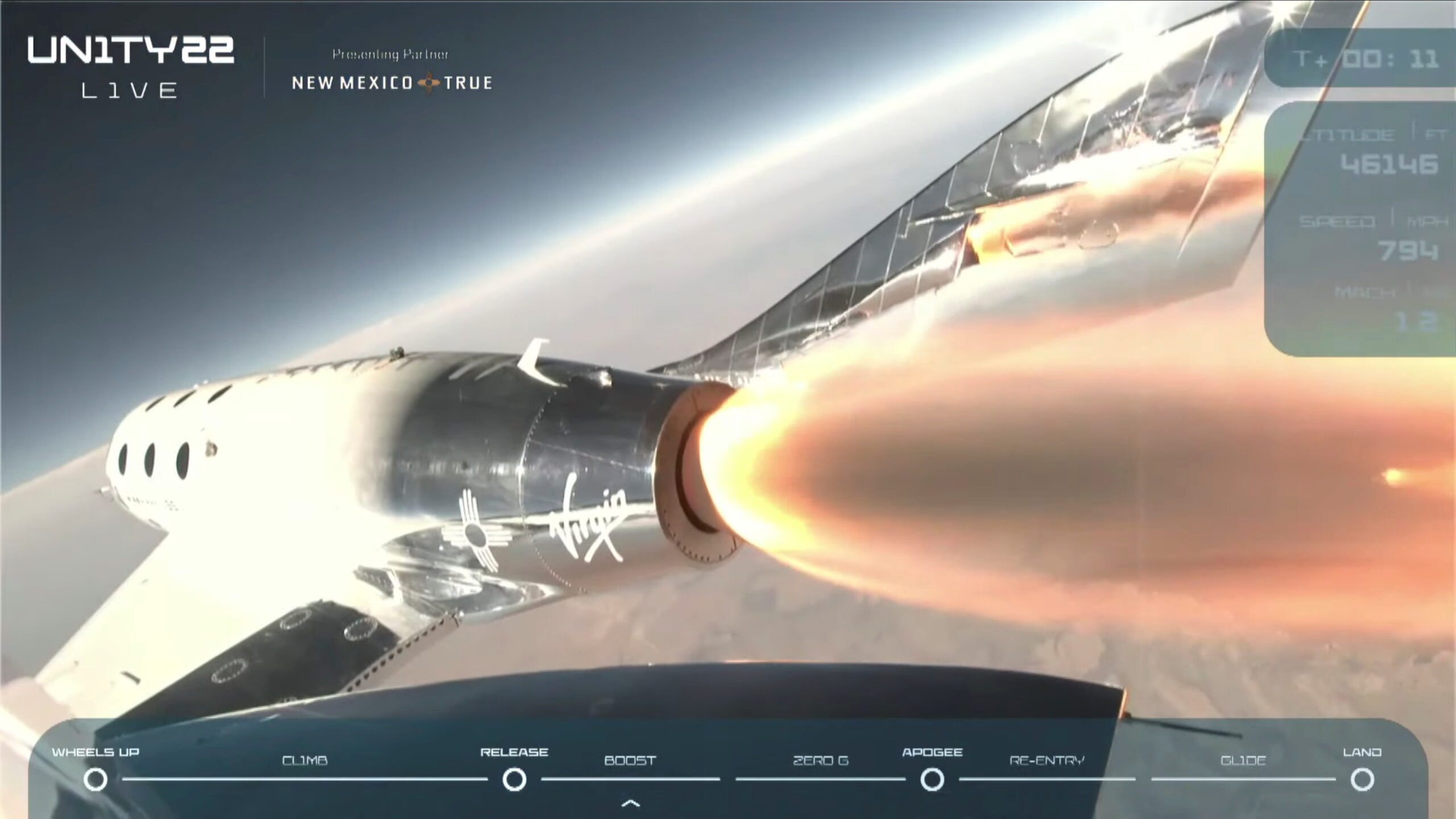
Reaching its high-altitude launch point at about 46,000 feet (14,020 m), the VSS Unity passenger rocket plane was released from the mothership and fell away as the crew ignited its rocket, sending it streaking straight upward at supersonic speed to the blackness of space some 53 miles (86 km) high.
The spaceplane’s contrail was clearly visible from the ground as it soared through the upper atmosphere, to the cheers of the crowd below.
At the apex of the climb with the rocket shut down, the crew then experienced a few minutes of microgravity, before the spaceplane shifted into re-entry mode, and began a gliding descent to a runway back at the spaceport. The entire flight lasted about an hour.
“I was once a child with a dream looking up to the stars. Now I’m an adult in a spaceship looking down to our beautiful Earth,” Branson said in a video from space.
Back at a celebration with supporters from a stage outside Virgin Galactic’s Gateway to Space complex at the spaceport, he and crewmates doused one another with champagne.
Retired Canadian astronaut Chris Hadfield pinned Virgin-produced astronaut wings onto the blue flight suits worn by Branson and his team. Official wing pins from the Federal Aviation Administration will be presented later, a company spokesman said.
HIGH-COST TICKETS
Virgin Galactic has said it plans at least two further test flights of the spaceplane in the months ahead before beginning regular commercial operation in 2022. One of those flights will carry four Italian astronauts-in-training, according to company CEO Michael Colglazier.
He said 600 wealthy would-be citizen astronauts have also booked reservations, priced at about $250,000 per ticket for the exhilaration of supersonic flight, weightlessness and the spectacle of spaceflight.
Branson has said he aims ultimately to lower the price to about $40,000 per seat as the company ramps up service, achieving greater economies of scale. Colglazier said he envisions eventually building a large enough fleet to accommodate roughly 400 flights annually at the spaceport.
The Swiss-based investment bank UBS has estimated the potential value of the space tourism market reaching $3 billion annually by 2030.
Proving rocket travel safe for the public is key.
An earlier prototype of the Virgin Galactic rocket plane crashed during a test flight over California’s Mojave Desert in 2014, killing one pilot and seriously injuring another.
SPACE RACE
Branson’s participation in Sunday’s flight, announced just over a week ago, typified his persona as the daredevil executive whose various Virgin brands – from airlines to music companies – have long been associated with his ocean-crossing exploits in sailboats and hot-air balloons.
His ride-along also upstaged rival astro-tourism venture Blue Origin and its founder, Bezos, in what has been popularized as the “billionaire space race.” Bezos has been planning to fly aboard his own suborbital rocketship, the New Shepard, later this month.
Branson has insisted he and Bezos are friendly rivals and were not racing to beat one another into space.
“We wish Jeff the absolute best and that he will get up and enjoy his flight,” Branson said at a post-flight news conference.
Blue Origin, however, has disparaged Virgin Galactic as falling short of a true spaceflight experience, saying that unlike Unity, Bezos’s New Shepard tops the 62-mile-high-mark (100 km), called the Kármán line, set by an international aeronautics body as defining the boundary between Earth’s atmosphere and space.
“New Shepard was designed to fly above the Kármán line so none of our astronauts have an asterisk next to their name,” Blue Origin said in a series of Twitter posts on Friday.
However, U.S. space agency NASA and the U.S. Air Force both define an astronaut as anyone who has flown higher than 50 miles (80 km).
A third player in the space tourism sector, Musk’s SpaceX, plans to send its first all-civilian crew (without Musk) into orbit in September, after having already launched numerous cargo payloads and astronauts to the International Space Station for NASA.
A Virgin Galactic spokesperson told the Wall Street Journal that Musk had bought a ticket for his own space ride. The newspaper said that it was not clear how far up the waiting list Musk is for a seat.
Representatives for Musk could not be immediately reached. Virgin Galactic and Tesla did not immediately respond to requests for comment.
The spaceplane’s two pilots were Dave Mackay and Michael Masucci. The three other mission specialists were Beth Moses, the company’s chief astronaut instructor; Virgin Galactic’s lead operations engineer Colin Bennett; and Sirisha Bandla, a research operations and government affairs vice president.
All recounted afterward being mesmerized by the view through Unity’s windows. Mackay described the immense blackness of space against the brightness of Earth’s surface, “separated by the beautiful blue atmosphere, which is very complex and very thin.”
“Cameras don’t do it justice,” he told reporters. “You have to see it with your own eyes.”






Science & Technology
Swirling, vortex-like patterns observed on the sun’s surface
The researchers said the observations may provide insight into underlying physical processes that impact the dynamics of the sun and other stars, including eruptions from the solar surface that can interfere with the operation of satellites, GPS navigation, power grids and global communications on Earth.
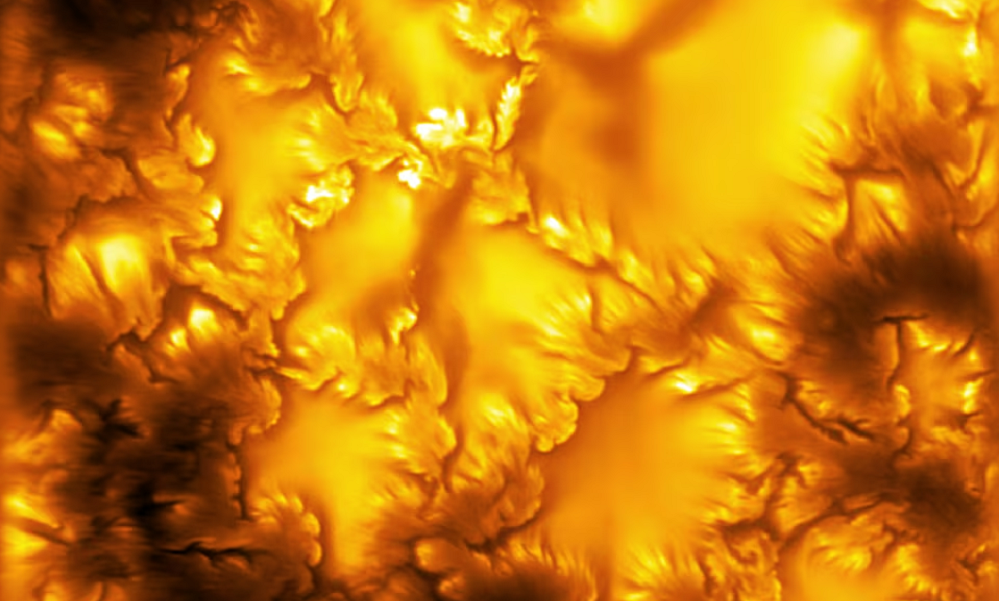
Astronomers have obtained the highest-resolution images to date of our sun’s visible surface, observing swirling, vortex-like patterns in superheated solar gases reminiscent of the shapes depicted in the nocturnal sky in Vincent van Gogh’s 1889 painting “The Starry Night.”
The researchers made the observations of a portion of the sun’s photosphere, a relatively thin layer — about 60 miles (100 km) in depth compared to the overall solar diameter of roughly 865,000 miles (1.4 million km) — using the U.S. National Science Foundation’s Hawaii-based Daniel K. Inouye Solar Telescope, Reuters reported.
The still images and time-lapse video reveal continuously growing whirls of hot plasma, gas heated to temperatures so high that subatomic particles called electrons break free from atoms and form a broth of charged particles. The observed whirls are large on a human scale but small on the scale of a stellar surface, with diameters ranging from about 12 miles (19 km) — the minimum scale detectable by the world’s most powerful solar telescope — up to roughly 100 miles (170 km).
The researchers said the observations may provide insight into underlying physical processes that impact the dynamics of the sun and other stars, including eruptions from the solar surface that can interfere with the operation of satellites, GPS navigation, power grids and global communications on Earth.
The curly, circular patterns do not represent random shapes, but rather are the first detection of a phenomenon called Kelvin-Helmholtz instability, or KHI, on the surface of a star. KHI, first described in the 19th century, refers to a dynamic process that happens when two parallel streams of fluids or gases interact while moving at different velocities.
“The interface can become unstable and develop wave-like vortices that grow in size until they break apart, not unlike waves out on a lake or out on the ocean in windy conditions,” said astronomer Friedrich Wöger, a senior scientist at the National Science Foundation’s National Solar Observatory in Colorado, the Inouye telescope’s instrument program scientist, and co-lead author of the study published on Wednesday in the journal Nature.
Swirling clouds caused by KHI are a well-known, albeit rare, meteorological occurrence on Earth, and also have been observed in the atmospheres of the giant gas planets Jupiter and Saturn, Wöger said.
“The difference from the waves and clouds we know here on Earth is that the two interacting fluids are hot plasma — about 6,000 degrees Kelvin and 10,000 degrees Fahrenheit (5,540 degrees Celsius) — moving within a magnetic field that helps create the conditions for the instability to develop,” Wöger said.
By twisting the solar magnetic field, KHI creates energy that can suddenly unleash an explosion.
‘A TRUE GAME-CHANGER’
Wöger called the discovery of solar KHI “a true game-changer,” saying it opens up a new framework for understanding how the sun energizes its atmosphere.
“The sun and sun-like stars are extremely dynamic systems, characterized by a whole spectrum of rapid, explosive events within their magnetic elements. How these explosions are triggered is one of the main frontiers in modern solar physics,” National Solar Observatory astronomer and study co-lead author David Kuridze said.
The KHI manifestation might help explain why the sun’s outer atmosphere becomes as hot as it does and why magnetic energy accumulates and moves around on the solar surface.
The constant twisting motions generated by KHI can gradually build the energy required to trigger coronal mass ejections and solar flares, Kuridze said. Coronal mass ejections are huge bubbles of gas threaded with magnetic field lines that are expelled from the sun’s surface. Solar flares are gigantic explosions on the sun that propel light, energy and high-speed particles into space.
Aside from the science, the researchers admired the beauty of the new close-up views of the sun.
“Maybe ‘magnificent’ comes closest to describing the aesthetics in the images for us,” Wöger said.
“Interestingly, artists have long captured this fluid dynamic intuition in their work. A famous example is Van Gogh’s ‘The Starry Night,’ where the sky’s vortex structures closely resemble turbulent KHI structures,” Kuridze said. “A similar parallel appears in Hokusai’s famous woodblock print, ‘The Great Wave off Kanagawa,’ where the curling crests of the wave echo the iconic shape of KHI billows. It shows how the fundamental geometry of nature deeply resonates with human art.”
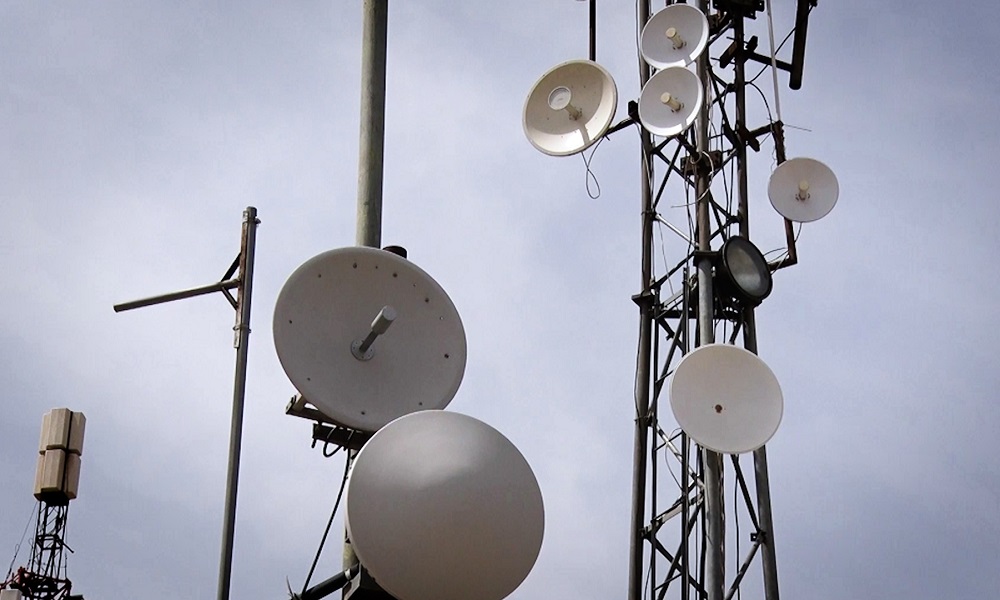
Afghanistan is currently serving as a transit route for internet traffic between South Asia and Central Asia, the Ministry of Communications and Information Technology (MCIT) said, highlighting the country’s growing role in regional digital connectivity.
The ministry said fiber-optic traffic from several South Asian countries is routed through Afghanistan to Central Asian nations via the country’s fiber-optic network.
According to the ministry, nearly $3 billion has been invested in Afghanistan’s fiber-optic and telecommunications sector so far, with expansion efforts continuing.
Officials said Afghanistan offers significant investment opportunities in telecommunications and fiber-optic infrastructure. They added that, alongside expanding domestic communications services, the ministry is working to enhance the country’s capacity to provide transit services for regional countries.
The ministry said Afghanistan is already facilitating the transit of internet traffic from parts of South Asia to Central Asia and stressed that the country’s strategic geographic location positions it as an important digital corridor between the two regions.
“We are currently transiting internet traffic through Afghanistan to South Asian and Central Asian countries,” said Enayatullah Alokozai, spokesperson for the Ministry of Communications and Information Technology. “Afghanistan is a suitable geographical corridor for data transmission.”
Economic analysts say Afghanistan has the potential to become a key hub for regional connectivity. They noted that, in addition to serving as a corridor for energy transmission from Central Asia, the country could also facilitate the large-scale transit of fiber-optic connectivity, internet traffic, and commercial goods.
Representatives of the private sector also said Afghanistan has strong potential to attract further investment in telecommunications and fiber-optic infrastructure. They noted that numerous domestic and international companies are active in the sector, creating direct employment opportunities for thousands of Afghans.
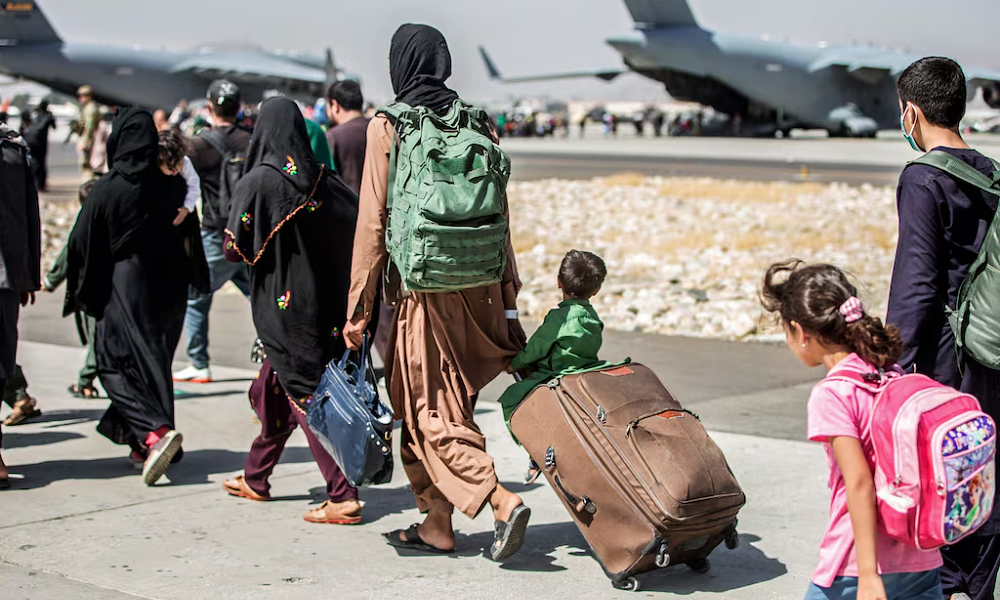
A veteran-led organisation has launched a new artificial intelligence-powered platform designed to help Afghans navigate complex visa and relocation options as thousands remain stranded or at risk nearly five years after the withdrawal of U.S. forces from Afghanistan.
The Visa Pathways and Relocation Information Center (V-PRIC), developed by AfghanEvac, uses artificial intelligence to guide users through possible immigration and protection pathways based on their individual circumstances.
According to AfghanEvac founder and U.S. Navy veteran Shawn VanDiver, the platform attracted more than 30,000 visits during its first week online.
Users begin by answering questions about their current location, whether they worked with the United States, whether they face security risks, and by providing a brief description of their situation. The system then compares that information with a database covering 124 U.S. visa and immigration categories, including 16 relevant to Afghan applicants, as well as relocation options offered by other countries.
VanDiver said the platform is intended to simplify what is often a confusing and constantly changing immigration process. Before using the service, applicants must acknowledge that it does not provide legal advice.
The launch comes as many Afghans who supported the U.S. during its two-decade military presence continue to face uncertainty. AfghanEvac says policy changes have significantly reduced available relocation opportunities, leaving many applicants unable to progress with immigration cases.
According to the organisation, around 1,100 Afghan allies and their family members remain at the Camp As Sayliyah processing facility in Doha, Qatar, despite many having previously received approval to enter the United States. AfghanEvac says travel restrictions have prevented them from completing the process.
VanDiver said the new tool helps users identify obstacles affecting their applications, including whether delays are caused by legal requirements or government policy, while also highlighting possible next steps.
The platform has been trained using legal decisions, executive orders, policy documents and information gathered through AfghanEvac surveys and guidance materials. The organisation says it will continue updating the system as immigration policies evolve.
VanDiver said the tool could also help applicants avoid actions that may complicate future immigration cases, such as pursuing visa interviews when programmes are temporarily suspended.
AfghanEvac recently surveyed more than 1,100 Afghans between January and July this year. Of the 427 respondents still inside Afghanistan, nearly half reported facing direct security threats. Another 427 respondents were in Pakistan awaiting relocation, with many expressing concerns about possible deportation and limited access to healthcare.
The organisation emphasised that the AI platform is intended to complement, rather than replace, professional legal assistance. It encourages applicants to seek legal advice while using the service to better understand the immigration options available to them.


Tahawol: Afghanistan’s future in the global press discussed

Saar: The Islamic Emirate’s five-year rule discussed

Shamshad Eagles beat Speenghar Warriors by six wickets

Kabul Premier League: Abasin Defenders thrash Band-e Amir Stars by 163 runs

Islamic Emirate leader urges Kabul University graduates to uphold Islamic values

Pakistan’s governance system has ‘collapsed’: Mohsin Naqvi

Spain sweep FIFA World Cup player awards after historic triumph

Iran, Afghanistan and Tajikistan discuss expanding regional transit cooperation

Afghan health minister, Gavi discuss expanding routine immunization

Afghanistan temporarily eases fuel import standards to help curb rising prices
Tahawol: Afghanistan’s future in the global press discussed
Saar: The Islamic Emirate’s five-year rule discussed

Tahawol: Hamid Karzai’s call for Afghan reconciliation discussed

Saar: Preparations for IEA’s fifth anniversary discussed

Tahawol: Iran’s acknowledgment of Afghanistan’s cooperation discussed
-

 Sport4 days ago
Afghanistan secure direct qualification for 2027 Men’s ODI World Cup
-
 Regional5 days ago
Goods transporters to go on strike from Saturday after talks with Pakistan govt fail
-
 Latest News4 days ago
Pakistan-backed armed groups in Balochistan using former Afghan government forces: report
-

 Sport5 days ago
Rashid Khan takes six as Afghanistan thrash Ireland by 92 runs
-
 World5 days ago
US Senate passes Russia sanctions championed by Graham; US House next
-
 Sport3 days ago
Abasin Defenders stun Kabul Zalmi in Kabul Premier League
-

 Latest News5 days ago
Moldova president criticizes visa approval for IEA delegation
-
 Regional4 days ago
Turkey, Pakistan, Saudi Arabia defence pact technically same as NATO’s Article 5, Turkish minister says