
World
Trump rejects Putin offer of one-year extension of New START deployment limits

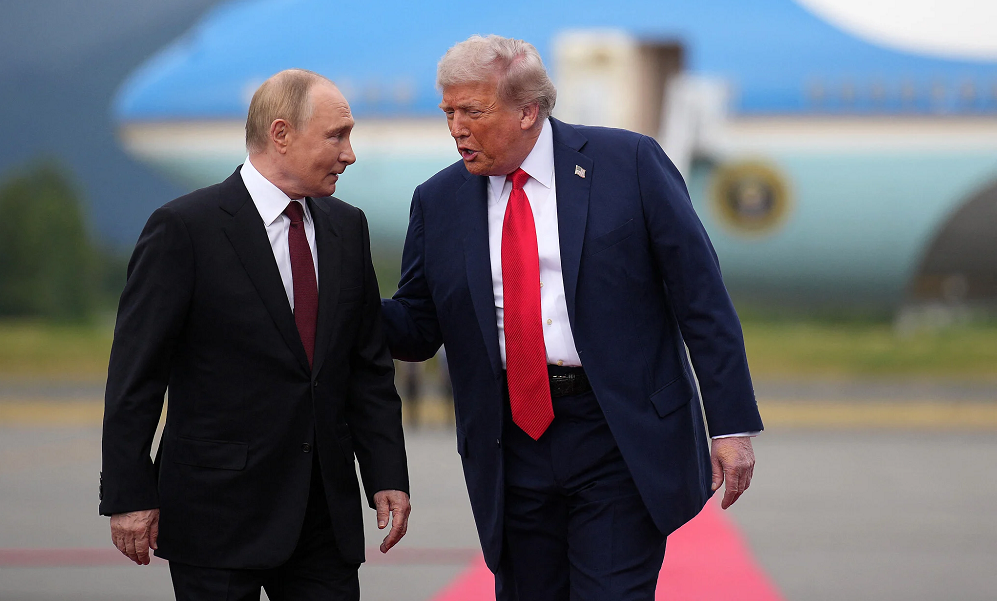
U.S. President Donald Trump on Thursday rejected an offer from his Russian counterpart to voluntarily extend the caps on strategic nuclear weapons deployments after the treaty that held them in check for more than two decades expired.
“Rather than extend “New START … we should have our Nuclear Experts work on a new, improved and modernized Treaty that can last long into the future,” Trump wrote in a post on his Truth Social platform, Reuters reported.
Arms control advocates warn that the expiration of the treaty will fuel an accelerated nuclear arms race, while U.S. opponents say the pact constrained the U.S. ability to deploy enough weapons to deter nuclear threats posed by both Russia and China.
Trump’s post was in response to a proposal by Russian President Vladimir Putin for the sides to adhere for a year to the 2010 accord’s limit of 1,550 warheads on 700 delivery systems — missiles, aircraft and submarines.
New START was the last in a series of arms control treaties between the world’s two largest nuclear weapons powers dating back more than half a century to the Cold War. It allowed for only a single extension, which Putin and former U.S. President Joe Biden agreed to for five years in 2021.
In his post, Trump called New START “a badly negotiated deal” that he said “is being grossly violated,” an apparent reference to Putin’s 2023 decision to halt on-site inspections and other measures designed to reassure each side that the other was complying with the treaty.
Putin cited U.S. support for Ukraine’s battle against Russia’s 2022 full-scale invasion as the reason for his decision.
White House spokeswoman Karoline Leavitt told reporters that the U.S. would continue talks with Russia.
BOTH SIDES SIGNAL OPENNESS TO TALKS
Earlier, Kremlin spokesman Dmitry Peskov said Russia was still ready to engage in dialogue with the U.S. if Washington responded constructively to Putin’s proposal.
“Listen, if there are any constructive replies, of course we will conduct a dialogue,” Peskov told reporters.
The UN has urged both sides to restore the treaty.
Besides setting numerical limits on weapons, New START included inspection regimes experts say served to build a level of trust and confidence between the nuclear adversaries, helping make the world safer.
If nothing replaces the treaty, security analysts see a more dangerous environment with a higher risk of miscalculation. Forced to rely on worst-case assumptions about the other’s intentions, the U.S. and Russia would see an incentive to increase their arsenals, especially as China plays catch-up with its own rapid nuclear build-up.
Trump has said he wants to replace New START with a better deal, bringing in China. But Beijing has declined negotiations with Moscow and Washington. It has a fraction of their warhead numbers – an estimated 600, compared to around 4,000 each for Russia and the U.S.
Repeating that position on Thursday, China said the expiration of the treaty was regrettable, and urged the U.S. to resume dialogue with Russia on “strategic stability.”
UNCERTAINTY OVER TREATY EXPIRY DATE
There was confusion over the exact timing of the expiry, but Peskov said it would be at the end of Thursday.
Russia’s Foreign Ministry said Moscow’s assumption was that the treaty no longer applied and both sides were free to choose their next steps.
It said Russia was prepared to take “decisive military-technical countermeasures to mitigate potential additional threats to national security” but was also open to diplomacy.
That warning was in apparent response to the possibility that Trump could expand U.S. nuclear deployments by reversing steps taken to comply with New START, including reloading warheads on intercontinental ballistic missiles and submarine-launched missiles from which they were removed.
A bipartisan congressionally appointed commission in 2023 recommended that the U.S. develop plans to reload some or all of its reserve warheads, saying the country should prepare to fight simultaneous wars with Russia and China.
Ukraine, which has been at war with Russia since Moscow’s 2022 invasion, said the treaty’s expiry was a consequence of Russian efforts to achieve the “fragmentation of the global security architecture” and called it “another tool for nuclear blackmail to undermine international support for Ukraine.”
Strategic nuclear weapons are the long-range systems that each side would use to strike the other’s capital, military and industrial centres in the event of a nuclear war. They differ from so-called tactical nuclear weapons that have a lower yield and are designed for limited strikes or battlefield use.
If left unconstrained by any agreement, Russia and the U.S. could each, within a couple of years, deploy hundreds more warheads, experts say.
“Transparency and predictability are among the more intangible benefits of arms control and underpin deterrence and strategic stability,” said Karim Haggag, director of the Stockholm International Peace Research Institute.








World
Trump welcomes Chinese President Xi as US-China summit gets underway
WATCH: ▶️ Trump’s decision to meet Xi at Joint Base Andrews airport marked the first time since 1962 that a US president has personally welcomed a foreign leader at the base.
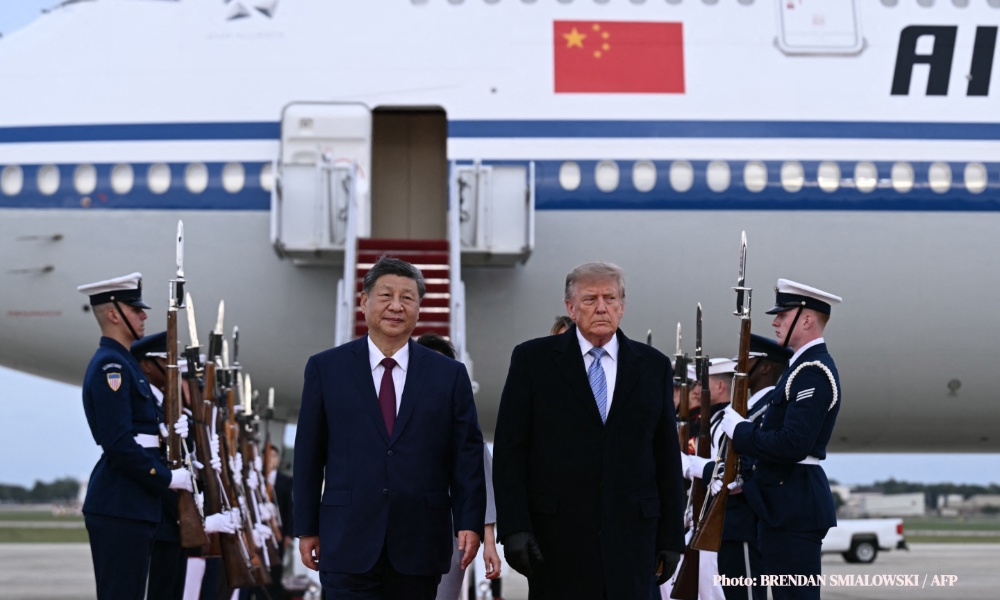
US President Donald Trump welcomed Chinese President Xi Jinping to Washington with a high-profile military ceremony, as the two leaders begin a three-day summit focused on trade, technology and other major areas of tension between the two countries.
Xi arrived at Joint Base Andrews in Maryland on Wednesday evening, where Trump and First Lady Melania Trump personally greeted him and his wife, Peng Liyuan.
The Chinese leader was welcomed with a red carpet, a military honor guard, marching band and a flyover by two US B-1 bombers. Trump’s decision to meet Xi at the airport marked the first time since 1962 that a US president has personally welcomed a foreign leader at the base.
Xi’s visit to Washington is his first since 2015 and comes as the two countries seek to maintain a fragile trade truce.
US Treasury Secretary Scott Bessent said on Wednesday that Washington and Beijing had agreed to extend their current trade truce until January. The arrangement had been due to expire on 10 November.
The agreement has involved the US lowering tariffs on some Chinese goods in exchange for China easing restrictions on exports of rare earth minerals.
Bessent said discussions with Chinese Vice Premier He Lifeng also covered the possibility of reaching a broader trade agreement.
In a statement carried by China’s state news agency Xinhua, Xi said the US and China should be “partners rather than rivals”, adding that cooperation between the two countries could benefit the world.
The summit is expected to address a wide range of issues, including trade and tariffs, rare earth minerals, agricultural exports, artificial intelligence, Taiwan and the ongoing conflict involving Iran.
Trump is expected to seek increased Chinese purchases of US agricultural products, greater access to Chinese rare earth minerals and lower Chinese tariffs on American goods.
Taiwan is also expected to feature in the talks, with Beijing opposing US arms sales to the self-governing island.
Xi is travelling with senior Chinese officials including Cai Qi, a member of the Communist Party’s Politburo Standing Committee, Vice Premier He Lifeng and Foreign Minister Wang Yi.
The Chinese president is expected to attend a state dinner at the White House on Thursday, with leaders from the US artificial intelligence industry among the guests.
The two countries are competing for greater influence in AI, while also debating the regulation and potential risks associated with the technology.
Xi’s visit will conclude on Friday.
World
Trump warns in UN speech he could ‘annihilate’ Iran without peace deal
Members of the Cuban delegation walked out of the hall as Trump referenced his pressure campaign against the country.
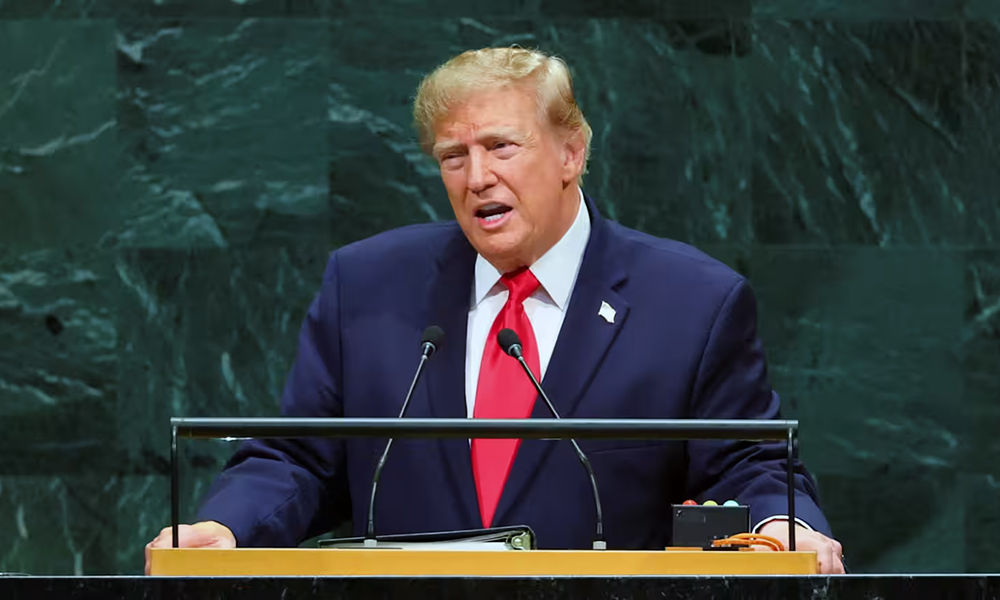
US President Donald Trump used his UN General Assembly speech on Tuesday to make the case for his war on Iran, arguing he has prevented Tehran from obtaining a nuclear weapon and warning that he could “annihilate the Islamic Republic” if no deal is reached to end the conflict, Reuters reported.
While predicting his administration would strike a peace deal with Iran following the November 3 US midterm elections, Trump called on other nations to join America in isolating Iran economically to force it to the negotiating table.
“I have a big decision to make. Will a deal be made with Iran that lets them rebuild and create a far greater country than it ever was before?” Trump said. “Or do I annihilate the Islamic Republic and do it quickly, never giving them a chance to kill and destroy people and countries again?”
He later told reporters at the United Nations that US officials had held a “very good” three-hour meeting with the Iranian delegation on Tuesday. He subsequently appeared to clarify that special envoys Steve Witkoff and Jared Kushner had met with mediators rather than Iranian officials directly.
“Steve and Jared had a very productive meeting today with mediators of Iran, merely mediators,” he told reporters at the start of a meeting with Gulf leaders at the UN. “Let’s see what happens with that.”
Since returning to office last year for a second term, Trump has sent waves through the global order, joining Israel to attack Iran, ordering a raid on Venezuela that captured the country’s leader, and threatening to seize Greenland.
In a 37-minute speech ahead of a whirlwind diplomatic schedule that included meetings with the leaders of Britain, Ukraine and Japan, Trump laid out his foreign policy vision, arguing that the Iran war had spared the world the threat of a nuclear-armed menace while asserting US dominance in the Western Hemisphere is essential to preventing crises from taking root.
“Our actions in Venezuela are proof that the United States will no longer permit threats to America to gain a foothold anywhere in the Western Hemisphere,” Trump said. “While others have spoken of peace, I have made peace.”
Outside the UN headquarters, dozens of anti-Iranian-government demonstrators gathered, a few of them holding up signs calling for democracy and decrying dictatorship.
Trump brushed aside suggestions that the midterm elections, in which his Republican Party risks losing control of Congress, could constrain his handling of the war. Some analysts have argued that a Democratic takeover of the legislature would weaken his leverage in the conflict.
“What they don’t realize is that I’m not running,” Trump said, referring to the leadership in Tehran. “I did that already, and won in a landslide. We won in a giant landslide, and I’ll be here for 2-1/2 years.”
Taking aim at US neighbors, Trump labeled Mexico “the epicenter of cartel violence,” urged its government to “reclaim control of its soil,” and said his administration was pursuing “a fundamental change in the situation in Cuba.”
Members of the Cuban delegation walked out of the hall as Trump referenced his pressure campaign against the country.
“It’s an absolutely failed state, it’s failing like never before, and it will fall,” said Trump.
Yet Trump’s appearance was less dramatic than in 2025, when he used a combative speech to chastise world leaders, warning that some countries were “going to hell,” and complained about UN facilities after being briefly stranded on a malfunctioning escalator and suffering an initial teleprompter failure, read the report.
Trump renewed his criticism of the UN, highlighting his efforts to cut its bureaucracy, but offered no fresh attacks or indications that the US would leave any additional UN agencies.
Trump spoke less than a week after a UN fact-finding mission said it had reasonable grounds to believe US forces committed war crimes in two strikes on Iran, including one that hit a primary school in the southern city of Minab.
He renewed his criticism of international bodies that could serve as a check on US power, singling out the International Criminal Court and declaring that US military personnel would not be subject to its authority.
“We will never allow US service members or anyone else to be investigated or given show trials by an anti-American tribunal with no jurisdiction over us,” he said.
Ahead of a UN Security Council meeting on AI and international security on Wednesday, Trump acknowledged the challenges of the new technology but said, “I’m not going to stifle growth of something that will be bigger than the Industrial Revolution.”
The speech kicked off a day of high-level diplomacy at the United Nations, where Trump was due to meet more than a dozen world leaders as wars in the Middle East and Ukraine continued to test his foreign policy agenda.
British Prime Minister Andy Burnham said he had “established a good connection” with Trump in their first-ever meeting, where they discussed trade, Ukraine and the status of the Falkland Islands. Trump called Burnham a “natural business person” after the meeting.
At the press-facing start of their talks, Japanese Prime Minister Sanae Takaichi said the meeting would demonstrate the strength of the US-Japan alliance amid a “severe security environment, including in Asia,” an apparent nod to China. Trump is due to meet Chinese President Xi Jinping in Washington later this week.
Trump lavished praise on Takaichi, calling her a friend and predicting she would “go down as one of the great prime ministers.”
On his meeting with Ukrainian President Volodymyr Zelenskiy, Trump told reporters that the two talked about finding a solution to end Russia’s war in Ukraine.
World
CNN, MS NOW and Politico sue Trump, challenging White House ban
Trump has stepped up his actions targeting the media since winning a second term, suing multiple outlets and repeatedly urging broadcasters to drop programs he deems unfair.
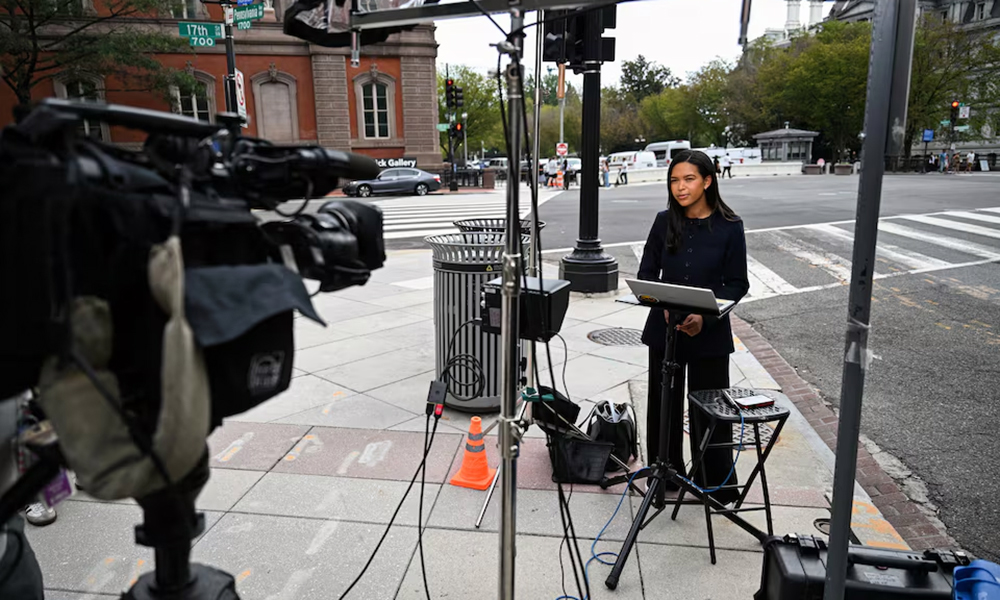
CNN, MS NOW and Politico sued President Donald Trump and other members of his administration on Monday for banning them from White House grounds, saying the action violated their rights to free speech and a free press under the US Constitution’s First Amendment, Reuters reported.
The news outlets are seeking a temporary restraining order to block Trump’s action in federal court in Washington, D.C., with a hearing scheduled for Wednesday.
“This ban could not be a more direct assault on the First Amendment nor a more blatant violation of our most fundamental constitutional principles,” the lawsuit stated.
“Left unchallenged, this threatens press freedom and the public’s right to independent journalism free from government interference,” the outlets wrote in a joint statement. “The government does not decide what the press reports or publishes.”
Trump announced the ban on Friday on social media, saying those news outlets “shouldn’t be able to constantly write or report FICTION and LIES when they’re covering the President of the United States,” and defended it in another post on Monday.
“The White House is not instituting an assault on the Free Press, something which I cherish. It is instituting an assault on the FAKE NEWS. It is a threat to our National Security, and must be stopped, NOW!” Trump wrote on Monday, without providing evidence of a national security threat.
Past presidents have battled with the press, but Trump’s campaign against the media has been unprecedented. He has upended decades of tradition by denying basic access to many major news organizations, launching personal attacks on journalists for their reporting and elevating media outlets seen as more sympathetic to the administration. He also has filed lawsuits against multiple news outlets, read the report.
The White House launched a “Trump TV” stream on Monday evening, days after Trump banned the media outlets from the White House.
The White House said the stream will run videos and highlights of what it calls the Trump administration’s achievements but a press freedom advocate said it amounted to “a steady diet of government propaganda.”
A 60-second trailer displayed the Republican leader’s 2024 presidential win and the first video streamed after the platform went live was Trump’s remarks on July 3 at Mount Rushmore. The stream had only about 8,000 live views 15 minutes after it was launched on YouTube.
“This just makes it even clearer that the real goal here is to ensure that the American public is fed a steady diet of government propaganda,” Jameel Jaffer, executive director of the Knight First Amendment Institute at Columbia University, said.
CNN is one of the five news organizations – along with ABC, CBS, Fox News and NBC – that make up the primary White House television pool. They share the costs of covering the president, take turns organizing coverage and share the footage with outlets around the country.
CNN had been scheduled to cover Trump’s trip to New York for the United Nations General Assembly on Monday, but was not able to provide a pool feed.
In response, the other major TV networks suspended presidential pool coverage. This effectively eliminated the most widespread video source for White House events just as Trump is set to meet with numerous world leaders on the sidelines of the General Assembly and host Chinese President Xi Jinping in Washington later in the week.
“This is to advise that, effective today (Monday), the TV pool will not be covering events designated as pool coverage of the President,” Bryan Boughton, who runs the Fox News Washington bureau and is the current TV pool chair, said in an email Monday. “There will be no replacement pool put in place.”
Otherwise, it was business as usual in the White House press room on Monday as reporters planned for the day’s events, including an afternoon ribbon-cutting ceremony for the Republican president’s new Marine One helipad on the South Lawn.
The audio on the White House’s own live stream of the ceremony, which it promoted as an alternative to the pool feed, was inaudible.
Trump’s party is seeking to retain its narrow majorities in both chambers of Congress in the November midterm elections. Polls show the public souring on Republicans and Trump’s own approval ratings stand near historic lows.
A person familiar with the matter, speaking on condition of anonymity, said Natalie Harp, a close presidential aide, showed Trump clips and graphics of recent news coverage, which contributed to his decision to ban the three outlets.
Trump has been “very unhappy” with coverage of the midterm elections, the person added, and his frustration intensified after last week’s Supreme Court ruling that blocked his attempt to limit mail-in voting, Reuters reported.
“The Fake News has no place demanding a spot in the President’s Oval Office,” the White House said in response to Reuters questions about the lawsuit, Harp’s role and Trump’s views on election coverage. “They’re completely capable of reporting from directly outside.”
The affected news organizations moved quickly to present a united front. Within 10 minutes of Trump’s announcement on Friday, CNN reached out to MS NOW and Politico to discuss joint legal action, according to a person with direct knowledge of the matter, speaking on condition of anonymity.
“Banning news organizations from the White House prevents them from confronting government officials face-to-face and perhaps eliciting off-the-cuff unguarded comments that might shed new light onto political matters, which is especially important during an election year,” said Victor Pickard, a professor of media policy and political economy at the University of Pennsylvania’s Annenberg School for Communication.
Last year, Trump banned the Associated Press from the pool of reporters that cover his movements because the news agency did not adopt his preferred name for the Gulf of Mexico. The AP has sued over the ban. His administration also has limited the access of many journalists to the Pentagon.
In his first term, Trump’s White House sought to take away the credentials of then-CNN correspondent Jim Acosta and Playboy correspondent Brian Karem. Federal judges ordered their White House press passes be restored.
The lawsuit was assigned to US District Judge Timothy Kelly, who was appointed by Trump in 2017. It was Kelly who ruled against Trump in 2018 in the Acosta case.
Trump has stepped up his actions targeting the media since winning a second term, suing multiple outlets and repeatedly urging broadcasters to drop programs he deems unfair.
He has called on the Federal Communications Commission to strip disfavored broadcast stations of their licenses.
David Ellison, son of Trump ally and Oracle (ORCL.N), Executive Chairman Larry Ellison, took control of Paramount and its CBS news unit, leading to a shakeup at “60 Minutes,” the most popular US TV news magazine.
Ellison is now seeking to acquire CNN parent Warner Bros, in a move approved by Trump’s administration.


Toofan Herat beat Khurasan Faryab 2–1 in Afghanistan Champions League

Tahawol: Discussion on fresh Pakistani airstrikes on Afghanistan

Afghanistan Champions League: Ariana Khost beat Sarsabz Yashlar 2–1

Khalilzad warns Pakistan-Afghanistan tensions likely to worsen after fresh airstrikes

Saar: Calls for international support for Afghanistan discussed

Saudi energy group signs major Afghanistan deals covering gas exploration and pipeline plans

ATN secures exclusive rights to broadcast T20I series in India across Afghanistan

Trump floats idea of renaming Atlantic or Pacific Ocean

US hits Egyptian bank branches with Iran sanctions as war marks six months

Nepal flood rescue mission enters critical phase as thousands remain missing
Tahawol: Discussion on fresh Pakistani airstrikes on Afghanistan
Saar: Calls for international support for Afghanistan discussed

Tahawol: Opening of the 81st UN General Assembly Session

Saar: OIC Assessment of Afghanistan’s humanitarian and development situation discussed

Tahawol: Reactions to Pakistan’s attacks on Afghanistan discussed
-

 Sport3 days ago
Afghanistan to face Japan and Nepal in Asian Games cricket group stage
-
 Latest News4 days ago
Pakistan says Kohat attackers had roots in Afghanistan
-
 Latest News5 days ago
OIC to hold Afghanistan Contact Group meeting on sidelines of UN General Assembly
-

 Regional5 days ago
Flames, smoke seen near Riyadh airport; Houthis claim attacks on Saudi capital
-
 Regional4 days ago
Iran and US trade threats after Houthi attacks escalate regional conflict
-
 Business4 days ago
Dogharoun handles 60% of Iran’s exports to Afghanistan
-

 World3 days ago
CNN, MS NOW and Politico sue Trump, challenging White House ban
-
 World4 days ago
World leaders return to UN amid wars in Middle East and Ukraine