
Latest News
Haiti quake survivors cry for help as death toll nears 2,000

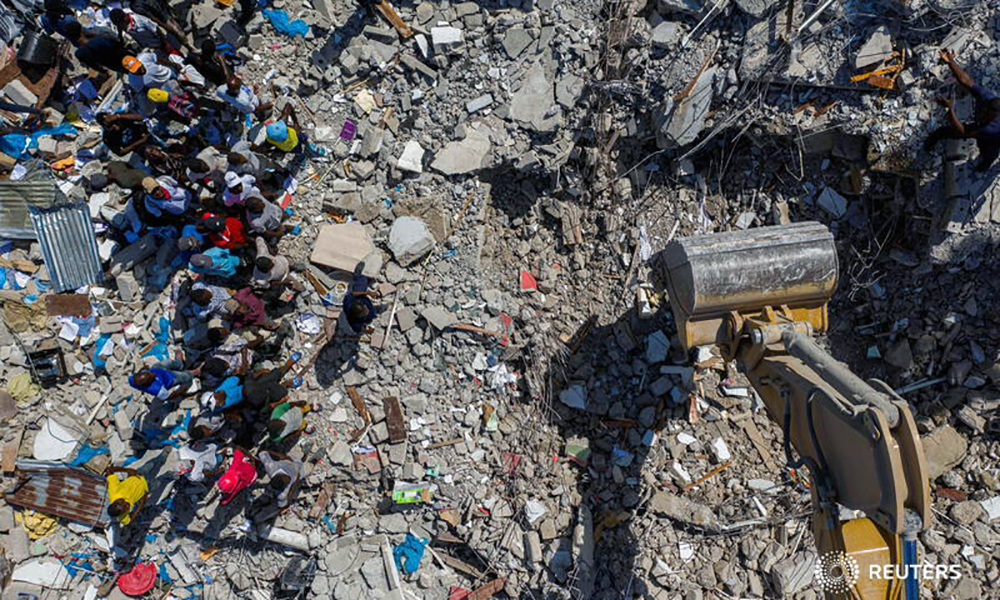
Survivors of the earthquake that killed at least 1,941 people in Haiti clamored for food, shelter and medical care on Tuesday as search and rescue efforts resumed after a tropical storm lashed the Caribbean nation with rain, causing dangerous flooding.
Quake damage to several major hospitals hampered humanitarian efforts, and doctors in makeshift tents outside battled to save the lives of the many injured, including young children and the elderly. But they could not help them all, Reuters reported.
“There weren’t enough doctors and now she’s dead,” said Lanette Nuel, sitting listlessly next to her daughter’s body outside the main hospital of Les Cayes, one of the towns worst hit by both the tremor and the storm’s heavy rains and winds.
The 26-year-old deceased woman, herself a mother of two, had been crushed by debris during the magnitude 7.2 quake. Now she lay under a white sheet on the floor.
“We came in yesterday afternoon, she died this morning. I can’t do anything,” her mother said.
Saturday’s quake knocked down tens of thousands of buildings in the poorest country in the Americas, which is still recovering from a temblor 11 years ago that killed over 200,000 people. Aside from the dead, the latest quake also injured at least 9,915, with many people still missing or under the rubble, the civil protection service said on Tuesday afternoon, Reuters reported.
Relief efforts were already complicated due to political turmoil and difficult road access from the capital to the south due to gang control of key points. Flash flooding and landslides in the wake of Tropical Storm Grace, which by Tuesday afternoon had continued on past Jamaica, exacerbated the situation.
“Countless Haitian families who have lost everything due to the earthquake are now living literally with their feet in the water due to the flooding,” said Bruno Maes, the United Nations Children’s Fund (UNICEF) representative in the country.
“Right now, about half a million Haitian children have limited or no access to shelter, safe water, healthcare and nutrition.”
The United Nations said it had allocated $8 million in emergency funds to provide relief for affected people, Reuters reported.
Latin America countries including Venezuela, Chile, Mexico, Panama, Colombia and the neighboring Dominican Republic sent food, medicine and supplies. The United States also dispatched supplies and search and rescue teams.
Although criminal gangs have been blocking access roads for months, the United Nations Office for the Coordination of Human Affairs said “successful negotiations” had made it possible for a convoy to reach Les Cayes.
The hospital in Les Cayes, about 150 km west of the capital Port-au-Prince, was even more overwhelmed on Tuesday than before as patients who had been camping outside moved indoors to escape the tropical storm.
Director Peterson Gede said medics were doing the best they could. “We couldn’t handle all the patients,” he said. “And we have been receiving supplies, but it’s not enough.”
At a tent city in Les Cayes containing many children and babies, over a hundred people scrambled to repair makeshift coverings made of wooden poles and tarps that were destroyed by Grace overnight. Some took cover under plastic sheets.
Mathieu Jameson, deputy head of the committee formed by the tent city residents, said hundreds of people there were in urgent need of food, shelter and medical care.
“We don’t have a doctor. We don’t have food. Every morning more people are arriving. We have no bathroom, no place to sleep. We need food, we need more umbrellas,” said Jameson, adding the tent city was still waiting for government aid.
Haiti’s latest natural disaster comes just over a month after the country was plunged into political turmoil by the July 7 assassination of President Jovenel Moise.
U.S. national security adviser Jake Sullivan said on Tuesday it was too early to gauge the impact of the quake on Haiti’s political process and that the United States, the country’s main donor, had no current plans to deploy its military there.
Rescue workers have been digging alongside residents through the rubble in a bid to reach survivors.
On Tuesday morning 16 people were recovered alive alongside nine dead, Haitian civil protection authorities said.
But hopes were fading, and a smell of dust and decomposing bodies permeated the air, Reuters reported.
“We came from all over to help: from the north, from Port-au Prince, from everywhere,” said Maria Fleurant, a firefighter from northern Haiti.
Prime Minister Ariel Henry, who was sworn in less then a month ago after Moise’s assassination, vowed to disburse humanitarian aid better than in the wake of the 2010 quake.
Though billions of dollars in aid poured into Haiti after that quake and Hurricane Matthew in 2016, many Haitians say they saw scant benefits from the uncoordinated efforts: government bodies remained weak, amid persistent shortages of food and basic goods.
“The earthquake is a great misfortune that happens to us in the middle of the hurricane season,” Henry told reporters. He said the government would not repeat “the same things” done in 2010.












Kazakhstan’s Foreign Minister Mukhtar Tileuberdi has called for pragmatic and coordinated international engagement with Afghanistan, saying the country’s long-term stability is closely linked to the security and sustainable development of Central Asia.
Speaking during the general debate of the 81st session of the United Nations General Assembly in New York on Friday, Tileuberdi said humanitarian assistance to Afghanistan remains essential but alone cannot break the cycle of poverty, displacement and dependency.
He said Kazakhstan supports a “pragmatic, coordinated and step-by-step” approach to international engagement with Afghanistan, with the United Nations playing a central role.
Tileuberdi also said Kazakhstan is working with the UN to operationalize the United Nations Regional Centre for the Sustainable Development Goals for Central Asia and Afghanistan in Almaty.
He said the success of the centre should be measured by the results and assistance it delivers to the region.


Abu Muslim Farah defeat Khurasan Faryab 2-0 in ACL season six

Saar: Concerns over Pakistan’s political crisis discussed

Afghanistan Champions League: Omar Zawak Herat beat Toofan Herat 1-0

Blast in Pakistan’s Dera Ismail Khan kills 11, injures 30

Ariana Afghan Airlines increases Kabul-Delhi cargo flights

Saudi energy group signs major Afghanistan deals covering gas exploration and pipeline plans

Trump floats idea of renaming Atlantic or Pacific Ocean

US hits Egyptian bank branches with Iran sanctions as war marks six months

Nepal flood rescue mission enters critical phase as thousands remain missing

Iranian clubs to face Gulf opponents at neutral venues in Asian Champions League Elite
Saar: Concerns over Pakistan’s political crisis discussed

Exclusive interview with Abdul Latif Mansoor, Minister of MRRD

Tawsia: Overview of Afghanistan’s iron mines

Tahawol: Discussion on fresh Pakistani airstrikes on Afghanistan

Saar: Calls for international support for Afghanistan discussed
-

 World5 days ago
CNN, MS NOW and Politico sue Trump, challenging White House ban
-

 Latest News3 days ago
Ariana Afghan Airlines ranks seventh among 45 Central Asian airlines
-

 Latest News4 days ago
UN reiterates call for respect for international law after Kunar airstrikes
-

 Regional3 days ago
US and Iran hold first talks since June after Trump’s ‘annihilation’ threat
-

 Latest News3 days ago
Silk Road highway in Wakhan corridor now reaches the China border
-

 Latest News5 days ago
Afghan Official: Pakistan’s airstrikes will not go unanswered
-

 Sport4 days ago
Afghan boxing referee heads to China for international festival
-

 Regional5 days ago
G7 foreign ministers call on Iran to stop arming Houthis