
Latest News
Afghan Prime Minister addresses nation in first voice message

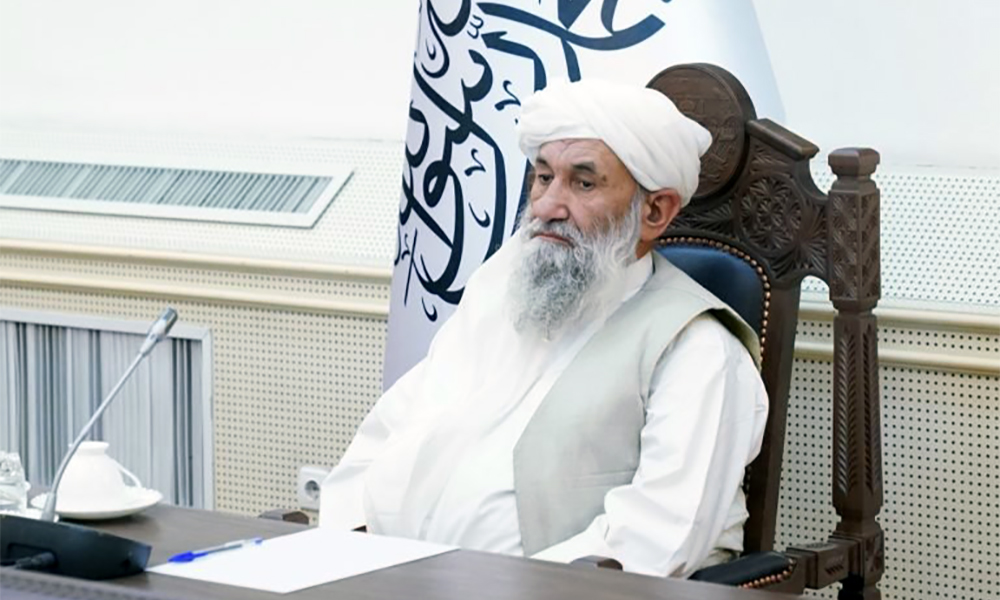
The Prime Minister of the Islamic Emirate of Afghanistan (IEA), Mullah Mohammad Hassan Akhund, addressed the nation for the first time on Saturday in a half-hour audio message.
“The Islamic Emirate is not the cause of unemployment and the poor economic situation in Afghanistan, all these problems are the legacy of the previous government,” he told the nation.
In the message, Akhund called on the people of Afghanistan to support the government of the Islamic Emirate and stressed that the Islamic Emirate (IE) has fulfilled its promises.
He acknowledged that there were economic problems in the country, but said that the “sustenance of the people” was not promised by the government of the Islamic Emirate, that it was from Allah, and that Allah was testing his servants.
“In the past, people did not have a place to spend the day and night, but now there is an atmosphere where security is everywhere,” he said.
Addressing IE members and forces, Akhund said: “I call on all the people and the Mujahideen to stand side by side in the formation and stability of this Islamic system and work for a better future.
“We work day and night to solve people’s problems beyond our human capacity. We have formed various commissions and committees to coordinate matters, all of which are working,” he said.
“People who enter people’s homes are not Mujahideen, they are armed thieves dressed as Mujahideen and doing evil deeds,” he stressed.
Akhund said: “All governors, commanders and officials are strongly instructed to open your gates to the people, otherwise the gates of Allah’s mercy will be closed to you.”
He rejected the criticism of the structure of the government. He claimed that the government of the Islamic Emirate was “inclusive” and that the rights of all classes were guaranteed.
“The decision to integrate the system must be made by the people,” he said.
In his message he asked, “Did the previous government create an inclusive system in which two departments operated in the same place and each had its own supporters?”
He claimed that “in the current system, any nation and section can see itself.”
Akhund also claimed that “the Islamic Emirate has guaranteed women’s rights.”
“Education is mandatory for both men and women. We hope all women have access to education.”
However, Akhund emphasized that “the Islamic Emirate has given women’s rights, dignity and chastity.”
He also assured neighboring countries that there is no threat to them from the IEA.
“We have already told our neighbors and we are still telling them that we will not harm you,” he said.
He added that we are thinking about rebuilding our country.
“We do not have a policy of interfering in the internal affairs of other countries,” he said.
This is his first message to the nation since the IEA takeover in Afghanistan in August.







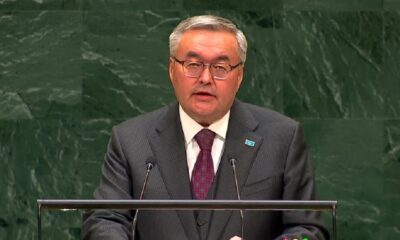




Kazakhstan’s Foreign Minister Mukhtar Tileuberdi has called for pragmatic and coordinated international engagement with Afghanistan, saying the country’s long-term stability is closely linked to the security and sustainable development of Central Asia.
Speaking during the general debate of the 81st session of the United Nations General Assembly in New York on Friday, Tileuberdi said humanitarian assistance to Afghanistan remains essential but alone cannot break the cycle of poverty, displacement and dependency.
He said Kazakhstan supports a “pragmatic, coordinated and step-by-step” approach to international engagement with Afghanistan, with the United Nations playing a central role.
Tileuberdi also said Kazakhstan is working with the UN to operationalize the United Nations Regional Centre for the Sustainable Development Goals for Central Asia and Afghanistan in Almaty.
He said the success of the centre should be measured by the results and assistance it delivers to the region.


Saar: Concerns over Pakistan’s political crisis discussed

Afghanistan Champions League: Omar Zawak Herat beat Toofan Herat 1-0

Blast in Pakistan’s Dera Ismail Khan kills 11, injures 30

Ariana Afghan Airlines increases Kabul-Delhi cargo flights

Khalilzad questions Pakistan’s commitment to Afghan welfare

Saudi energy group signs major Afghanistan deals covering gas exploration and pipeline plans

Trump floats idea of renaming Atlantic or Pacific Ocean

US hits Egyptian bank branches with Iran sanctions as war marks six months

Nepal flood rescue mission enters critical phase as thousands remain missing

Iranian clubs to face Gulf opponents at neutral venues in Asian Champions League Elite
Saar: Concerns over Pakistan’s political crisis discussed

Exclusive interview with Abdul Latif Mansoor, Minister of MRRD

Tawsia: Overview of Afghanistan’s iron mines

Tahawol: Discussion on fresh Pakistani airstrikes on Afghanistan

Saar: Calls for international support for Afghanistan discussed
-

 World5 days ago
CNN, MS NOW and Politico sue Trump, challenging White House ban
-

 Latest News3 days ago
Ariana Afghan Airlines ranks seventh among 45 Central Asian airlines
-

 Latest News4 days ago
UN reiterates call for respect for international law after Kunar airstrikes
-
 Latest News5 days ago
Khalilzad condemns Pakistan airstrikes, says current strategy is not working
-

 Regional3 days ago
US and Iran hold first talks since June after Trump’s ‘annihilation’ threat
-

 Latest News3 days ago
Silk Road highway in Wakhan corridor now reaches the China border
-

 Latest News4 days ago
Afghan Official: Pakistan’s airstrikes will not go unanswered
-

 Sport4 days ago
Afghan boxing referee heads to China for international festival