
Latest News
Sudan factions agree to 72-hour ceasefire as foreigners are evacuated

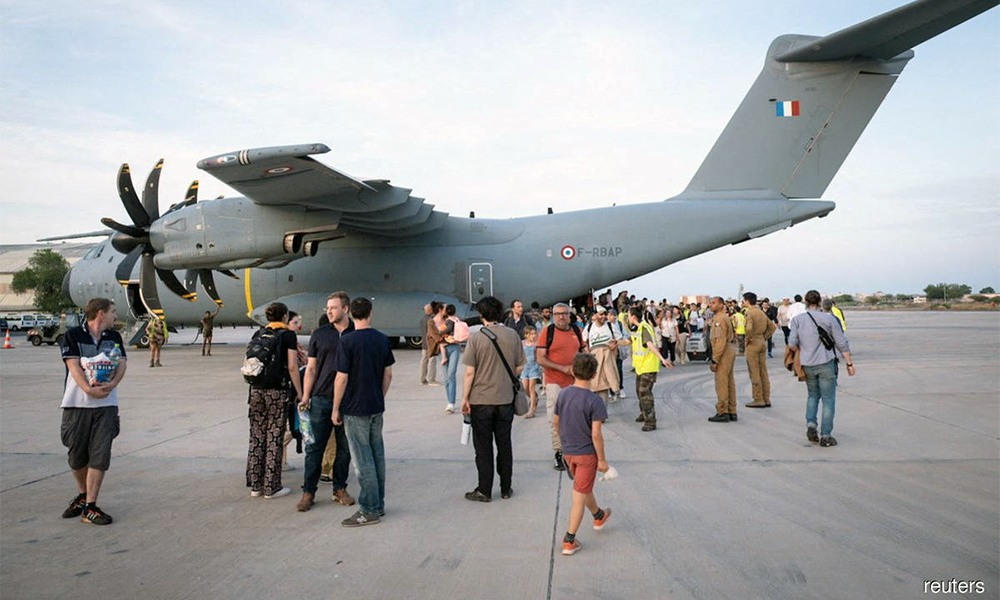
Sudan’s warring factions agreed to a 72-hour ceasefire starting on Tuesday, while Western, Arab and Asian nations raced to extract their citizens from the country.
The Sudan Armed Forces (SAF) said the U.S. and Saudi Arabia mediated the truce. U.S. Secretary of State Anthony Blinken announced the agreement first and said it followed two days of intense negotiations. The two sides have not abided by several previous temporary truce deals, Reuters reported.
Fighting erupted between the SAF and Rapid Support Forces (RSF) paramilitary group on April 15 and has killed at least 427 people, knocked out hospitals and other services, and turned residential areas into war zones.
“During this period, the United States urges the SAF and RSF to immediately and fully uphold the ceasefire,” Blinken said in a statement.
He said the U.S. would coordinate with regional, international and Sudanese civilian interests to create a committee that would oversee work on a permanent ceasefire and humanitarian arrangements.
The RSF confirmed in Khartoum that it had agreed to the ceasefire, starting at midnight, to facilitate humanitarian efforts. “We affirm our commitment to a complete ceasefire during the truce period”, the RSF said.
The SAF said on its Facebook page that it also agreed to the truce deal. A coalition of Sudanese civil society groups that had been part of negotiations on a transition to democracy welcomed the news.
Ahead of the evening truce announcement, air strikes and ground fighting shook Omdurman, one of three adjacent cities in the capital region, and there were also clashes in capital Khartoum, a Reuters reporter said.
Dark smoke enveloped the sky near the international airport in central Khartoum, adjacent to army headquarters, and booms of artillery fire rattled the surroundings.
U.N. Secretary-General Antonio Guterres said that the violence in a country that flanks the Red Sea, Horn of Africa and Sahel regions “risks a catastrophic conflagration … that could engulf the whole region and beyond”.
The Security Council planned a meeting on Sudan on Tuesday.
Tens of thousands of people including Sudanese and citizens from neighboring countries have fled in the past few days, to Egypt, Chad and South Sudan, despite instability and difficult living conditions there.
Foreign governments have been working to bring their nationals to safety. One 65-vehicle convoy took dozens of children, along with hundreds of diplomats and aid workers, on an 800-km, 35-hour journey in searing heat from Khartoum to Port Sudan on the Red Sea.
For those remaining in Africa’s third-largest country, where a third of its 46 million people needed aid even before the violence, the situation was increasingly bleak.
There were acute shortages of food, clean water, medicines and fuel and limited communications and electricity, with prices skyrocketing, said deputy U.N. spokesperson Farhan Haq.
He cited reports of looting of humanitarian supplies and said “intense fighting” in Khartoum as well as in Northern, Blue Nile, North Kordofan and Darfur states was hindering relief operations.
Facing attacks, aid organizations were among those withdrawing staff, and the World Food Programme suspended its food distribution mission, one of the largest in the world.
“The quick evacuation of Westerners means that the country is on the brink of collapse. But we expect a greater role from them in supporting stability by pressuring the two sides to stop the war,” said Suleiman Awad, a 43-year-old academic in Omdurman.
Several nations, including Canada, France, Poland, Switzerland and the United States, have halted embassy operations until further notice.












Kazakhstan’s Foreign Minister Mukhtar Tileuberdi has called for pragmatic and coordinated international engagement with Afghanistan, saying the country’s long-term stability is closely linked to the security and sustainable development of Central Asia.
Speaking during the general debate of the 81st session of the United Nations General Assembly in New York on Friday, Tileuberdi said humanitarian assistance to Afghanistan remains essential but alone cannot break the cycle of poverty, displacement and dependency.
He said Kazakhstan supports a “pragmatic, coordinated and step-by-step” approach to international engagement with Afghanistan, with the United Nations playing a central role.
Tileuberdi also said Kazakhstan is working with the UN to operationalize the United Nations Regional Centre for the Sustainable Development Goals for Central Asia and Afghanistan in Almaty.
He said the success of the centre should be measured by the results and assistance it delivers to the region.


Abu Muslim Farah defeat Khurasan Faryab 2-0 in ACL season six

Saar: Concerns over Pakistan’s political crisis discussed

Afghanistan Champions League: Omar Zawak Herat beat Toofan Herat 1-0

Blast in Pakistan’s Dera Ismail Khan kills 11, injures 30

Ariana Afghan Airlines increases Kabul-Delhi cargo flights

Saudi energy group signs major Afghanistan deals covering gas exploration and pipeline plans

Trump floats idea of renaming Atlantic or Pacific Ocean

US hits Egyptian bank branches with Iran sanctions as war marks six months

Nepal flood rescue mission enters critical phase as thousands remain missing

Iranian clubs to face Gulf opponents at neutral venues in Asian Champions League Elite
Saar: Concerns over Pakistan’s political crisis discussed

Exclusive interview with Abdul Latif Mansoor, Minister of MRRD

Tawsia: Overview of Afghanistan’s iron mines

Tahawol: Discussion on fresh Pakistani airstrikes on Afghanistan

Saar: Calls for international support for Afghanistan discussed
-

 World5 days ago
CNN, MS NOW and Politico sue Trump, challenging White House ban
-

 Latest News3 days ago
Ariana Afghan Airlines ranks seventh among 45 Central Asian airlines
-

 Latest News4 days ago
UN reiterates call for respect for international law after Kunar airstrikes
-

 Regional3 days ago
US and Iran hold first talks since June after Trump’s ‘annihilation’ threat
-

 Latest News3 days ago
Silk Road highway in Wakhan corridor now reaches the China border
-

 Latest News4 days ago
Afghan Official: Pakistan’s airstrikes will not go unanswered
-

 Sport4 days ago
Afghan boxing referee heads to China for international festival
-
 Regional5 days ago
G7 foreign ministers call on Iran to stop arming Houthis