/var/www/vhosts/ariananews.af/httpdocs/wp-content/themes/ariana-news/parts/post-single.php on line 153
">
Warning: Undefined array key 0 in /var/www/vhosts/ariananews.af/httpdocs/wp-content/themes/ariana-news/parts/post-single.php on line 153
Warning: Attempt to read property "cat_name" on null in /var/www/vhosts/ariananews.af/httpdocs/wp-content/themes/ariana-news/parts/post-single.php on line 153
Tehran says it is ‘unhappy’ about IEA taking news of killing of Afghans at border seriously
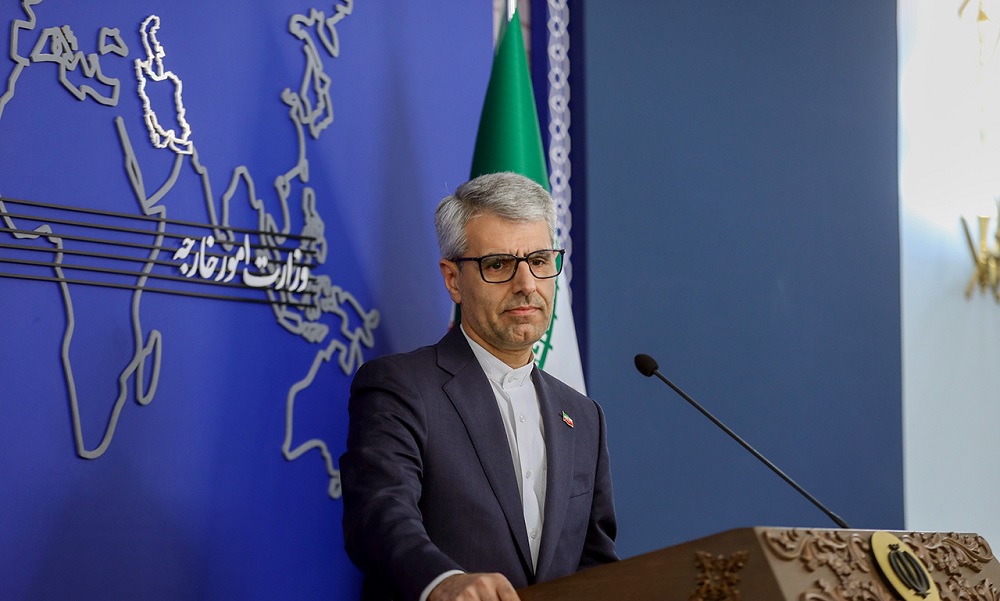
Iran’s Ministry of Foreign Affairs said on Monday that Tehran is “surprised and unhappy” that “some officials” of the Islamic Emirate of Afghanistan (IEA) took reports of Afghan migrants being killed by Iranian border guards seriously.
Iran’s foreign ministry spokesperson, Ismail Beqaei, emphasized that the reports were baseless.
“The Afghan authorities issued a statement on this matter. We were surprised and displeased that a non-existent matter was reported and some officials of Afghanistan took this baseless news seriously. I hope we all learn from this issue to be more careful about any news published in the media,” Beqaei said.
A human rights organization reported that dozens of Afghan migrants were killed and wounded by Iranian border forces about three weeks ago.
The Islamic Emirate said last week that explosions and gunfire targeted Afghan nationals in the Kalgan Valley, situated in Iranian territory, adding that the bodies of two deceased people and 34 injured have been repatriated.

Warning: Undefined array key 0 in /var/www/vhosts/ariananews.af/httpdocs/wp-content/themes/ariana-news/parts/post-single.php on line 573
Warning: Attempt to read property "cat_ID" on null in /var/www/vhosts/ariananews.af/httpdocs/wp-content/themes/ariana-news/parts/post-single.php on line 573
Regional
Iran insists on keeping control over Hormuz, senior Iranian sources say
Oman stretches along the southern coast of the Strait and Iran is planning talks with the sultanate to define transit paths through the waterway, Tehran said on Monday.
Iran is determined to win international recognition of its control over the Strait of Hormuz and ability to levy fees on ships entering or leaving the Gulf even if it has to do so by force, two senior Iranian sources said.
Under this month’s interim deal with the U.S. to end their three-month conflict, Iran agreed to let ships pass through the Strait for 60 days without charge. But it believes the wording of the agreement allows it to keep control of which ships may pass and which route they take through the narrow waterway, Reuters reported.
It is also determined to secure lasting formal acceptance of this control once the interim phase expires, and its negotiators will not move to other areas of dispute in ongoing peace talks with Washington until that has been agreed, the sources said.
If the interim deal ends without being extended, Iran would start charging ships for passage in mid-August, though it has not yet laid out any list of what fees it will charge or how. Iran closed the Strait when the war began and Iranian officials have said authorities charged some vessels navigation or other fees to leave the Gulf.
Any lasting Iranian control over the Strait of Hormuz, with formalities and fees for ships, would add costs, delays and risks to all shipping through a waterway that before the war transported a fifth of global energy supplies plus other critical goods.
Passage through the Strait was never previously subject to fees and Tehran’s position runs directly counter to U.S. interpretations of the interim Memorandum of Understanding agreed on June 17, and to Washington’s stance on what the ultimate post-war arrangements will be.
U.S. President Donald Trump said last week that there would be no tolls charged for passage through the Strait unless Washington decided to impose them itself. Secretary of State Marco Rubio said during a meeting with Gulf states that no country had the right to block shipping or impose fees or tolls for passage through an international waterway.
Iran interprets the interim deal as meaning it can maintain control over all passage through the Strait, though without collecting fees during the interim phase of the deal, and that while it has to discuss arrangements with Gulf states, it is not obliged to reach an agreement with them, the sources said.
Oman stretches along the southern coast of the Strait and Iran is planning talks with the sultanate to define transit paths through the waterway, Tehran said on Monday.
However, Iran shot at four ships over the weekend that tried to traverse the Strait on the Omani side without first getting Iranian permission, triggering a brief but intense exchange of fire with the United States.
One of the senior officials said Iran would not let the situation return to the pre-war status quo. Instead, it believes new arrangements must govern Hormuz including Iran choosing how vessels enter and leave the Strait, holding the right to deny entry to any it suspects of threatening Iranian security, and charging fees for compulsory services it provides.
Iran is ready to impose its demands on the Strait through force if there is no agreement by other countries to accept its terms, the official added, saying Tehran would not back down even if it led to renewed – and intensified – confrontation with the U.S.
The second senior Iranian official said that having survived what Tehran had seen as its biggest potential threat – a war with the U.S. and Israel – Iran believed it had a “historic opportunity” to secure a long-term advantage.
Ship-owning countries would eventually accept Iranian management of the Strait because of the growing cost of the dispute, and Washington would accept it to ensure uninterrupted global energy supplies, the official added.
However, Iran may be overplaying its hand and miscalculating how far Washington would be willing to accept what would be seen as an enormous concession, said Ali Ansari, professor of modern history at St Andrews University, read the report.
“The prospect of this conflict reigniting is much higher than people think because neither side thinks they’ve lost,” he said.
Neither Iran nor the U.S. is a signatory of the U.N. Convention on the Law of the Sea that designates Hormuz as an international strait, although Oman, which stretches along its southern coast, is.
While the waterway is split between the territorial waters of Iran and Oman, its status as an international strait under the convention requires free passage.
The convention is widely regarded, including by the U.S., as customary international law.
It is also the agreement under which Iran could claim its territorial waters extend 12 miles rather than the mere 3 miles off its shore under other maritime conventions, said Chris O’Flaherty, a former British navy captain and specialist in naval warfare and law. The Strait of Hormuz is just over 20 miles wide at its narrowest point.
“This is an intensely political matter in which most people think international law is settled. However, Iran has decided to challenge that,” O’Flaherty said.
International Sports
Haaland fires Norway into World Cup Round of 16 with late winner
With Canada, Paraguay, Morocco, Brazil, Norway, France and Mexico already through, attention now turns to Wednesday’s Round of 32 fixtures.
Erling Haaland scored a dramatic late winner as Norway defeated Ivory Coast 2-1 on Tuesday to book their place in the FIFA World Cup 2026 Round of 16, where they will face Brazil.
Haaland struck in the 86th minute to seal Norway’s victory at Dallas Stadium, taking his tally to five goals at the tournament after Antonio Nusa had given the Scandinavians the lead before Amad Diallo equalised for Ivory Coast.
Ivory Coast made the brighter start, with Nicolas Pépé and Ghislain Konan both testing the Norwegian defence during an energetic opening spell. Yan Diomande also created an opportunity for Pépé, but the winger was unable to convert.
The victory sets up an intriguing Round of 16 clash with five-time world champions Brazil in New York on Sunday, while Ivory Coast exit the tournament after a spirited knockout performance.
France, and Mexico advance as World Cup Round of 16 takes shape
In two other Round of 32 matches, France and Mexico also secured places in the last 16 after impressive knockout victories.
France produced one of the standout performances of the tournament with a commanding 3-0 victory over Sweden at MetLife Stadium.
Kylian Mbappé starred with two goals, while Bradley Barcola also found the net as Les Bleus dominated from start to finish to book their place in the next round.
France will now face Paraguay, who stunned Germany on penalties a day earlier, in a highly anticipated Round of 16 clash.
Mexico also delighted home supporters with a 2-0 victory over Ecuador at Estadio Banorte in Mexico City to keep their World Cup dream alive.
The hosts controlled much of the contest and sealed their place in the Round of 16, where they will meet the winner of Wednesday’s clash between England and DR Congo.
With Canada, Paraguay, Morocco, Brazil, Norway, France and Mexico already through, attention now turns to Wednesday’s Round of 32 fixtures. England face DR Congo, Belgium take on Senegal, and the United States meet Bosnia and Herzegovina as the race for the remaining places in the last 16 continues.
Fans across Afghanistan can tune in to Ariana Radio and Television Network (ATN) to watch the matches live and exclusively across the country. Viewers are also encouraged to follow Ariana Television and Ariana News’ social media pages for the latest schedules and updates.
Latest News
NRC warns of alarming global shortfall in humanitarian funding in 2026
The organization says that halfway through 2026, only 30 percent of the funding required to support 143 million people out of 252 million in need globally has been received.
The Norwegian Refugee Council (NRC) has warned that humanitarian funding for some of the world’s most neglected displacement crises has fallen to critically low levels in 2026, leaving millions of vulnerable people increasingly abandoned.
The organization says that halfway through 2026, only 30 percent of the funding required to support 143 million people out of 252 million in need globally has been received.
NRC Secretary General Jan Egeland described 2026 as a “make-or-break year” for millions affected by conflict in countries including Venezuela and Sudan, warning that continued funding cuts could lead to “a massive loss of lives.”
He said global assistance is declining at a time when violence, displacement, and inflation continue to rise, and stressed that humanitarian funding must be allocated based on need rather than geopolitical or national interests.
The report highlights that Afghanistan is among the worst affected and has been included for the first time on NRC’s list of the world’s most neglected crises, with humanitarian response plans currently only 11 percent funded.
NRC said the decline in funding comes as 21.9 million people in Afghanistan require assistance, while millions more are returning from neighboring countries.
Egeland warned that without a dramatic increase in support, millions of families in Afghanistan and other crisis-hit regions risk facing deeper hunger, displacement, and loss of basic services, urging donors to act before it is too late.
-
Latest News5 days agoTAPI project sees rapid progress in Afghanistan
-
Business3 days agoAfghanistan eyes direct Basmati rice imports from India amid tensions with Pakistan
-
International Sports4 days agoFIFA World Cup: Iran held by Egypt after controversial late goal Is disallowed
-
Latest News4 days agoDelawar says Afghanistan has achieved security and unity after 47 years
-
Latest News4 days agoEU announces major funding to support Afghan small businesses
-
Latest News5 days agoAshura observed across Afghanistan with calls for unity and justice
-
Latest News3 days agoAfghan minister says ‘outsiders’ should not claim to support Afghanistan’s independence
-
Sport3 days agoAfghanistan, Uzbekistan set for friendly cricket clash in Khost