
Business
Farmers Won’t Benefit, if Transit Issues inst Solved: Officials


Officials in chamber of commerce of Afghanistan have stated that if the Pakistan transit issues don’t get resolved 110 thousand tons of fresh fruits will be rotten in current year 2015, which is huge loss for Afghan farmers.
Officials in exporting department of chamber of commerce by expressing concerns, saying this year the fresh fruits harvest increased 60 tons, comparing to last year.
Afghan businessmen have been suffering from different existed challenges in Torkham port, saying taking bribes on custom department in Pakistan are the main issues.
Responsible for exporting department in chamber of commerce Mirzaman Popal said,” we witness 25 % of increasing of fresh fruits,110 thousand fresh fruits are ready to be exported to foreign markets,we are still concerned over Pakistan for not fulfilling their commitments to remove issues causing Afghanistan’s exported goods to be damaged.”
Afghanistan’s apricots, Grapes, and Pomegranate are exported to Europe, India, and United Arab Emirates.
The other Afghan fruits businessman Haji Najwat said,” exporting process of fresh Fruits from Afghanistan is with full of problems, we have to pay three times for municipalities, tolerate other issues on the way till we see our fruits in International markets.”
As we predicated the cultivation of Afghanistan fresh fruits will be increased up to 170 thousand tons by coming 2020, we still need to find best markets for our products,if our problems is removed we could easily get our fruits to foreign markets Mirzaman Popal head of exporting in chamber of commerce added.
Air transportation with heavy charges is the other problem for Afghan businessmen, they are demanding both Afghanistan-Pakistan to pave better plat form for businesses.
Reported by Wahid Nawisa

Business
Iran–China rail link via Afghanistan proposed to cut transit time
Officials estimate annual traffic on the China–Europe route could rise to 300 trains following regional agreements.
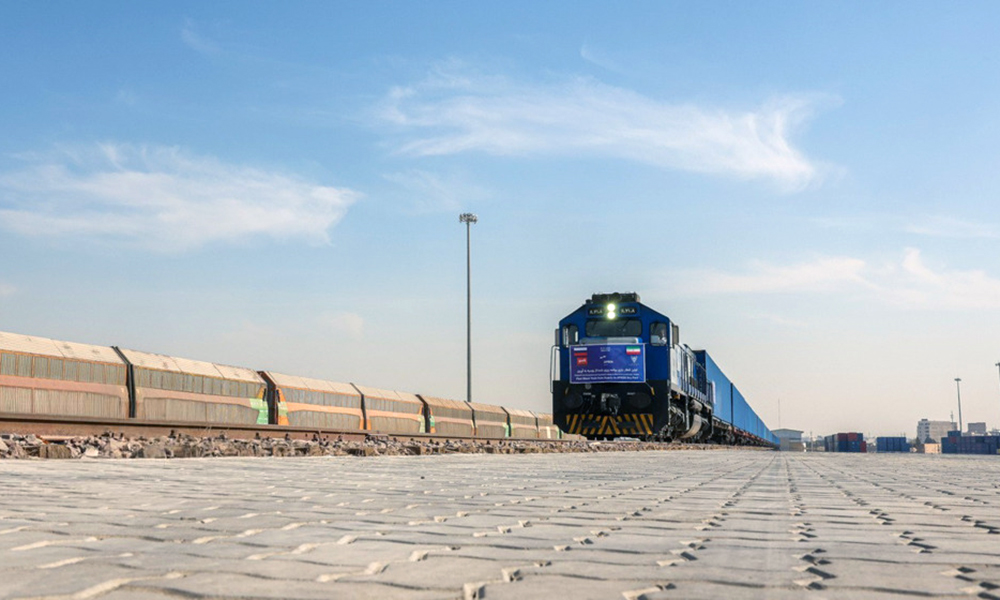
A proposed rail connection linking Iran to China through Afghanistan could reduce transport distances by up to 50 percent and enable direct freight train services to Europe.
The proposed Herat–Mazar-e-Sharif–Wakhan railway would connect China to Europe and West Asia via Afghanistan, Iran, and Turkey, strengthening regional trade corridors, IRNA reported. The project was recently discussed during talks between Afghan public works officials and the CEO of Iran Railways.
Iranian rail officials say the plan would use standard-gauge tracks, allowing trains to travel directly from China to Europe without cargo transfers, easing bottlenecks at borders with Kazakhstan and Turkmenistan. Technical studies are underway to assess investment needs.
Since the start of the current Iranian year, more than 63 China-bound freight trains have entered Iran, up from seven last year.
Officials estimate annual traffic on the China–Europe route could rise to 300 trains following regional agreements.
The project includes a 64-kilometer rail segment to Herat, an extension to Mazar-e-Sharif, and a connection through Afghanistan’s Wakhan region to China’s Xinjiang province. Despite challenging terrain, Iranian and Afghan companies have expressed interest in construction.
Iranian officials say the route would cut costs and transit time, boost trade with China, and strengthen Afghanistan’s integration into regional rail networks.
Business
Afghanistan signs 845MW Power deal with Azizi energy; Baradar meets company Chief to advance investment plans
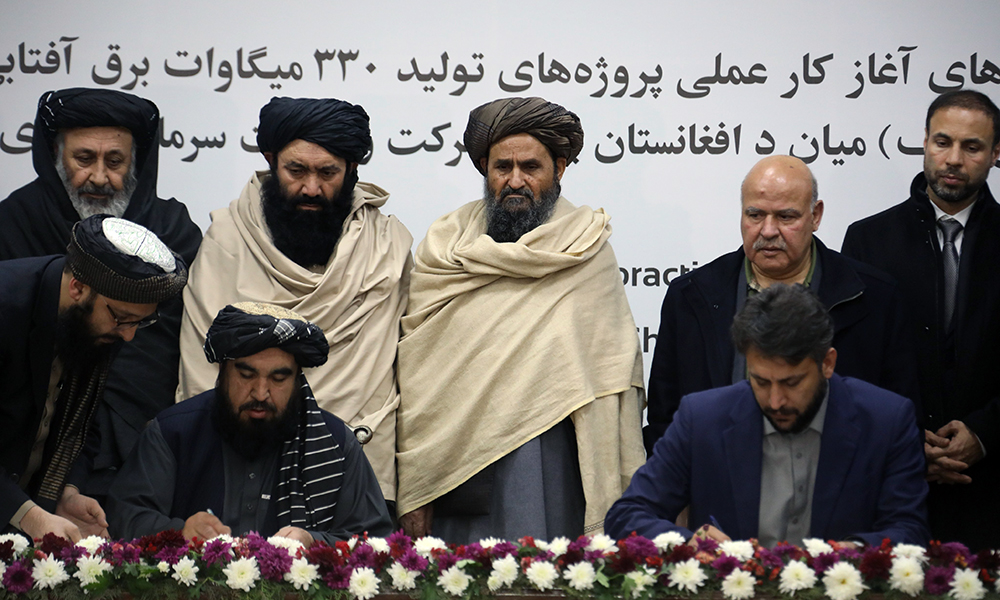
Contracts for the commencement of practical work on five major power generation projects with a total capacity of 845 megawatts were signed on Wednesday between Da Afghanistan Breshna Sherkat (DABS) and Azizi Energy.
The signing ceremony was held at the Government Media and Information Center in the presence of Deputy Prime Minister for Economic Affairs Mullah Abdul Ghani Baradar.
Under the agreements, Azizi Energy will invest approximately $463 million in the projects, which include 100 megawatts of solar power in the Naghlu area of Kabul province, 100 megawatts of solar power in Barik Ab area of Parwan province, and 130 megawatts of solar power in Ghazni province.
In addition, the company will construct 165 megawatts of coal-fired power generation in Takhar province and 350 megawatts in Baghlan province.
Officials said the solar projects are expected to be completed within two years, while the coal-fired plants will be finalized within three years. The projects form part of a broader 10,000-megawatt energy investment plan aimed at strengthening domestic electricity production and reducing reliance on imports.
Following the signing ceremony, Deputy PM Baradar met with Azizi Group’s Chief Executive Officer Mirwais Azizi and his technical team at his office.
Baradar welcomed the launch of practical work on the five projects, describing them as significant steps toward job creation and economic growth in the country.
Azizi expressed appreciation for the cooperation provided by the Deputy Prime Minister’s office and relevant institutions, stating that the company had faced no major obstacles in advancing its plans. He said the Islamic Emirate has demonstrated a strong commitment to national development, which paved the way for the implementation of the projects.
Azizi further announced that an additional 15 to 20 power generation projects, with a combined capacity of up to 5,000 megawatts, are expected to be launched by the end of the current year.
He also noted that work on the TAPI project is progressing steadily on Afghan soil. Once gas reaches Herat province, Azizi Group plans to coordinate with the Ministry of Mines and Petroleum to develop major gas distribution networks and establish a 3,000-megawatt gas-fired power plant.
Azizi called for close cooperation with relevant authorities in the exploration, extraction, and utilization of natural gas and coal resources for electricity production.
Deputy PM Baradar and officials from the concerned institutions assured full cooperation and joint coordination in advancing the energy sector projects.
The agreements mark one of the latest investments in Afghanistan’s power infrastructure, signaling renewed efforts to boost domestic energy production and stimulate economic development.
Business
Uzbekistan approves feasibility study agreement for Trans-Afghan Railway
The agreement builds on a tripartite document signed on July 17, 2025, which outlined cooperation on preparing a feasibility study for the Termez–Kharlachi railway corridor.
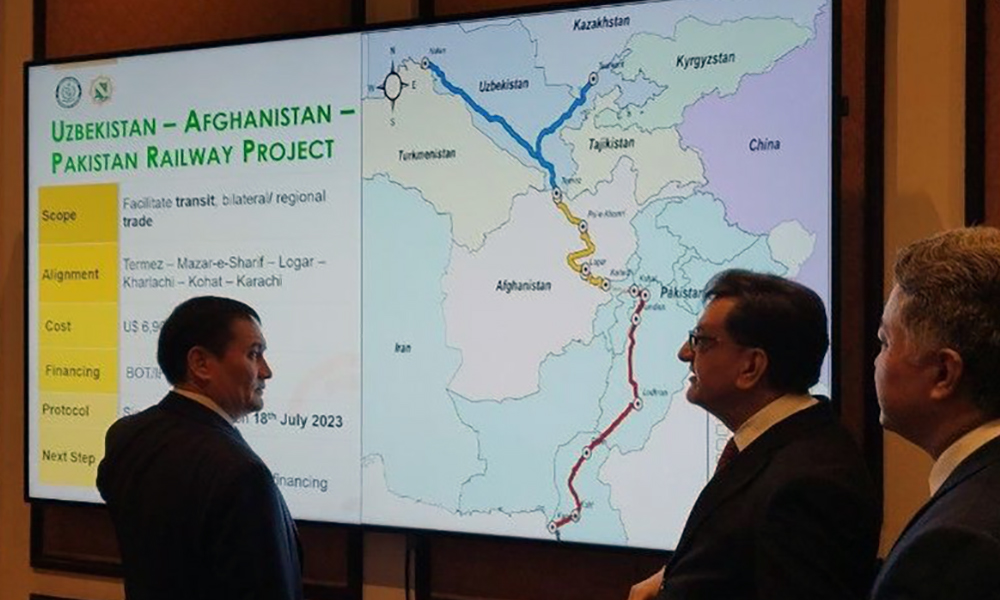
Uzbekistan has ratified an international agreement to prepare a feasibility study for the Naybabad–Kharlachi section of the Trans-Afghan Railway, formalizing its participation in the project.
President Shavkat Mirziyoyev signed a decree on February 4 approving the agreement.
The framework agreement involves the transport ministries of Uzbekistan, Afghanistan and Pakistan and provides for joint work on a feasibility study for the proposed railway line between Naybabad and Kharlachi. The section forms part of the wider Trans-Afghan Railway project aimed at strengthening transport links between Central and South Asia.
Under the decree, Uzbekistan’s Ministry of Transport has been designated as the competent authority responsible for implementing the agreement. The Ministry of Foreign Affairs has been tasked with notifying Kabul and Islamabad that Uzbekistan has completed the internal procedures required for the agreement to enter into force.
The agreement builds on a tripartite document signed on July 17, 2025, which outlined cooperation on preparing a feasibility study for the Termez–Kharlachi railway corridor.
The planned route is expected to run through Termez, Naybabad, Maidanshahr, Logar and Kharlachi, providing a transit corridor through Afghanistan.
The feasibility study will be commissioned by the Tripartite Project Office for the Development Strategy of International Transport Corridors under Uzbekistan Railways.
Established in Tashkent in May 2023, the office also operates branches in Kabul and Islamabad to coordinate the project.
First proposed in 2018, the Trans-Afghan Railway was initially projected to carry up to 20 million tons of cargo annually at a cost of about $5 billion. Cost estimates have since been revised.
In July 2022, Uzbekistan Railways cited an estimate of $4.6 billion with a construction period of up to five years, while Pakistan’s Ministry of Railways put the cost at $8.2 billion in December 2024.
More recent assessments have placed the overall cost at around $7 billion, with a public-private partnership under a Build-Operate-Transfer model among the options under consideration.


Netanyahu says US deal with Iran must dismantle nuclear infrastructure

Tahawol: 37th anniversary of Soviet exit from Afghanistan

Saar: 37th anniversary of Soviet withdrawal from Afghanistan

Iran would prevail in potential conflict with the United States, says IEA spokesman

Islamabad mosque attack is the result of Pakistan’s policy of nurturing Daesh: Mujahid

Pakistan army orders evacuation of Tirah Valley, fears of mass displacement grow

Afghan traders sign deal to import pharmaceuticals from Bangladesh

AFC Futsal Asian Cup 2026: Day One Review

AFC Futsal Asian Cup: Afghanistan to face Iran in crucial Group D clash

Afghanistan shine on Day Two of AFC Futsal Asian Cup Indonesia 2026
Tahawol: 37th anniversary of Soviet exit from Afghanistan
Saar: 37th anniversary of Soviet withdrawal from Afghanistan

Tahawol: Impact of continued sanctions on Afghanistan reviewed

Exclusive interview with Kenichi Masamoto, Japanese Ambassador to Kabul

Saar: Discussion on Iran and US negotiations
-

 Sport4 days ago
Afghanistan’s semi-final hopes hang in the balance after two T20 World Cup defeats
-
 Business5 days ago
Afghanistan signs 845MW Power deal with Azizi energy; Baradar meets company Chief to advance investment plans
-

 International Sports5 days ago
AFC Champions League Elite delivers key results as race for knockout stage intensifies
-

 Sport4 days ago
AFC U17 Men’s Asian Cup Saudi Arabia 2026 Draw sets stage for continental showdown
-

 Latest News5 days ago
Khalilzad questions whether Pakistan played a ‘double game’ in Afghanistan war
-

 World5 days ago
Israel’s Netanyahu expected to press Trump over Iran diplomacy
-

 World4 days ago
Pressure rises on Dubai port giant DP World over chief’s alleged Epstein ties
-

 Sport4 days ago
Winter Olympics 2026: Wednesday brings records, first-ever golds and thrilling action