
Latest News
Ghani suggests US troops might not be withdrawn by May as planned

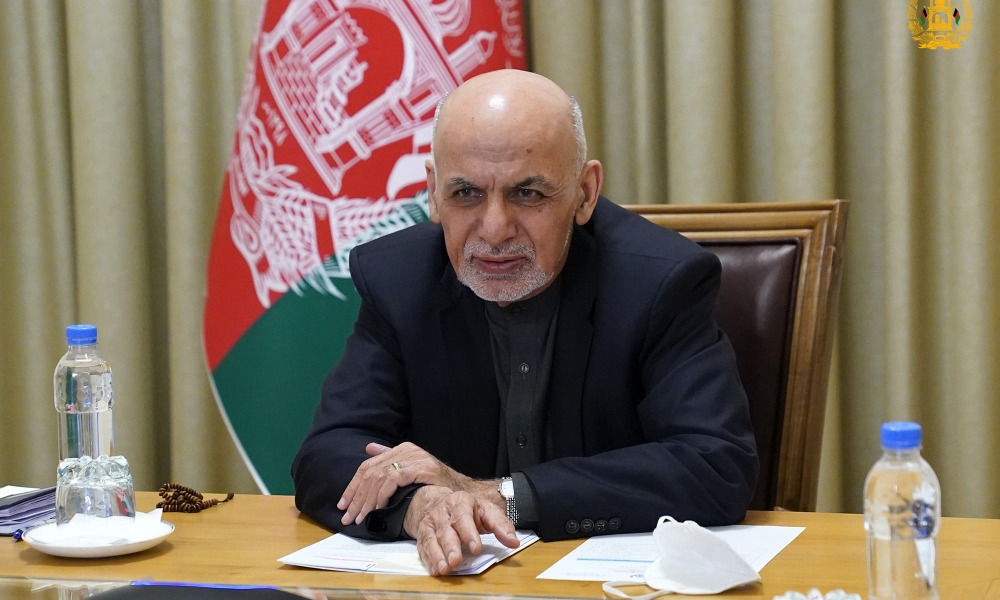
President Ashraf Ghani implied on Friday that he expects the Biden administration to keep US troops in Afghanistan for longer than anticipated under the US-Taliban deal, signed by the Trump administration, saying the Taliban aren’t meeting their obligations to reduce violence.
This comes after a dramatic surge in violence since the signing of the deal in Doha in February last year.
On Thursday Pentagon spokesman John Kirby said the Taliban’s refusal to reduce the violence is raising questions over whether the 2,500 US troops remaining will leave by May as planned.
In an interview on Friday with the Aspen Institute, Ghani said such statements send “a signal to the Taliban that the US is here to secure peace and not to retreat and leave the field open.”
Ghani said during the virtual event that the new Biden administration’s review of the peace deal should take weeks, not months, which is a sign of a “very predictable” new phase in the US-Afghanistan relationship.
Ghani said he hopes to speak soon with President Joe Biden and that the US is planning to send a team to Kabul to discuss how to “energize the peace talks.”
He also said Zalmay Khalilzad, the US envoy who brokered the agreement with the Taliban will now be reporting to a “very organized decision-making process,” this being in reference to the new Biden administration.
He also stated that “NATO will play a bridging role” as the US draws down, but “NATO without US enablers cannot continue its mission.”
On the high level of violence in the country, he said Afghanistan must hold the Taliban responsible for the surge in killings.
“If the Taliban realize they can prevail through violence they will not let go,” he said adding “we must hold the Taliban responsible for this environment of violence…This is not the way to get attention. It is the way to get condemnation for truly inhuman violence.”On the issue of a possible interim government, Ghani was adamant that this was not a good idea.
He pointed out that Afghanistan has had interim governments in the past that have been unsuccessful.
“We’ve had interim governments. They have led to bloodshed,” he said adding that such a move would be detrimental to Afghanistan.
“The citizens of Afghanistan must be empowered…Where would I get the authority to dissolve the Republic? I have sworn to uphold the constitution,” he said.
Ghani also pointed out that the ethos of peace talks has not been passed down to the Taliban’s fighters on the ground.
“Peace has not been socialized to the Taliban commanders or rank and file,” he said implying that just recently the group’s leaders were seen visiting wounded fighters in a hospital in Pakistan and giving them words of encouragement.
Encouraged by the Biden administration’s approach to Afghanistan, Ghani said Washington is working with the government, and “the focus is on ending 40 years of violence.”
“The process has begun and we couldn’t be more pleased with the early focus, systematic attention, and a dialogue between two partners,” he said.











Kazakhstan’s Foreign Minister Mukhtar Tileuberdi has called for pragmatic and coordinated international engagement with Afghanistan, saying the country’s long-term stability is closely linked to the security and sustainable development of Central Asia.
Speaking during the general debate of the 81st session of the United Nations General Assembly in New York on Friday, Tileuberdi said humanitarian assistance to Afghanistan remains essential but alone cannot break the cycle of poverty, displacement and dependency.
He said Kazakhstan supports a “pragmatic, coordinated and step-by-step” approach to international engagement with Afghanistan, with the United Nations playing a central role.
Tileuberdi also said Kazakhstan is working with the UN to operationalize the United Nations Regional Centre for the Sustainable Development Goals for Central Asia and Afghanistan in Almaty.
He said the success of the centre should be measured by the results and assistance it delivers to the region.


Abu Muslim Farah defeat Khurasan Faryab 2-0 in ACL season six

Saar: Concerns over Pakistan’s political crisis discussed

Afghanistan Champions League: Omar Zawak Herat beat Toofan Herat 1-0

Blast in Pakistan’s Dera Ismail Khan kills 11, injures 30

Ariana Afghan Airlines increases Kabul-Delhi cargo flights

Saudi energy group signs major Afghanistan deals covering gas exploration and pipeline plans

Trump floats idea of renaming Atlantic or Pacific Ocean

US hits Egyptian bank branches with Iran sanctions as war marks six months

Nepal flood rescue mission enters critical phase as thousands remain missing

Iranian clubs to face Gulf opponents at neutral venues in Asian Champions League Elite
Saar: Concerns over Pakistan’s political crisis discussed

Exclusive interview with Abdul Latif Mansoor, Minister of MRRD

Tawsia: Overview of Afghanistan’s iron mines

Tahawol: Discussion on fresh Pakistani airstrikes on Afghanistan

Saar: Calls for international support for Afghanistan discussed
-

 World5 days ago
CNN, MS NOW and Politico sue Trump, challenging White House ban
-

 Latest News4 days ago
Ariana Afghan Airlines ranks seventh among 45 Central Asian airlines
-

 Latest News5 days ago
UN reiterates call for respect for international law after Kunar airstrikes
-

 Regional4 days ago
US and Iran hold first talks since June after Trump’s ‘annihilation’ threat
-

 Latest News4 days ago
Silk Road highway in Wakhan corridor now reaches the China border
-

 Regional3 days ago
Iran airlines cancel flights as US sanctions hit
-

 Latest News5 days ago
Afghan Official: Pakistan’s airstrikes will not go unanswered
-
 Regional5 days ago
G7 foreign ministers call on Iran to stop arming Houthis