
Regional
Trump weighs Iran strikes to inspire renewed protests – Reuters

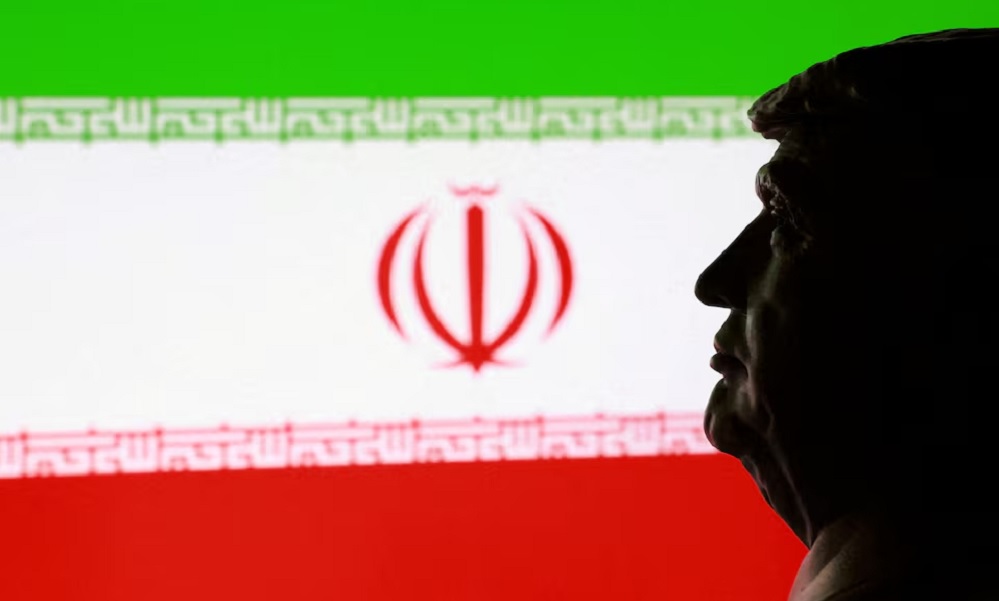
U.S. President Donald Trump is weighing options against Iran that include targeted strikes on security forces and leaders to inspire protesters, multiple sources said, even as Israeli and Arab officials said air power alone would not topple the clerical rulers, Reuters reported.
Two U.S. sources familiar with the discussions said Trump wanted to create conditions for “regime change” after a crackdown crushed a nationwide protest movement earlier this month, killing thousands of people.
To do so, he was looking at options to hit commanders and institutions Washington holds responsible for the violence, to give protesters the confidence that they could overrun government and security buildings, they said.
One of the U.S. sources said the options being discussed by Trump’s aides also included a much larger strike intended to have lasting impact, possibly against the ballistic missiles that can reach U.S. allies in the Middle East or its nuclear enrichment programmes.
The other U.S. source said Trump has not yet made a final decision on a course of action including whether to take the military path.
The arrival of a U.S. aircraft carrier and supporting warships in the Middle East this week has expanded Trump’s capabilities to potentially take military action, after he repeatedly threatened intervention over Iran’s crackdown.
Four Arab officials, three Western diplomats and a senior Western source whose governments were briefed on the discussions said they were concerned that instead of bringing people onto the streets, such strikes could weaken a movement already in shock after the bloodiest repression by authorities since the 1979 Islamic Revolution.
Alex Vatanka, director of the Iran Program at the Middle East Institute, said that without large-scale military defections Iran’s protests remained “heroic but outgunned.”
The sources in this story requested anonymity to talk about sensitive matters. Iran’s foreign office, the U.S. Department of Defense and the White House did not respond to requests for comment. The Israeli Prime Minister’s office declined to comment.
Trump urged Iran on Wednesday to come to the table and make a deal on nuclear weapons, warning that any future U.S. attack would be more severe than a June bombing campaign against three nuclear sites. He described the ships in the region as an “armada” sailing to Iran.
A senior Iranian official told Reuters that Iran was “preparing itself for a military confrontation, while at the same time making use of diplomatic channels.” However, Washington was not showing openness to diplomacy, the official said.
Iran, which says its nuclear program is civilian, was ready for dialogue “based on mutual respect and interests” but would defend itself “like never before” if pushed, Iran’s mission to the United Nations said in a post on X on Wednesday.
Trump has not publicly detailed what he is looking for in any deal. His administration’s previous negotiating points have included banning Iran from independently enriching uranium and restrictions on long-range ballistic missiles and on Tehran’s network of armed proxies in the Middle East.
LIMITS OF AIR POWER
A senior Israeli official with direct knowledge of planning between Israel and the United States told Reuters Israel does not believe airstrikes alone can topple the Islamic Republic, if that is Washington’s goal.
“If you’re going to topple the regime, you have to put boots on the ground,” he said, noting that even if the United States killed Supreme Leader Ayatollah Ali Khamenei, Iran would “have a new leader that will replace him.”
Only a combination of external pressure and an organised domestic opposition could shift Iran’s political trajectory, the official said.
The Israeli official said Iran’s leadership had been weakened by the unrest but remained firmly in control despite the ongoing deep economic crisis that sparked the protests.
Multiple U.S. intelligence reports reached a similar conclusion, that the conditions that led to the protests were still in place, weakening the government, but without major fractures, two people familiar with the matter said.
The Western source said they believed Trump’s goal appeared to be to engineer a change in leadership, rather than “topple the regime,” an outcome that would be similar to Venezuela, where U.S. intervention replaced the president without a wholesale change of government.
Khamenei has publicly acknowledged several thousand deaths during the protests. He blamed the unrest on the United States, Israel and what he called “seditionists.”
U.S.-based rights group HRANA has put the unrest-related death toll at 5,937, including 214 security personnel, while official figures put the death toll at 3,117. Reuters has been unable to independently verify the numbers.
KHAMENEI RETAINS CONTROL BUT LESS VISIBLE
At 86, Khamenei has retreated from daily governance, reduced public appearances and is believed to be residing in secure locations after Israeli strikes last year decimated many of Iran’s senior military leaders, regional officials said.
Day-to-day management has shifted to figures aligned with the Islamic Revolutionary Guard Corps (IRGC), including senior adviser Ali Larijani, they said. The powerful Guards dominate Iran’s security network and big parts of the economy.
However, Khamenei retains final authority over war, succession and nuclear strategy – meaning political change is very difficult until he exits the scene, they said. Iran’s foreign ministry did not respond to questions about Khamenei.
In Washington and Jerusalem, some officials have argued that a transition in Iran could break the nuclear deadlock and eventually open the door to more cooperative ties with the West, two of the Western diplomats said.
But, they cautioned, there is no clear successor to Khamenei. In that vacuum, the Arab officials and diplomats said they believe the IRGC could take over, entrenching hard-line rule, deepening the nuclear standoff and regional tensions.
Any successor seen as emerging under foreign pressure would be rejected and could strengthen, not weaken the IRGC, the official said.
Across the region, from the Gulf to Turkey, officials say they favour containment over collapse – not out of sympathy for Tehran, but out of fear that turmoil inside a nation of 90 million, riven by sectarian and ethnic fault lines, could unleash instability far beyond Iran’s borders.
A fractured Iran could spiral into civil war as happened after the 2003 U.S. invasion of Iraq, two of the Western diplomats warned, unleashing an influx of refugees, fueling Islamist militancy and disrupting oil flows through the Strait of Hormuz, a global energy chokepoint.
The gravest risk, analyst Vatanka warned, is fragmentation into “early-stage Syria,” with rival units and provinces fighting for territory and resources.
REGIONAL BLOWBACK
Gulf states – long‑time U.S. allies and hosts to major American bases- fear they would be the first targets for Iranian retaliation that could include Iranian missiles or drone attacks from the Tehran-aligned Houthis in Yemen.
Saudi Arabia, Qatar, Oman and Egypt have lobbied Washington against a strike on Iran. Saudi Crown Prince Mohammed bin Salman has told Iranian President Masoud Pezeshkian that Riyadh will not allow its airspace or territory to be used for military actions against Tehran.
“The United States may pull the trigger,” one of the Arab sources said, “but it will not live with the consequences. We will.”
Mohannad Hajj-Ali of the Carnegie Middle East Center said the U.S. deployments suggest planning has shifted from a single strike to something more sustained, driven by a belief in Washington and Jerusalem that Iran could rebuild its missile capabilities and eventually weaponise its enriched uranium.
The most likely outcome is a “grinding erosion – elite defections, economic paralysis, contested succession – that frays the system until it snaps,” analyst Vatanka said.






Regional
Flames, smoke seen near Riyadh airport; Houthis claim attacks on Saudi capital
The Saudi-led military coalition fighting the Houthis said its air defences had destroyed a missile fired by the Yemeni group toward Riyadh early on Saturday.
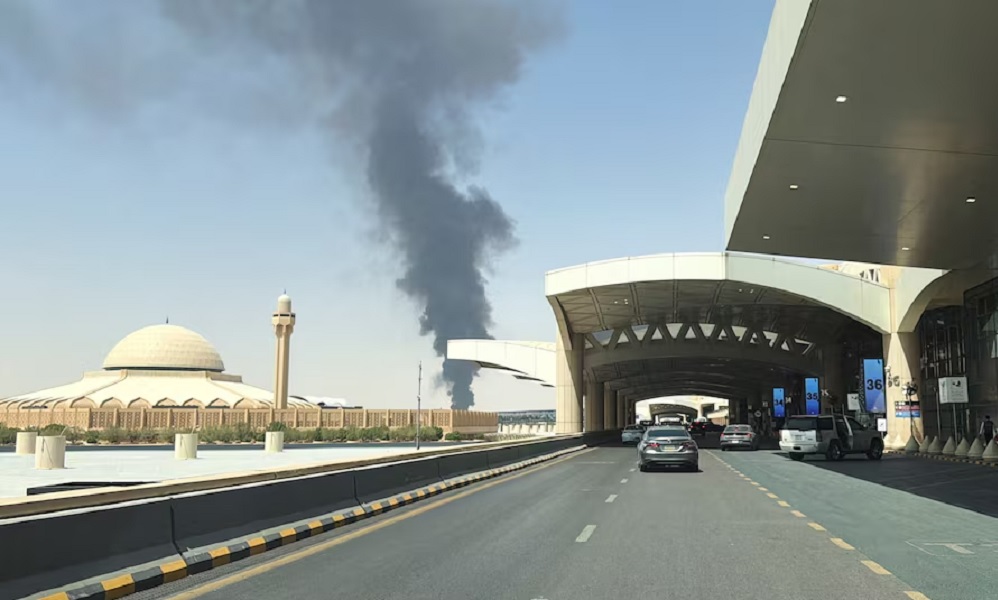
Yemen’s Houthis said they attacked “sensitive” sites in the Saudi capital Riyadh on Saturday with missiles and drones, hours after flames and a large plume of smoke were seen near the city’s main airport.
Saudi Arabia had sent alerts overnight warning of potential danger around Riyadh, amid an escalation in attacks by the Houthis in the kingdom, Reuters reported.
Reuters video and photographs showed a huge pillar of black smoke rising in the area, with the airport highway, main terminal building and other facilities in the foreground. At one point in the video, flames were visible rising from behind what appeared to be fuel tanks.
While the Iranian-backed Houthis have launched repeated attacks against Saudi Arabia since July, Saturday’s claim appeared to be their first reported strike on Riyadh since the current escalation began.
The Houthis did not specify what they had targeted in Riyadh, but said they had also attacked an Aramco facility in the Red Sea city of Yanbu, a key Saudi oil export hub.
They said the operation came as a response to an attack in the Yemeni capital Sanaa.
The Saudi-led military coalition fighting the Houthis said its air defences had destroyed a missile fired by the Yemeni group toward Riyadh early on Saturday.
In a statement, the coalition also said it had foiled attacks targeting civilians in the Saudi cities of Bish and Farasan in the southwest and Taif in the west, as well as Yanbu on the Red Sea coast. It did not say whether there was any damage.
Saudi civil defence sent the alerts by phone overnight for potential danger of aerial attacks in Riyadh and the city of Al-Kharj east of the capital, before issuing an all-clear on Saturday morning. A Reuters journalist in Riyadh’s Olaya area heard booms before the all-clear was sent.
Although some alerts had been issued in Riyadh this year after the start of the US-Iran war, these were the first since the escalation with the Houthis began in July.
The fighting between the Houthis and Saudi Arabia has developed as a new theatre of conflict in the wider war that began with US and Israeli strikes against Iran at the end of February. US President Donald Trump has rebuffed Saudi requests for direct US military intervention against the Houthis.
A US State Department security alert issued on Saturday for Americans in the Middle East cited Houthi attacks. The State Department urged US citizens in the region to “exercise heightened vigilance” and that Americans outside the Middle East “should seriously reconsider travel to and through the region.”
HOUTHI WARNING
The Houthis, who control the most populous parts of Yemen and much of the north, have been launching attacks against Saudi Arabia since declaring a naval blockade against Riyadh in July, with strikes targeting Saudi vessels in the Red Sea.
The attacks have targeted Saudi cities, energy infrastructure and shipping, creating new threats to global oil supplies and putting at risk the main alternative Red Sea route for Gulf exports while traffic through the Strait of Hormuz remains blockaded.
Turkish Foreign Minister Hakan Fidan said Saudi Arabia may have military needs due to the ongoing Houthi attacks and Turkey was ready to help under a trilateral defence pact that also includes Pakistan.
It was unclear what kind of support Turkey might provide but Fidan, in an interview with broadcaster NTV, said Saudi needs could include “some technical issues.”
The trilateral agreement signed last month stipulates that an armed attack on any of the three countries would be regarded as an attack on all of them.
Mohsen Rezaei, secretary of Iran’s Supreme National Security Council, told Al Jazeera in an interview aired on Saturday that Tehran wanted the war between Saudi Arabia and the Houthis to end, adding that he believed Yemenis also wanted a settlement with Saudi Arabia.
Rezaei also said Iran had conveyed its conditions to mediators for re-engaging in stalled negotiations with the United States, including “ending the war on all fronts”.
Consultations were continuing with Qatari and Pakistani mediators and Tehran was awaiting a response from Trump, Rezaei said.
The UN Security Council in a statement on Friday “condemned in the strongest terms continued Houthi attacks against the Kingdom of Saudi Arabia, including attacks impacting civilian and energy infrastructure, which have resulted in the injury of civilians, including women and children.”
In the statement, the Security Council also condemned “Houthi military escalation in Yemen”.
Iran executed a man convicted of passing missile site intelligence to Israel during the 12-day war, according to the judiciary.
Iran’s judiciary-run Mizan news agency said Hossein Pedaran was hanged after the Supreme Court upheld his death sentence on charges of espionage and intelligence cooperation with Israel, Reuters reported.
It said Pedaran had provided Israel’s Mossad intelligence service with information on sensitive military sites in the central province of Isfahan, and had carried out the espionage for financial gain.
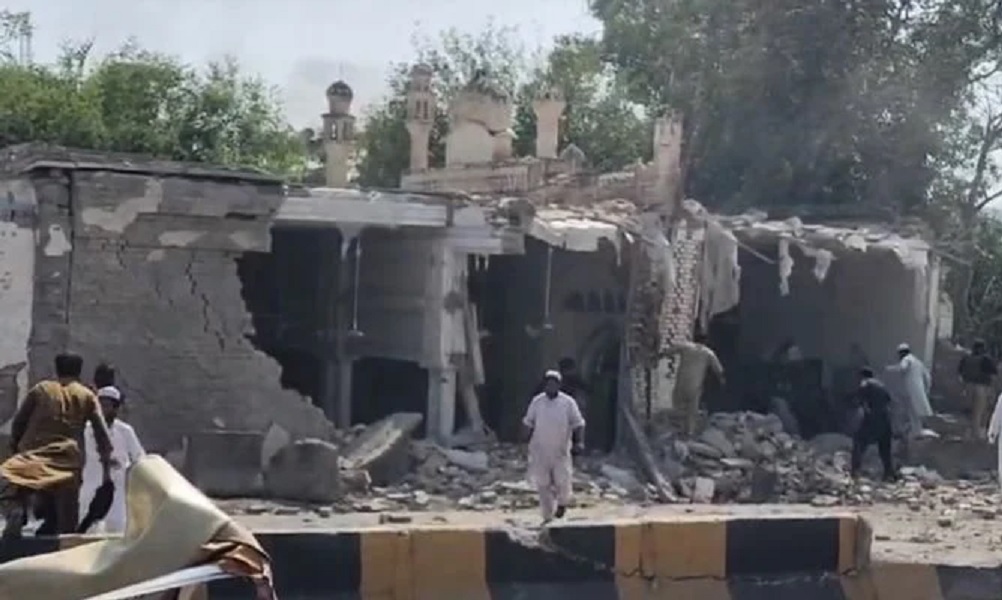
At least 15 people were killed and more than 50 others injured in a blast near a mosque in Kohat district of Khyber Pakhtunkhwa province on Friday, Pakistan’s Geo News reported.
Police said the blast occurred during Friday prayers and damaged the outer section of the mosque. Several police personnel were among those injured.
Khyber Pakhtunkhwa’s Inspector General of Police, Zulfiqar Hameed, said an explosives-laden vehicle struck the gate of the old Police Lines before exploding. He said the incident was followed by gunfire and another explosion at a Special Branch building.
Security forces and rescue teams were deployed at the scene, while emergency measures were declared at the district hospital to treat the injured.
There was no immediate claim of responsibility for the bombing.


Sorkh Poshan Khafi beat Toofan Herat 3-1 in Afghanistan Champions League

ACL: Arman FC fight back to beat Khurasan Faryab 2-1

Tahawol: Impact of middle East war on Afghanistan

Pakistan says Kohat attackers had roots in Afghanistan

Saar: Pakistan blames Afghanistan for deadly attack

Four mediators struggle to secure lasting Pakistan-Afghanistan ceasefire

Syria and Saudi Arabia condemn Kabul bombing, express solidarity with Afghanistan

Afghanistan’s trade diversification challenges Pakistan

Saudi energy group signs major Afghanistan deals covering gas exploration and pipeline plans

ATN secures exclusive rights to broadcast T20I series in India across Afghanistan
Tahawol: Impact of middle East war on Afghanistan
Saar: Pakistan blames Afghanistan for deadly attack

Tahawol: Kabul’s warning over any threat from Pakistan discussed

Debate on Afghanistan and New Investment Opportunities

Tahawol: Reasons behind Qatari, Turkish security officials’ Kabul visit discussed
-
 Latest News5 days ago
UN warns of mounting humanitarian and human rights pressures in Afghanistan
-
 Regional5 days ago
Saudi Arabia calls alleged Mecca attack a ‘red line’ as Houthis deny involvement
-
 Latest News5 days ago
Five Years On: IEA touts economic growth despite international isolation
-

 Sport5 days ago
India take 2-0 lead in 3-match series against Afghanistan
-

 Latest News4 days ago
Five years out of school: Amnesty raises alarm over Afghan girls’ education
-
 Latest News4 days ago
Russia urges dialogue and economic support for Afghanistan, warns against excessive pressure
-

 Sport4 days ago
ACL: Ariana Khost win, Aino Mina and Khurasan Faryab draw
-
 Latest News3 days ago
Afghanistan seeks stronger ties with Saudi Arabia, dialogue with Pakistan: Mujahid