Connect with us

Latest News

IFJ reiterates calls to Afghan govt to safeguard the lives of journalists

Published

on

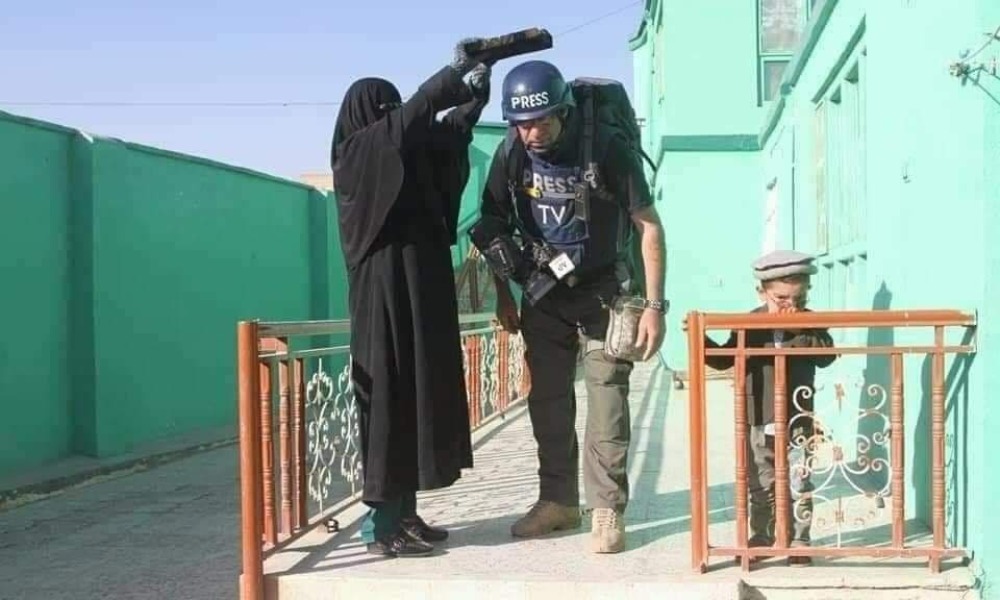
The International Federation of Journalists (IFJ) has condemned the killing of well-known Ghazni-based journalist Rahmatullah Nikzad, who was gunned down outside his home on Monday night. 
 
In a statement issued by the IFJ on Tuesday, the organization’s General Secretary, Anthony Bellanger, said: “Afghanistan has descended again in terms of journalist safety in 2020 with at least eight media workers killed to date, up from six in 2019. 
 
“The IFJ again implores that the Afghan government must increase its efforts to ensure the safety of journalists in this volatile space. 
 
“Too often journalists are the target, often between internal conflicts and the quest for power. Journalists’ lives must be respected and defended,” Bellanger stated.
 
The IFJ’s Afghanistan affiliate the Afghan Independent Journalists’ Association (AIJA) also condemned “the heinous assassination” and caled for swift action to locate and bring the perpetrators to justice.
 
The AIJA said: “AIJA strongly condemns the killing and call it a crime against humanity. AIJA shares empathy with his family and urges the Security forces to investigate the killing and bring the perpetrators to justice.”
 
Nikzad, a reporter, photographer and chief of the Ghazni Journalists’ Union, was killed by unknown gunmen outside his home on Monday night. 
 
According to the IFJ, Nikzad was shot three times in the chest with a pistol fitted with a silencer as he left his home to visit a local mosque. 
 
The gunmen have not yet been identified and no group has claimed responsibility. 
 
Nikzad, who was in his mid-40s, was a Ghazni resident and started working as a journalist in 2003. 
 
He was associated with several international news outlets and worked on a freelance basis with Al Jazeera and Associated Press. 
 
Al Jazeera issued a statement on Twitter and strongly condemned the attack and attempts to silence journalists in the country and stated it was “shocked at the news of the killing of our cameraman Rahmatullah Nikzad, a former colleague who worked with our team in Afghanistan.”
 
The Taliban meanwhile were quick to distance themselves from the incident on Monday night. Soon after news broke of Nikzad’s death, Zabiullah Mujahid, a spokesperson for the Taliban,  stated they were not involved in the shooting. 
 
Mujahid said Nikzad was a committed journalist and had “maintained good relations” with the group. “We consider this killing a loss for the country,” he said.
 
Nikzad is the third media worker to be killed in Afghanistan this month. On December 10, female reporter Malala Maiwand, and her driver Mohammad Tahir, were shot and killed when assailants opened fire on their car while she was on her way to work in Jalalabad, in Nangarhar province.
 
IS (Daesh) claimed responsibility for the attack. 
 
On November 12, Radio Free Europe correspondent Elias Daei was killed in a targeted magnetic mine explosion in Lashkar Gah.
 
However, the latest killing brings the total number of journalists killed in the past two months to five. 

Latest News

UN Security Council extends UNAMA mandate in Afghanistan for one year

Published

on

The United Nations Security Council on Monday unanimously adopted a resolution extending the mandate of the United Nations Assistance Mission in Afghanistan (UNAMA) for one year.

All 15 members of the Security Council voted in favor of the resolution, reflecting broad international support for the mission’s ongoing role in Afghanistan.

UNAMA serves as the United Nations’ principal political mission in Afghanistan and is tasked with supporting peace and stability, coordinating humanitarian assistance, promoting human rights, and engaging with Afghan authorities and international stakeholders on key political and development issues.

The extension comes as Afghanistan continues to face significant humanitarian and economic challenges.

UNAMA, established in 2002 after the fall of first IEA government, has usually been extended annually, although there was a six-month extension in 2021 to look at what changes might ​be needed after the IEA returned to power. In March this year, the mandate was extended for three months, after Washington called for a review of assistance and engagement in the country.

Continue Reading

Latest News

Afghanistan to host regional meeting of strategic research centers in Kabul

The meeting will be officially inaugurated by Foreign Minister Mawlawi Amir Khan Muttaqi.

Published

on

The Strategic Studies Center of the Ministry of Foreign Affairs of the Islamic Emirate of Afghanistan is set to host a high-level regional meeting of leading research and policy institutions from Afghanistan, Central Asia, and Azerbaijan in Kabul on 16 June 2026.

The gathering will bring together heads of strategic studies centres, researchers, and policy experts from Uzbekistan, Turkmenistan, Kazakhstan, Kyrgyzstan, Tajikistan, and Azerbaijan. The participating institutions operate under the respective presidential administrations of their countries.

Officials say the meeting comes amid growing engagement between Afghanistan and regional states, with discussions expected to focus on regional connectivity, stability, trade, energy cooperation, transit, and investment. Participants will also review current cooperation frameworks and develop practical recommendations for future collaboration.

A key aspect of the forum is the direct exchange of views between research institutions on shared regional challenges and opportunities, aimed at strengthening coordination and mutual understanding.

The meeting will be officially inaugurated by Foreign Minister Mawlawi Amir Khan Muttaqi.

Organisers say the forum reflects Afghanistan’s balanced, economy-oriented foreign policy and is expected to contribute to greater trust-building, expanded economic and transit cooperation, and long-term stability and shared prosperity across the region.

The initiative underscores Afghanistan’s continued role as an active participant in advancing regional connectivity and economic integration.

Continue Reading

Latest News

TAPI project advances in Afghanistan as 84kms of pipeline laid

Technical and engineering teams, along with skilled workers, remain actively engaged in construction.

Published

on

Construction work on the Afghanistan section of the Turkmenistan–Afghanistan–Pakistan–India (TAPI) gas pipeline is progressing steadily, with officials confirming that around 84 kilometres of pipeline have now been installed.

Mohammad Yousuf Saeedi, spokesman for the governor of Herat, said the major regional infrastructure project has reached approximately 60 percent completion, with efforts underway to finalise the remaining work by the end of the current year.

He added that groundwork has been completed along roughly 130 kilometres of the route, while 108 kilometres are now fully prepared for pipeline installation.

Technical and engineering teams, along with skilled workers, remain actively engaged in construction. The pipeline route extends from Rabat-e-Sangi district near the Turkmenistan border and has now reached parts of Zinda Jan district in Herat province.

Saeedi said sufficient equipment, machinery, and logistical support have been deployed to the site, noting that there are currently no major obstacles affecting implementation.

The TAPI pipeline is regarded as one of the region’s most significant energy and economic initiatives, aimed at enhancing regional connectivity and strengthening energy cooperation among the participating countries.

Continue Reading

Trending

Copyright © 2025 Ariana News. All rights reserved!