
Business
Iran to launch three new cross-border rail routes to boost regional connectivity
The new initiatives come amid a broader push by Iran to expand its international railway footprint as part of its regional connectivity and trade facilitation strategy.

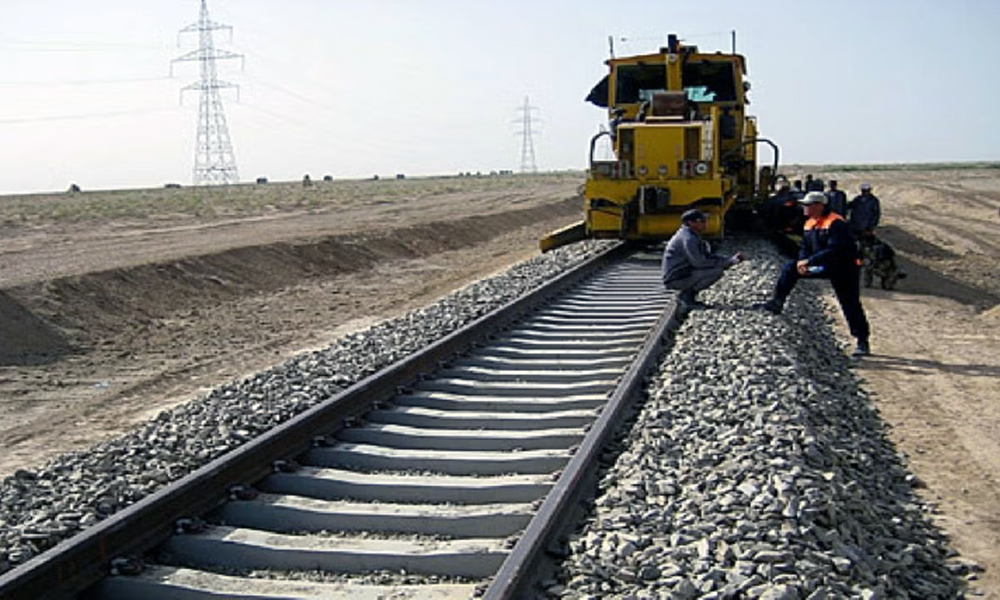
Iran’s National Railway Company (RAJA) is preparing to launch three new international railway routes connecting the country to Turkey, Afghanistan, and Turkmenistan, in a move designed to strengthen regional trade and passenger mobility.
Jabbar Ali Zakeri, CEO of RAJA and Deputy Minister of Roads and Urban Development, announced the initiative during an interview with Mehr News Agency, stating that the new rail links will bolster Iran’s role as a regional transport hub and support its broader economic and diplomatic outreach.
One of the main projects is a direct passenger rail service between Tehran and Ankara, Turkey, which will extend the current Tehran–Van route. Zakeri said discussions with Turkish authorities on operational and financial details — including ticket pricing — are underway, and the service is expected to be launched within the next two months.
Another strategic route will connect Tehran and Mashhad with Herat in western Afghanistan, marking a significant step in cross-border mobility between the two neighbors. Initial operations will reach Rozanak, just outside Herat, while a 70-kilometer rail segment—currently under construction by Iranian contractors—will eventually link the line directly to Herat city. Launch of the route is pending resolution of travel document protocols and cross-border coordination.
The third route will establish passenger rail service from Mashhad to Marv in Turkmenistan, with the long-term aim of integrating Iranian rail lines with Uzbekistan and Tajikistan. The move is seen as part of Iran’s strategy to deepen economic ties with Central Asia and position itself as a key transit corridor in the region.
The new initiatives come amid a broader push by Iran to expand its international railway footprint as part of its regional connectivity and trade facilitation strategy.
In May 2024, Iran and Afghanistan reopened the Khaf–Rozanak railway, a section of a larger project aimed at linking eastern Iran with western Afghanistan. Iranian officials have expressed interest in accelerating work on the Herat–Rozanak–Khaf corridor, which is considered critical for trade and transit to landlocked Afghanistan.
In addition, discussions are ongoing between Iran, Pakistan, and Turkey under the framework of the Economic Cooperation Organization (ECO) to revitalize the Istanbul–Tehran–Islamabad (ITI) freight corridor. Test runs have resumed in recent years, though regular service still faces logistical and political hurdles.
Iran has also made progress on north-south connectivity, particularly through the International North-South Transport Corridor (INSTC), which aims to connect India, Iran, and Russia via multimodal routes. The Rasht–Astara segment, which would complete Iran’s portion of the corridor, is currently under development with support from Russia.
The Chabahar–Zahedan railway, backed by Indian investment, is another high-priority project for Iran. Once completed, it will link the strategic port of Chabahar to Iran’s rail network and provide Afghanistan and Central Asia with direct sea access.
With sanctions continuing to limit air and banking sectors, Iran views regional rail as a relatively insulated and strategic lever for economic resilience, especially in its relationships with neighbors such as Afghanistan, Turkmenistan, and Turkey.
These new rail corridors are expected to increase not only the movement of passengers, but also facilitate trade, tourism, and regional cooperation, reinforcing Iran’s vision of becoming a central node in Eurasian transit networks.









Business
Uzbekistan delivers over 290 tons of aid to Afghanistan
The assistance, provided ahead of Eid al-Fitr, is intended to support vulnerable communities while reinforcing ties between the neighboring countries.
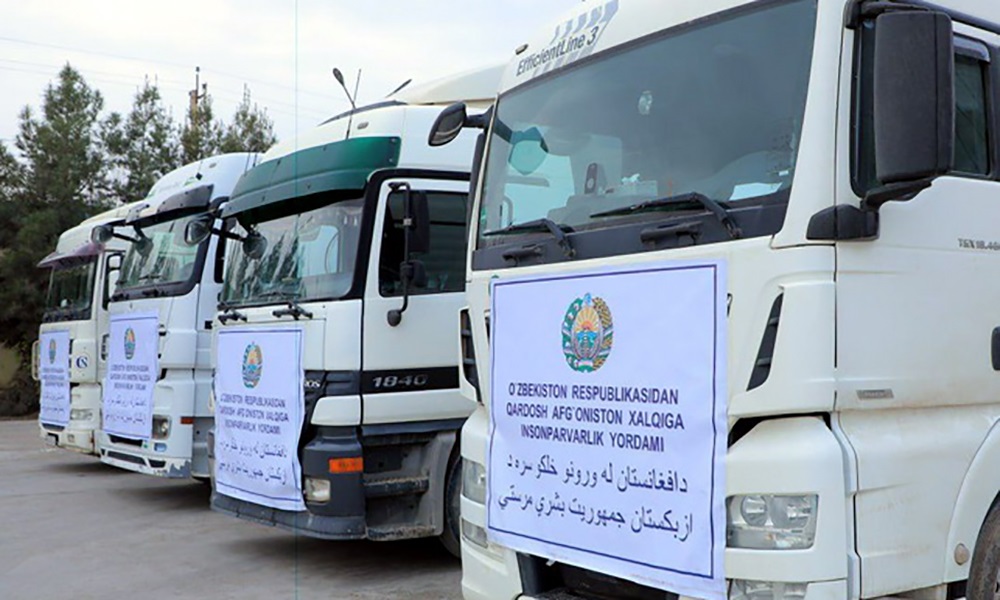
Uzbekistan has delivered more than 290 tons of humanitarian aid to Afghanistan, according to the country’s Ministry of Foreign Affairs.
The assistance, provided ahead of Eid al-Fitr, is intended to support vulnerable communities while reinforcing ties between the neighboring countries.
The shipment includes essential food supplies such as flour, rice, wheat, vegetable oil, instant meals, pasta, and confectionery. An official handover ceremony was held in the border town of Hairatan.
Local officials, including Balkh province representatives and authorities from Hairatan, expressed appreciation for the continued support, acknowledging Uzbekistan’s efforts to assist the Afghan people.
Among those present at the ceremony were Uzbekistan’s Ambassador to Afghanistan, Oybek Usmanov, and Surkhandarya regional governor Ulugbek Kosimov.
The aid delivery underscores Uzbekistan’s ongoing humanitarian engagement and its broader efforts to promote regional cooperation and stability.
Business
Turkmenistan, Afghanistan discuss steps to speed up land acquisition for TAPI pipeline
By the end of the year, the vessels are expected to deliver about 11,700 pipes as part of preparations for construction of the TAPI pipeline.
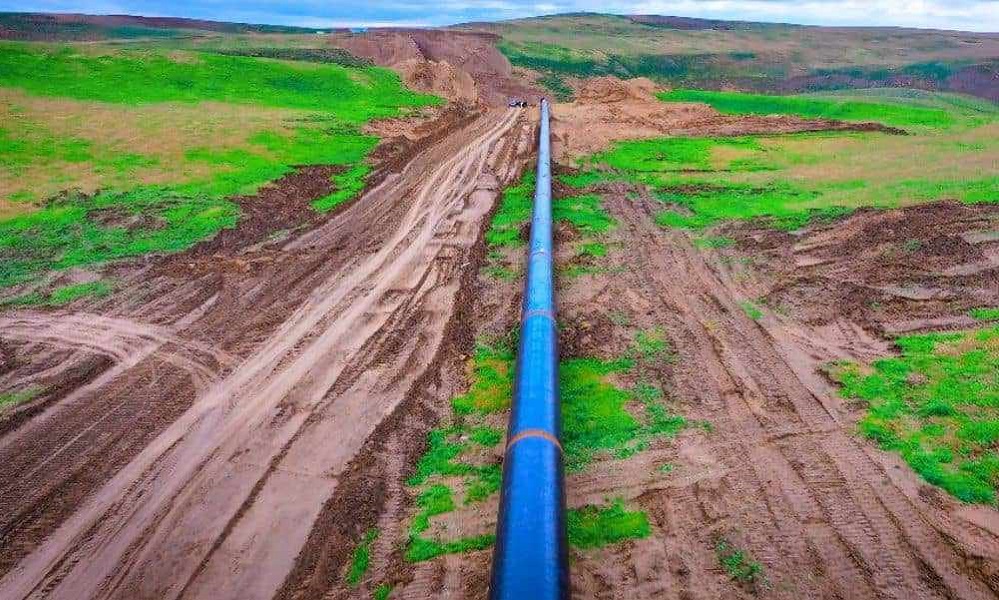
Officials from Turkmenistan and Afghanistan have held talks aimed at accelerating land acquisition for the long-planned Turkmenistan-Afghanistan-Pakistan-India (TAPI) pipeline, according to Afghanistan’s Ministry of Agriculture, Irrigation, and Livestock.
The issue was discussed during a meeting between TAPI project head Murad Amanov, Afghanistan’s acting Minister of Agriculture, Irrigation, and Livestock Mullah Attaullah Omari, and Turkmenistan’s ambassador to Afghanistan Hoja Ovezov.
Amanov briefed Afghan officials on recent progress and emphasized the need to accelerate procedures related to land acquisition and the determination of land prices in line with the framework agreement signed by the four participating countries.
Meanwhile, vessels operated by the Azerbaijan Caspian Shipping Company (ASCO), part of AZCON Holding, have begun transporting pipes for the project. The shipments are being carried from the Port of Baku to the Turkmenbashi International Seaport.
By the end of the year, the vessels are expected to deliver about 11,700 pipes as part of preparations for construction of the TAPI pipeline.
Business
Afghanistan expands exports through Lapis Lazuli Corridor
A transport company is scheduled to move the shipments on Sunday, March 15, along the route that links Afghanistan with Turkmenistan, Azerbaijan, and Georgia before reaching Turkey.

Afghanistan’s Ministry of Transport and Civil Aviation has announced the dispatch of eight export shipments through Torghundi port via the Lapis Lazuli Corridor to international markets.
In a statement, the ministry said the move is part of ongoing efforts to facilitate transit and strengthen the country’s export sector. Officials confirmed that coordination has been completed for eight commercial consignments to be transported along the corridor.
According to the ministry, a transport company is scheduled to move the shipments on Sunday, March 15, along the route that links Afghanistan with Turkmenistan, Azerbaijan, and Georgia before reaching Turkey.
The consignments include dried fruits, jam, pressure cookers and energy drinks. After arriving in Turkey, the goods are expected to be re-exported to markets in Saudi Arabia, the United States, Australia and the Netherlands.
The Lapis Lazuli Corridor is a regional trade and transit route launched in 2018 to connect Afghanistan with European markets through the Caucasus and Turkey, providing an alternative pathway for Afghan exports beyond traditional routes.
The Ministry of Transport and Civil Aviation said expanding transit corridors, supporting export and import growth, and facilitating international transport operations remain among its key priorities.
Officials added that practical steps are being taken to strengthen Afghanistan’s role in regional trade and connectivity.


Tahawol: Temporary ceasefire draws broad support

Security Sources: Pakistani military shelling in Kunar and Nuristan leaves female doctor dead

Saar: Emphasis on resolving conflicts through diplomacy

UN Secretary-General condemns Pakistani airstrike on Kabul rehab center

IEA Supreme Leader: Afghanistan’s victory lies in faith and National unity

Pakistani military jet downed in Afghanistan’s Jalalabad, pilot captured alive

Afghan Air Force conducts airstrikes in Islamabad, other cities

Afghanistan’s Chief of Armed Forces underscores readiness and equipment for national defense

Afghanistan welcomes investment and technology partnerships with India

Prominent Muslim scholar issues fatwa calling for Afghanistan-Pakistan ceasefire
Tahawol: Temporary ceasefire draws broad support
Saar: Emphasis on resolving conflicts through diplomacy

Tahawol: Global reactions to Pakistan’s recent attacks discussed

Saar: Consequences of Pakistani airstrikes on Afghans discussed

Tahawol: Pakistan’s new attacks on Kabul hospital discussed
-
 Latest News4 days ago
IEA Supreme Leader issues Eid-ul-Fitr message urging unity and support for Islamic system
-

 Latest News5 days ago
Regional criticism grows amid Pakistan strikes inside Afghanistan
-
 Latest News5 days ago
Afghan airstrike targets a military camp in South Waziristan
-

 Business4 days ago
Turkmenistan, Afghanistan discuss steps to speed up land acquisition for TAPI pipeline
-

 Sport5 days ago
IPL 2026 kicks off in under two weeks; Afghan players set to shine
-

 Business5 days ago
Afghanistan expands exports through Lapis Lazuli Corridor
-

 Latest News1 day ago
IEA announces temporary pause in defensive operations against Pakistan for Eid
-

 World5 days ago
Trump rejects efforts to launch Iran ceasefire talks, sources say