
Latest News
Pentagon says Bagram withdrawal was discussed with Afghan leaders

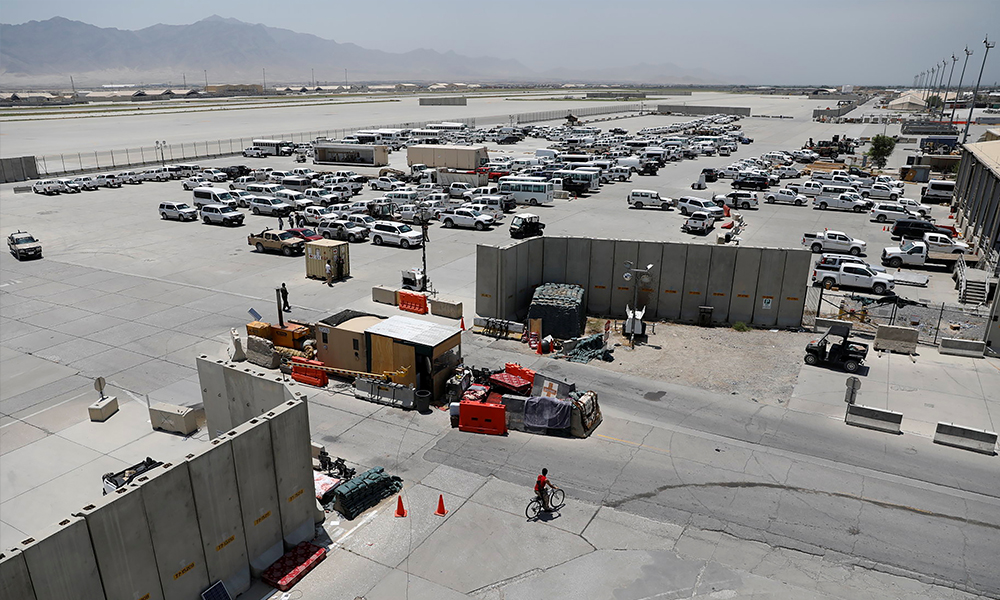
Dispelling reports that the Afghan leadership had not been informed about the final withdrawal of US troops from Bagram Airfield last week, Pentagon press secretary John Kirby said there had been coordination with Afghan leaders, both in government as well as in the Afghan security forces, about the eventual turnover of the base.
Addressing a press conference on Tuesday, Kirby said: “As you know, it was the seventh and the final base that we turned over to the Afghan National Security Forces. You don’t do that in a vacuum and this wasn’t done in a vacuum.
“I can’t speak for the level of information that went down the Afghan chain of command but I can tell you that Afghan leaders, civilian and military, were appropriately coordinated with and briefed about the turnover of Bagram Air Base.
“The specific conversation and coordination about the turnover of Bagram, the final conversations occurred about 48 hours prior.”
He said however that “obviously, for operational security reasons, we didn’t go into the exact hour at which all U.S. forces would leave Bagram.”
This comes after reports emerged this week that the U.S. forces flew out of Bagram in the early hours of Saturday morning after switching off the lights and not informing anyone.
A walkthrough of the base on Monday showed the deserted facility littered with discarded equipment including hundreds of civilian and armored vehicles.
Kirby stated however that due to security concerns U.S. forces are taking precautions. “We have had to operate under the assumption that this drawdown could be contested at any time. And so we’re very careful about what we say and how — how much detail we provide out there, but there was coordination.”
He also said “it’s not like the closure or the turnover of Bagram was at — at all in dispute throughout this drawdown process. Everybody knew that was happening and — and there was general understanding about roughly when. Again, as we got closer, more detail was provided to — to Afghan leaders.
He acknowledged that there had been some vehicles left behind and some turned over to Afghan officials.
“Our commitment to the future of a stable and secure Afghanistan has not changed. It’s just going to look different. We’re just not going to be on the ground the way we are now,” he said.
On the issue of over-the-horizon counterterrorism, Kirby said “it’s difficult but it’s doable”.
He told members of the press “I don’t have a breakdown for you right now what that’s going to look like. But, again, it’s important to remember we already have an over-the-horizon counterterrorism capability that the — a carrier strike group in the region, we’ve got facilities throughout the Middle East that have and will continue to be of value in this regard so we have that capability”.
Kirby also said many of the contractors are still in Afghanistan and providing ongoing support to the Afghans and the Afghan Air Force.
“We are actively working on ways in which that contract support can be done remotely or virtually or even physically outside the country,” he said.












Kazakhstan’s Foreign Minister Mukhtar Tileuberdi has called for pragmatic and coordinated international engagement with Afghanistan, saying the country’s long-term stability is closely linked to the security and sustainable development of Central Asia.
Speaking during the general debate of the 81st session of the United Nations General Assembly in New York on Friday, Tileuberdi said humanitarian assistance to Afghanistan remains essential but alone cannot break the cycle of poverty, displacement and dependency.
He said Kazakhstan supports a “pragmatic, coordinated and step-by-step” approach to international engagement with Afghanistan, with the United Nations playing a central role.
Tileuberdi also said Kazakhstan is working with the UN to operationalize the United Nations Regional Centre for the Sustainable Development Goals for Central Asia and Afghanistan in Almaty.
He said the success of the centre should be measured by the results and assistance it delivers to the region.


Abu Muslim Farah defeat Khurasan Faryab 2-0 in ACL season six

Saar: Concerns over Pakistan’s political crisis discussed

Afghanistan Champions League: Omar Zawak Herat beat Toofan Herat 1-0

Blast in Pakistan’s Dera Ismail Khan kills 11, injures 30

Ariana Afghan Airlines increases Kabul-Delhi cargo flights

Saudi energy group signs major Afghanistan deals covering gas exploration and pipeline plans

Trump floats idea of renaming Atlantic or Pacific Ocean

US hits Egyptian bank branches with Iran sanctions as war marks six months

Nepal flood rescue mission enters critical phase as thousands remain missing

Iranian clubs to face Gulf opponents at neutral venues in Asian Champions League Elite
Saar: Concerns over Pakistan’s political crisis discussed

Exclusive interview with Abdul Latif Mansoor, Minister of MRRD

Tawsia: Overview of Afghanistan’s iron mines

Tahawol: Discussion on fresh Pakistani airstrikes on Afghanistan

Saar: Calls for international support for Afghanistan discussed
-

 World5 days ago
CNN, MS NOW and Politico sue Trump, challenging White House ban
-

 Latest News3 days ago
Ariana Afghan Airlines ranks seventh among 45 Central Asian airlines
-

 Latest News5 days ago
UN reiterates call for respect for international law after Kunar airstrikes
-

 Regional4 days ago
US and Iran hold first talks since June after Trump’s ‘annihilation’ threat
-

 Latest News4 days ago
Silk Road highway in Wakhan corridor now reaches the China border
-

 Regional3 days ago
Iran airlines cancel flights as US sanctions hit
-

 Latest News5 days ago
Afghan Official: Pakistan’s airstrikes will not go unanswered
-

 Sport5 days ago
Afghan boxing referee heads to China for international festival