
World
Thousands of northeast Japan homes still without power after earthquake kills four


Tens of thousands of Japanese households remained without power on Thursday morning, more than 10 hours after a powerful earthquake that left at least four dead and more than 100 injured, and severed transport links to the country’s northeast, Reuters reported.
Companies including a giant chipmaker and Toyota Motor Corp (7203.T) raced to assess the impact of the magnitude 7.4 quake, which struck shortly before midnight on Wednesday. Supply chain disruptions could put more pressure on already strained global output of smartphones, electronics and automobiles, read the report.
The temblor revived memories of the March 11, 2011 disaster in the same area, and left Shinkansen bullet train service indefinitely suspended, with at least one major highway to the region closed for safety checks.
According to Reuters parts of building facades tumbled into streets below in some areas, and television footage showed a steep tiled roof crumpled over a parked, crushed car and workers examining cracked highways.
Areas of Tokyo lost power immediately after the quake, though most regained it within three hours.
But some 24,270 households serviced by Tohoku Electric Power Co (9506.T) in northeast Japan remained without electricity by 10:00 a.m. local time (0100 GMT) on Thursday, although the firm said it expected most will have supply restored later in the day.
Prime Minister Fumio Kishida said four people had died and that the government would be on high alert for the possibility of further strong tremors over the next two to three days, Reuters reported.
According to Reuters at least 107 people were reported injured, several of them seriously, with 4,300 households still without water by mid-morning. Residents of one Fukushima city formed a long queue in a parking lot to fill up plastic tanks with water for use at home.
Renesas Electronics Corp (6723.T), the world’s biggest maker of automotive microcontroller chips, said it was checking for quake damage at three plants in Japan.
Among them is its advanced Naka plant in Ibaraki prefecture, which closed for three months following the March 2011 quake and for a shorter time after a quake in 2021. It had to halt production last year because of a fire, exacerbating a global chip shortage that is forcing auto companies to curb output.
The quake, initially measured at magnitude 7.3 but later revised up to 7.4 by the Japan Meteorological Agency, hit at 11.36 p.m. local time just off the coast of Fukushima prefecture at a depth of 60 kilometres. The 2011 quake and tsunami off Fukushima – commemorated across the country less than a week ago – left some 18,000 dead.
A tsunami warning was issued but cancelled early on Thursday morning. Some areas reported a rise in the sea level but no serious damage was immediately reported.
The 2011 disaster also set off meltdowns at the Fukushima Daiichi nuclear power plant. No abnormalities were reported at any nuclear power plants, although authorities had earlier said a fire alarm had been triggered at a turbine building at the crippled plant.
Manufacturers said they were trying to gauge the potential damage to their facilities in the region.
Toyota said it had cancelled the day shift at two factories in northeast Japan after workers evacuated the plants during their evening shift on Wednesday. The automaker said it will decide on the evening shift later.
Mizuho Financial Group Inc’s (8411.T) main banking arm said some of its ATMs temporarily stopped operations due to power outages, but that they had all been restored to service.
In an attempt to cover the area affected by the Shinkansen outage, All Nippon Airways (9202.T) and Japan Airlines (JAL) said they had added extra flights to northern cities. There were no forecasts of when regular rail service might be restored.
Japan’s benchmark Nikkei stock average jumped, with no impact seen from the quake




World
US Treasury ratchets up pressure on Iran with sweeping new aviation sanctions
Treasury Secretary Scott Bessent last week warned that airlines were possible sanctions targets along with digital assets and the maritime industry.
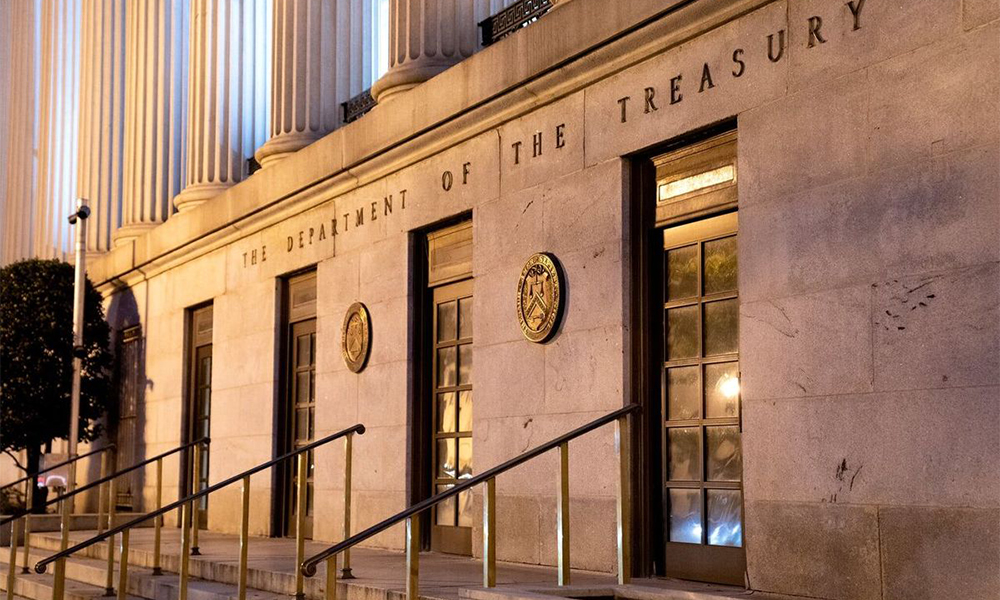
The United States on Tuesday issued 36 Iran-related sanctions targeting the country’s aviation sector and other companies as part of a broad push to escalate economic pressure on Tehran as the war in the Middle East has moved into a seventh month, Reuters reported.
The U.S. Treasury Department said the action was aimed at grounding Iran’s Mahan Air, which was already sanctioned by the U.S. and the European Union, and expanding sanctions to all other Iranian airlines. The sanctions also took aim at covert front companies, cargo handlers, foreign intermediaries and deceptive trans-shipment routes that Washington says Iran relies on to obtain U.S.-origin aircraft and sensitive technology.
The Treasury instructed financial institutions to report any procurement networks supporting Iran’s aviation industry, while designating firms in Turkey, the United Arab Emirates, Malaysia and Kazakhstan that it said had helped Iran’s airlines operate and Tehran acquire U.S.-origin aircraft and sensitive technology.
Treasury’s Office of Foreign Assets Control also suspended three Iran-related aviation authorizations that allowed overflights and permitted non-U.S. airlines to fly U.S.-origin or U.S.-controlled commercial aircraft into Iran.
Miad Maleki, a former senior Treasury official and fellow at the Foundation for Defense of Democracies, said the suspension would hit air traffic from Dubai, Doha and Istanbul, shutting Tehran’s main gateways to regional trade and finance. OFAC’s action also closes previous carve-outs that allowed transport of safety parts, fuel and emergency repairs, he said.
Tuesday’s actions marked a sharp escalation of the Trump administration’s renewed push to squeeze Iran’s economy and pressure Tehran to loosen its chokehold on the Strait of Hormuz. A U.S. naval blockade and tougher sanctions are curbing Iran’s oil exports, restricting access to foreign currency and exposing growing strains in the economy.
Treasury said any foreign firm or individual aiding Iranian airlines through aircraft transfers, cargo services or general sales agent support would face serious consequences.
Treasury Secretary Scott Bessent last week warned that airlines were possible sanctions targets along with digital assets and the maritime industry.
”Under Operation Economic Outcast, we promised severe consequences for those providing financial lifelines to the Iranian regime,” Bessent said in a statement on Tuesday. “Let this be a warning to anyone doing business with Iran’s remaining airlines, all of which we sanctioned today: You are at risk of being cut off from the global financial system.”
On Tuesday, Treasury designated 27 Iranian airlines, as well as several firms based in Turkey and the United Arab Emirates for helping Mahan Air secure at least three Boeing B-777 aircraft this summer that had been retired elsewhere, read the report.
It hit UAE-based Egyptian citizen Ibrahim Ali Mohamed Mohamed Mahran, the chief executive of ECT Aviation Support, as well as the British unit of the firm.
OFAC also imposed sanctions on two firms based in Turkey and Malaysia that it said had serviced Mahan Air’s international flights and coordinated cargo shipments.
The U.S. Treasury has repeatedly targeted global networks supporting Mahan Air. In July, Treasury designated six entities and individuals in China, India, Russia and Iran, including several firms that act as sales agents for the airline. Washington first sanctioned Mahan in 2011 over support it provided to Iran’s Islamic Revolutionary Guard Corps.
In 2020, Washington imposed sanctions on a China-based company it accused of acting on behalf of Mahan Air.
Brett Erickson, managing principal of Obsidian Risk Advisors, said the latest moves were significant.
“The United States is using sanctions to effectively blockade Iran’s aviation sector from the rest of the world,” he said. “That represents a major expansion of the economic war, with foreseeable consequences for civilian travel, commerce, supply chains and Iran’s ability to sustain their strained economy.”
World
EU to give Greenland a cash boost amid Trump annexation drive
While Denmark is a member of the EU, Greenland left the bloc in 1985. But its people, as Danish citizens, are also citizens of the EU.
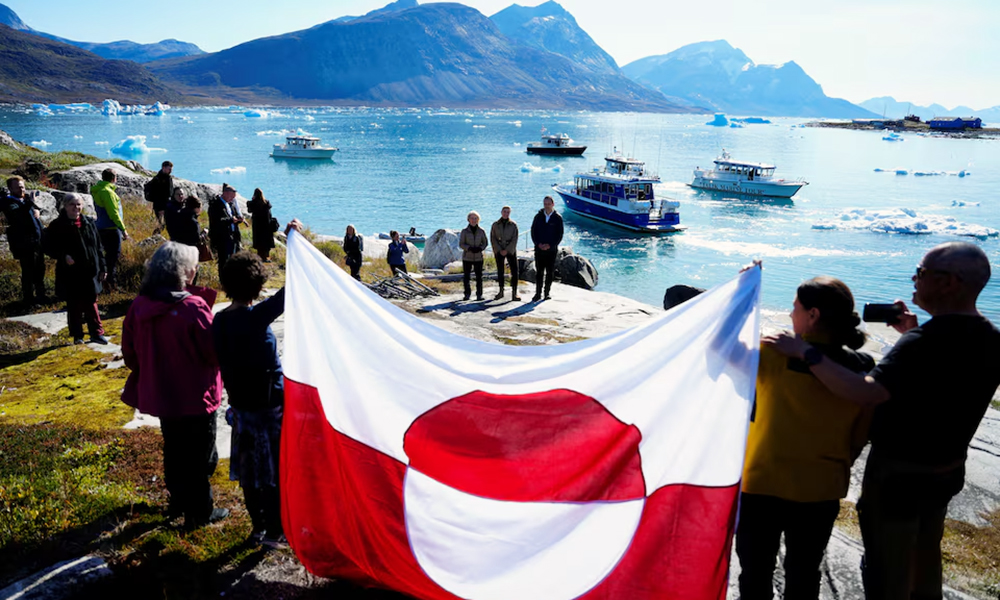
European Commission President Ursula von der Leyen is expected to unveil on Monday a boost in EU investments in Greenland and closer political ties with the Danish Arctic territory, which Donald Trump has insisted should belong to the United States, Reuters reported.
Von der Leyen arrived in Greenland on Sunday for a two-day visit serving as a show of support for the governments of Greenland and Denmark, which have strongly rebuffed Trump’s campaign to annex the world’s largest island.
The head of the 27-nation European Union’s executive body, von der Leyen is expected to unveil plans to invest in sectors including critical minerals, satellite communications and renewable energy in Greenland, a semi-autonomous part of the Danish realm.
On Sunday in Nuuk, the capital, von der Leyen said the package would be “substantial” but gave no details. Greenland Premier Jens-Frederik Nielsen said his country wanted to build on its “close friendship and good partnership” with the EU.
Von der Leyen’s visit reflects the increasing geopolitical importance of the Arctic to major powers, such as the United States, Russia, China and Europe, as melting ice opens new shipping routes to make the region’s mineral wealth more accessible.
“Greenland’s stunning landscapes and natural beauty will stay with me for a long time. But so will the visible scars of climate change on the ice sheet,” von der Leyen posted on X after a boat trip under clear blue skies in a fjord scattered with chunks of ice.
“As the ice melts, a new reality is taking shape.”
Trump, the U.S. president, sparked a crisis in U.S.-European ties and turmoil within the transatlantic NATO military alliance this year when he stepped up his demands for the U.S. to control Greenland, arguing that fellow NATO member Denmark could not defend it.
European officials stressed Greenland is part of NATO territory, meaning it is covered by the alliance’s mutual defence pact, and that the U.S. already has the right to increase its military presence there under a longstanding treaty.
Tensions lowered after Trump and NATO boss Mark Rutte agreed in Davos in January that the United States, Denmark and Greenland would begin talks to resolve their differences and NATO would step up its role in Arctic security, read the report.
However, the trilateral talks have yet to yield an agreement and, at a NATO summit in Turkey in July, Trump restated his insistence that the U.S. should control Greenland.
While Denmark is a member of the EU, Greenland left the bloc in 1985. But its people, as Danish citizens, are also citizens of the EU.
The EU has long provided funding to Greenland, mainly to pay for fishing rights and support its education system. The package to be announced by von der Leyen will represent not only a big increase in funding but a broadening of the sectors that will receive EU cash, according to EU officials.
World
US envoys make first Kyiv visit amid Ukraine war peace push
Kushner and Witkoff travelled from Moscow, where they held three hours of talks with Russian President Vladimir Putin on Saturday but did not appear to secure a breakthrough in the conflict, Reuters reported.
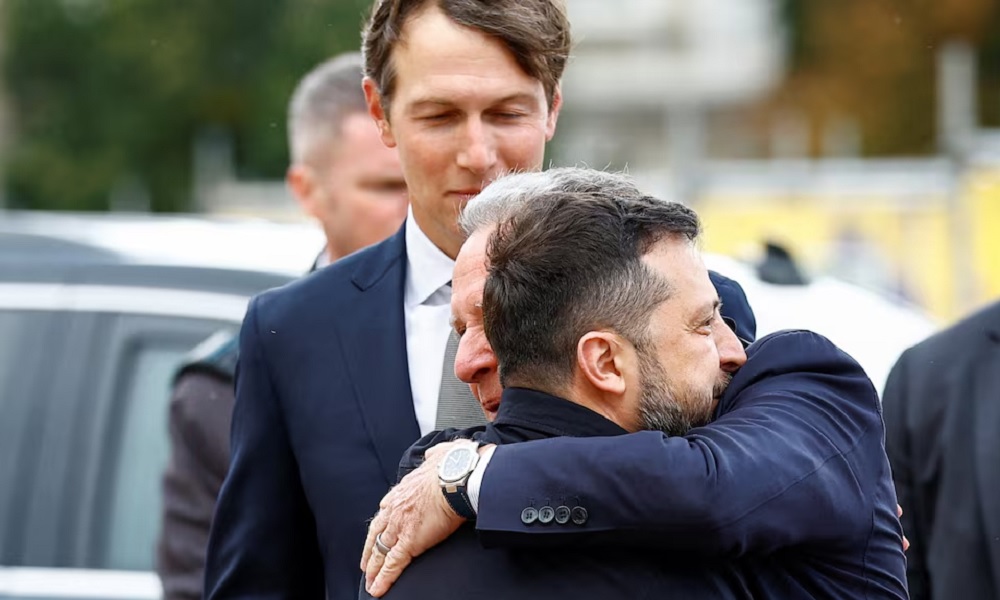
U.S. peace envoys Jared Kushner and Steve Witkoff met with Ukrainian President Volodymyr Zelenskiy in Kyiv on Sunday as the Trump administration renewed its push to end Russia’s four-and-a-half-year war in Ukraine.
Kushner and Witkoff travelled from Moscow, where they held three hours of talks with Russian President Vladimir Putin on Saturday but did not appear to secure a breakthrough in the conflict, Reuters reported.
Previous rounds of U.S.-mediated peace talks encouraged by President Donald Trump, who campaigned on a promise to quickly end the war, have yielded few results. He suggested on Friday that the U.S. had a fresh proposal though he did not elaborate.
Kremlin aide Yuri Ushakov described Saturday’s meeting as “highly useful”, while a White House official told Reuters that next steps would be announced in the coming weeks.
The two envoys met Zelenskiy and other top Ukrainian officials in central Kyiv.
Zelenskiy, who believes Washington will be key to any peace deal, has said a window of opportunity to make peace exists before the U.S. begins focusing on its next presidential election.
After the first round of talks between Ukrainian and U.S. negotiators that lasted about three hours, the U.S. envoys said that they were looking forward to making more progress.
“Substantive, important, and we are very encouraged,” Witkoff told reporters after the talks, which also included a working lunch.
Zelenskiy said that more talks, which would also include European representatives, were planned later on Sunday. British, French and German national security advisers were in Kyiv on Sunday.
“Security guarantees are needed. A dignified post-war peace is needed. Our proposals have been drawn up,” Zelenskiy said as his negotiating team was preparing to meet U.S. envoys.
CAUTIOUS OPTIMISM ON THE STREETS OF KYIV
Witkoff and Kushner, Trump’s son-in-law, have visited Moscow several times in their roles as peace envoys. But Sunday is their first visit to Kyiv in their capacity as U.S. negotiators.
Their visit has long been sought by Ukraine’s leadership, and on the streets of Kyiv, which has been bombarded heavily in recent weeks, some residents were hopeful.
“The issue can be solved in the blink of an eye. We want peace. I’ve fought myself, so I know what war is like. We need peace, because there’s no other way,” said military veteran Stepan Yermak.
In previous talks, the sides have remained far apart on key issues, including the future of the eastern Ukrainian region of Donbas. Russia has demanded Ukraine’s withdrawal from an entrenched belt of towns that it still controls there, but Kyiv has refused, reasoning that it can still hold on.
For Ukraine, hard security guarantees from its European allies and the U.S. are crucial to deterring Russia from invading again.
“We need an agreement that will never be broken,” said Svitlana Kurylenko, a 19-year-old cafe worker.
“Just leave Ukraine alone and let people live in peace.”
TEMPORARY HALT IN STRIKES
Though the front lines of the ground war remain largely static, both Russian and Ukrainian forces have intensified long-range air strikes in recent weeks.
Russia has pounded the Ukrainian capital day and night with missiles and drones for the past two weeks, including an attack on Friday on the headquarters of the SBU security service.
The Kremlin has said it would pause strikes on Kyiv until Monday, while Zelenskiy has said Ukraine would also halt strikes on Moscow.
There was no let-up in fighting along the 1,200-km (750-mile) front, however, and Russia bombarded other Ukrainian cities on Saturday.
Ukraine has inflicted damaging hits throughout the summer on Russian refineries, oil terminals and the warehouses of online retailer Wildberries, in an attempt to raise the cost to Moscow of continuing the war.
Ukraine said on Sunday it had struck the Ryazan oil refinery, around 480 km (300 miles) inside Russia, overnight, causing a fire.


Afghanistan, Bangladesh discuss expanding economic ties

Russia says strengthening Tajik-Afghan border is security priority

UAE firm eyes investment in Salang’s second tunnel and pharmaceutical factories

UN chief warns of more than 8,500 attacks on education worldwide

Mujahid calls Pakistan’s order to expel Afghan medical students ‘inhumane’

Four mediators struggle to secure lasting Pakistan-Afghanistan ceasefire

HesabPay unveils new visa card and digital payment app in Kabul

AFC Champions League Elite draw nears as Al-Nassr seeded above Al-Hilal

Juma Khan Fateh surrenders to IEA forces in Badakhshan

Afghanistan’s trade diversification challenges Pakistan

Tahawol: Victory of Germany’s far-right party in state election discussed

Saar: UN Human Rights Council meeting on Afghanistan reviewed

Tahawol: Possible future scenarios for Ukraine crisis

Saar: Afghanistan’s relations with international community

Tahawol: Hopes for improved relations between Kabul and Washington
-

 Business2 days ago
Saudi energy group signs major Afghanistan deals covering gas exploration and pipeline plans
-

 Latest News2 days ago
Khalilzad: Afghanistan ready to attract major investment
-

 Latest News4 days ago
Muttaqi and Khalilzad discuss expanding Afghanistan-US relations
-

 Latest News4 days ago
Russian official: West seeks military infrastructure in Central Asia, citing Afghanistan threat
-

 Latest News3 days ago
Maryam Nawaz says Punjab faces greater security threats from neighbouring provinces
-

 Regional3 days ago
US and Iran exchange fire on vessels near Strait of Hormuz
-

 World4 days ago
World food prices at highest since 2022 as supply risks mount, FAO says
-
 Regional4 days ago
Iranian tanker hit by US attack near Iran’s Kharg Island, Tasnim says