
World
Trump praises Japan’s ‘great’ female leader in talks on trade, critical minerals
Takaichi followed other world leaders to recommended Trump for the Peace Prize he has long said he is worthy of.

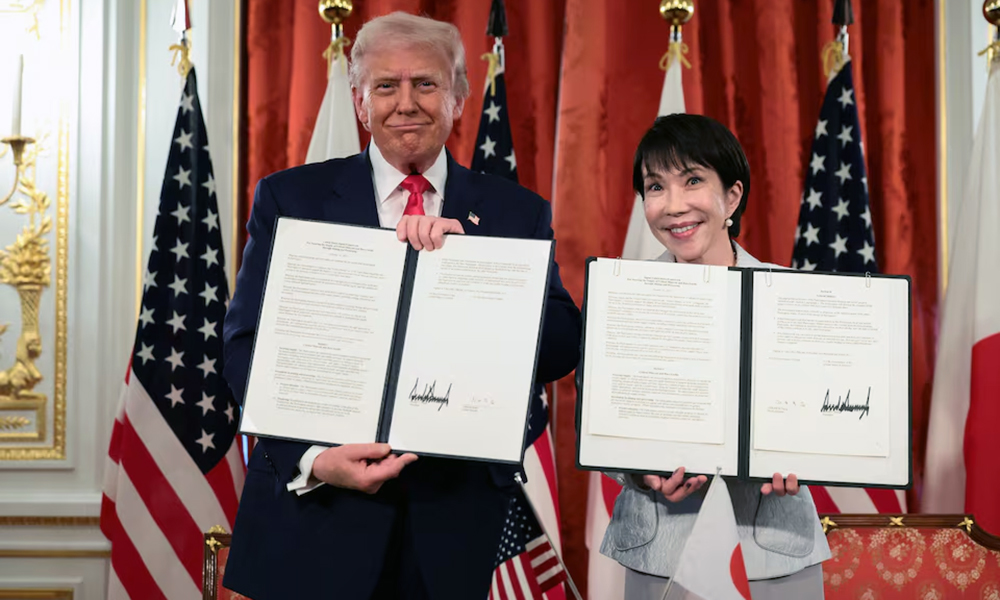
U.S. President Donald Trump lavished praise on Japan’s first female leader Sanae Takaichi in Tokyo on Tuesday, welcoming her pledge to accelerate a military buildup and signing deals on trade and critical minerals, Reuters reported.
Takaichi, a close ally of Trump’s friend and golfing partner late Japanese leader Shinzo Abe, also said she would nominate Trump for the Nobel Peace Prize, White House spokeswoman Karoline Leavitt told reporters.
The new prime minister is also expected to offer a package of U.S. investments under a $550-billion deal agreed this year, including shipbuilding, and increased purchases of U.S. soybeans, natural gas and pickup trucks, sources familiar with the talk said.
Those gestures may temper any Trump demands for Tokyo to spend more on defending islands from an increasingly assertive China, which Takaichi sought to head off by pledging last week to fast-track plans to increase defence spending to 2% of GDP.
“It’s a very strong handshake,” Trump said, as the pair posed for photos at the Akasaka Palace in downtown Tokyo.
“Everything I know from Shinzo and others, you will be one of the great prime ministers. I’d also like to congratulate you on being the first woman prime minister. It’s a big deal,” Trump told Takaichi as the pair sat down for discussions with their delegations.
Takaichi gifted Trump Abe’s putter, a golf bag signed by Japanese major winner Hideki Matsuyama and a gold leaf golf ball, according to photos posted on X by Trump’s assistant Margo Martin, read the report.
Trump also praised Japan’s efforts to purchase more U.S. defence equipment, while Takaichi said Trump’s role in securing ceasefires between Cambodia and Thailand, and Israel and Palestinian militants, were “unprecedented” achievements.
Takaichi followed other world leaders to recommended Trump for the Peace Prize he has long said he is worthy of.
The leaders then signed an agreement to support the supply of critical minerals and rare earths, as the countries seek to wean reliance off China’s chokehold on the materials crucial for a wide range of products from smartphones to fighter jets.
The deal aims to jointly identify projects of interest in areas such as magnets and batteries over the next six months and work together to develop stockpiles of key minerals among other measures.
Trump was last at the palace, an ornate residence built in a European style, in 2019 for talks with Abe, who was assassinated in 2022.
After lunch with Takaichi there, Trump met with relatives of people abducted by North Korea in the 1960s and 1970s to train its spies and their relatives. While some were later repatriated, Japan continues to press Pyongyang for a full accounting of all the abductees and the return of any who remain alive, a cause championed by Abe, Reuters reported.
“The United States is with them all the way,” Trump said after greeting the families.
The U.S. leader began his visit on Monday with a meeting at the Imperial Palace with Japanese Emperor Naruhito .
Takaichi’s gifts to Trump and repeated references to Abe are aimed at evoking memories of a close bond forged over hours the pair spent golfing together during Trump’s first term. Abe was assassinated in 2022, with the trial of his assailant coincidentally beginning in the western city of Nara on Tuesday.
A similar close relationship with the leader of Japan’s key security and trade partner could help Takaichi bolster her weak political position at home.
Though she has seen a surge in public support since becoming prime minister, her coalition government is two votes shy of a majority in parliament’s lower house.
Trump and Takaichi will later visit the U.S. naval base in Yokosuka near Tokyo, which is home to the aircraft carrier USS George Washington, part of the U.S. military’s powerful presence in the region, read the report.
Trump will then meet business leaders in Tokyo, before travelling on Wednesday to South Korea. In talks there with Chinese President Xi Jinping, Trump said he hopes to seal a trade war truce between the world’s two biggest economies.




World
North Korea’s Kim vows to expand ties with Russia, backs victory in ‘sacred war’
Kim delivered a similar message to Chinese President Xi Jinping in a reply published by KCNA on Sunday.

North Korean leader Kim Jong Un said he would “expand and deepen” joint work with Russia in a message to Russian President Vladimir Putin, state media KCNA reported on Tuesday.
In a reply sent on Monday to Putin’s congratulations for North Korea’s 78th founding anniversary, Kim said Pyongyang’s government had a firm will to broaden cooperation with Russia “in a comprehensive way” based on friendship, mutual assistance, and what he described as the countries’ alliance relations.
Kim also said he was convinced of Russia’s victory in the current “sacred war for defending the security interests of the country and international justice”, language that appeared to refer to Russia’s war in Ukraine.
He pledged his “invariable support” for Putin and the Russian people.
The remarks come as Moscow and Pyongyang have drawn markedly closer, with North Korea sending troops to fight alongside Russian forces in Ukraine in 2024 and deepening military cooperation under a mutual defence pact.
Kim delivered a similar message to Chinese President Xi Jinping in a reply published by KCNA on Sunday, saying North Korea would work with China to further develop their traditional friendship and advance their shared socialist cause.
Both messages were responses to congratulatory letters sent by Putin and Xi on September 9, when North Korea marked the 78th anniversary of its founding.
World
Houthi advance in Yemen puts U.S. in a new bind
The U.S. administration can’t afford to have the Houthis close the strait, driving up energy prices and disrupting global trade.
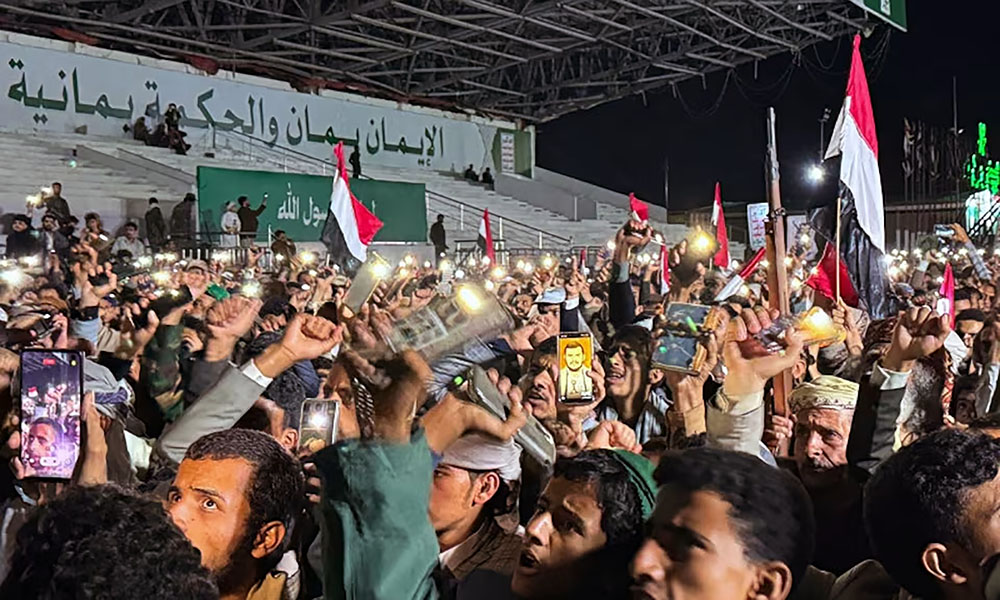
A lightning offensive by the Iran-aligned Houthis has put the militants in a position to control a crucial Middle East waterway, creating a major new problem for U.S. President Donald Trump as his war with Iran grinds on in its seventh month, Reuters reported.
Widening the Middle East conflict, Houthi fighters have advanced south along Yemen’s coast, increasing their ability to choke off the Bab el-Mandeb Strait — the “Gate of Tears” at the mouth of the Red Sea — giving Tehran potential leverage over both of the region’s main oil-shipping corridors.
The militants reached the island of Perim on Friday, in the middle of the strait between Yemen and Africa. That is bad news for Saudi Arabia, which has been shipping much of its oil from Red Sea ports since the war effectively closed the Strait of Hormuz, on the opposite side of the Arabian Peninsula.
It also comes at a difficult time for Trump, who is already grappling with record-low approval ratings and searching for a way out of the conflict, most recently by announcing an economic pressure campaign designed to force concessions from Iran’s government.
High U.S. gasoline prices driven by the conflict have jeopardized his Republican Party’s chances of keeping control of Congress in the November midterm elections. Iran remains defiant despite being hurt militarily and economically.
“Just weeks ago, Trump adopted a strategy of squeezing Iran’s economy while keeping military conflict at levels too low to squeeze the American economy,” said Stephen Wertheim, a senior fellow at Carnegie Endowment for International Peace. “The Houthis have shattered Trump’s plan.”
The U.S. administration can’t afford to have the Houthis close the strait, driving up energy prices and disrupting global trade.
But at the same time, entering a fight with a foe that has withstood previous attacks by Saudi Arabia and the U.S. would be a dangerous new mission for a U.S. military already stretched by the fighting in Iran.
Saudi Arabia’s de facto ruler, Crown Prince Mohammed bin Salman, phoned Trump on Thursday and asked for U.S. military help fighting the Houthis, three sources told Reuters. He was told Washington would not intervene directly for now but would help with intelligence, the sources said.
Trump confirmed on Saturday that he had spoken to the crown prince, and said the Houthis had also phoned his administration and asked for Washington not to become directly involved in the conflict, read the report.
A senior Trump administration official declined to address specific questions, but said the U.S. is focused on national security interests such as ensuring freedom of navigation in the Red Sea “while empowering our regional partners to take the lead in managing and resolving regional security challenges”.
Saudi Arabia, Iran and the Houthis did not respond to a request for comment. Iran’s foreign ministry said in a statement on Thursday that the Yemen conflict could not be solved by blockade or military action against the Houthis and called for dialogue, without addressing Iran’s own role.
Iran responded to U.S. and Israeli attacks earlier this year by disrupting the Strait of Hormuz, the outlet to the Gulf through which around a fifth of global oil supplies flowed before the war.
If the Houthis close the Bab el-Mandeb, that would deal another economic blow, constraining another 7% of global petroleum supplies and about 12% of global trade.
“This was always the worst-case scenario, that the Iranians exert control not only of Strait of Hormuz but Bab el-Mandeb, two of the leading energy choke points in the world,” said David Schenker, who served as Assistant Secretary of State for Near East Affairs during Trump’s first term and is now at the Washington Institute for Near East Policy, a think tank.
“It’s an enormous amount of leverage that [the Iranians] have in hand.”
Analysts and former officials say Trump now faces a choice: devote U.S. forces and scarce air-defense munitions to pushing back the Houthis, or leave Saudi Arabia and its allies, a Yemeni government based in the south, to confront them alone.
The Houthis seized Yemen’s capital 12 years ago, and a Saudi-led military intervention has failed to dislodge them since.
Taking on the Houthis would effectively end a deal Trump struck last year in which the U.S. would stop bombing the group in exchange for a halt to strikes on Red Sea shipping. That would be likely to expose U.S. forces to missile attacks from Yemen.
It would also be another burden for the U.S. military.
U.S. officials say a fight with the Houthis could require significant naval and aerial resources and divert U.S. intelligence assets, given the need to pinpoint Houthi positions that have changed since last year.
If U.S. Navy vessels and aircraft have to start shooting down Houthi drones and missiles, it could also worsen diminished stockpiles of U.S. munitions and air-defense interceptors.
The senior administration official denied that the U.S. was concerned about its resources being stretched. “The United States Military has more than enough munitions, ammo, and stockpiles to serve all of the Commander-in-Chief’s strategic goals and beyond,” the official said.
Tim Lenderking, who served as U.S. special envoy on Yemen under former President Joe Biden and is now a principal at law firm Squire Patton Boggs, said that with Trump signaling an unwillingness to get directly involved militarily against the Houthis, the U.S. needs to do more to share intelligence with the Saudis for their air campaign and step up diplomatic and material support for Yemen’s internationally recognized government.
“This administration came in asking the question, ‘What can Yemen do for us?’” Lenderking said during a webcast sponsored by the Middle East Institute think-tank in Washington. “Well, Yemen can spoil our day.”
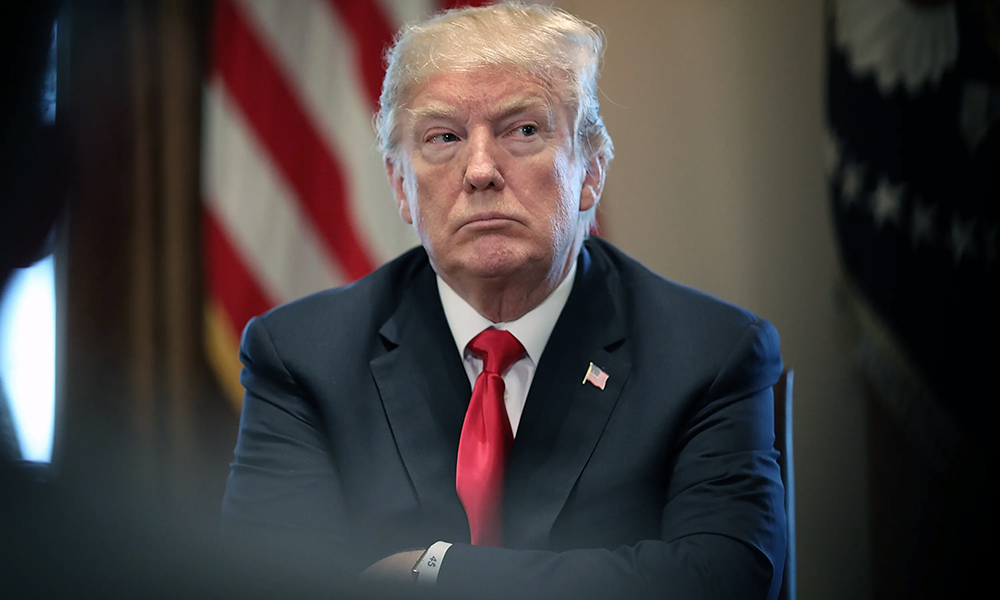
U.S. President Donald Trump says he does not regret launching the war against Iran, despite its potential impact on the November midterm elections.
In an interview with Fox News host Laura Ingraham, Trump said that if given the choice again, he would take the same course of action, adding that he does not believe in the word “regret.”
Trump also dismissed suggestions that some of his supporters had become upset or demoralized over the war, saying they were proud that he was preventing Iran from obtaining a nuclear weapon.
He also reiterated his claim that the war would end immediately after the midterm elections, saying, “It ends right after the election.”
The conflict and the resulting rise in oil and gas prices have become a major political issue for Republicans ahead of the elections.
The United States and Israel launched attacks on Iran on February 28, while Iran responded with strikes on Israel and Gulf states hosting U.S. military bases. The fighting has reportedly killed thousands and displaced millions.
Trump has cited the weakening of Iran’s nuclear capabilities as one of the main objectives of the war. Iran, however, says its uranium-enrichment program is peaceful and maintains that it does not possess nuclear weapons.


Five years out of school: Amnesty raises alarm over Afghan girls’ education

Afghanistan condemns alleged drone attack on Mecca

Quetta commissioner calls for stronger coordination on Afghan refugee repatriation

US sentences Afghan man to 20 year in case linked to 2021 Kabul airport bombing

Top Qatari official meets Afghan interior minister in Kabul

Four mediators struggle to secure lasting Pakistan-Afghanistan ceasefire

Afghanistan’s trade diversification challenges Pakistan

Syria and Saudi Arabia condemn Kabul bombing, express solidarity with Afghanistan

Saudi energy group signs major Afghanistan deals covering gas exploration and pipeline plans

Afghanistan-India T20I series could see major schedule change

Tahawol: Afghanistan’s readiness for US relations discussed

Saar: UN Security Council meeting on Afghanistan discussed

Tahawol: Afghanistan at the center of UN discussions

Saar: Afghanistan’s relations with regional countries discussed

Tahawol: Houthis’ return to regional power dynamics
-
 Sport4 days ago
Zadran calls on Afghan fans to rally behind team against India
-
 Latest News4 days ago
Khalilzad warns US risks losing influence in Afghanistan to China and Russia
-
 Business4 days ago
EU and FAO launch €5m programme to strengthen Afghanistan’s agrifood sector
-
 World4 days ago
Houthi advance in Yemen puts U.S. in a new bind
-
 Regional4 days ago
Iran and UAE back joint BRICS statement urging restraint in war
-

 Sport4 days ago
India beat Afghanistan by seven wickets in first T20I
-
 Latest News5 days ago
Chinese ambassador, Muttaqi discuss expanding bilateral relations
-
 Latest News3 days ago
Helmand governor, UNAMA discuss province’s key challenges