
Latest News
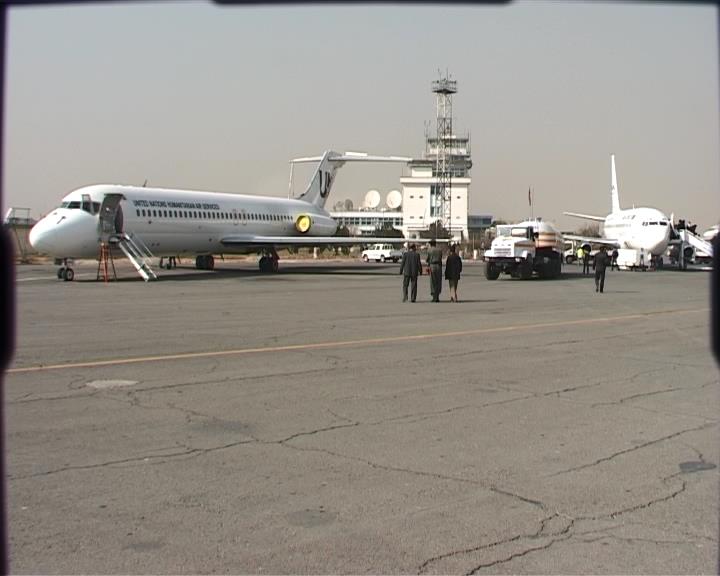
Afghanistan, Iran agree to increase air flights between two countries

![AIR PLAN _12_08_2015_DARI_SOT.avi_snapshot_00.04_[2015.08.12_17.43.22]](https://ariananews.af/wp-content/uploads/2015/08/AIR-PLAN-_12_08_2015_DARI_SOT.avi_snapshot_00.04_2015.08.12_17.43.22.jpg)
Afghanistan and its neighboring country Iran have agreed on increasing the maximum number of flights for each country, Civil Aviation Administration of Afghanistan said.
Afghanistan Civil Aviation Administration declared that more flights to Iranian port will be conducted aimed to solve trade problems of the two countries.
Tehran and Kabul expect bilateral trade to increase once Iran’s Chabahar port is fully operational. The port is intended to be a conduit for landlocked Afghanistan to trade with India and other countries.
Afghan authorities noted that according to the new agreement, Afghan new flights to Iran will be more from now on.
Chabahar port, Abas port and Kish are the new areas where Afghan investors can use them.
“Our aim is to improve trade relation between Afghanistan and Iran and the two countries to have better trade deals,” Qasim Rahimi, spokesman of Civil Aviation Administration said.
Meanwhile, officials in Chamber of Commerce and Industry said that the increase of flights to Iran is effective for Afghan businessmen.
“We can reach to Gulf countries in this way and creates a new market for Afghan investors,” Hashim Rasouli, spokesman of chamber of commerce said.
Afghan economic analysts are also optimistic over the increase of flights between the two countries.
“The agreement between two countries will have positive effects for Afghan investors,” Taj Muhammad Talash, economic analyst said.
Bilateral trade between the Iran and Afghanistan is estimated at over $2 billion per year, and rising

Latest News
Afghan community in California condemns Pakistani strikes amid growing global protests
The gathering in California follows a series of protests held last week by Afghan communities in Europe, highlighting growing concern among the diaspora over the deteriorating security situation.

Members of the Afghan diaspora in the United States have joined a widening wave of international condemnation over recent Pakistani military strikes on Afghan territory, as tensions along the disputed Durand Line continue to escalate.
A group of Afghan citizens in Sacramento gathered this week to denounce the attacks, describing them as a violation of sovereignty and a threat to civilian lives. Participants issued a formal resolution calling on the international community to investigate the strikes and hold those responsible accountable.
Speakers at the event warned that continued military action risks deepening instability in the region, urging global leaders to take the situation seriously and push for measures to prevent further escalation.
The gathering in California follows a series of protests held last week by Afghan communities in Europe, highlighting growing concern among the diaspora over the deteriorating security situation.
In London, hundreds of demonstrators marched through central streets, chanting slogans against the strikes and calling for urgent international intervention.
Protesters pointed to rising civilian casualties in eastern Afghanistan and warned that repeated shelling along the Durand Line could further destabilize already fragile local communities.
Meanwhile, in Oslo, members of the Afghan community gathered outside the Norwegian Parliament to voice similar concerns. Organizers said a formal resolution was submitted to national authorities, as well as to the United Nations and the International Criminal Court, urging immediate steps to halt the violence and ensure civilian protection.
The demonstrations come amid renewed tensions between Afghanistan and Pakistan, where cross-Durand Line clashes and artillery exchanges have periodically flared. Analysts warn that without sustained diplomatic engagement, the situation risks escalating into a broader security crisis with far-reaching regional implications.
International Sports
IPL 2026: Lucknow hold nerve in final over to defeat Sunrisers
The match went down to the wire, with Sunriser’s bowlers applying pressure in the death overs through tight lines and clever variations.

Lucknow Super Giants edged out Sunrisers Hyderabad in a thrilling Indian Premier League (IPL) encounter on Sunday, completing a tense run chase in the final over to register a crucial early-season win.
Batting first, Sunrisers posted a competitive total built around a fluent innings from Heinrich Klaasen, who once again demonstrated his ability to accelerate in the middle overs. He found support from the top order, helping the hosts set what looked like a defendable target on a surface offering some assistance to bowlers.
In response, Lucknow’s chase was steady rather than explosive. Early wickets threatened to derail their innings, but captain Rishabh Pant played a composed and calculated knock, anchoring the innings while rotating strike effectively.
Nicholas Pooran provided a late surge with some aggressive hitting, shifting momentum back in Lucknow’s favour.
The match went down to the wire, with Sunriser’s bowlers applying pressure in the death overs through tight lines and clever variations. However, Lucknow kept their composure, finding the boundaries when needed to cross the line with just one delivery remaining.
The win gives Lucknow Super Giants valuable momentum in the opening phase of the tournament, while Sunrisers Hyderabad will take positives from their batting performance but look to tighten their execution at the death.
Focus now moves to Monday’s fixture which sees Kolkata Knight Riders face Punjab Kings in what is expected to be a high-tempo contest.
Kolkata’s strength lies in their all-round depth, with power hitters and a varied bowling attack capable of adapting to different conditions. Punjab Kings, on the other hand, will be banking on their explosive top order and improved bowling unit to deliver a more complete performance.
Both teams are still shaping their combinations, making this an important match for building rhythm and consistency as the league stage progresses.
Fans across Afghanistan can follow every moment of the IPL live on Ariana Television Network, which holds exclusive broadcast rights for the tournament.
Viewers are also encouraged to stay connected via the social media platforms of Ariana Television and Ariana News for updated match schedules, live coverage details, highlights, and breaking IPL news throughout the season.



Afghanistan and Uzbekistan seek stronger ties in health sector

Afghanistan, Kyrgyzstan aim to boost trade to $1 billion

IRGC intelligence chief killed as wave of strikes continues against Iran’s leadership

Afghanistan U-17s open their CAFA campaign against Kyrgyzstan

Afghan community in California condemns Pakistani strikes amid growing global protests

IEA Supreme Leader issues Eid-ul-Fitr message urging unity and support for Islamic system

14 Pakistani soldiers killed after military post falls along Durand line: MoD

Afghan airstrikes target Pakistani military sites in retaliation for air attacks

Turkmenistan, Afghanistan discuss steps to speed up land acquisition for TAPI pipeline

IPL 2026 kicks off in under two weeks; Afghan players set to shine

Tahawol: Continuation of Middle East crisis discussed

Saar: Ongoing Kabul-Islamabad talks in China discussed

Tawsia: This week’s key economic developments in Afghanistan discussed

Tahawol: Start of talks between Kabul-Islamabad in China discussed

Saar: Ongoing US and Israeli attacks on Iran discussed
-

 Business3 days ago
Tripartite agreement to launch new Russia–Turkmenistan–Afghanistan transit corridor
-

 Latest News3 days ago
China says Afghanistan–Pakistan peace talks show progress
-

 Latest News1 day ago
Afghanistan hosts inaugural Afghanistan–Central Asia Consultative Dialogue to strengthen regional cooperation
-

 Business2 days ago
Kazakhstan eyes rare metals mining projects in Afghanistan and Rwanda
-

 Latest News4 days ago
Afghanistan–Pakistan talks begin in China amid hopes for easing tensions
-

 Latest News5 days ago
19 Afghan migrants killed as boat capsizes off Turkish coast
-

 Sport4 days ago
Late drama as Lucknow edge Delhi Capitals in IPL thriller
-

 Latest News4 days ago
Two Afghan brothers drown while fishing in Ireland