
Latest News
Germany warns against premature troop withdrawal from Afghanistan

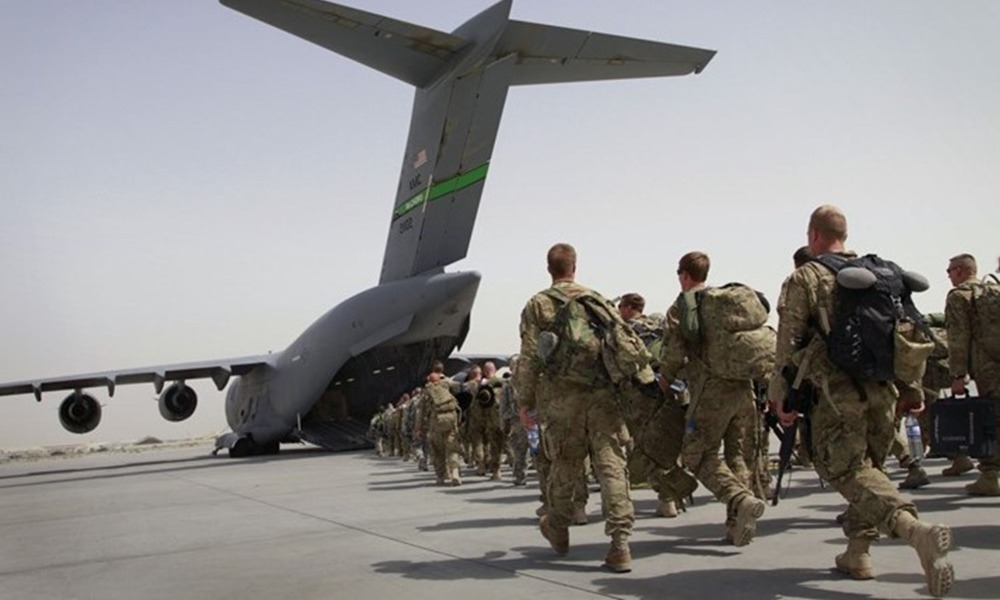
The German government on Wednesday warned US President Donald Trump that his planned drawdown of American troops from Afghanistan risks putting peace and progress in the country in danger.
“Our serious concern is that a premature withdrawal could jeopardize the negotiation process [between the Afghan government and the Taliban], create a security vacuum and jeopardize the progress achieved in Afghanistan,” German foreign ministry spokesperson Christofer Burger told reporters during a briefing in Berlin.
This came after acting US Defense Secretary Christopher Miller said late Tuesday that Washington will reduce its military presence in Afghanistan from around 4,500 troops to 2,500 by January 15.
Since the US ousted the Taliban in Afghanistan in 2001, NATO allies, including Germany, have assisted American military efforts in the country.
The US currently has around 4,500 troops in Afghanistan while NATO has just under 12,000.
In February the US signed a conditions-based withdrawal agreement with the Taliban which paved the way for the start of peace talks between the Afghanistan Republic’s negotiating team and the Taliban.
However, since the start of talks in September – which quickly hit a deadlock – the Taliban has markedly increased violence across the country.
In line with this, Burger told reporters on Wednesday that German Foreign Minister Heiko Maas “has repeatedly acknowledged that it was a great diplomatic achievement, including that of the Trump government, to create the conditions for peace negotiations between the Taliban and the Afghan government to take place.”
He added: “In our view, this peace process is the best way to ensure that a troop withdrawal can take place in such a way that everything that has been achieved in Afghanistan in recent years — in terms of human rights, education, economic development, development opportunities for girls and women as well — is not lost or put at risk. One of the key business principles of this peace process has always been that military withdrawal steps are subject to conditions.”
At the same briefing, German defense ministry spokesperson Arne Collatz-Johannsen acknowledged that the US troop withdrawal also risks having consequences for the over 1,000 German troops that are currently in Afghanistan as part of the Resolute Support mission.
“We are of course trying to find out — also together with our partners and NATO as a whole — what this means in concrete terms for capabilities on the ground, because it is also very clear that the US, as the strongest contributor to the deployment on the ground, has a significant role to play in capabilities that are necessary to sustain the overall [troop presence],” Collatz-Johannsen said.
“Here we assume that the principle — together in, together out, and out at the right time — will be upheld,” he said. “We now have to adjust our planning … to what we are told by the American side.”
On Tuesday, NATO Secretary-General Jens Stoltenberg also warned the Trump administration against a hasty pullout from Afghanistan, saying “the price for leaving too soon or in an uncoordinated way could be very high.”






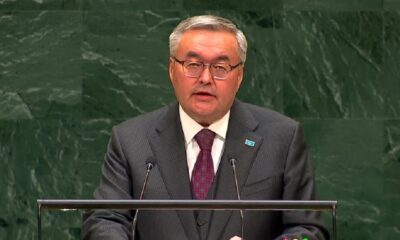




Kazakhstan’s Foreign Minister Mukhtar Tileuberdi has called for pragmatic and coordinated international engagement with Afghanistan, saying the country’s long-term stability is closely linked to the security and sustainable development of Central Asia.
Speaking during the general debate of the 81st session of the United Nations General Assembly in New York on Friday, Tileuberdi said humanitarian assistance to Afghanistan remains essential but alone cannot break the cycle of poverty, displacement and dependency.
He said Kazakhstan supports a “pragmatic, coordinated and step-by-step” approach to international engagement with Afghanistan, with the United Nations playing a central role.
Tileuberdi also said Kazakhstan is working with the UN to operationalize the United Nations Regional Centre for the Sustainable Development Goals for Central Asia and Afghanistan in Almaty.
He said the success of the centre should be measured by the results and assistance it delivers to the region.


Afghanistan Champions League: Omar Zawak Herat beat Toofan Herat 1-0

Blast in Pakistan’s Dera Ismail Khan kills 11, injures 30

Ariana Afghan Airlines increases Kabul-Delhi cargo flights

Khalilzad questions Pakistan’s commitment to Afghan welfare

India, UN envoy discuss Afghanistan’s humanitarian needs

Saudi energy group signs major Afghanistan deals covering gas exploration and pipeline plans

Trump floats idea of renaming Atlantic or Pacific Ocean

US hits Egyptian bank branches with Iran sanctions as war marks six months

Nepal flood rescue mission enters critical phase as thousands remain missing

Iranian clubs to face Gulf opponents at neutral venues in Asian Champions League Elite

Exclusive interview with Abdul Latif Mansoor, Minister of MRRD

Tawsia: Overview of Afghanistan’s iron mines

Tahawol: Discussion on fresh Pakistani airstrikes on Afghanistan

Saar: Calls for international support for Afghanistan discussed

Tahawol: Opening of the 81st UN General Assembly Session
-

 World5 days ago
CNN, MS NOW and Politico sue Trump, challenging White House ban
-

 Latest News3 days ago
Ariana Afghan Airlines ranks seventh among 45 Central Asian airlines
-

 Latest News4 days ago
UN reiterates call for respect for international law after Kunar airstrikes
-
 Latest News5 days ago
Khalilzad condemns Pakistan airstrikes, says current strategy is not working
-

 Regional3 days ago
US and Iran hold first talks since June after Trump’s ‘annihilation’ threat
-

 Latest News3 days ago
Silk Road highway in Wakhan corridor now reaches the China border
-

 Latest News4 days ago
Afghan Official: Pakistan’s airstrikes will not go unanswered
-

 Sport4 days ago
Afghan boxing referee heads to China for international festival