
Latest News
US exit from Bagram Air Base met with mixed reaction

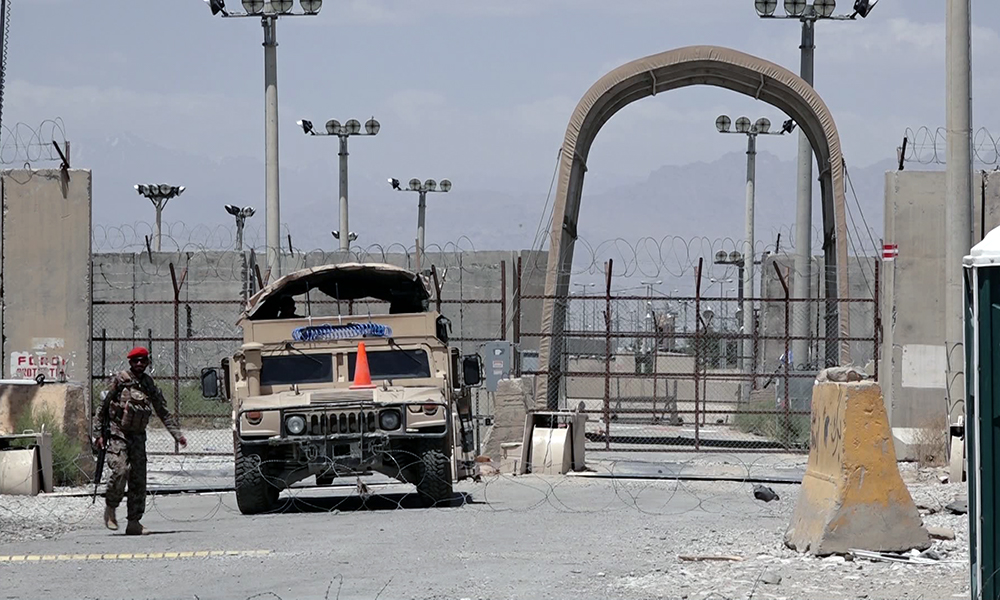
The US is one step closer to completing its troops withdrawal after vacating the sprawling Bagram Airfield base outside Kabul in the early hours of Saturday morning.
Local residents said the last plane carrying US forces flew out at 1am on Saturday adding that the base is now in the hands of the Afghan security forces.
Bagram, has in the past been called the “Guantanamo of Afghanistan” as it served as the main prison facility where US forces jailed alleged terrorists.
While the prison held as many as 3,000 prisoners at any given time in the past, today there is estimated to be between 400 and 500 prisoners, mostly members of the Taliban, in two blocks.
According to some sources, members of Daesh, al-Qaeda and Haqqani network are also imprisoned at Bagram, including some foreigners such as Arabs, Pakistanis, Tajiks and Chinese.
Sources also told Ariana News that soon after the last US plane flew out of the country, locals looted the facility, stealing thousands of dollars worth of equipment that had been left behind.
Angry residents accused the US of entering the country in a cowardly manner and leaving it the same way.
They said despite agreements to stand by the Afghans, they have left the country during a time of turmoil.
“They [Americans] have come cowardly to Afghanistan and cowardly left Afghanistan last night and fled,” said Basharmal, a resident.
“It was one o’clock in the night when their planes left, and after one o’clock everything was calm in the area,” said another.
The massive military base was the largest in the country and had two runways, three large hangars, an air traffic control tower and dozens of support buildings.
While some residents voiced their anger at the US for having withdrawn from the base, others have welcomed their exit.
“The Americans left at night and fled, but why? Because this country belongs to us and we will take care of it,” said Mohammad Hanif, an army soldier.
But government officials have also raised concern over the fate of the base, fearing it might fall into the hands of the Taliban.
“If the Taliban want to take Afghanistan by force, the people will not accept them,” said Dawolat Waziri, the former spokesman for the ministry of defense.
A few meters from the base lies the “American Bazaar” – a local market that sells a wide range of goods. Today, items looted from the base can be found at the bazaar – on sale.
“A number of people looted and sold some equipment,” said Amer Agha, a local resident.
The Wall Street Journal meanwhile reported Saturday that US officials have intensified planning for an emergency evacuation of the American embassy in Kabul amid concern that a worsening security situation could imperil the remaining military and diplomatic corps, as well as other Americans.
According to the WSJ, the preparations are taking place as part of the US withdrawal from Afghanistan, which the Pentagon said Friday would take place by the end of August.
The plan to withdraw by the end of August represents a shift from earlier plans to remove all US forces by as soon as this month, the WSJ reported.
The report also stated that the expanded planning for an embassy evacuation, reflecting an increase in concern that a Taliban offensive could overwhelm US security and Afghan government forces guarding the US Embassy, has not been previously reported.
An evacuation could involve not only hundreds of personnel at the US Embassy but thousands of other Americans in the country, the WSJ stated.
Because of the more pressing concerns in Afghanistan, planners stepped up preparations, contemplating evacuation operations based on scenarios that are more specific, officials familiar with the planning told the WSJ.












Kazakhstan’s Foreign Minister Mukhtar Tileuberdi has called for pragmatic and coordinated international engagement with Afghanistan, saying the country’s long-term stability is closely linked to the security and sustainable development of Central Asia.
Speaking during the general debate of the 81st session of the United Nations General Assembly in New York on Friday, Tileuberdi said humanitarian assistance to Afghanistan remains essential but alone cannot break the cycle of poverty, displacement and dependency.
He said Kazakhstan supports a “pragmatic, coordinated and step-by-step” approach to international engagement with Afghanistan, with the United Nations playing a central role.
Tileuberdi also said Kazakhstan is working with the UN to operationalize the United Nations Regional Centre for the Sustainable Development Goals for Central Asia and Afghanistan in Almaty.
He said the success of the centre should be measured by the results and assistance it delivers to the region.


Abu Muslim Farah defeat Khurasan Faryab 2-0 in ACL season six

Saar: Concerns over Pakistan’s political crisis discussed

Afghanistan Champions League: Omar Zawak Herat beat Toofan Herat 1-0

Blast in Pakistan’s Dera Ismail Khan kills 11, injures 30

Ariana Afghan Airlines increases Kabul-Delhi cargo flights

Saudi energy group signs major Afghanistan deals covering gas exploration and pipeline plans

Trump floats idea of renaming Atlantic or Pacific Ocean

US hits Egyptian bank branches with Iran sanctions as war marks six months

Nepal flood rescue mission enters critical phase as thousands remain missing

Iranian clubs to face Gulf opponents at neutral venues in Asian Champions League Elite
Saar: Concerns over Pakistan’s political crisis discussed

Exclusive interview with Abdul Latif Mansoor, Minister of MRRD

Tawsia: Overview of Afghanistan’s iron mines

Tahawol: Discussion on fresh Pakistani airstrikes on Afghanistan

Saar: Calls for international support for Afghanistan discussed
-

 World5 days ago
CNN, MS NOW and Politico sue Trump, challenging White House ban
-

 Latest News3 days ago
Ariana Afghan Airlines ranks seventh among 45 Central Asian airlines
-

 Latest News4 days ago
UN reiterates call for respect for international law after Kunar airstrikes
-

 Regional3 days ago
US and Iran hold first talks since June after Trump’s ‘annihilation’ threat
-

 Latest News3 days ago
Silk Road highway in Wakhan corridor now reaches the China border
-

 Latest News5 days ago
Afghan Official: Pakistan’s airstrikes will not go unanswered
-
 Regional5 days ago
G7 foreign ministers call on Iran to stop arming Houthis
-

 Regional3 days ago
Iran airlines cancel flights as US sanctions hit