
Latest News
US positioning itself to take on threats and opportunities: Ned Price

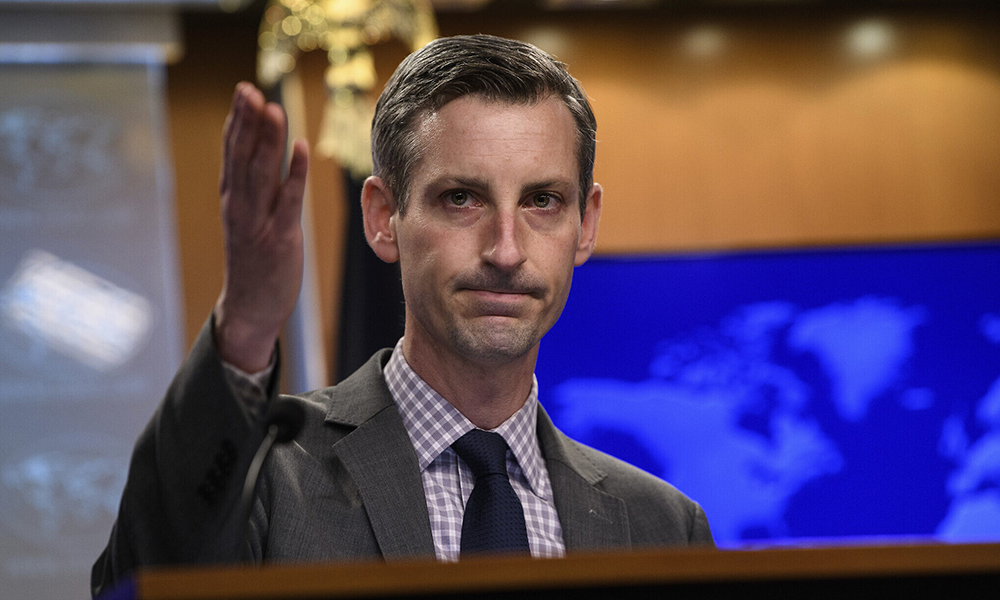
US State Department spokesman Ned Price told reporters Monday he has a “hard time” understanding how the US military’s withdrawal from Afghanistan has emboldened autocratic leaders around the world like Russian President Vladimir Putin.
During a press briefing on Monday about ongoing discussions with Russia, Price was asked whether the Biden administration was aware that “the whole world is watching just like what happened in Afghanistan.”
Price said that ending the war in Afghanistan allowed the U.S. to be more “strategically positioned” to address Russia.
He said: “I have a hard time understanding how it is that putting an end to a 20-year military commitment where the United States spent billions upon billions of dollars every year, where thousands of American troops, at one point tens of thousands of American troops were stationed, where there was a NATO commitment, where thousands of NATO troops were stationed for many years, taking casualties, enduring the loss of life with an open-ended military commitment – were that still to be the case, how [would] we be better strategically positioned to take on what we’re seeing now from the Russian Federation?”
Price also said the US “has not turned its back on Afghanistan.”
“Anyone who would take any lesson from that, other than the fact that the United States is positioning itself to take on the threats and opportunities that we face now while we continue to partner with and support the people of Afghanistan, that would be mistaken analysis.”
Price’s comments come amid increasing tensions between Russia and Ukraine, where the US has repeatedly vowed severe economic sanctions against Russia if it mobilizes against the country.
The United States has heightened the readiness of some 8,500 troops, but no decisions have been made yet to deploy them.
Meanwhile, KT McFarland, deputy national security adviser to former president Donald Trump, told Fox News Digital on Sunday that the chaotic Afghanistan withdrawal “contributed” to what’s now taking place between Ukraine and Russia because it gave other countries the perception that the United States is “chaotic” and “won’t stand up to its adversaries.”
“Whatever happened in Afghanistan had a ripple effect with Ukraine,” McFarland said. “Whatever is going to happen with Ukraine is going to have a ripple effect with China, but it will have a ripple effect with Iran. It’s going to have a ripple effect with North Korea because all of these countries will think they’ll seize the moment. They’ll think this is my time. America’s weak, it’s disorganized.”




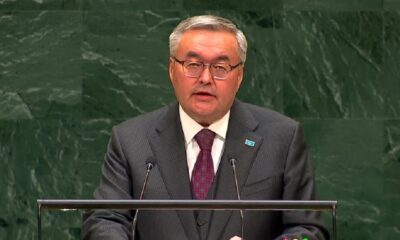




Kazakhstan’s Foreign Minister Mukhtar Tileuberdi has called for pragmatic and coordinated international engagement with Afghanistan, saying the country’s long-term stability is closely linked to the security and sustainable development of Central Asia.
Speaking during the general debate of the 81st session of the United Nations General Assembly in New York on Friday, Tileuberdi said humanitarian assistance to Afghanistan remains essential but alone cannot break the cycle of poverty, displacement and dependency.
He said Kazakhstan supports a “pragmatic, coordinated and step-by-step” approach to international engagement with Afghanistan, with the United Nations playing a central role.
Tileuberdi also said Kazakhstan is working with the UN to operationalize the United Nations Regional Centre for the Sustainable Development Goals for Central Asia and Afghanistan in Almaty.
He said the success of the centre should be measured by the results and assistance it delivers to the region.


Ariana Afghan Airlines increases Kabul-Delhi cargo flights

Khalilzad questions Pakistan’s commitment to Afghan welfare

India, UN envoy discuss Afghanistan’s humanitarian needs

Kazakhstan calls for coordinated international engagement with Afghanistan

Pakistan PM, UN chief discuss Afghanistan amid rising Kabul-Islamabad tensions

Saudi energy group signs major Afghanistan deals covering gas exploration and pipeline plans

Trump floats idea of renaming Atlantic or Pacific Ocean

US hits Egyptian bank branches with Iran sanctions as war marks six months

Nepal flood rescue mission enters critical phase as thousands remain missing

Iranian clubs to face Gulf opponents at neutral venues in Asian Champions League Elite

Exclusive interview with Abdul Latif Mansoor, Minister of MRRD

Tawsia: Overview of Afghanistan’s iron mines

Tahawol: Discussion on fresh Pakistani airstrikes on Afghanistan

Saar: Calls for international support for Afghanistan discussed

Tahawol: Opening of the 81st UN General Assembly Session
-

 World4 days ago
CNN, MS NOW and Politico sue Trump, challenging White House ban
-

 Latest News3 days ago
Ariana Afghan Airlines ranks seventh among 45 Central Asian airlines
-

 Latest News4 days ago
UN reiterates call for respect for international law after Kunar airstrikes
-
 Latest News5 days ago
Khalilzad condemns Pakistan airstrikes, says current strategy is not working
-

 Regional3 days ago
US and Iran hold first talks since June after Trump’s ‘annihilation’ threat
-

 Latest News3 days ago
Silk Road highway in Wakhan corridor now reaches the China border
-

 Latest News4 days ago
Afghan Official: Pakistan’s airstrikes will not go unanswered
-

 Regional4 days ago
G7 foreign ministers call on Iran to stop arming Houthis