
Latest News
Afghanistan, Pakistan agree on shared vision for peace and stability

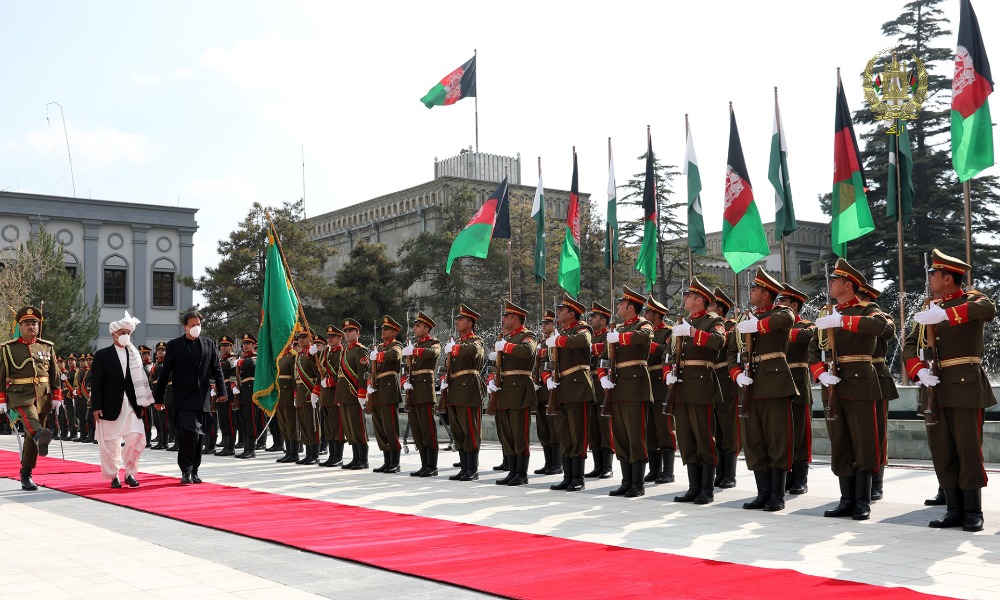
Pakistan’s Prime Minister Imran Khan on Thursday arrived on a day-long visit to Afghanistan where he met top Afghan government officials including President Ashraf Ghani.
According to Presidential Place the two side discussed a number of important issues pertaining to the Afghan peace process, bilateral relations and cooperation between the nations on mutual interest.
The Afghan Ministry of Foreign issued a statement on Thursday evening, saying the two countries have agreed on a shared vision to support peace and stability in both countries and the wider region.
“During the visit, an agreement was reached on Shared Vision to Support Peace and Stability in both countries and in the wider region.’ The document is highly important and the basic principles of the document are about cooperation between the two countries, cooperation in the field of peace, security and economic development,” the ministry statement said.
The document states that both parties welcomed the start of the Afghan peace process in Doha on 12 September 2020 and hoped that the talks will bring lasting peace and tranquility to the Islamic Republic of Afghanistan.
“They affirm their intention that both countries should look towards a future relationship built on trust, aiming to achieve tangible outcomes from that relationship. They note that closer and fraternal relations between the Islamic Republic of Afghanistan and the Islamic Republic of Pakistan would be beneficial, desirable and achievable, as indeed they had been in the decades before the latest conflict in Afghanistan,” the document says.
Afghanistan and Pakistan agreed that a shared vision for Afghanistan and Pakistan should comprise the following core elements:
1. High Ranking Representatives of Islamic Republic of Afghanistan and Islamic Republic of Pakistan met on 30 September 2020 and agreed upon the fundamental principle that Islamic Republic of Afghanistan and Islamic Republic of Pakistan should determine a new shared vision to help each other in furtherance of peace and stability in both their countries as well as the wider region.
2. They welcomed the start of Afghanistan Peace Process in Doha on 12 September 2020 and hoped that the talks will bring lasting peace and tranquility in Islamic Republic of Afghanistan. Talks have provided a unique opportunity to Afghans to decide their future without interference.
3. They affirm their intention that both countries should look towards a future relationship built on trust, aiming to achieve tangible outcomes from that relationship. They note that closer and fraternal relations between Islamic Republic of Afghanistan and Islamic Republic of Pakistan would be beneficial, desirable and achievable, as indeed they had been in the decades before the latest conflict in Afghanistan.
4. They agree, a shared vision for Afghanistan and Pakistan should comprise the following core elements:
a. That the Islamic Republic of Afghanistan and the Islamic Republic of Pakistan should enjoy a special relationship, founded on predictability, transparency, mutual and full respect for one another’s sovereignty, and on expanding and furthering their mutual interests through State-to-State mechanisms. That the mutually agreed cooperation framework under APAPPS provides a comprehensive, multi-sectoral mechanism for optimizing bilateral cooperation.
b. That the Islamic Republic of Afghanistan’s posture of “multi alignment” with other countries, pursuing a number of friendly relationships, presents a real opportunity for the two countries to exploit and conversely presents no threat.
c. That neither country could achieve lasting peace and stability without peace and stability in the other. Lasting peace implies peace-making which is wholly inclusive, encompasses the whole nation, and respects a democratic constitutional order in which rights of women and men remain inalienable and protected.
d. That neither country’s territory should be used for malicious purposes against the other’s territory, and that both countries should work together to identify and tackle enemies of peace, irreconcilables and those who undermine the peace process.
e. That the two countries should further their links and connections in a number of different ways, including through people to people contacts, business to business, government to government and, of particular note, security to security ties.
f. That regional connectivity should be broadened and deepened, with an emphasis on trade, free movement of people, goods and services, opening of trade and customs posts, and transport and energy infrastructure development, aiming for regional development dividends greater than what each country might expect to achieve alone.
g. That expeditious resolution of the refugee situation, i.e. the safe, time-bound and dignified return of refugees, would help the two countries address the humanitarian and socio-economic challenges associated with population displacement. Refugee returns would require resourcing, including donor support from the widest and the most inclusive possible donor community.
Part – 2
Implementation and Next Steps
1. The representatives of the Islamic Republic of Afghanistan and the Islamic Republic of Pakistan agree that timely progress to meet this vision would require close coordination, a structured dialogue, and willingness to take difficult and courageous decisions. They agree the need for urgency in their approach, with progress needed by the beginning of December 2020. Confirming commitments made on previous occasions, they agree to take rapid action on three main strands of activity, including identifying lead officials to take forward each activity:
a. By 15 December 2020: Re-energizing joint intelligence services-led work on analyzing, mapping and cooperating against enemies of peace and those undermining the peace process.
b. By 1st January 2021: A joint proposal for refugees return, elevating and intensifying treatment of this issue, to the point where credible and progressive action can start to be taken.
c. By 1st January 2021: A joint proposal to further regional connectivity, in a way which strengthens both Afghanistan and Pakistan, but also the wider region.
2. On Next Steps:
a. That the government leaders of the two countries will visit each other’s capital alternately to keep the momentum going. This initiative has commenced with the visit of the Honourable Prime Minister of the Islamic Republic of Pakistan to Kabul.
b. President Ghani would plan a reciprocal visit to Islamabad in the first quarter of 2021.
c. That the Islamic Republic of Afghanistan will share with the Islamic Republic of Pakistan summary of the key issues that are being discussed during the Afghanistan Peace Process.
3. Both sides agreed to keep this shared vision, its commitments, and previous commitments under regular review, to ensure measurable, clear and irreversible steps towards furthering closer and more productive relations between their two countries.










Kazakhstan’s Foreign Minister Mukhtar Tileuberdi has called for pragmatic and coordinated international engagement with Afghanistan, saying the country’s long-term stability is closely linked to the security and sustainable development of Central Asia.
Speaking during the general debate of the 81st session of the United Nations General Assembly in New York on Friday, Tileuberdi said humanitarian assistance to Afghanistan remains essential but alone cannot break the cycle of poverty, displacement and dependency.
He said Kazakhstan supports a “pragmatic, coordinated and step-by-step” approach to international engagement with Afghanistan, with the United Nations playing a central role.
Tileuberdi also said Kazakhstan is working with the UN to operationalize the United Nations Regional Centre for the Sustainable Development Goals for Central Asia and Afghanistan in Almaty.
He said the success of the centre should be measured by the results and assistance it delivers to the region.


Saar: Concerns over Pakistan’s political crisis discussed

Afghanistan Champions League: Omar Zawak Herat beat Toofan Herat 1-0

Blast in Pakistan’s Dera Ismail Khan kills 11, injures 30

Ariana Afghan Airlines increases Kabul-Delhi cargo flights

Khalilzad questions Pakistan’s commitment to Afghan welfare

Saudi energy group signs major Afghanistan deals covering gas exploration and pipeline plans

Trump floats idea of renaming Atlantic or Pacific Ocean

US hits Egyptian bank branches with Iran sanctions as war marks six months

Nepal flood rescue mission enters critical phase as thousands remain missing

Iranian clubs to face Gulf opponents at neutral venues in Asian Champions League Elite
Saar: Concerns over Pakistan’s political crisis discussed

Exclusive interview with Abdul Latif Mansoor, Minister of MRRD

Tawsia: Overview of Afghanistan’s iron mines

Tahawol: Discussion on fresh Pakistani airstrikes on Afghanistan

Saar: Calls for international support for Afghanistan discussed
-

 World5 days ago
CNN, MS NOW and Politico sue Trump, challenging White House ban
-

 Latest News3 days ago
Ariana Afghan Airlines ranks seventh among 45 Central Asian airlines
-

 Latest News4 days ago
UN reiterates call for respect for international law after Kunar airstrikes
-

 Regional3 days ago
US and Iran hold first talks since June after Trump’s ‘annihilation’ threat
-

 Latest News3 days ago
Silk Road highway in Wakhan corridor now reaches the China border
-

 Latest News4 days ago
Afghan Official: Pakistan’s airstrikes will not go unanswered
-
 Regional4 days ago
G7 foreign ministers call on Iran to stop arming Houthis
-

 Sport4 days ago
Afghan boxing referee heads to China for international festival