
Latest News
AGO says over 1,800 corruption cases tackled this solar year


Officials from the Attorney General’s Office (AGO) say they have registered and processed more than 1,800 corruption cases in the current solar year.
The AGOl says that among these cases, 278 have been registered with the Judicial and Anti-Corruption Center and 1,122 others were registered with provincial prosecutors’ offices.
Speaking at a press conference on Wednesday Jamshid Rasouly the spokesman for the AGO said out of 278 corruption cases, 63 were related to the defense and security sector.
“During the fiscal year 1399, the Attorney General of the country has addressed 1,803 cases of corruption,” Rasouly said.
Rasouly said that these cases were recorded across the board including among employees from the health, security and defense sectors, municipalities, economy, rural development, social affairs, provincial supervisors, disaster management department, Da Breshna company, Statistics and Information Department, education, legal employees of the Ministry of Justice, customs, Higher education, agriculture and livestock, national council and provincial councils.
“Of the 278 corruption cases that were addressed, 215 were related to the cases of individuals and civil institutions and another 63 were related to individuals in the security and defense sectors.” Rasouly said.
But a number of experts believe that the Attorney General’s Office has not been able to deal independently with corruption cases in recent years.
Rasouly said however that in many instances the investigations are time consuming – especially those involving procurement contracts which involve bribery and embezzlement.
Meanwhile, findings by the Herat Trust Network and Transparency International Afghanistan indicate that unnamed Herat provincial officials have allegedly committed widespread fraud in the procurement process of goods needed to fight the coronavirus pandemic in the country.
According to a probe by the two organizations, more than two million Afghanis worth of medical equipment has gone missing in Herat province.
A document, seen by Ariana News, shows prices paid for goods was considerably higher than what the actual market value was.
Local officials rejected the claims.
But as stated in the document, 10 items of medical supplies worth 1,881,450 AFN were sent to the Corona Hospital in Shaidaie area. These items were never delivered to the hospital, the document revealed.
The same problem was identified with another 17 medical items, worth 138,960 AFN, which were purchased for Covid Hospital No. 2 in Herat. Again, the documents seen by Ariana News point to these purchases never having reached the actual hospital.
Instead, according to Decree No. 60 of the Herat Governor, 10 x 32-inch TVs and an 85-inch TV with desks, receivers and other accessories, including 10 antennas and 100 meters of cable were ordered.
The document stated: “In addition, 10 computers, including eight desktops and two laptops, a camera, a camera and video lens, and some other items were purchased using the coronavirus budget, at the suggestion of local officials and with the approval of the governor of Herat.”
However, Zmari Hassan, from the provincial public health department, said these items were sent to patient contact centers for doctors/
He also said the purchase orders had not been run through the procurement process as staff had been “very busy”.
In September last year, the Office of the Inspector General (OIG) introduced the former governors of Herat and Nuristan and the current governors of Maidan Wardak and Badakhshan provinces to the prosecutor’s office on suspicion of mismanagement of the coronavirus budget.
But Rasouly said at the time: “Many of the embezzlement cases regarding the coronavirus budget which was shared by OIG or the intelligence services, have been finalized and forwarded to court, both in the capital and around the province. Other cases are under investigation and once these have been finalized the cases will be sent to court.”
Nearly a month ago, nine local officials and a member of the Herat Provincial Council were reported to the prosecutor’s office on charges of corruption and misuse of the coronavirus budget.







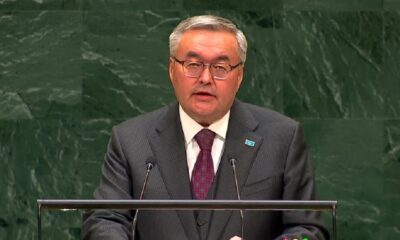




Kazakhstan’s Foreign Minister Mukhtar Tileuberdi has called for pragmatic and coordinated international engagement with Afghanistan, saying the country’s long-term stability is closely linked to the security and sustainable development of Central Asia.
Speaking during the general debate of the 81st session of the United Nations General Assembly in New York on Friday, Tileuberdi said humanitarian assistance to Afghanistan remains essential but alone cannot break the cycle of poverty, displacement and dependency.
He said Kazakhstan supports a “pragmatic, coordinated and step-by-step” approach to international engagement with Afghanistan, with the United Nations playing a central role.
Tileuberdi also said Kazakhstan is working with the UN to operationalize the United Nations Regional Centre for the Sustainable Development Goals for Central Asia and Afghanistan in Almaty.
He said the success of the centre should be measured by the results and assistance it delivers to the region.


Saar: Concerns over Pakistan’s political crisis discussed

Afghanistan Champions League: Omar Zawak Herat beat Toofan Herat 1-0

Blast in Pakistan’s Dera Ismail Khan kills 11, injures 30

Ariana Afghan Airlines increases Kabul-Delhi cargo flights

Khalilzad questions Pakistan’s commitment to Afghan welfare

Saudi energy group signs major Afghanistan deals covering gas exploration and pipeline plans

Trump floats idea of renaming Atlantic or Pacific Ocean

US hits Egyptian bank branches with Iran sanctions as war marks six months

Nepal flood rescue mission enters critical phase as thousands remain missing

Iranian clubs to face Gulf opponents at neutral venues in Asian Champions League Elite
Saar: Concerns over Pakistan’s political crisis discussed

Exclusive interview with Abdul Latif Mansoor, Minister of MRRD

Tawsia: Overview of Afghanistan’s iron mines

Tahawol: Discussion on fresh Pakistani airstrikes on Afghanistan

Saar: Calls for international support for Afghanistan discussed
-

 World5 days ago
CNN, MS NOW and Politico sue Trump, challenging White House ban
-

 Latest News3 days ago
Ariana Afghan Airlines ranks seventh among 45 Central Asian airlines
-

 Latest News4 days ago
UN reiterates call for respect for international law after Kunar airstrikes
-
 Latest News5 days ago
Khalilzad condemns Pakistan airstrikes, says current strategy is not working
-

 Regional3 days ago
US and Iran hold first talks since June after Trump’s ‘annihilation’ threat
-

 Latest News3 days ago
Silk Road highway in Wakhan corridor now reaches the China border
-

 Latest News4 days ago
Afghan Official: Pakistan’s airstrikes will not go unanswered
-

 Sport4 days ago
Afghan boxing referee heads to China for international festival