
Climate Change
G7 meets for climate talks, faces pressure on fossil fuels

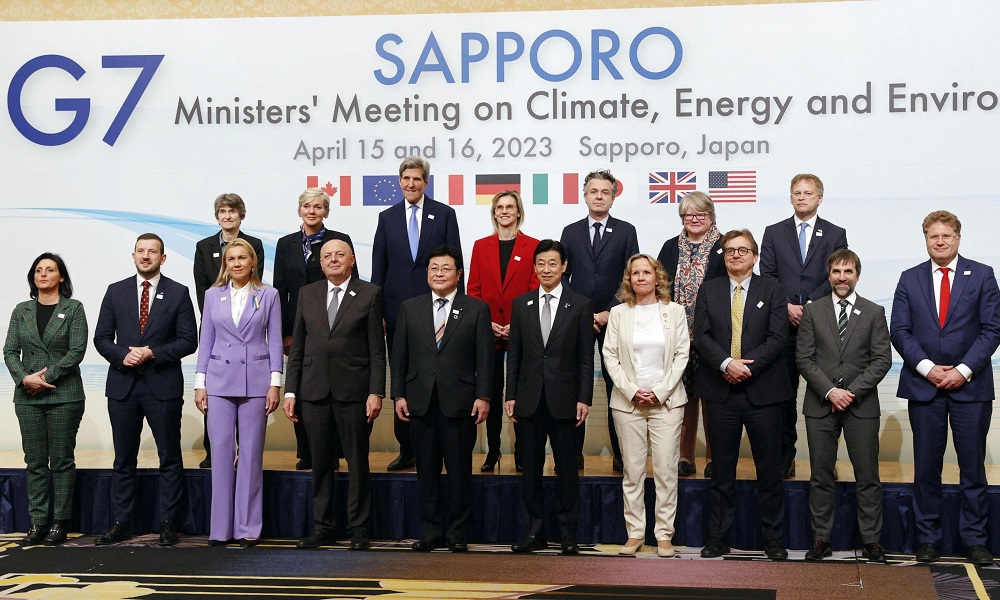
G7 allies met Saturday for two days of “difficult” climate talks in northern Japan, facing pressure to show progress on key fossil fuel commitments in an example to other major economies including China.
Campaigners have warned climate and environment ministers from the leading developed countries against backsliding on pledges to shift away from coal and natural gas at home and abroad, AFP reported.
But a leaked third draft of a statement to be issued on Sunday at the meeting in Sapporo has relieved some experts, who had feared a more ringing endorsement of the need for overseas gas investments.
“All in, given low expectations, it now seems a better outcome than many expected,” said Ed King from the climate-oriented communications firm GSCC.
The ministers want to show unity after a major United Nations climate report warned last month that 1.5 degrees Celsius of global warming would be seen in about a decade. It called for “rapid and far-reaching” action to keep increases within relatively safe limits.
However, as the energy crisis sparked by the Ukraine war squeezes G7 countries including Japan, Germany and the United States, divisions have arisen among the bloc.
A French government source earlier described “difficult” discussions, but the country’s energy transition minister Agnes Pannier-Runacher painted a brighter picture of Saturday’s talks.
She hailed “significant progress” in the joint statement, which she said sent “positive signals for the upcoming G20 and the upcoming COP” in Delhi and Dubai.
“For the first time ever, the G7 said that we must accelerate the ‘phasing out’ of all unabated fossil fuels,” and that there should be no more new coal-fired power plants, Pannier-Runacher told reporters.
‘Critical decade’
The latest draft statement, seen AFP calls on nations to take action “in this critical decade,” urging a peak in global greenhouse emissions by 2025 at the latest.
Experts say this language is aimed at China, the world’s largest carbon emitter, which is targeting a peak in its carbon emissions by 2030.
The draft also stresses the “urgency” of slashing global emissions by 60% by 2035 from 2019 levels, as recommended by the U.N.’s IPCC panel of climate experts.
Language on fossil fuels has been more contentious, however.
Britain and France proposed new concrete targets, while other members including this year’s G7 president Japan, which is heavily dependent on imported fossil fuels, and the United States have pushed a more conservative line.
Ministers pledged at the last G7 climate ministerial in Germany to end new direct public support in 2022 for overseas fossil fuel projects that do not offset emissions.
But this was watered down a month later when G7 leaders said the “exceptional circumstances” of Russia’s war in Ukraine made gas investments “appropriate as a temporary response.”
Japan had sought language to solidify that exception, but instead the draft statement calls for “gas demand reduction” and sets multiple parameters around such investments, AFP reported.
Hydrogen controversy
Coal is another hotly debated topic, with different degrees of ambition put forward by Japan, the United States and Britain on global efforts to phase out fossil fuels in electricity systems.
Japan had sought G7 recognition for its controversial strategy of burning hydrogen and ammonia alongside fossil fuels to reduce carbon emissions – which climate activists say only serves to extend the lifespan of polluting plants.
The draft statement simply notes that “some countries are exploring” the potential of the two fuels in the journey to net-zero emissions, adding that this should be “aligned with a 1.5C pathway.”







Japan and the UN Office for Project Services (UNOPS) have signed a $9.4 million grant agreement aimed at strengthening climate adaptation and disaster preparedness in Afghanistan.
The agreement, valued at 1.474 billion Japanese yen ($9.4 million) was signed by UNOPS Afghanistan Country Director Katy Ann Webley and Japan International Cooperation Agency (JICA) Afghanistan Chief Representative Sota Tosaka.
The project will be implemented in Kabul province and focuses on improving the capacity of local communities to cope with climate-related disasters.
Using a community-led approach, the programme will support the construction of infrastructure designed to reduce the impact of floods, droughts and other climate risks, alongside training to improve emergency preparedness and response.
Over the next 24 months, UNOPS will carry out activities aimed at enhancing climate risk awareness, strengthening local resilience and protecting livelihoods vulnerable to the effects of climate change.
Climate Change
Winter storm disrupts US travel, triggers thousands of flight cancellations
The disruptions followed a chaotic Sunday, when about 11,000 flights were scrapped—the highest daily total since the COVID-19 pandemic
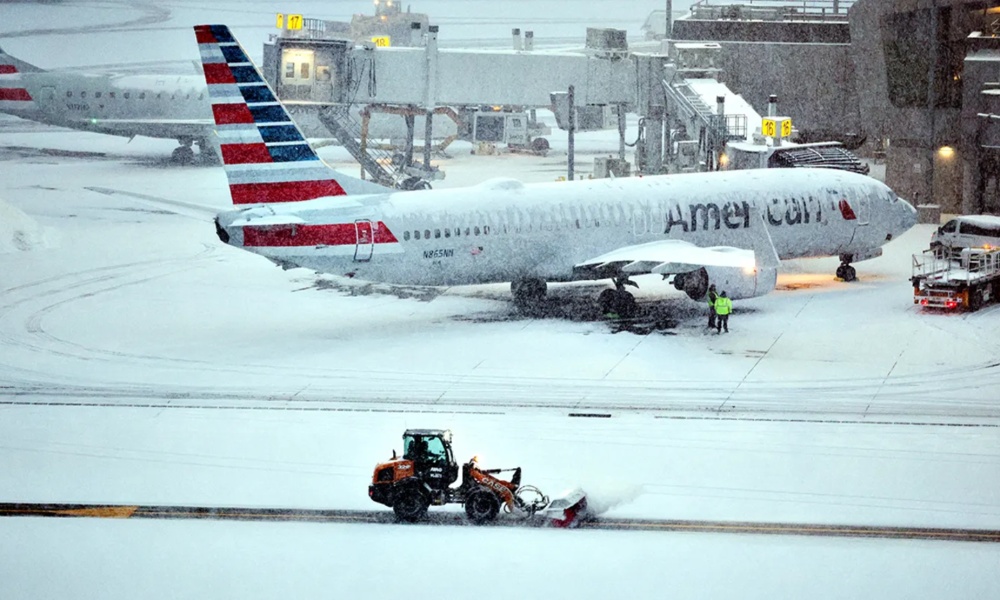
A powerful winter storm sweeping across the United States brought air travel to a near standstill on Monday, forcing airlines to cancel and delay thousands of flights as freezing rain and heavy snowfall battered large parts of the country.
By late afternoon, nearly 19% of scheduled flights had been canceled, according to aviation analytics firm Cirium. Separate data from FlightAware showed around 5,220 U.S. flights were canceled and more than 6,500 delayed by early evening.
The disruptions followed a chaotic Sunday, when about 11,000 flights were scrapped—the highest daily total since the COVID-19 pandemic, Cirium said.
The massive storm dumped up to a foot of snow from New Mexico to New England, paralyzing much of the eastern United States and contributing to at least 18 deaths. Extreme cold is expected to linger in some areas through the week.
American Airlines accounted for the largest share of disruptions on Monday, canceling nearly 1,180 flights and delaying about 1,130, followed by Republic Airways, JetBlue Airways, and Delta Air Lines.
In an advisory, the Federal Aviation Administration (FAA) warned that snow, freezing rain, and low visibility were affecting major hubs, including Boston and the New York metropolitan area. Boston Logan International Airport recorded the highest cancellation rate at 71%, according to Cirium.
American Airlines said the storm disrupted operations at five of its nine hub airports, including its largest base at Dallas–Fort Worth, where freezing temperatures and ice grounded flights.
The carrier requested FAA-approved ground stops for all its flights at Dallas–Fort Worth and Ronald Reagan Washington National Airport to manage gate capacity constraints.
The airline said teams were working around the clock to restore operations, as frustrated passengers flooded social media with requests for updates and assistance.
United Airlines said it had begun restoring flights, with cancellations dropping sharply from 1,019 on Sunday to 320 by Monday evening, FlightAware data showed.
The storm is on track to become the costliest severe weather event since the Los Angeles-area wildfires in early 2025, with preliminary damage and economic losses estimated between $105 billion and $115 billion, according to AccuWeather.
Airline operations remain vulnerable due to the interconnected nature of flight schedules, where cancellations can leave aircraft and crews out of position, slowing recovery efforts. Already, about 285 flights scheduled for Tuesday have been canceled, FlightAware data showed.
Climate Change
FAO warns of dry winter, low snowfall and rising food insecurity risks in Afghanistan
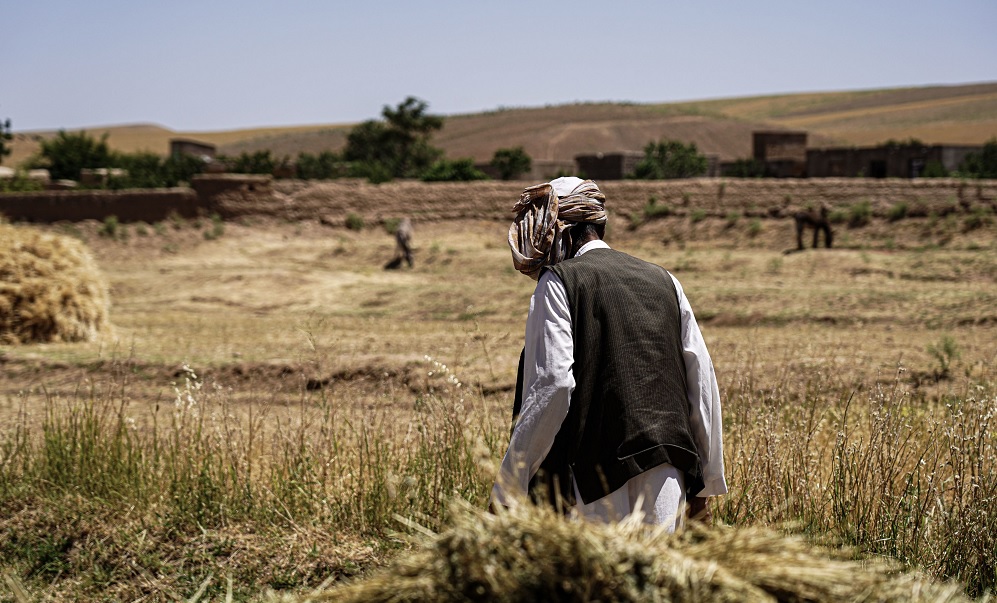
The Food and Agriculture Organization of the United Nations (FAO) has warned that Afghanistan is likely to face a drier and warmer-than-average winter, raising serious concerns about water availability, agricultural production and food security.
In its Seasonal Climate Outlook for December 2025 to February 2026, FAO said a weak La Niña pattern is driving below-average precipitation and above-average temperatures across most parts of the country. The report notes that the 2025/26 wet season has already begun drier and warmer than normal, with widespread soil moisture deficits persisting for another consecutive year
According to FAO, snow accumulation remains exceptionally low, with snow-water-equivalent levels at their lowest point in the past 25 years. This poses a critical hydrological risk, particularly for irrigated wheat-growing areas that depend on snowmelt-fed river systems. Even if precipitation improves later in winter, early deficits are unlikely to be fully offset, the report said
The outlook projects that December, January and February will all carry an elevated risk of below-normal rainfall, especially in northern, northeastern, western and central highland regions. Warmer daytime temperatures combined with cold nights are also expected to increase stress on crops, livestock and vulnerable communities
FAO warned that continued dryness could delay planting and weaken crop establishment for rain-fed winter wheat and barley, potentially reducing yields for the 2026 harvest. In irrigated areas, low snowpack threatens spring water supplies, increasing competition for water and reliance on already stressed groundwater resources.
Rangeland and pasture conditions are also expected to deteriorate, with delayed green-up likely to force herders to depend longer on stored fodder. This could lead to declining livestock health, reduced milk production and increased risk of animal losses toward late winter and early spring, the report said.
FAO and partner assessments caution that consecutive seasons of insufficient rainfall and high temperatures have already weakened agricultural systems and could leave millions of people facing acute food insecurity between late 2025 and early 2026
The UN agency emphasized the need for close monitoring of precipitation, snowpack and crop conditions, calling for timely agricultural support, improved water management and early anticipatory action to mitigate the impacts of the unfolding climate risks.


Afghanistan highlights water diplomacy at Tashkent ministerial forum

Russia sought to blackmail US using intelligence to Iran, Zelenskiy says

Trump to hit Iran harder if Tehran does not accept defeat, White House says

Tahawol: Efforts to release Mohammad Rahim from Guantanamo Bay Detention Camp

UN experts call for lasting ceasefire as Afghan–Pakistan violence escalates

Pakistani military jet downed in Afghanistan’s Jalalabad, pilot captured alive

Afghan Air Force conducts airstrikes in Islamabad, other cities

Prominent Muslim scholar issues fatwa calling for Afghanistan-Pakistan ceasefire

Afghan air force strikes key Pakistani military installations in retaliatory operation

IEA: Special circle in Pakistan has launched mission to destabilize region
Tahawol: Efforts to release Mohammad Rahim from Guantanamo Bay Detention Camp

Saar: End of ceasefire between Afghanistan-Pakistan reviewed

Tahawol: Escalating threats between Iran-US discussed

Tahawol: Possibility of US ground forces entering Iran war discussed

Saar: Using US prisoners as political pressure
-
 Latest News4 days ago
Deadly violence likely without dialogue between Afghanistan and Pakistan: ICG
-

 Latest News3 days ago
Pakistan seeks Russian mediation to resolve Afghanistan tensions
-

 International Sports4 days ago
FIFA World Cup 2026: Play-Off Tournament takes centre stage
-

 Sport4 days ago
Afghanistan secures third place at 2026 World Kokpar Championship
-

 Business4 days ago
Afghani strengthens nearly 10% against US dollar amid banking sector reforms
-
 Latest News3 days ago
World must re-engage to prevent all-out Afghanistan-Pakistan war: Financial Times
-
 Regional5 days ago
Trump says US considering ‘winding down’ Iran war
-
 Latest News5 days ago
Afghanistan again ranked last in global happiness index