
Regional
Putin arrives in China to deepen strategic partnership with Xi

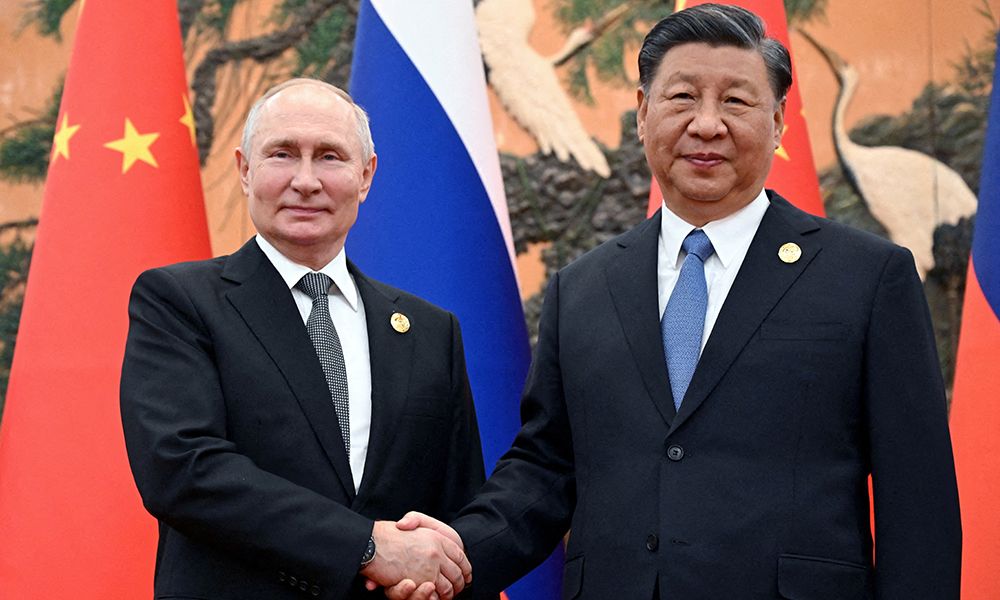
Russian President Vladimir Putin arrived in Beijing early on Thursday for talks with Xi Jinping that the Kremlin hopes will deepen a strategic partnership between the two most powerful geopolitical rivals of the United States, Reuters reported.
China and Russia declared a “no limits” partnership in February 2022 when Putin visited Beijing just days before he sent tens of thousands of troops into Ukraine, triggering the deadliest land war in Europe since World War Two.
By picking China for his first foreign trip since being sworn in for a six-year term that will keep him in power until at least 2030, Putin is sending a message to the world about his priorities and the depth of his personal relationship with Xi.
In an interview with China’s Xinhua news agency, Putin praised Xi for helping to build a “strategic partnership” with Russia based on national interests and deep mutual trust.
“It was the unprecedentedly high level of the strategic partnership between our countries that determined my choice of China as the first state that I would visit after officially taking office as president of the Russian Federation,” Putin said.
“We will try to establish closer cooperation in the field of industry and high technology, space and peaceful nuclear energy, artificial intelligence, renewable energy sources and other innovative sectors,” Putin said.
Putin, 71, and Xi, 70, will take part in a gala evening celebrating 75 years since the Soviet Union recognised the People’s Republic of China, which was declared by Mao Zedong in 1949, read the report.
Xinhua confirmed his arrival for what China’s state press has described as a state visit from an “old friend”.
Putin’s arrival and visit is the top trending item on the Chinese social media platform Weibo, with 1.4 million search requests amid a stream of images, videos and comments.
The United States casts China as its biggest competitor and Russia as its biggest nation-state threat while U.S. President Joe Biden argues that this century will be defined by an existential contest between democracies and autocracies.
Putin and Xi share a broad world view, which sees the West as decadent and in decline just as China challenges U.S. supremacy in everything from quantum computing and synthetic biology to espionage and hard military power.
Putin will also visit Harbin in northeastern China, a city with historic ties to Russia. A mall devoted to Russian-made goods representing some 80 Russian manufacturers opened on Thursday, the China Daily reported.
XI AND PUTIN
China has strengthened its trade and military ties with Russia in recent years as the United States and its allies imposed sanctions against both countries, particularly against Moscow for the invasion of Ukraine, Reuters reported.
The West says China has played a crucial role in helping Russia withstand the sanctions and has supplied key technology which Russia has used on the battlefield in Ukraine.
But China, once the junior partner of Moscow in the global Communist hierarchy, remains by far the most powerful of Russia’s friends in the world.
Putin’s arrival follows a mission to Beijing late last month by U.S. Secretary of State Antony Blinken, in part to warn China’s top diplomat Wang Yi against deepening military support for Russia.
Kremlin foreign policy aide Yuri Ushakov said that the two leaders would hold informal talks on Thursday evening over tea and that they would touch on Ukraine, Asia, energy and trade.
Putin’s newly appointed defence minister, Andrei Belousov, as well as Foreign Minister Sergei Lavrov, Security Council Secretary Sergei Shoigu and foreign policy adviser Yuri Ushakov, will also attend, along with Russia’s most powerful CEOs.
It was not immediately clear if Gazprom (GAZP.MM), opens new tab CEO Alexei Miller would go to China as he was on a working visit to Iran on Wednesday, Reuters reported.



Regional
Pakistan to host talks with Saudi Arabia, Turkey, Egypt amid Iran war diplomacy
Turkish Foreign Minister Hakan Fidan said the meeting would seek to establish a mechanism aimed at de-escalation.
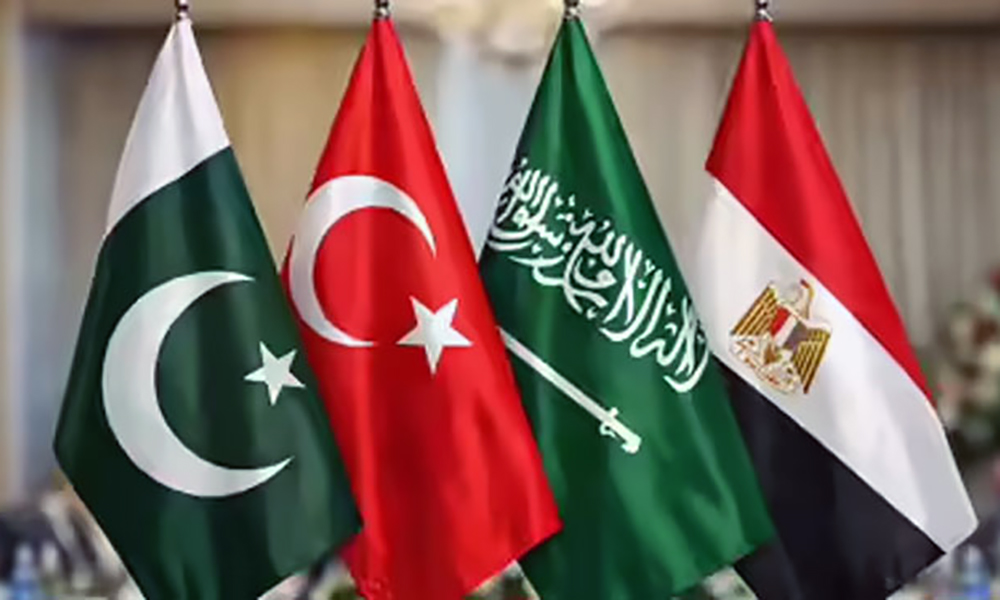
Pakistan will host Saudi Arabia, Turkey and Egypt for talks from Sunday on the Iran war as Islamabad positions itself as a potential venue for U.S.-Iran negotiations on the month-old conflict, Reuters reported.
The four countries’ foreign ministers will hold “in-depth discussions on a range of issues, including efforts to de-escalate tensions in the region” during the two-day talks, Pakistan’s foreign ministry said in a statement on Saturday.
Turkish Foreign Minister Hakan Fidan said the meeting would seek to establish a mechanism aimed at de-escalation.
“We would discuss where the negotiations in this war are heading and how these four countries assess the situation and what can be done,” he told broadcaster A Haber late on Friday.
The four nations have been involved in trying to mediate between Washington and Tehran in the war launched by the U.S. and Israel on February 28, and all are acutely vulnerable to threats to energy supplies and trade routes.
Pakistan has conveyed to Tehran a U.S. proposal for ending the war and offered to host talks, with Iranian officials indicating any negotiations could take place in Pakistan or Turkey.
U.S. President Donald Trump has said talks with Iran were going “very well,” but Tehran denies talking with Washington.
Iran has been reviewing the 15-point U.S. proposal, although one official has dismissed it as “one-sided and unfair”. Its demands range from dismantling Iran’s nuclear programme to curbing its missile development and effectively handing over control of the Strait of Hormuz, according to sources and reports.
Turkey’s Fidan told an Istanbul conference on Saturday that the world’s new “polycentric system” requires a solution to guarding vital energy and trade routes. He said Turkey’s high-level dialogue aims to swiftly chart out “actionable steps” to end the war before there is further destruction to the region and global economy.
Regional
Twelve US troops wounded in Iran strike on base in Saudi Arabia, US official says
Earlier on Friday, the U.S. military said 273 of them had already returned to duty. Thirteen U.S. troops have been killed in the conflict.

Twelve U.S. troops were wounded, two of them seriously, in an Iranian military strike on Prince Sultan Air Base in Saudi Arabia, a U.S. official told Reuters on Friday.
The latest casualties add to the more than 300 U.S. military service members who have been wounded since the war against Iran started on February 28.
Earlier on Friday, the U.S. military said 273 of them had already returned to duty. Thirteen U.S. troops have been killed in the conflict.
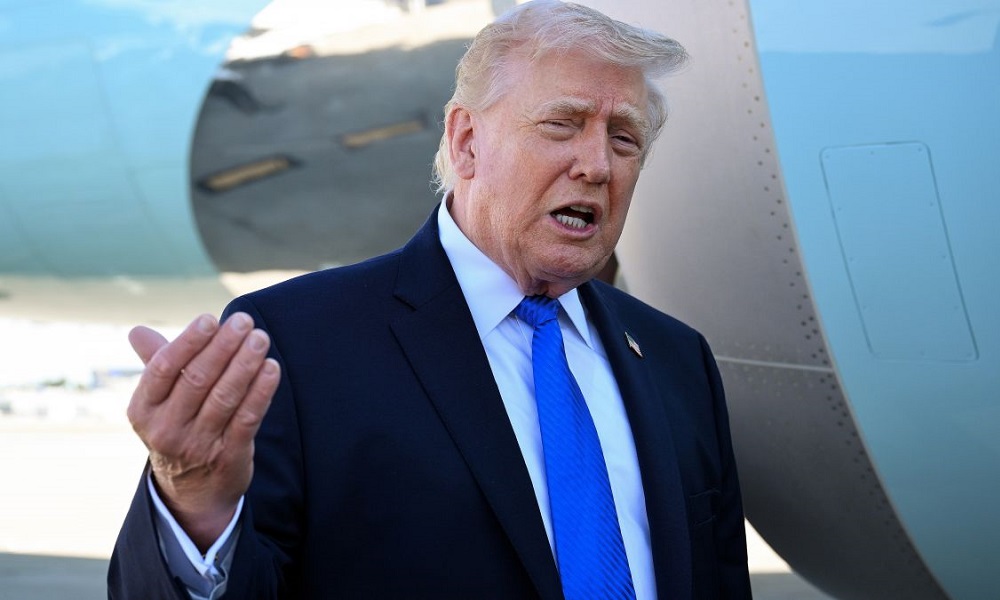
U.S. President Donald Trump announced a new extension of his deadline for Iran to reopen the Strait of Hormuz or face the destruction of its energy plants, after Iran rejected his 15-point proposal to end the war he launched with Israel.
Iran gave no direct indication that it was ready for negotiation or compromise. The Islamic Revolutionary Guard Corps issued a statement reaffirming that all shipping “to and from ports of allies and supporters of the Israeli-American enemies” to any destination was prohibited.
The war has spread across the Middle East, killing thousands of people and causing the biggest disruption in history to energy supplies, hitting the global economy with soaring oil, gas and fertiliser prices that have fuelled inflation fears.
The U.S. and Israel launched strikes on Iran on February 28 during talks with Tehran about its nuclear programme that had not yet yielded a deal. Attacks on Israel by Iran’s Lebanese ally Hezbollah then triggered an Israeli onslaught there that has displaced a fifth of Lebanon’s population.
On Thursday, Trump threatened during a cabinet meeting to increase pressure on Iran if it did not make a deal. He later posted on social media that he would pause threatened attacks on Iranian energy plants for 10 days until April 6 at 8 p.m. Eastern daylight time (0000 GMT on April 7).
“Talks are ongoing and, despite erroneous statements to the contrary by the Fake News Media, and others, they are going very well,” he added in his Truth Social post.


Afghanistan and Uzbekistan hold high-level bilateral meeting to boost trade and economic cooperation

US report flags continued presence of anti-India militant groups in Pakistan

Peshawar to host key Pakistan-Afghanistan peace jirga amid ongoing tensions

Afghanistan, Uzbekistan ink $514.8 million deals to deepen trade ties

Kohli shines as RCB open IPL title defence with dominant win

Pakistani military jet downed in Afghanistan’s Jalalabad, pilot captured alive

Prominent Muslim scholar issues fatwa calling for Afghanistan-Pakistan ceasefire

Afghan air force strikes key Pakistani military installations in retaliatory operation

IEA: Special circle in Pakistan has launched mission to destabilize region

IEA Supreme Leader issues Eid-ul-Fitr message urging unity and support for Islamic system

Tahawol: Concerns over spread of Middle East crisis discussed

Saar: Weakening relations between Kabul and Washington discussed

Exclusive interview with Indrika Ratwatte, Deputy UN Special Representative for Afghanistan

Tawsia: Efforts to boost Afghanistan’s domestic production and economic diplomacy

Tahawol: Discussion on day 27 of Iran–US war
-
 Latest News3 days ago
Tajikistan shifts stance on Afghanistan amid rising border tensions
-
 Latest News2 days ago
Russia deems US military presence in Afghanistan unacceptable
-
 Latest News2 days ago
IEA says Iranian drivers no longer need visas to enter Afghanistan
-
 Latest News4 days ago
Two civilians killed, eight injured in fresh shelling by Pakistan in Kunar
-

 Sport4 days ago
IPL 2026: RCB sold for $1.78 billion in landmark deal
-
 Sport3 days ago
Afghanistan to face Myanmar in crucial AFC clash
-
 Sport3 days ago
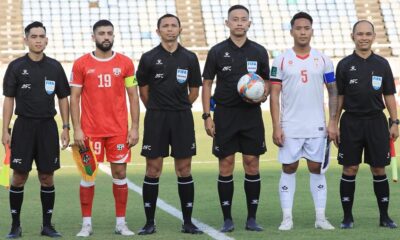
Myanmar trump Afghanistan 2-1 in Asian Cup Qualifier
-

 Business4 days ago
‘Made in Afghanistan’ expo opens in Tashkent