
World
Trump arrives in Britain for second state visit
On Wednesday, Trump and his wife, Melania, will be treated to British royal pageantry, including a carriage tour, a state banquet, a flypast by military aircraft and a gun salute.

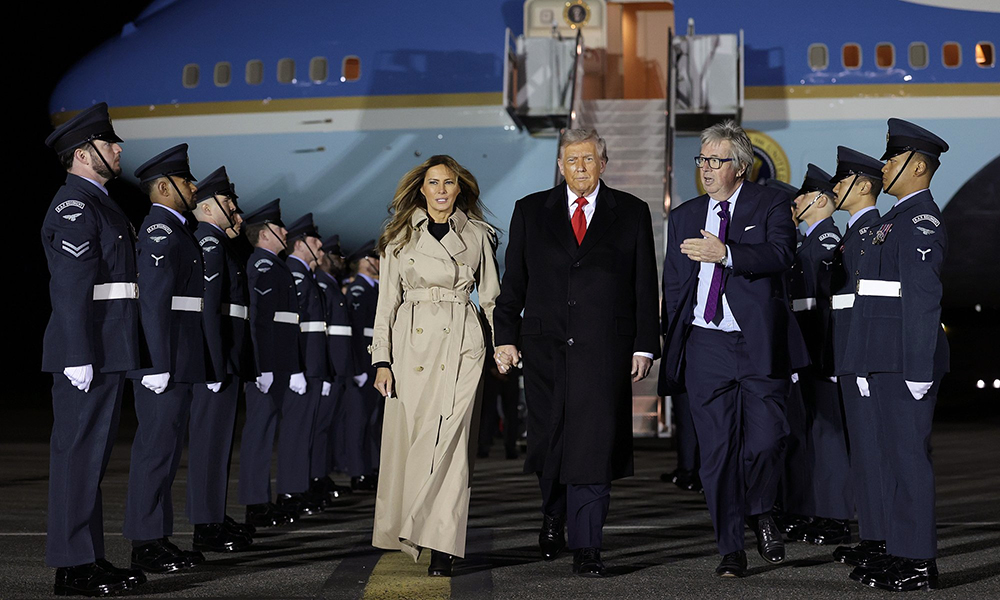
U.S. President Donald Trump arrived in Britain late on Tuesday for an unprecedented second state visit at which the two nations will seal investment deals, a renewal of a “special relationship” Prime Minister Keir Starmer is keen to champion, Reuters reported.
U.S. Treasury Secretary Scott Bessent and British finance minister Rachel Reeves led events before Trump’s arrival, announcing a “Transatlantic taskforce” to deepen work between two of the world’s largest financial centres.
Trump will then be greeted by King Charles on Wednesday, for a day of pomp at Windsor Castle, a regal show of soft power that Starmer hopes will offer him protection from possible pitfalls during the trip.
The visit should provide Trump with a diversion less than a week after a close ally, conservative activist Charlie Kirk, was shot dead, a killing that has appeared to affect the president deeply.
Starmer is also looking to turn the focus onto geopolitics and investment after enduring a tough couple of weeks that have undermined his authority. First he was forced to fire his deputy and then six days later his ambassador to the U.S., Peter Mandelson, over his ties to convicted sex offender Jeffrey Epstein.
Starmer wants to pitch Britain as a destination for U.S. investment, closely aligning its financial services, tech and energy sectors with larger U.S. peers to try to drive much-needed economic growth at home, read the report.
To that end, business executives including Nvidia Corp (NVDA.O), CEO Jensen Huang and OpenAI’s Sam Altman are due to attend, while billions of dollars of business deals are expected to be announced.
Micosoft (MSFT.O), said it would invest over $30 billion in Britain over the next four years, while Google said it would invest 5 billion pounds ($6.8 billion), partly on a new data centre close to London that would help meet demand for AI services.
A spokesperson for Starmer described the state visit as “a historic opportunity” coming “at a crucial time for global stability and security”.
“The prime minister will discuss the challenges that both our countries face, and the opportunities, as we enter a new era of our deep and unparalleled relationship,” the spokesperson told reporters.
Starmer will turn the focus to foreign affairs on Thursday when he hosts Trump at his Chequers country residence and will attempt to draw a line under his handling of the departures of his deputy, Angela Rayner, and Mandelson.
He gave both his full-throated support before being forced to let them go, prompting questions over his political judgment at a time when Nigel Farage’s populist Reform UK party holds a hefty lead the polls, read the report.
Mandelson’s ties to the late Epstein that led to his sacking could present Starmer with a tricky moment with Trump, whose administration had close ties to the former ambassador and whose own relationship with the financier has also come under scrutiny.
Starmer has justified his abrupt sacking of Mandelson last week by saying he was not aware of the depth of the ex-ambassador’s ties to Epstein and Trump has denied writing him a birthday letter which Democrats in the House of Representatives made public.
On Wednesday, Trump and his wife, Melania, will be treated to British royal pageantry, including a carriage tour, a state banquet, a flypast by military aircraft and a gun salute.
A day later, Starmer welcomes Trump to Chequers, a 16th century manor house in the southern English countryside, to discuss investment, tariffs on steel and aluminium, ending Russia’s full-scale invasion of Ukraine and the situation in Gaza.
Both nations will have sizeable delegations and will be largely protected from planned anti-Trump protests. U.S. Secretary of State Marco Rubio was greeted by Britain’s newly-appointed foreign minister, Yvette Cooper, when he arrived on Tuesday.








World
Top US, Israeli generals meet at Pentagon amid soaring Iran tensions
The officials did not offer details about the closed-door discussions between U.S. General Dan Caine, the chairman of the Joint Chiefs of Staff, and Eyal Zamir, the Israeli armed forces chief of staff.
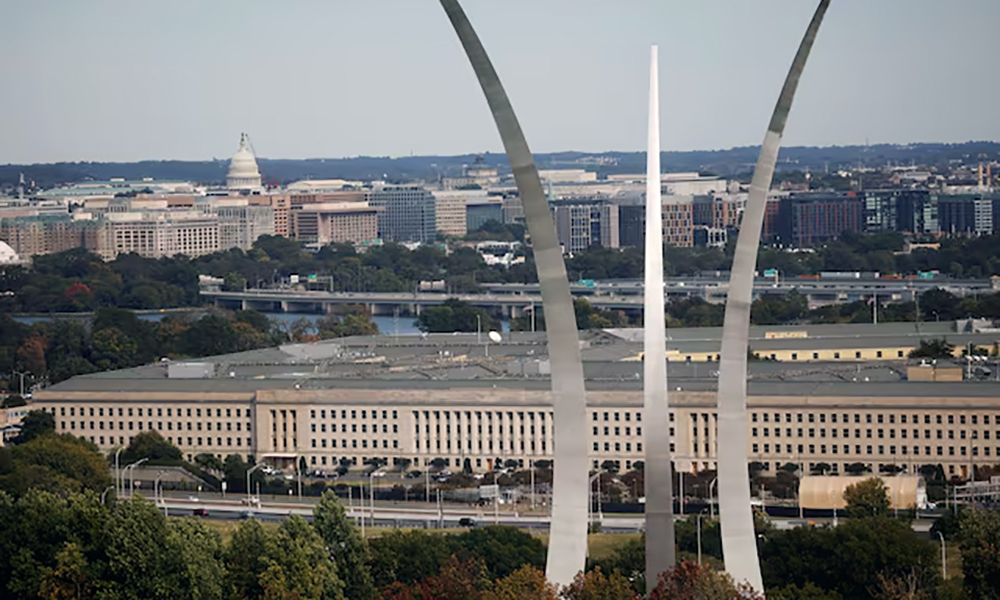
The top U.S. and Israeli generals held talks at the Pentagon on Friday amid soaring tensions with Iran, two U.S. officials told Reuters on Sunday, speaking on condition of anonymity, Reuters reported.
The officials did not offer details about the closed-door discussions between U.S. General Dan Caine, the chairman of the Joint Chiefs of Staff, and Eyal Zamir, the Israeli armed forces chief of staff. The meeting has not been previously reported.
The United States has ramped up its naval presence and hiked its air defences in the Middle East after President Donald Trump repeatedly threatened Iran, trying to pressure it to the negotiating table. Iran’s leadership warned on Sunday of a regional conflict if the U.S. were to attack it, read the report.
Israeli Defence Minister Israel Katz on Sunday met with Zamir after his talks in Washington, Katz’s office said, to review the situation in the region and the Israeli military’s “operational readiness for any possible scenario.”
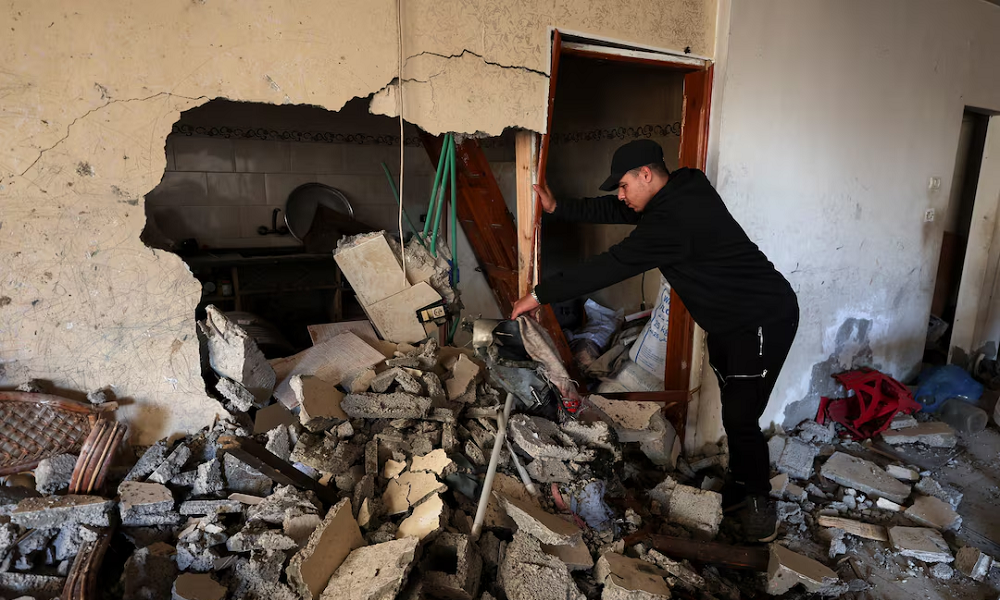
At least 31 Palestinians, including six children, were killed in Israeli attacks on Gaza City and Khan Younis since early Saturday, according to medical sources cited by Al Jazeera.
The strikes came a day before Israel is scheduled to reopen the Rafah crossing between Gaza and Egypt on Sunday, marking the first reopening of the border crossing since May 2024.
Gaza’s Government Media Office said that more than 500 Palestinians have been killed by Israeli forces since a United States-brokered ceasefire came into effect on October 10.
According to local health authorities, Israel’s military campaign in Gaza has killed at least 71,769 Palestinians and wounded 171,483 others since it began in October 2023. In Israel, at least 1,139 people were killed during the Hamas-led attacks on October 7, 2023, with approximately 250 people taken captive.
World
Guterres warns of UN’s ‘imminent financial collapse’
In his letter, Guterres said “decisions not to honour assessed contributions that finance a significant share of the approved regular budget have now been formally announced.”
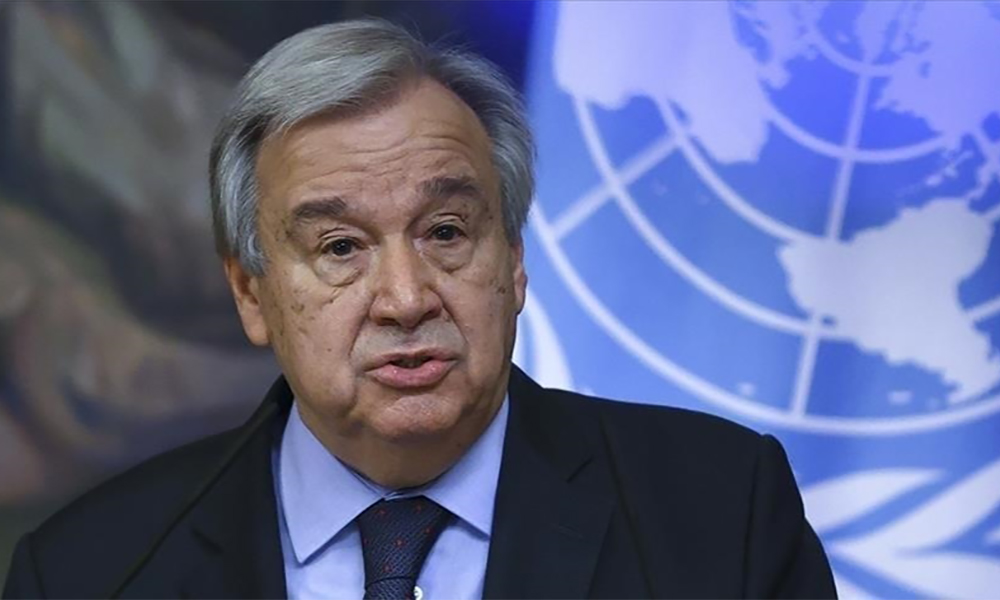
The U.N. chief has told member states the organisation is at risk of “imminent financial collapse,” citing unpaid fees and a budget rule that forces the global body to return unspent money, a letter seen by Reuters on Friday showed.
U.N. Secretary-General Antonio Guterres has repeatedly spoken about the organisation’s worsening liquidity crisis but this is his starkest warning yet, and it comes as its main contributor the U.S. is retreating from multilateralism on numerous fronts.
“The crisis is deepening, threatening programme delivery and risking financial collapse. And the situation will deteriorate further in the near future,” Guterres wrote in a letter to ambassadors dated January 28.
The U.S. has slashed voluntary funding to U.N. agencies and refused to make mandatory payments to its regular and peacekeeping budgets.
U.S. President Donald Trump has described the U.N. as having “great potential” but said it is not fulfilling that, and he has launched a Board of Peace which some fear could undermine the older international body.
Founded in 1945, the U.N. has 193 member states and works to maintain international peace and security, promote human rights, foster social and economic development, and coordinate humanitarian aid.
In his letter, Guterres said “decisions not to honour assessed contributions that finance a significant share of the approved regular budget have now been formally announced.”
He did not say which state or states he was referring to, and a U.N. spokesperson was not immediately available for comment.
Under U.N. rules, contributions depend on the size of the economy of each member state. The U.S. accounts for 22% of the core budget followed by China with 20%.
But by the end of 2025 there was a record $1.57 billion in outstanding dues, Guterres said, without naming the nations that owed them.
“Either all Member States honour their obligations to pay in full and on time – or Member States must fundamentally overhaul our financial rules to prevent an imminent financial collapse,” he said.
U.N. officials say the U.S. currently owes $2.19 billion to the regular U.N. budget, another $1.88 billion for active peace-keeping missions and $528 million for past peace-keeping missions.
The U.S. State Department did not immediately respond to a request for comment on the Guterres letter.
Guterres launched a reform task force last year, known as UN80, which seeks to cut costs and improve efficiency. To that end, states agreed to cut the 2026 budget by around 7% to $3.45 billion.
Still, Guterres warned in the letter that the organisation could run out of cash by July.
One of the problems is a rule now seen as antiquated whereby the global body has to credit back hundreds of millions of dollars in unspent dues to states each year.
“In other words, we are trapped in a Kafkaesque cycle expected to give back cash that does not exist,” said Guterres, referring to author Franz Kafka who wrote about oppressive bureaucratic processes.


Tahawol: Afghanistan’s bid to engage with SCO

Saar: Afghanistan and Iran’s expanding ties discussed

Central Asia and Afghanistan are key security concerns for CSTO: Lavrov

Afghanistan to establish first-ever faculty of ‘prophetic medicine’

Afghanistan crush Scotland in ICC T20 World Cup warm-up

Turkey withdraws from Afghanistan-Pakistan mediation amid rising tensions

ICG report says Pakistan most impacted by IEA’s return in Afghanistan

Pakistan approves re-export of stranded Afghan transit trade cargo

Afghanistan–China joint market opens in Kabul

Afghanistan set to face West Indies in crucial T20I series
Tahawol: Afghanistan’s bid to engage with SCO
Saar: Afghanistan and Iran’s expanding ties discussed

Tahawol: Tense regional situation over Iran discussed

Saar: Pakistan’s allegations of India backing Balochistan attacks

Tahawol: BLA’s coordinated attacks in Balochistan discussed
-

 Sport5 days ago
Afghanistan shine on Day Two of AFC Futsal Asian Cup Indonesia 2026
-

 Sport4 days ago
Afghanistan eye second straight win ahead of Malaysia clash at AFC Futsal Asian Cup
-

 Sport2 days ago
AFC Futsal Asian Cup: Afghanistan to face Iran in crucial Group D clash
-

 Sport3 days ago
Afghanistan dominates Malaysia 7–0 in AFC Futsal Asian Cup
-

 Latest News4 days ago
Australia announces $50 million in new humanitarian aid for Afghanistan
-

 Sport2 days ago
T20 World Cup 2026: Afghanistan national cricket team arrives in India
-
 Business3 days ago
Pakistan, China plan to extend CPEC to Afghanistan, revive trilateral framework
-

 Health5 days ago
Pakistan becomes latest Asian country to introduce checks for deadly Nipah virus