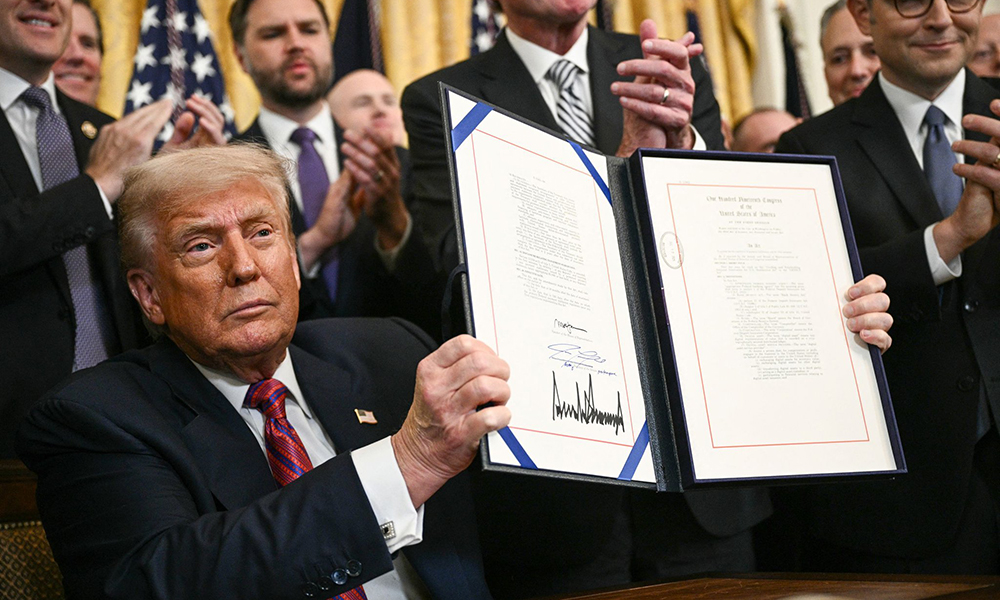
U.S. paper currency will bear President Donald Trump’s signature starting this summer, the first time a sitting president has signed American money, the Treasury Department said on Thursday.
The redesigned notes, planned to mark the 250th anniversary of American independence, will also for the first time in 165 years drop the signature of the U.S. treasurer, who reports to the Treasury Secretary and oversees the Bureau of Engraving and Printing, the U.S. Mint and other Treasury functions, Reuters reported.
The first $100 bills with Trump’s signature and that of U.S. Treasury Secretary Scott Bessent will be printed in June, followed by other bills in subsequent months. The new bills may take several weeks to circulate through banks.
The Treasury is still producing notes bearing the signatures of former President Joe Biden’s Treasury secretary, Janet Yellen, and former Treasurer Lynn Malerba.
Malerba will be the last of an unbroken line of treasurers whose signatures have appeared on U.S. federal currency since 1861, when the U.S. government first issued it.
The signature change is the latest effort by the Trump administration and its allies to put the president’s name on buildings, institutions, government programs, warships and coins. A federal arts panel, whose members Trump appointed, approved last week the design for a commemorative gold coin with Trump’s image.
Bessent said in a statement that the move was appropriate for the U.S. 250th anniversary, given strong U.S. economic growth and financial stability during Trump’s second term, read the report.
“There is no more powerful way to recognize the historic achievements of our great country and President Donald J. Trump than U.S. dollar bills bearing his name, and it is only appropriate that this historic currency be issued at the Semiquincentennial,” Bessent said.
An effort for a circulating $1 Trump coin was set back by laws prohibiting the depiction of living individuals on U.S. coins.
A statute governing the printing of Federal Reserve notes gives the Treasury broad discretion to change designs to guard against counterfeiting. The law requires keeping certain elements, including the words “In God We Trust,” and only allows portraits of deceased individuals.
The overall designs of bills will not change, except for Trump’s signature replacing the Treasurer’s, Treasury officials said. A mock-up of the $100 bill with Trump’s signature was not immediately available.
Malerba, the former treasurer, declined comment on the Trump administration’s move.
Her predecessor, Jovita Carranza, who served as treasurer in Trump’s first term, called the change “a powerful symbol of American resilience, the enduring strength of free enterprise and the promise of continued greatness.”
The current treasurer, Brandon Beach, whose name has not appeared on the currency, also issued a supportive statement, saying Trump was the architect of a “golden age economic revival.”