
Latest News
US indicates Daesh might have been behind deadly school bombing

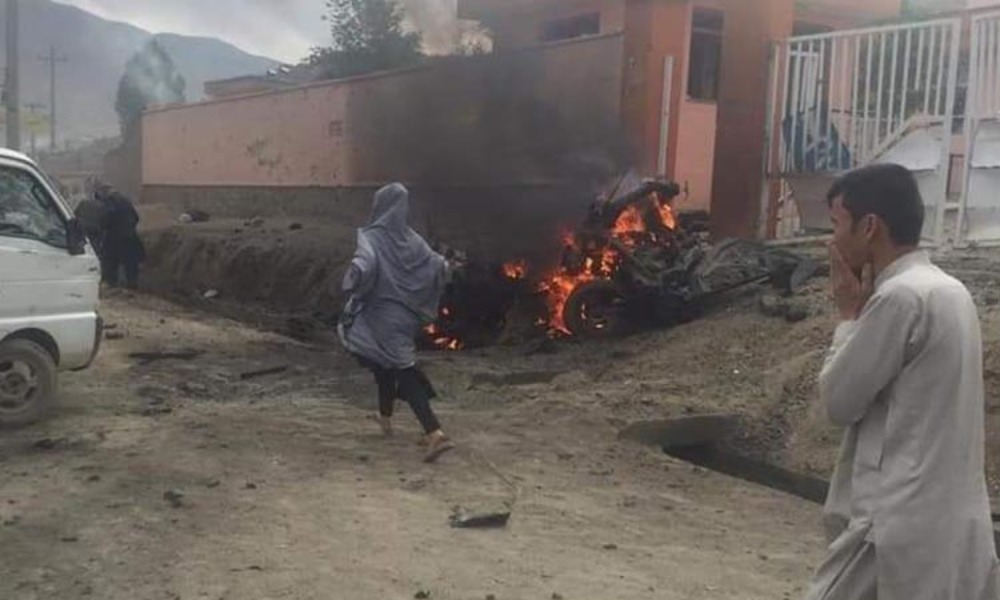
The US State Department said Monday ISIS (Daesh) could possibly have been behind the deadly school bombing in Kabul that left over 80 people, mostly schoolgirls, dead.
In a press briefing, the department’s spokesman Ned Price said there are some indications that Daesh was behind the attack.
“We are still looking into what or who is responsible, but I would note that ISIS has been responsible for similar attacks on Shia communities in Kabul in the past,” he said.
“We note the Taliban has denied involvement in the attack, and we welcome their announcement of a three-day ceasefire over the upcoming Eid holiday.
“We call on the Taliban and Afghan leaders to engage seriously in the ongoing peace process to ensure the Afghan people enjoy a future free of terrorism and of senseless violence,” he said.
He went on to say that although the United States is withdrawing its troops, America is not disengaging from Afghanistan. He said Washington “will continue to use our diplomatic, economic, and humanitarian toolset to ensure that the gains of the past 20 years, particularly those made by women, girls, and minorities, are preserved.”
Price pointed out that in leaving Afghanistan, it was only “a military withdrawal”.
Quoting US President Joe Biden, Price said: “As the President has said, we will be withdrawing our military forces, except those required for the protection of our embassy in Kabul. And that’s the other important point: We are going to retain an embassy in Kabul precisely though – so that we can continue to partner and to provide support for not only the Government of Afghanistan, but the people of Afghanistan.
He stated that the circumstances of the bombing at the school on Saturday “are not yet crystal clear. As I said before, there are some indications that this may have been attributable to ISIS and not the Taliban.”
Price also stated that Washington has “long been concerned about the growth of ISIS in Afghanistan”.
“As you know, we have had a military presence in Afghanistan to see to it that the country could not be used as a staging ground to attack the United States, to propel force beyond – well beyond Afghanistan’s borders. We have been able to accomplish that goal.
“We continue to have important humanitarian goals when it comes to Afghanistan. We will continue to carry out and to move forward with those objectives, even as our military withdraws from the country,” he said.
Special Immigrant Visa Program
Price also noted that as the US withdraws, they will keep “adequate resources in the region and over-the-horizon capacity should threats emerge that require us to leverage the use of force.”
On the issue of visas for interpreters who have worked for the US military, Price said that serious attention was being given to the Special Immigrant Visa Program.
He said Washington has “added resources to help process the special immigrant visa applicants, knowing that as the United States, we have a special responsibility to those who have helped us along the way, who have helped the US military, who have helped the US government, oftentimes placing themselves in harm’s way.
“Our commitment to these people, to these individuals will continue, and we are doing all we can to process them as expeditiously as we can,” he said.
In answer to a question, Price added: “We have been acting with the utmost urgency knowing that, again, we have a special responsibility to the women and men who have, in many cases, placed themselves in harm’s way to assist the US government over the years.”
He said additional resources, including augmenting domestic staff in Washington to process applications, has already been put in place. In addition, the US has approved a temporary increase in consular staffing at the embassy in Kabul in order to conduct interviews and process visa applications,” Price said.
“And we’ll continue to do that contingent on the security situation in the country. We will continue to look for ways to speed up this process, to facilitate the processing of – for these brave individuals.”
Welcoming the three-day ceasefire announced by the Taliban for the Eid holidays, Price said they “urge the Taliban to extend the ceasefire and order a significant reduction in violence.
“We all know that a return to violence would be senseless as well as tragic. We remind the Taliban that engaging in violence will not afford it legitimacy or durability. That has been our point all along. Engaging in serious negotiations to determine a political roadmap for Afghanistan’s future that leads to a just and durable settlement will,” he said.
He said it was in no one’s interest for Afghanistan to once again devolve into civil war. “It’s not in the Taliban’s interests, it’s not in the Government of Afghanistan’s interests, it’s not in the interests of Afghanistan’s neighbors, and it’s certainly not in the interests of the people of Afghanistan.”




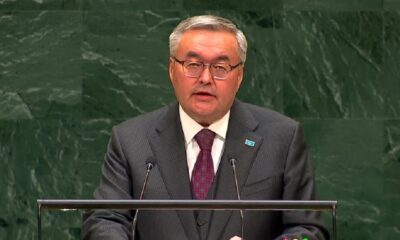




Kazakhstan’s Foreign Minister Mukhtar Tileuberdi has called for pragmatic and coordinated international engagement with Afghanistan, saying the country’s long-term stability is closely linked to the security and sustainable development of Central Asia.
Speaking during the general debate of the 81st session of the United Nations General Assembly in New York on Friday, Tileuberdi said humanitarian assistance to Afghanistan remains essential but alone cannot break the cycle of poverty, displacement and dependency.
He said Kazakhstan supports a “pragmatic, coordinated and step-by-step” approach to international engagement with Afghanistan, with the United Nations playing a central role.
Tileuberdi also said Kazakhstan is working with the UN to operationalize the United Nations Regional Centre for the Sustainable Development Goals for Central Asia and Afghanistan in Almaty.
He said the success of the centre should be measured by the results and assistance it delivers to the region.


Ariana Afghan Airlines increases Kabul-Delhi cargo flights

Khalilzad questions Pakistan’s commitment to Afghan welfare

India, UN envoy discuss Afghanistan’s humanitarian needs

Kazakhstan calls for coordinated international engagement with Afghanistan

Pakistan PM, UN chief discuss Afghanistan amid rising Kabul-Islamabad tensions

Saudi energy group signs major Afghanistan deals covering gas exploration and pipeline plans

Trump floats idea of renaming Atlantic or Pacific Ocean

US hits Egyptian bank branches with Iran sanctions as war marks six months

Nepal flood rescue mission enters critical phase as thousands remain missing

Iranian clubs to face Gulf opponents at neutral venues in Asian Champions League Elite

Exclusive interview with Abdul Latif Mansoor, Minister of MRRD

Tawsia: Overview of Afghanistan’s iron mines

Tahawol: Discussion on fresh Pakistani airstrikes on Afghanistan

Saar: Calls for international support for Afghanistan discussed

Tahawol: Opening of the 81st UN General Assembly Session
-

 Sport5 days ago
Afghanistan to face Japan and Nepal in Asian Games cricket group stage
-

 World4 days ago
CNN, MS NOW and Politico sue Trump, challenging White House ban
-

 Latest News3 days ago
Ariana Afghan Airlines ranks seventh among 45 Central Asian airlines
-

 Latest News4 days ago
UN reiterates call for respect for international law after Kunar airstrikes
-
 Latest News5 days ago
Khalilzad condemns Pakistan airstrikes, says current strategy is not working
-

 Regional3 days ago
US and Iran hold first talks since June after Trump’s ‘annihilation’ threat
-

 Latest News3 days ago
Silk Road highway in Wakhan corridor now reaches the China border
-

 Latest News4 days ago
Afghan Official: Pakistan’s airstrikes will not go unanswered