Connect with us

Latest News

Washington a ‘ghost town’ ahead of Biden’s inauguration

Published

on

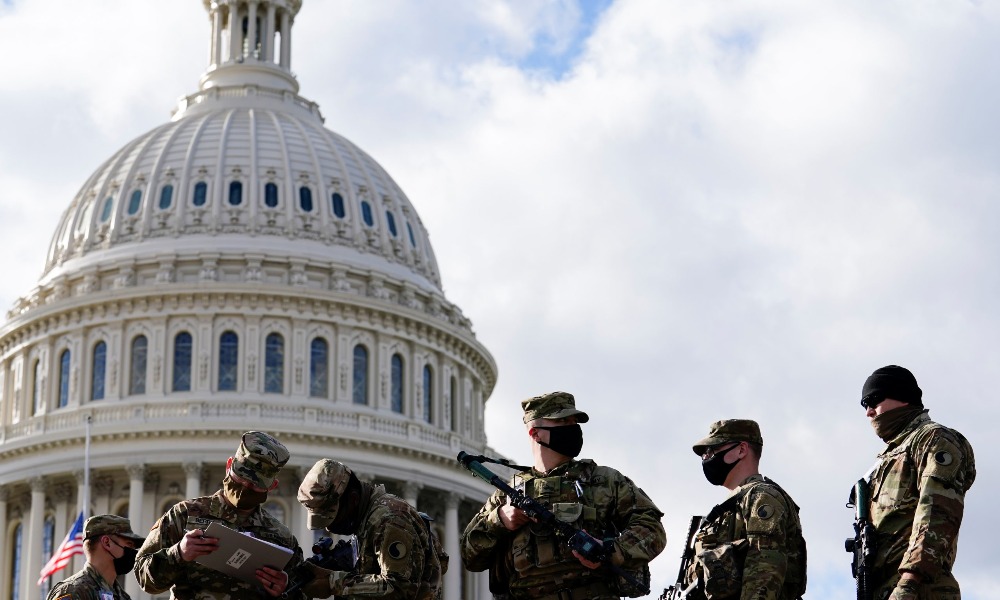
Central Washington is an armed fortress, fenced off with razor wire and surrounded by 25,000 National Guard troops ahead of President-elect Joe Biden’s inauguration on Wednesday, a stark contrast to previous inaugurations, when the United States capital erupted in days of celebration.
 
The COVID-19 pandemic had already canceled the inaugural balls and now the National Mall is closed to the public due to threats of violence from groups who attacked the US Capitol on January 6, Reuters reported. 
 
Almost none of the public will witness firsthand the transition of power, souring the mood of Washingtonians.
 
“It’s like a ghost town but with soldiers,” said Dana O’Connor, who walked with her husband past concrete barriers near the White House on Sunday. “It’s eerie. It feels super unnatural.”
 
Reuters reported that previous inaugurations sometimes drew over a million spectators to the National Mall, to watch the ceremony from giant television screens and the new president parading on foot from the Capitol to the White House. 
 
Presidential inaugurations are normally high-security events, with metal detectors at key entry points, restricted ID-only zones and National Guard supplementing local and federal law enforcement. But the level of precautions this year is unprecedented.
 
Washington Mayor Muriel Bowser said on Sunday that law enforcement officials had no choice but to ramp up security after the deadly Capitol attack, where “so-called patriots would attempt to overthrow their government and kill police officers.”
 
“We don’t want to see fences. We definitely don’t want to see armed troops on our streets. But we do have to take a different posture,” Bowser said on NBC’s “Meet the Press.”
 
For a nation that has prided itself as a beacon for democracy around the world, the peaceful transition of power looks anything but, Larry Sabato, director of the University of Virginia’s Center for Politics, told Reuters.
 
“The world will see Biden sworn in, in the middle of a military camp that’s indistinguishable from the Green Zone,” Sabato said, referring to the fortress-like area of central Baghdad set up after the Iraq War.
 
Sabato has attended every inauguration since Richard Nixon’s second one in 1973, and Ronald Reagan’s 1985 swearing-in that was held indoors because of the bitter cold. But he won’t attend this one.
 
Reuters reported that the Secret Service has incorporated the term “Green Zone” into its inauguration security maps, and District of Columbia residents have started using the moniker for the vast restricted area running from two blocks east of the Capitol to the Potomac River west of the Lincoln Memorial.
 
The district, one of the most Democratic jurisdictions in the United States, voted 92 percent for Biden, making the current situation even more painful for many residents.

Latest News

Ministries of Public Health and Higher Education sign cooperation agreement

Published

on

The Ministry of Public Health announced on Tuesday it has signed a cooperation agreement with the Ministry of Higher Education aimed at expanding scientific, research, educational, and technical cooperation.

At the signing ceremony held in Kabul, Noor Jalal Jalali, Minister of Public Health, said that the agreement would lead to significant improvements in the capacity-building of students and doctors, ensure that research is conducted based on evidence, and enable the collection of accurate data.

Meanwhile, Neda Mohammad Nadeem, Minister of Higher Education, described the agreement as beneficial to the public and to both institutions, stressing the need to train individuals at universities who can contribute to social development and make the country self-sufficient in the public health sector.

Continue Reading

Latest News

UNAMA holds new round of Working Group meetings on counter-narcotics and private sector

Published

on

The United Nations Assistance Mission in Afghanistan (UNAMA) has convened a new round of Doha Process Working Group meetings focusing on counter-narcotics and private sector development.

The meetings, held in Kabul on February 3 and 9, brought together representatives of UN member states and international organizations, officials of the Islamic Emirate, and subject-matter experts.

According to UNAMA, discussions in the counter-narcotics working group centered on efforts by Islamic Emirate authorities and the international community to support alternative livelihoods for Afghans previously dependent on poppy cultivation and the illicit opium trade. Participants also reviewed drug-use prevention and treatment initiatives, as well as law-enforcement measures to curb narcotics production and trafficking.

The private sector working group focused on job creation and entrepreneurship, with particular attention to women’s participation in the private sector, market integration, access to finance, and the development of private banking and financial infrastructure.

UNAMA said both working groups identified priority areas for enhanced engagement and explored more effective and sustainable approaches to supporting Afghan men and women. Participants also examined the linkages between the two areas, noting that private sector development is a key source of livelihoods, while counter-narcotics efforts contribute to Afghanistan’s economic and social stability.

The working groups were established following the third Meeting of Special Envoys held in Doha, Qatar, in June and July 2024, in line with recommendations of the Independent Assessment endorsed by the UN Security Council. The process aims to promote more coherent, coordinated, and structured engagement with Afghanistan’s de facto authorities for the benefit of the Afghan people.

UNAMA added that stakeholders engage in the working groups on an ongoing basis, with full-format meetings convened periodically. Since their establishment, the groups have improved information-sharing, helped mobilize additional resources, and facilitated expert exchanges to strengthen support for the Afghan people.

Continue Reading

Latest News

Economic Commission approves national policy for development of agriculture

Published

on

At a regular meeting of the Economic Commission chaired by Mullah Abdul Ghani Baradar, Deputy Prime Minister for Economic Affairs, the National Policy for the Development of the Agriculture and Livestock Sector was approved.

According to a statement from the deputy PM’s office, the key objectives of the policy include the mechanization of the agriculture and livestock sector; development of agricultural, irrigation, and livestock research and extension systems; management of irrigation systems; support for investment in these sectors; and ensuring public access to high-quality agricultural and animal products.

During the same meeting, the development plan for the fish farming sector was also approved.

Under this plan, through private sector investment, 7,700 small, medium, and large fish production and farming facilities will be established on 6,500 hectares of land in various parts of the country.

The statement added that the implementation of this plan will create direct employment opportunities for 50,000 people and indirect employment for 250,000 others.

Continue Reading
Advertisement
Advertisement
Advertisement
Advertisement

Trending

Copyright © 2025 Ariana News. All rights reserved!