
Latest News
Afghanistan at a crossroads: UN expert in Kabul

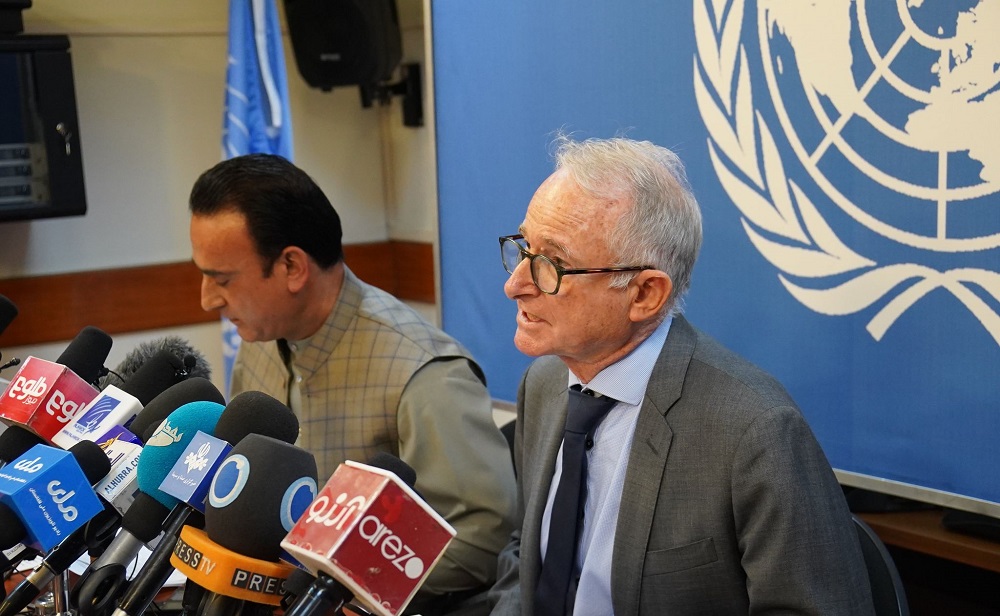
The newly appointed Special Rapporteur on the situation of human rights in Afghanistan, Richard Bennett, said Thursday the country faced serious human rights challenges, and urged the authorities to take the path that brings stability and freedom to all Afghans, especially women.
At the end of his 11-day visit to the country Bennett told a news conference in Kabul that he welcomed the opportunity to meet Islamic Emirate of Afghanistan (IEA) leaders, members of civil society, including women human rights defenders, journalists, minorities, victims of human rights violations, people with disabilities, and the judiciary.
He acknowledged the de facto authorities extended their invitation to access the entire territory and to visit sensitive locations such as schools, hospitals, and prisons, a crucial commitment to ensure that transparent monitoring can be undertaken.
Bennett noted that armed hostilities in many parts of the country had ceased and there was a consequent reduction in conflict-related casualties since the IEA takeover. He said the recently established commission for the return of leading Afghan personalities may provide an opportunity for dialogue and potentially strengthen governance.
While the granting of the general amnesty to officials of the former government and members of the security forces could be a first step toward reconciliation, he remains alarmed about reports of ongoing extrajudicial and revenge killings of former members of the security forces and officials and door-to-door searches,
UN Human Rights Office reported.
Bennett expressed concern about the humanitarian and economic crisis, and called on the international community to continue to provide humanitarian support, ensure its equitable and gender-sensitive distribution, and that the implementation of sanctions does not substantially impede the provision of essential public services, accessible to all, which are necessary for the enjoyment of human rights.
The advancing erasure of women from public life is especially concerning, he said.
Measures such as the suspension of girls’ secondary education, severe barriers to employment, no opportunities to participate in political and public life, limits on freedom of movement, association, and expression, directives on maharam (male family member chaperone), enforcing a strict form of Hijab and strong advice to stay at home, fit the pattern of absolute gender segregation and are aimed at making women invisible in society, Bennett said.
These directives contravene Afghanistan’s obligations under numerous human rights treaties to which it is a State party.
Nevertheless, women continue to demonstrate their determination to participate equally in society at all levels, despite the odds against them, he said.
“I call upon the de facto authorities to immediately reverse policies and directives that negatively impact women as well as to prioritize women’s and girls’ rights to equal participation in education, employment, and all other aspects of public life,” he said.
Bennett called for investigations into a series of attacks on places of worship and schools in Kabul, Kunduz, and Balkh provinces, instances of which have been claimed by the Daesh.
He said that such attacks specifically targeting members of the Hazara, Shia, and Sufi communities are becoming increasingly systematic in nature and reflect elements of an organizational policy, thus bearing hallmarks of crimes against humanity.
“The Taliban stands at a crossroads. Either the society will become more stable and a place where every Afghan enjoys freedom and human rights, or it will become increasingly restrictive,” Bennett said.
“If benchmarks are met such as the urgent opening of secondary schools for girls, the establishment of an inclusive administration that genuinely represents every segment of the Afghan society, and a platform is provided for dialogue and avenues for redressing grievances, the risks of further instability and suffering in Afghanistan may be mitigated.”
The Special Rapporteur’s first report will be presented to the September session of the Human Rights Council.












Kazakhstan’s Foreign Minister Mukhtar Tileuberdi has called for pragmatic and coordinated international engagement with Afghanistan, saying the country’s long-term stability is closely linked to the security and sustainable development of Central Asia.
Speaking during the general debate of the 81st session of the United Nations General Assembly in New York on Friday, Tileuberdi said humanitarian assistance to Afghanistan remains essential but alone cannot break the cycle of poverty, displacement and dependency.
He said Kazakhstan supports a “pragmatic, coordinated and step-by-step” approach to international engagement with Afghanistan, with the United Nations playing a central role.
Tileuberdi also said Kazakhstan is working with the UN to operationalize the United Nations Regional Centre for the Sustainable Development Goals for Central Asia and Afghanistan in Almaty.
He said the success of the centre should be measured by the results and assistance it delivers to the region.


Abu Muslim Farah defeat Khurasan Faryab 2-0 in ACL season six

Saar: Concerns over Pakistan’s political crisis discussed

Afghanistan Champions League: Omar Zawak Herat beat Toofan Herat 1-0

Blast in Pakistan’s Dera Ismail Khan kills 11, injures 30

Ariana Afghan Airlines increases Kabul-Delhi cargo flights

Saudi energy group signs major Afghanistan deals covering gas exploration and pipeline plans

Trump floats idea of renaming Atlantic or Pacific Ocean

US hits Egyptian bank branches with Iran sanctions as war marks six months

Nepal flood rescue mission enters critical phase as thousands remain missing

Iranian clubs to face Gulf opponents at neutral venues in Asian Champions League Elite
Saar: Concerns over Pakistan’s political crisis discussed

Exclusive interview with Abdul Latif Mansoor, Minister of MRRD

Tawsia: Overview of Afghanistan’s iron mines

Tahawol: Discussion on fresh Pakistani airstrikes on Afghanistan

Saar: Calls for international support for Afghanistan discussed
-

 World5 days ago
CNN, MS NOW and Politico sue Trump, challenging White House ban
-

 Latest News3 days ago
Ariana Afghan Airlines ranks seventh among 45 Central Asian airlines
-

 Latest News5 days ago
UN reiterates call for respect for international law after Kunar airstrikes
-

 Regional4 days ago
US and Iran hold first talks since June after Trump’s ‘annihilation’ threat
-

 Latest News4 days ago
Silk Road highway in Wakhan corridor now reaches the China border
-

 Regional3 days ago
Iran airlines cancel flights as US sanctions hit
-

 Latest News5 days ago
Afghan Official: Pakistan’s airstrikes will not go unanswered
-

 Sport5 days ago
Afghan boxing referee heads to China for international festival