
Latest News
A new plan to ‘fix the war’ with a Bonn-style conference: AAN report

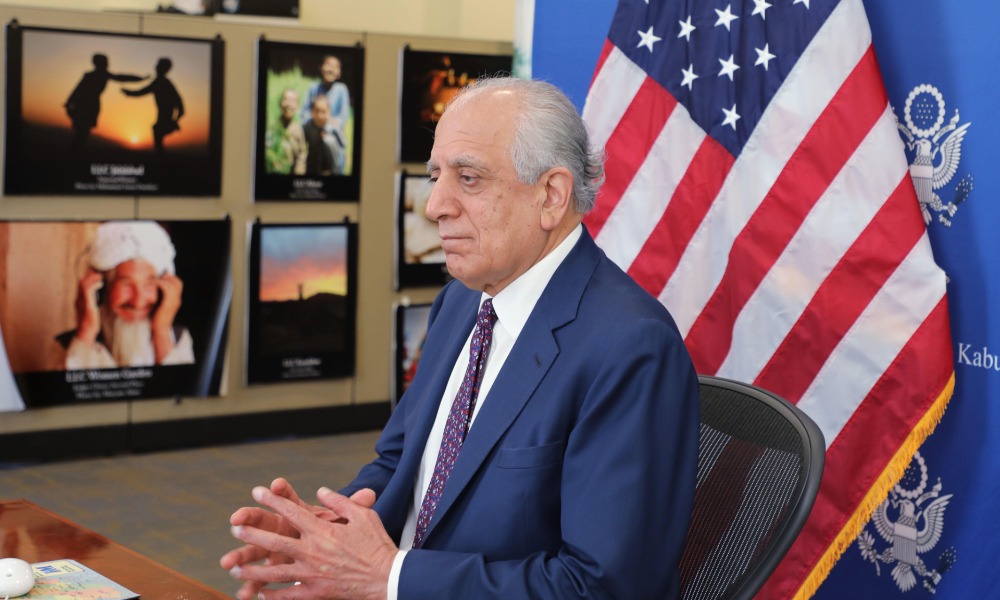
US peace envoy Zalmay Khalilzad has in the past week proposed the possibility of a Bonn-type conference that could cancel or sideline the intra-Afghan peace talks currently underway in Doha.
According to Afghanistan Analysts Network (AAN), “Bonn 2” appears to have been discussed in a number of capitals and with various Afghan leaders.
The proposal appears aimed at ensuring a US troop withdrawal that would not look like Washington is cutting and running, AAN stated adding that any new power-sharing agreement reached as a ‘quick fix’ to the conflict would be inherently risky.
This could include increased conflict and the breaking down and loss of whatever stability and systems Afghanistan now enjoys.
AAN’s Thomas Ruttig, who was at the first Bonn conference as part of the UN team, argues that the situation in Afghanistan in 2021 is anyway so very different from those in 2001 that calling for a Bonn 2 conference to resolve the conflict is disingenuous.
Ruttig states that according to sources, the US envoy told Afghan politicians that the peace talks in Doha will be sidelined and that a Bonn Conference-style meeting will be held at the international level to discuss the prospect of a participatory government that would include the Taliban.
“A grand international conference that will be similar to the Bonn Conference will be held, in which the Taliban and the republic side will participate at the leadership level. At the same time, the international community, including the United States and the regional countries, will reach a political agreement that will take its legitimacy from the international community.
“However, the national legitimacy (agreement of the potential conference) would take its authority from the traditional Loya Jirga,” said Shahzada Massoud, a close aide to former president Hamid Karzai, AAN reported.
AAN stated that Khalilzad had reportedly carried a special letter from the US Secretary of State Antony Blinken to President Ashraf Ghani and Abdullah Abdullah, Chairman of the High Council for National Reconciliation (HCNR), calling on them “to speed up the peace process and build an internal consensus to negotiate with the Taliban on a new level,” and to prepare for a “Bonn model” conference with the Taliban, hosted by Turkey in Ankara “as soon as possible.”
According to the report, the new plan seems inspired by the desire to meet the short, albeit formally conditional, timeline that was established by the year-old US-Taliban agreement for the withdrawal of US and other troops by 1 May 2021.
Khalilzad’s hope, apparently, is that a Bonn-style conference could result in a quick power-sharing agreement (or, similarly to the approach to that before the February 2020 Doha deal with a Taliban, with a ‘framework’ agreement as a first step).
His proposal would appear to mean the end or sidelining of the intra-Afghan talks in Doha where the Taliban and Islamic Republic of Afghanistan (IRoA) have yet to agree on an agenda, AAN reported.
AAN stated that his proposal might be primarily aimed at providing cover for the US troop withdrawal by 1 May, or alternatively include conditions for a delayed final withdrawal. Such an agreement would also allow the new US government to sidestep the thorny issue of whether the Taliban have fulfilled their commitments to the bilateral February 2020 Doha deal, with regard to cutting ties with al-Qaeda.
AAN stated that at least ten political leaders have agreed to the plan: President Ashraf Ghani, along with his two deputies, Amrullah Saleh and Sarwar Danesh; Abdullah Abdullah; former president Hamid Karzai and factional leaders Muhammad Mohaqeq, Muhammad Karim Khalili, Abdul Rashid Dostum, Abdul Rab Rasul Sayyaf and Yunes Qanuni.
The plan reported includes a handover of power from the current government to a transitional one, after “agreement on basic issues” in Ankara and in the presence of US and NATO military forces “in order to maintain political stability.”
The transitional government, reported AAN, could include leaders from Afghanistan and the Taliban but it is not clear how a transitional administration would become a permanent government.
Before Khalilzad arrived in Kabul last week, he had a stopover in Berlin. AAN reported it is likely Khalilzad discussed this plan with Berlin before heading to Afghanistan.
According to AAN, a first indirect reaction from the Afghan government to the Bonn 2 proposal came late on 3 March, from National Security Adviser Hamdullah Moheb, who said the government was “holding discussions about a wide range of alternatives” with various factions to achieve peace in the country.
He said any option needed “guarantees” from the international community and the Taliban. On 6 March, however, when opening the spring session of the Afghan parliament, Ghani indirectly rejected parts of the new US plan in a speech, particularly ideas of a non-elected government.
He reiterated that the transfer of power through elections was “a non-negotiable principle for us” and, tha the constitution would determine the country’s future, rather than other people’s plans.
He also said, however, that he was “ready to discuss the holding of a free, transparent, and countrywide election under the management of the international community” and that “[w]e can also talk about a date and reach a conclusion.”
Ghani did not refer to the idea of holding a new international conference.
AAN reported that it is interesting that Khalilzad chose to frame his plan as a ‘Bonn-style’ agreement, deliberately suggesting that it is possible to turn back history, press the restart button, deal the cards again – largely with the same factions, in some cases even the same individuals, but this time, with the Taliban at the table.
AAN stated that many authors and commentators, in hindsight, have described the fact that the Taliban were not included in Bonn 1 as one of its main mistakes.
In conclusion, AAN reported that the plan to hold a new “Bonn-style conference” prioritises US interests and timelines even more than the Doha agreement did.
Even if the Taliban agreed to a ‘Bonn 2 formula’, this would leave the causes of conflict unaddressed. It would hand the implementation of an agreement to parties who so far and to varying degrees have not been willing to seriously negotiate with each other or share power.
To only have armed factions at the negotiating table would again undercut the principle of broad participation, including of women’s organisations and other civil society groups, and would limit the chances of a peaceful future. It would repeat a major mistake of Bonn 1 where civilian political forces were not invited to the table, AAN reported.
However, if both sides could be brought to agree to a deal and even some form of truce, and troops withdrew, with the departing soldiers would go much of the remaining international attention on Afghanistan.
AAN reported that international powers would then have even less leverage on the Afghan parties, but might also have less interest, once their military engagement was over.











Kazakhstan’s Foreign Minister Mukhtar Tileuberdi has called for pragmatic and coordinated international engagement with Afghanistan, saying the country’s long-term stability is closely linked to the security and sustainable development of Central Asia.
Speaking during the general debate of the 81st session of the United Nations General Assembly in New York on Friday, Tileuberdi said humanitarian assistance to Afghanistan remains essential but alone cannot break the cycle of poverty, displacement and dependency.
He said Kazakhstan supports a “pragmatic, coordinated and step-by-step” approach to international engagement with Afghanistan, with the United Nations playing a central role.
Tileuberdi also said Kazakhstan is working with the UN to operationalize the United Nations Regional Centre for the Sustainable Development Goals for Central Asia and Afghanistan in Almaty.
He said the success of the centre should be measured by the results and assistance it delivers to the region.


Trump rejects Iranian proposal to open Hormuz and end fighting

Abu Muslim Farah defeat Khurasan Faryab 2-0 in ACL season six

Saar: Concerns over Pakistan’s political crisis discussed

Afghanistan Champions League: Omar Zawak Herat beat Toofan Herat 1-0

Blast in Pakistan’s Dera Ismail Khan kills 11, injures 30

Saudi energy group signs major Afghanistan deals covering gas exploration and pipeline plans

Trump floats idea of renaming Atlantic or Pacific Ocean

US hits Egyptian bank branches with Iran sanctions as war marks six months

Nepal flood rescue mission enters critical phase as thousands remain missing

Iranian clubs to face Gulf opponents at neutral venues in Asian Champions League Elite
Saar: Concerns over Pakistan’s political crisis discussed

Exclusive interview with Abdul Latif Mansoor, Minister of MRRD

Tawsia: Overview of Afghanistan’s iron mines

Tahawol: Discussion on fresh Pakistani airstrikes on Afghanistan

Saar: Calls for international support for Afghanistan discussed
-

 Latest News4 days ago
Ariana Afghan Airlines ranks seventh among 45 Central Asian airlines
-

 Latest News5 days ago
UN reiterates call for respect for international law after Kunar airstrikes
-

 Regional4 days ago
US and Iran hold first talks since June after Trump’s ‘annihilation’ threat
-

 Latest News4 days ago
Silk Road highway in Wakhan corridor now reaches the China border
-

 Regional3 days ago
Iran airlines cancel flights as US sanctions hit
-

 Latest News5 days ago
Afghan Official: Pakistan’s airstrikes will not go unanswered
-

 Sport5 days ago
Afghan boxing referee heads to China for international festival
-
 Latest News5 days ago
22 Russian tourists arrive in Badakhshan’s Wakhan