
Regional
Ayatollah’s wife dies from injuries sustained in airstrike on Tehran residence
Bagherzadeh, believed to have been in her late seventies, largely remained out of public view throughout her husband’s decades in power.

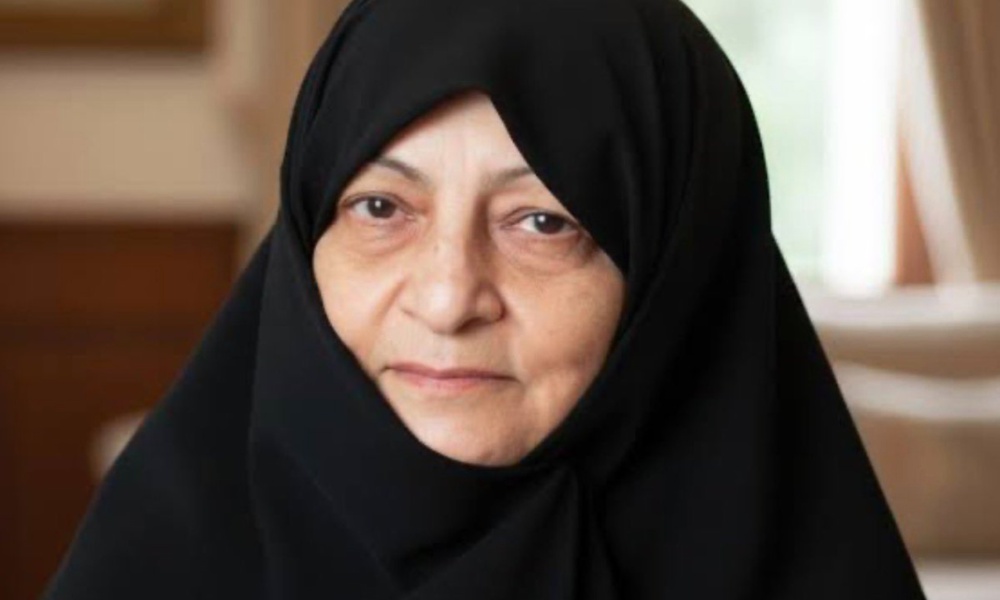
Mansoureh Khojasteh Bagherzadeh, the wife of Iran’s late supreme leader Ali Khamenei, has died after succumbing to injuries sustained in a recent airstrike on their residence in central Tehran, Iranian state media reported on Monday.
According to Iranian news outlets, including the semi-official Tasnim News Agency, Bagherzadeh had been in a coma since the strike, which took place two days ago. The attack, described by US officials as part of “Operation Epic Fury,” was reportedly carried out by the United States and Israel amid escalating hostilities with Iran.
Iranian authorities confirmed over the weekend that Khamenei was killed in the same strike, along with several members of his family and senior leaders who were present at the compound. State media characterized the attack as a major escalation and a severe blow to the country’s leadership structure.
Khamenei, 86, had served as Iran’s Supreme Leader since 1989, holding ultimate authority over the state, armed forces, and key institutions including the Islamic Revolutionary Guard Corps (IRGC).
His death marks one of the most consequential developments in the ongoing conflict and raises significant questions about Iran’s political succession and regional posture.
Bagherzadeh, believed to have been in her late seventies, largely remained out of public view throughout her husband’s decades in power. Married in the mid-1960s, the couple had six children. Despite her proximity to one of the region’s most powerful figures, she maintained a private life and held no official political role.
In a rare interview with Iranian state media in 2011, she described her role as creating a calm home environment to support her husband’s political responsibilities. She also recounted visiting him during his imprisonment under the Shah’s rule and assisting with revolutionary activities prior to 1979.
The killing of Khamenei and members of his family represents a dramatic turning point in the crisis, with regional and international observers warning of heightened instability in an already volatile security landscape.




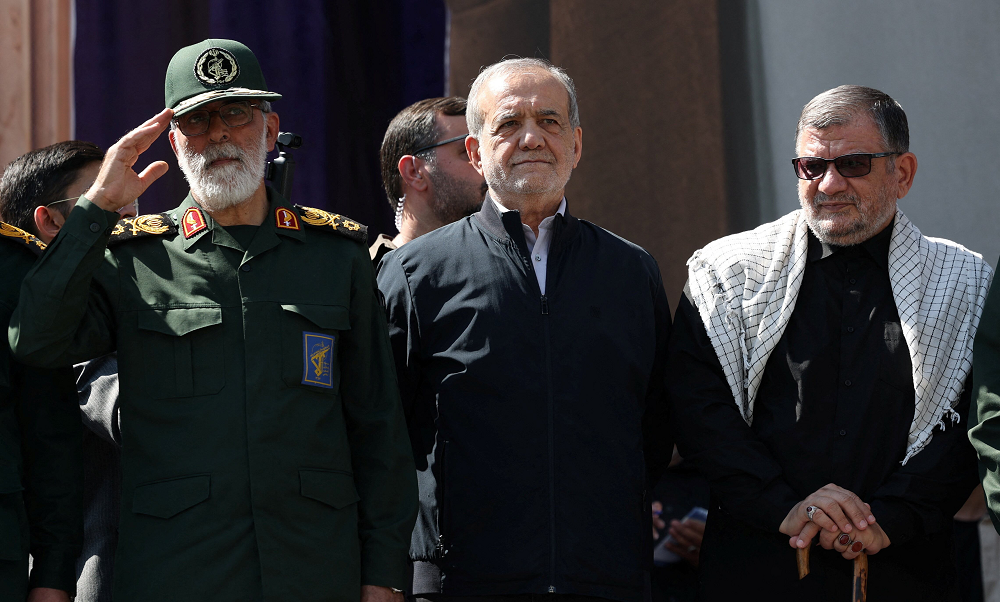
Iran and the United States exchanged new threats on Sunday, with President Donald Trump warning Iran would fail economically or face its leadership being wiped out if it didn’t make a deal, and the Iranian military saying it would retaliate harshly to any fresh attack.
The conflict has looked stalemated for months, with no sign either side was ready for concessions even as it has deepened a global energy crisis, cratered swathes of Iran’s economy and spilled over into new regional escalations, Reuters reported.
In a phone call with a Fox News reporter, Trump said Iran’s leaders should make a deal, rot economically or be wiped out, the reporter said.
However, with Iran’s President Masoud Pezeshkian expected in New York this week for the United Nations General Assembly, Trump said he would be open to meeting him, the Fox reporter added.
Trump has repeatedly made vague threats of major military escalations during the conflict that began with US and Israeli strikes on February 28, without carrying them out.
Earlier, Iran’s military central command said any new attack would trigger sustained retaliation against US bases and interests and that Washington’s regional allies would be considered parties to the conflict.
The Iranian military added that it had information that an attack was being prepared, without elaborating on what that information might be.
HOUTHIS TARGET RIYADH
US Gulf allies have already been badly scarred by a war that the US and Israel launched with no warning, bringing their cities under Iranian fire and hammering their economies with the crucial Strait of Hormuz waterway blockaded.
On Saturday their predicament worsened further, with Yemen’s Iran-backed Houthi group launching missile and drone strikes at the Saudi capital after having made sudden military gains in Yemen’s reignited civil war earlier this month.
Reuters video showed a massive plume of black smoke billowing from the area of Riyadh’s main international airport following booms overnight.
The US State Department issued a security alert citing the Houthi hostilities. It said there was potential for unforeseen escalation in the Middle East, and Americans should exercise more vigilance and be aware of possible flight cancellations and airspace closures.
Saudi Arabia did not comment on the incident, though a Saudi-led coalition fighting the Houthis said it had foiled other attacks on the kingdom.
Recent escalation by the Houthis has forced Riyadh into a painful dilemma: continue airstrikes on the group to stop it seizing more Yemeni territory or step back in the hopes of averting drone strikes on critical infrastructure.
ENERGY EXPORTS BLOCKADED
The Houthi gains along the coast mean the group’s forces now sit on the Bab el-Mandeb Strait, giving them easier control over shipping travelling between the Red Sea and Asia and the ability to blockade the crucial waterway.
With Iran already having blockaded most shipping in the Strait of Hormuz, the oil-rich Gulf’s energy exports are now almost entirely cut off from global markets, adding to pressure on oil prices.
A US blockade of Iranian ports is meanwhile stopping Iran from selling its own oil, contributing to major problems in the Islamic Republic’s economy.
Despite the economic damage, there is little sign of a return to the interim ceasefire agreement that was struck in June but fell apart in July amid disputes over its terms.
Iran reiterated on Sunday that it would not reopen the Strait of Hormuz until the terms of that June agreement, as it interpreted them, were met.
Iranian Parliament Speaker Mohammad Baqer Qalibaf said Iran would have to keep on fighting as well as negotiating, to push back its enemies and to consolidate any gains with diplomacy.
Regional
Flames, smoke seen near Riyadh airport; Houthis claim attacks on Saudi capital
The Saudi-led military coalition fighting the Houthis said its air defences had destroyed a missile fired by the Yemeni group toward Riyadh early on Saturday.
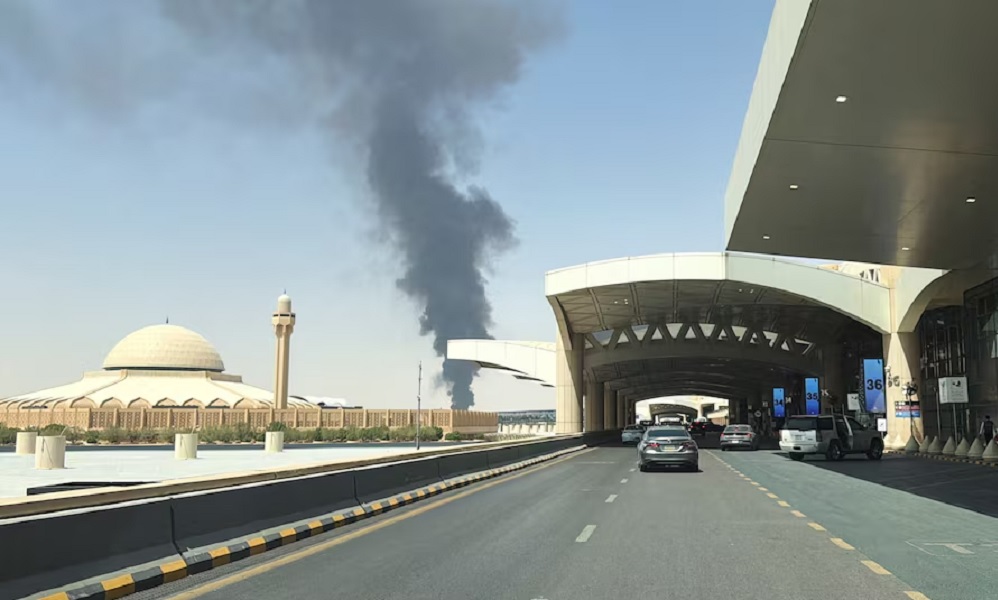
Yemen’s Houthis said they attacked “sensitive” sites in the Saudi capital Riyadh on Saturday with missiles and drones, hours after flames and a large plume of smoke were seen near the city’s main airport.
Saudi Arabia had sent alerts overnight warning of potential danger around Riyadh, amid an escalation in attacks by the Houthis in the kingdom, Reuters reported.
Reuters video and photographs showed a huge pillar of black smoke rising in the area, with the airport highway, main terminal building and other facilities in the foreground. At one point in the video, flames were visible rising from behind what appeared to be fuel tanks.
While the Iranian-backed Houthis have launched repeated attacks against Saudi Arabia since July, Saturday’s claim appeared to be their first reported strike on Riyadh since the current escalation began.
The Houthis did not specify what they had targeted in Riyadh, but said they had also attacked an Aramco facility in the Red Sea city of Yanbu, a key Saudi oil export hub.
They said the operation came as a response to an attack in the Yemeni capital Sanaa.
The Saudi-led military coalition fighting the Houthis said its air defences had destroyed a missile fired by the Yemeni group toward Riyadh early on Saturday.
In a statement, the coalition also said it had foiled attacks targeting civilians in the Saudi cities of Bish and Farasan in the southwest and Taif in the west, as well as Yanbu on the Red Sea coast. It did not say whether there was any damage.
Saudi civil defence sent the alerts by phone overnight for potential danger of aerial attacks in Riyadh and the city of Al-Kharj east of the capital, before issuing an all-clear on Saturday morning. A Reuters journalist in Riyadh’s Olaya area heard booms before the all-clear was sent.
Although some alerts had been issued in Riyadh this year after the start of the US-Iran war, these were the first since the escalation with the Houthis began in July.
The fighting between the Houthis and Saudi Arabia has developed as a new theatre of conflict in the wider war that began with US and Israeli strikes against Iran at the end of February. US President Donald Trump has rebuffed Saudi requests for direct US military intervention against the Houthis.
A US State Department security alert issued on Saturday for Americans in the Middle East cited Houthi attacks. The State Department urged US citizens in the region to “exercise heightened vigilance” and that Americans outside the Middle East “should seriously reconsider travel to and through the region.”
HOUTHI WARNING
The Houthis, who control the most populous parts of Yemen and much of the north, have been launching attacks against Saudi Arabia since declaring a naval blockade against Riyadh in July, with strikes targeting Saudi vessels in the Red Sea.
The attacks have targeted Saudi cities, energy infrastructure and shipping, creating new threats to global oil supplies and putting at risk the main alternative Red Sea route for Gulf exports while traffic through the Strait of Hormuz remains blockaded.
Turkish Foreign Minister Hakan Fidan said Saudi Arabia may have military needs due to the ongoing Houthi attacks and Turkey was ready to help under a trilateral defence pact that also includes Pakistan.
It was unclear what kind of support Turkey might provide but Fidan, in an interview with broadcaster NTV, said Saudi needs could include “some technical issues.”
The trilateral agreement signed last month stipulates that an armed attack on any of the three countries would be regarded as an attack on all of them.
Mohsen Rezaei, secretary of Iran’s Supreme National Security Council, told Al Jazeera in an interview aired on Saturday that Tehran wanted the war between Saudi Arabia and the Houthis to end, adding that he believed Yemenis also wanted a settlement with Saudi Arabia.
Rezaei also said Iran had conveyed its conditions to mediators for re-engaging in stalled negotiations with the United States, including “ending the war on all fronts”.
Consultations were continuing with Qatari and Pakistani mediators and Tehran was awaiting a response from Trump, Rezaei said.
The UN Security Council in a statement on Friday “condemned in the strongest terms continued Houthi attacks against the Kingdom of Saudi Arabia, including attacks impacting civilian and energy infrastructure, which have resulted in the injury of civilians, including women and children.”
In the statement, the Security Council also condemned “Houthi military escalation in Yemen”.
Iran executed a man convicted of passing missile site intelligence to Israel during the 12-day war, according to the judiciary.
Iran’s judiciary-run Mizan news agency said Hossein Pedaran was hanged after the Supreme Court upheld his death sentence on charges of espionage and intelligence cooperation with Israel, Reuters reported.
It said Pedaran had provided Israel’s Mossad intelligence service with information on sensitive military sites in the central province of Isfahan, and had carried out the espionage for financial gain.


Afghanistan summons Pakistani diplomat over airstrikes in Kunar and Paktika

Three civilians killed, four wounded in Kunar airstrikes

Afghanistan to face Japan and Nepal in Asian Games cricket group stage

Four-day polio vaccination campaign begins across Afghanistan

Humanoid robot sales tally hit 7,000 globally last year

Four mediators struggle to secure lasting Pakistan-Afghanistan ceasefire

Afghanistan’s trade diversification challenges Pakistan

Saudi energy group signs major Afghanistan deals covering gas exploration and pipeline plans

ATN secures exclusive rights to broadcast T20I series in India across Afghanistan

Afghanistan squad announced for three-match T20I series against India

Tahawol: Impact of middle East war on Afghanistan

Saar: Pakistan blames Afghanistan for deadly attack

Tahawol: Kabul’s warning over any threat from Pakistan discussed

Debate on Afghanistan and New Investment Opportunities

Tahawol: Reasons behind Qatari, Turkish security officials’ Kabul visit discussed
-

 Latest News4 days ago
Five years out of school: Amnesty raises alarm over Afghan girls’ education
-
 Latest News4 days ago
Russia urges dialogue and economic support for Afghanistan, warns against excessive pressure
-

 Sport5 days ago
ACL: Ariana Khost win, Aino Mina and Khurasan Faryab draw
-
 Latest News3 days ago
Afghanistan seeks stronger ties with Saudi Arabia, dialogue with Pakistan: Mujahid
-
 Regional4 days ago
US officials met Iran-backed Houthis in Oman over the weekend
-
 Latest News5 days ago
Sirajuddin Haqqani meets Turkish intelligence chief
-
 Latest News4 days ago
US sentences Afghan man to 20 year in case linked to 2021 Kabul airport bombing
-

 Tahawol5 days ago
Tahawol: Afghanistan’s readiness for US relations discussed