
Latest News
FM Muttaqi and Iran’s envoy discuss political, economic issues

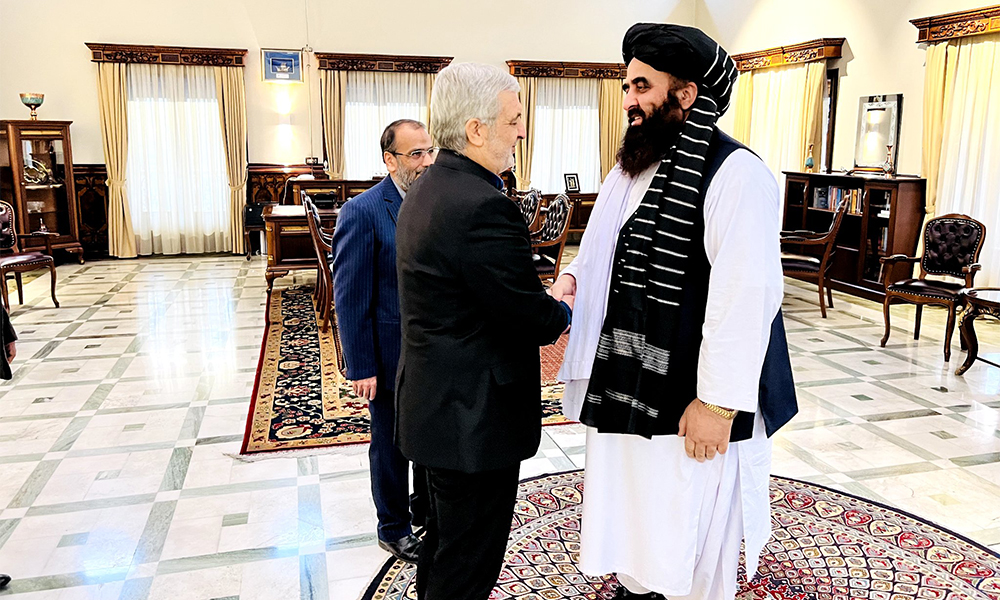
Amir Khan Muttaqi, the foreign minister of the Islamic Emirate, and Hassan Kazemi Qomi, Iran’s ambassador and special representative for Afghanistan, met on Sunday to discuss issues of interest including the need for good relations, the foreign ministry said.
Hafiz Zia Ahmad, the Deputy Spokesperson of the Ministry of Foreign Affairs said Monday the two sides discussed political and economic issues between the two countries, emphasizing good neighborliness and mutual interests.
During the meeting Hassan Kazemi Qomi, Iran’s new ambassador in Kabul, said that considering the importance of water, efforts should be made to manage water in such a way that it is not wasted and Iran’s right to it is maintained.
Muttaqi also said that the Islamic Emirate is committed to respecting Iran’s water rights according to the 1351 treaty between the two countries.
Muttaqi has stated that with little rain over the past few months, there is a water shortage in the country, which is a real problem.
The issue of water has long been a problem for Iran, primarily around water from the Helmand River, which originates near Kabul and flows south-west for about 1,100 kilometers before emptying into Lake Hamun, located on the Afghan-Iranian border.
Afghan authorities have however constructed the Kamal Khal Dam along this river – which Iran has always opposed.
According to Iranian experts, Lake Hamun and dozens of wetlands fed by the Helmand River waters may dry up due to water intake at the Kamal Khan Dam.
In 1973, the two countries signed the Water Treaty of Helmand River protocol, which Iran regards as a basis for compliance by the other side. Based on the agreement, Afghanistan is committed to delivering an average of 820 million cubic meters of water per annum to Iran. This water runs into the Hamun marshland along the length of its common border.
Iran has accused Afghanistan of violating its water rights, claiming that it gets less water than the amount agreed upon in the 1973 treaty. The former Afghan government rejected the accusation.
Iran’s annual rainfall is about 240 mm, which is significantly lower than the global average of 990 mm. Water shortages are particularly critical in the east of the country which has an average precipitation of about 115 mm per year. Therefore, Iran needs secure access to border rivers, especially those in the east, as the country’s water consumption grows.












Kazakhstan’s Foreign Minister Mukhtar Tileuberdi has called for pragmatic and coordinated international engagement with Afghanistan, saying the country’s long-term stability is closely linked to the security and sustainable development of Central Asia.
Speaking during the general debate of the 81st session of the United Nations General Assembly in New York on Friday, Tileuberdi said humanitarian assistance to Afghanistan remains essential but alone cannot break the cycle of poverty, displacement and dependency.
He said Kazakhstan supports a “pragmatic, coordinated and step-by-step” approach to international engagement with Afghanistan, with the United Nations playing a central role.
Tileuberdi also said Kazakhstan is working with the UN to operationalize the United Nations Regional Centre for the Sustainable Development Goals for Central Asia and Afghanistan in Almaty.
He said the success of the centre should be measured by the results and assistance it delivers to the region.


Abu Muslim Farah defeat Khurasan Faryab 2-0 in ACL season six

Saar: Concerns over Pakistan’s political crisis discussed

Afghanistan Champions League: Omar Zawak Herat beat Toofan Herat 1-0

Blast in Pakistan’s Dera Ismail Khan kills 11, injures 30

Ariana Afghan Airlines increases Kabul-Delhi cargo flights

Saudi energy group signs major Afghanistan deals covering gas exploration and pipeline plans

Trump floats idea of renaming Atlantic or Pacific Ocean

US hits Egyptian bank branches with Iran sanctions as war marks six months

Nepal flood rescue mission enters critical phase as thousands remain missing

Iranian clubs to face Gulf opponents at neutral venues in Asian Champions League Elite
Saar: Concerns over Pakistan’s political crisis discussed

Exclusive interview with Abdul Latif Mansoor, Minister of MRRD

Tawsia: Overview of Afghanistan’s iron mines

Tahawol: Discussion on fresh Pakistani airstrikes on Afghanistan

Saar: Calls for international support for Afghanistan discussed
-

 World5 days ago
CNN, MS NOW and Politico sue Trump, challenging White House ban
-

 Latest News3 days ago
Ariana Afghan Airlines ranks seventh among 45 Central Asian airlines
-

 Latest News5 days ago
UN reiterates call for respect for international law after Kunar airstrikes
-

 Regional4 days ago
US and Iran hold first talks since June after Trump’s ‘annihilation’ threat
-

 Latest News4 days ago
Silk Road highway in Wakhan corridor now reaches the China border
-

 Regional3 days ago
Iran airlines cancel flights as US sanctions hit
-

 Latest News5 days ago
Afghan Official: Pakistan’s airstrikes will not go unanswered
-

 Sport5 days ago
Afghan boxing referee heads to China for international festival