
Regional
Putin arrives in China to deepen strategic partnership with Xi

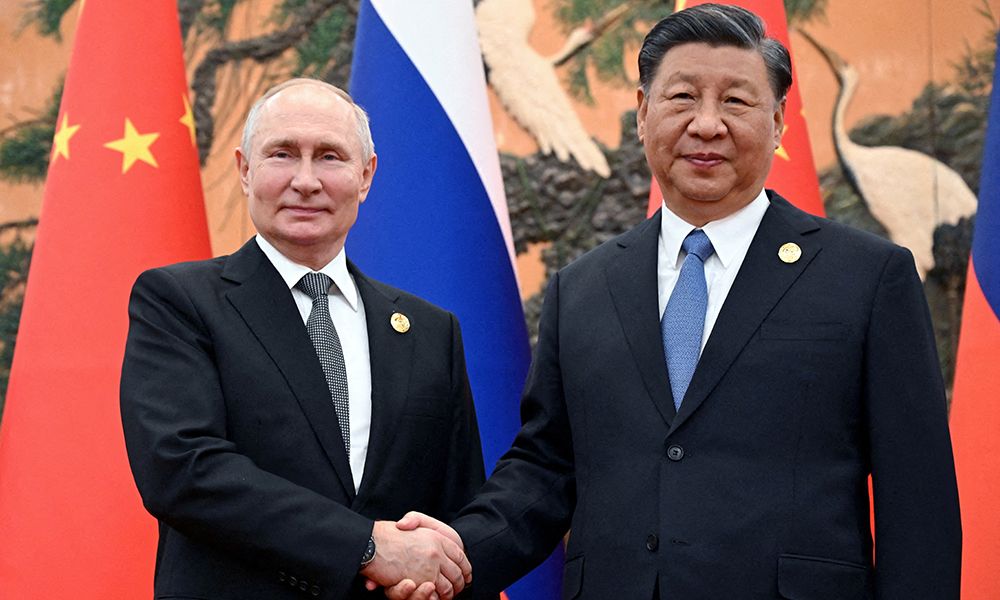
Russian President Vladimir Putin arrived in Beijing early on Thursday for talks with Xi Jinping that the Kremlin hopes will deepen a strategic partnership between the two most powerful geopolitical rivals of the United States, Reuters reported.
China and Russia declared a “no limits” partnership in February 2022 when Putin visited Beijing just days before he sent tens of thousands of troops into Ukraine, triggering the deadliest land war in Europe since World War Two.
By picking China for his first foreign trip since being sworn in for a six-year term that will keep him in power until at least 2030, Putin is sending a message to the world about his priorities and the depth of his personal relationship with Xi.
In an interview with China’s Xinhua news agency, Putin praised Xi for helping to build a “strategic partnership” with Russia based on national interests and deep mutual trust.
“It was the unprecedentedly high level of the strategic partnership between our countries that determined my choice of China as the first state that I would visit after officially taking office as president of the Russian Federation,” Putin said.
“We will try to establish closer cooperation in the field of industry and high technology, space and peaceful nuclear energy, artificial intelligence, renewable energy sources and other innovative sectors,” Putin said.
Putin, 71, and Xi, 70, will take part in a gala evening celebrating 75 years since the Soviet Union recognised the People’s Republic of China, which was declared by Mao Zedong in 1949, read the report.
Xinhua confirmed his arrival for what China’s state press has described as a state visit from an “old friend”.
Putin’s arrival and visit is the top trending item on the Chinese social media platform Weibo, with 1.4 million search requests amid a stream of images, videos and comments.
The United States casts China as its biggest competitor and Russia as its biggest nation-state threat while U.S. President Joe Biden argues that this century will be defined by an existential contest between democracies and autocracies.
Putin and Xi share a broad world view, which sees the West as decadent and in decline just as China challenges U.S. supremacy in everything from quantum computing and synthetic biology to espionage and hard military power.
Putin will also visit Harbin in northeastern China, a city with historic ties to Russia. A mall devoted to Russian-made goods representing some 80 Russian manufacturers opened on Thursday, the China Daily reported.
XI AND PUTIN
China has strengthened its trade and military ties with Russia in recent years as the United States and its allies imposed sanctions against both countries, particularly against Moscow for the invasion of Ukraine, Reuters reported.
The West says China has played a crucial role in helping Russia withstand the sanctions and has supplied key technology which Russia has used on the battlefield in Ukraine.
But China, once the junior partner of Moscow in the global Communist hierarchy, remains by far the most powerful of Russia’s friends in the world.
Putin’s arrival follows a mission to Beijing late last month by U.S. Secretary of State Antony Blinken, in part to warn China’s top diplomat Wang Yi against deepening military support for Russia.
Kremlin foreign policy aide Yuri Ushakov said that the two leaders would hold informal talks on Thursday evening over tea and that they would touch on Ukraine, Asia, energy and trade.
Putin’s newly appointed defence minister, Andrei Belousov, as well as Foreign Minister Sergei Lavrov, Security Council Secretary Sergei Shoigu and foreign policy adviser Yuri Ushakov, will also attend, along with Russia’s most powerful CEOs.
It was not immediately clear if Gazprom (GAZP.MM), opens new tab CEO Alexei Miller would go to China as he was on a working visit to Iran on Wednesday, Reuters reported.




Regional
Iran ties Hormuz reopening to US concessions on several demands
Araqchi said reopening the strait would depend in part on the U.S. paying compensation for damage it caused in widespread attacks on Iran.
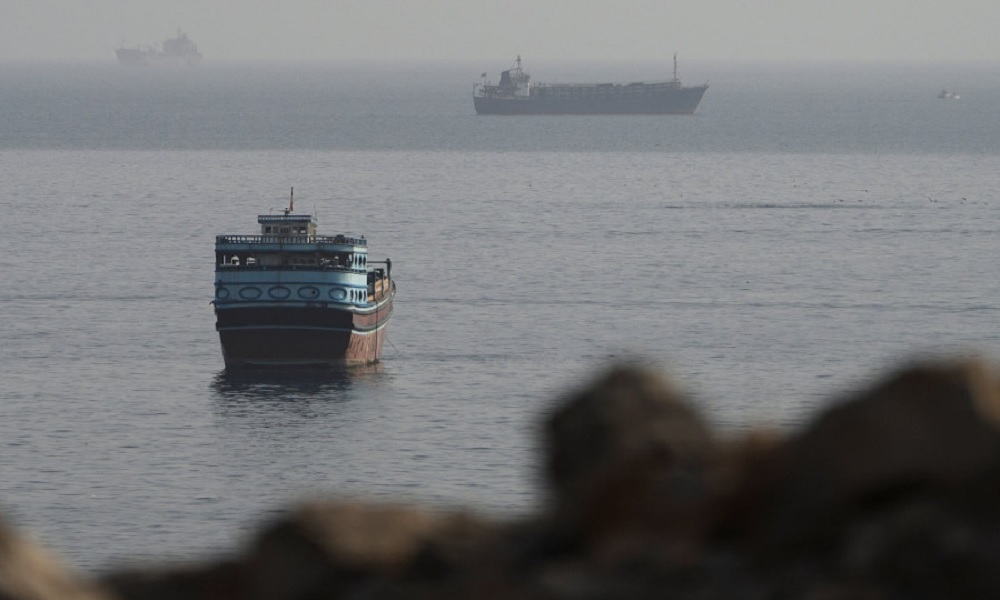
Iran said it was nearing a final pact with Oman defining new shipping lanes between them through the Strait of Hormuz but repeated that the U.S. must meet other conditions, including compensation and an end to sanctions and military threats, before the strategic waterway is reopened.
A U.S. official told Reuters on Friday that Iran and Oman were close to a deal that could pave the way for restoring safe passage through the strait, a major conduit for oil and gas shipping before Iran blocked Hormuz in response to U.S. and Israeli attacks on Tehran that began in late February, Reuters reported.
Iranian Foreign Minister Abbas Araqchi said on Sunday an agreement with Oman on the strait was in its “final stages” but reiterated comments made on Saturday that Tehran would not reopen the channel unless the U.S. met certain demands made by Tehran.
The deal with Iran would set out the new shipping lanes to be used once the U.S. fulfils those conditions and the strait is reopened, Iran’s Mehr news agency quoted him as saying.
Iran and the U.S. are not engaged in direct talks, and Tehran will not start them as long as Washington breaches an interim deal signed in June, Araqchi said, adding that messages were being exchanged through intermediaries.
U.S. President Donald Trump said in an interview with Axios that the U.S. was “low-keying” it with Iran. “We are only semi-negotiating with them. We are just watching Iran with its huge inflation and the fact they have no money.”
CONDITIONS INCLUDE COMPENSATION
Araqchi said reopening the strait would depend in part on the U.S. paying compensation for damage it caused in widespread attacks on Iran.
The secretary of Iran’s top national security body, Mohammad Baqer Zolqadr, also listed ending further U.S. threats against Iran; halting aggression toward Iran and its Lebanese, Palestinian, Yemeni and Iraqi allies; removing a U.S. naval blockade in the Gulf; lifting sanctions on Iran; and releasing frozen Iranian assets.
The United States and Israel launched air strikes on Iran more than five months ago. Trump has said the attacks were aimed at keeping the Islamic Republic from developing nuclear weapons and degrading its ability to threaten the region.
Washington and Tehran agreed to a ceasefire in June, but the U.S. reimposed a blockade on Iranian shipping in the Gulf in July, a move that Tehran said violated the truce, which by then had already broken down.
“Once the deal is announced to restore commercial shipping without impediments, the United States will lift the blockade of Iranian ports,” the U.S. official told Reuters on condition of anonymity.
U.S. actions would be tied to Iran’s implementation of its commitments, the official said.
The U.S. comments indicated delicate sequencing toward a deal that sources had told Reuters appeared to be set to give Tehran control over vessel traffic entering the Gulf through the strait, which shippers have said was not easily workable.
The United Arab Emirates said on Saturday that Iran had attacked a ship affiliated with its state oil company. There was no immediate comment from Iran, whose Revolutionary Guard Corps previously has attacked ships that it said tried to cross the strait without Iranian permission.
HOUTHI ATTACKS
Iranian strikes on Strait of Hormuz shipping have been coupled with increased attacks by its Yemen-based allies, the Houthi rebels, who have targeted ships at another oil chokepoint on the other side of the Arabian Peninsula between the Red Sea and Gulf of Aden.
The Houthis also declared a naval blockade against Saudi Arabia in the Red Sea last month in response to what they said was a Saudi siege on them in Yemen, an allegation denied by Riyadh, which backs Yemen’s internationally recognised government.
The Yemeni rebel group said they had attacked Saudi Aramco’s Jazan refinery on Sunday, two days after the kingdom signed a defence pact with Sunni Muslim allies Turkey and Pakistan in response to growing regional instability from the U.S.-Israeli war on Shi’ite Iran.
The Saudi energy ministry said a fire had broken out at the refinery but was later extinguished with no injuries, without giving a cause.
Turkish Foreign Minister Hakan Fidan said the new alliance was not directed against Iran or any other country, but rather served as a general pledge to support security.
Fighting has escalated between the Houthis and government forces in Yemen, with the Yemeni military on Monday saying seven people including military personnel and civilians were killed in a Houthi attack on the Red Sea port city of Mocha.
Air defences intercepted and shot down 11 Houthi drones that participated in the attack, the military said.
Regional
Turkey, Pakistan, Saudi Arabia defence pact technically same as NATO’s Article 5, Turkish minister says
Fidan also said Turkish President Tayyip Erdogan wanted to see the alliance expand, and that Egypt was a potential candidate to join, among others.
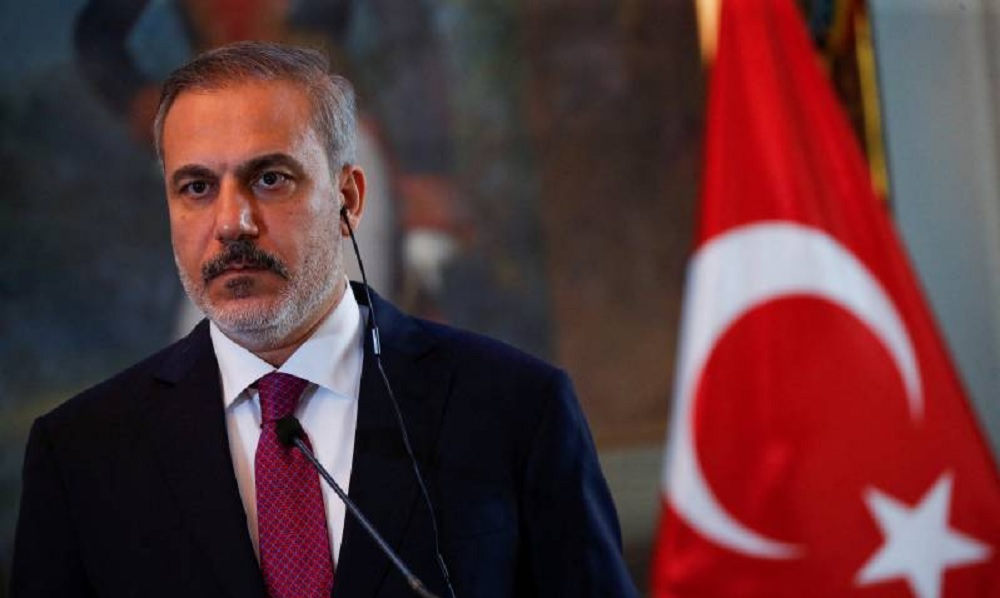
A defence pact signed between Turkey, Pakistan and Saudi Arabia is technically the same as NATO’s Article 5 mutual defence agreement, Turkish Foreign Minister Hakan Fidan said on Saturday, adding the accord was not targeting Iran.
Fidan also said Turkish President Tayyip Erdogan wanted to see the alliance expand, and that Egypt was a potential candidate to join, among others.
The regional powers signed the “Mecca Joint Defence Agreement” on Friday, wedding Sunni Muslim U.S. allies alarmed at a regional conflagration that has brought Iranian missile fire onto Gulf oil exporters.
In a joint statement, they said the accord intended to strengthen collective deterrence against any act of aggression and stipulates that an armed attack against any of the three would be regarded as an attack on all.
Speaking to the state-run Anadolu news agency, Fidan said the new alliance was not directed against Iran or any other country, but rather served as a general pledge to support the three allies’ security.
He added that the allies would decide through consultations what degree, form, and format of support they would ask for in the event of an attack, but that no country would be considered a threat as long as a member state is not attacked.
Turkey, which has NATO’s second-largest army, has said the pact was open to expansion to other regional countries and did not seek to replace any existing alliances.
“NATO is a giant military alliance where there are 32 countries. We have started here as three countries and we have to take very humble but concrete steps,” he said, adding efforts to finalise the pact had been underway for two years and eight months.
He added that a committee of ministers similar to that within NATO would be formed as part of the alliance, as well as a general secretariat based in Saudi Arabia, but that operational details would be set at the first committee meeting.
“Our president’s vision is that we don’t remain limited to three countries, that we grow and bring together all (regional) countries under this roof,” he said, adding Egypt could potentially join the pact once certain technical matters are resolved.
In recent months, Turkey, Saudi Arabia, Pakistan and Egypt formed a group to address regional issues, namely the war on Iran. Turkey has said the group – dubbed the R4 – aims to solidify its partnership through concrete mechanisms.
Fidan also said Turkey should be involved in an international coalition to protect shipping in the Red Sea from Houthi attacks because shipping safety concerned Ankara’s interests.
Regional
Goods transporters to go on strike from Saturday after talks with Pakistan govt fail
However, the minister has assured the transporters that he would discuss their demands, and the next round of talks would be held on Monday morning.
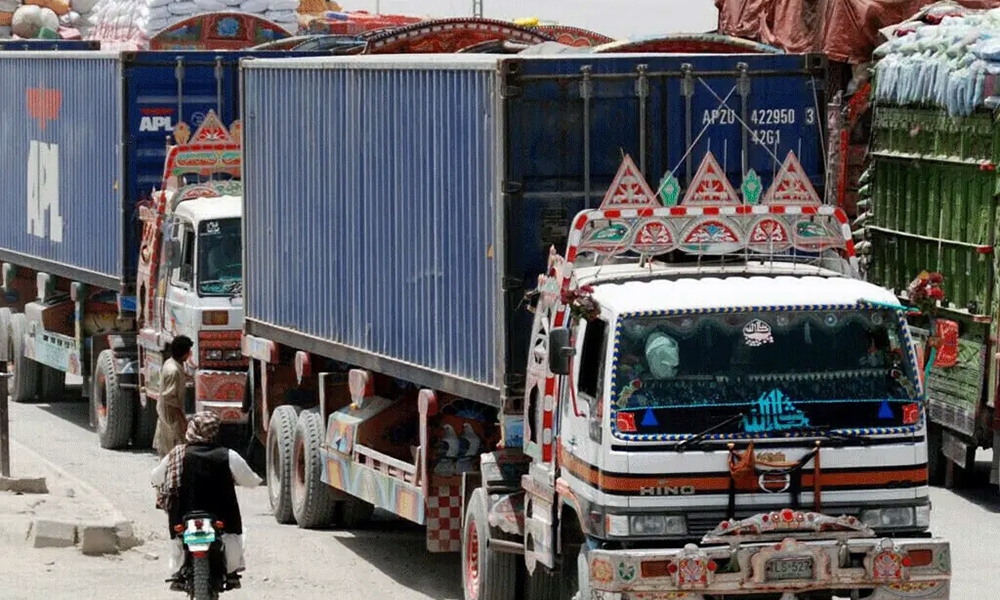
Goods transporters and oil tanker operators began suspending their services on Friday night after negotiations with the Pakistani government failed, ahead of their nationwide wheel-jam strike scheduled for Saturday.
All Pakistan Goods Transport Itehad spokesman and All Pakistan Goods Transport Owners Association President Mohammad Owais Chaudhry Advocate told Dawn that talks with Federal Minister for Communications Aleem Khan and other government officials had failed.
He said the negotiations ended without a breakthrough, prompting transporters, including edible oil tanker operators, petroleum oil tanker operators, truckers, trailer operators and other intercity transporters, to proceed with their previously announced strike.
“We have informed the government side about the problems we are facing and our concerns,” Chaudhry said, adding that the strike would continue until their demands were accepted.
However, the minister has assured the transporters that he would discuss their demands, and the next round of talks would be held on Monday morning.
The unified body of transporters had already announced that it would begin its wheel-jam strike from August 8, and warned that it would not be a token strike but an indefinite one.
“Commercial goods carriers across the country have already been taken off the roads and will remain stationed at designated places during the protest period,” Chaudhry said.
Among the key demands of the transporters is the uniform enforcement of axle-load limits across the country and permission for 10-wheel vehicles to carry up to 35 tonnes.
They have also demanded reductions in diesel prices and toll taxes, besides seeking relief in withholding tax to ease the financial burden on the transport sector.
The transporters have also called for the withdrawal of customs provisions that, according to the association, allow authorities to confiscate vehicles carrying goods found to be in violation of customs laws.
Other demands include the withdrawal of the Punjab Highway Patrol’s powers to issue challans to commercial vehicles, an end to what the association described as unnecessary challans and excessive fines on motorways and highways, and measures to facilitate the issuance of heavy transport vehicle licences to drivers.


Iran ties Hormuz reopening to US concessions on several demands

Tahawol: Afghanistan: An Alternative to the Strait of Hormuz?

Saar: Pakistan-Saudi-Turkey Pact: Regional Impact

Ariana Airlines brings $2.3 million Boeing 737 engine from US to Kabul

Israel rejects Trump’s 15-point plan for Gaza, PM Netanyahu says

Pakistan’s governance system has ‘collapsed’: Mohsin Naqvi

India offers 1,000 online scholarships for Afghan students for 2026-27 academic year

Turkey spent over $120 million to prepare airport for Qatar-donated U.S. presidential aircraft

FIFA’s inaugural YouTube Creator Cup to stream live on Ariana Television and Ariana Sport YouTube channels

FIFA World Cup semi-final line-up confirmed
Tahawol: Afghanistan: An Alternative to the Strait of Hormuz?
Saar: Pakistan-Saudi-Turkey Pact: Regional Impact

Tahawol: Escalating disputes over Iran war discussed

Saar: Turkey, Saudi Arabia and Pakistan defense pact reviewed

Tahawol: End of US sanctions waiver for Chabahar Port discussed
-
 Latest News5 days ago
Khalilzad says Pakistan needs ‘reset’ amid economic crisis and rising instability
-

 Latest News5 days ago
First Afghanistan-Ireland ODI abandoned without a ball bowled
-

 Sport5 days ago
Afghanistan aim for winning start against Ireland
-
 Sport4 days ago
Afghanistan holds Russia to 3-3 draw, earns first point at Continental Futsal Championship
-

 Latest News5 days ago
Afghan boxer appears in Greek court over death of Scottish woman
-
 Business4 days ago
Uzbekistan’s Fergana region strengthens economic ties with Afghanistan
-
 Regional4 days ago
Iran threatens to hit Gulf states if US launches new strikes
-
 World2 days ago
US Senate passes Russia sanctions championed by Graham; US House next