
Latest News
Trump preps bans on WeChat, TikTok, stoking tension with China

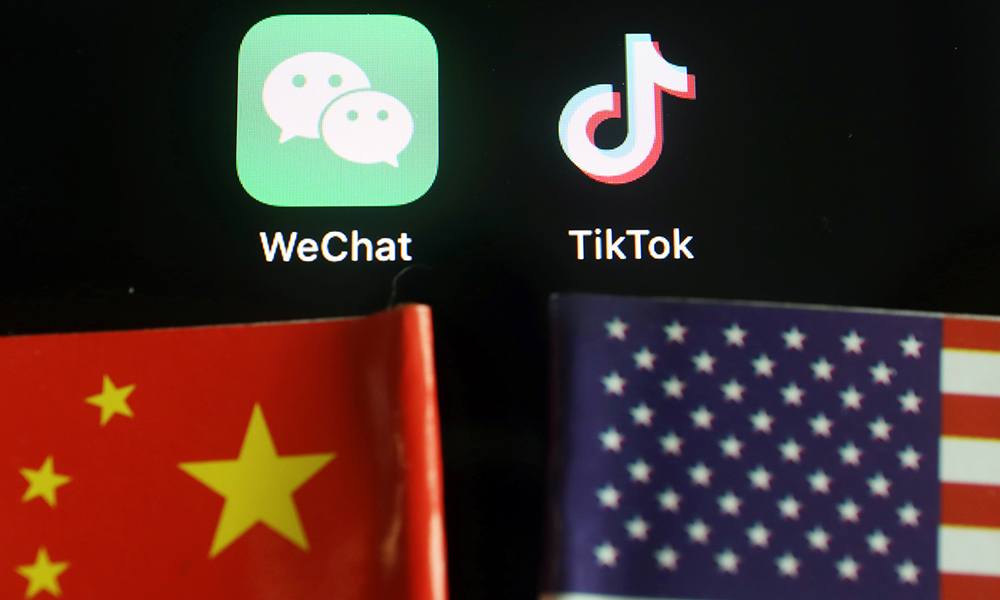
U.S. President Donald Trump has unveiled sweeping bans on U.S. transactions with the Chinese owners of messaging app WeChat and video-sharing app TikTok, escalating a high-stakes confrontation with Beijing over the future of the global tech industry.
The executive orders announced Thursday and effective in 45 days come after the Trump administration this week flagged increased effort to purge “untrusted” Chinese apps from U.S. digital networks, calling Tencent Holdings Ltd’s <0700.HK> WeChat and Bytedance’s popular TikTok “significant threats.”
China said on Friday the companies comply with U.S. laws and regulations and warned that the United States would have to “bear the consequences” of its action.
“The U.S. is using national security as an excuse and using state power to oppress non-American businesses. That’s just a hegemonic practice,” foreign ministry spokesman Wang Wenbin told a media briefing.
TikTok has come under fire from U.S. lawmakers over national security concerns surrounding data collection as distrust between Washington and Beijing grows. Reuters on Sunday reported that Trump has given Microsoft Corp <MSFT.O> 45 days to complete the purchase of TikTok’s U.S. operations.
“We are shocked by the recent Executive Order, which was issued without any due process,” TikTok said in a statement on Friday, adding that it would “pursue all remedies available to us in order to ensure that the rule of law is not discarded”.
The ban on U.S. transactions with Tencent, one of the world’s biggest internet companies, portends further fracturing of the global internet and severing of long-standing ties between the tech industries in the United States and China.
“This is the rupture in the digital world between the U.S. and China,” said James Lewis, a technology expert with Washington-based think-tank Center for Strategic and International Studies.
“Absolutely, China will retaliate.”
On Wednesday, U.S. Secretary of State Mike Pompeo expanded a program dubbed “Clean Network” to prevent various Chinese apps and telecoms firms from accessing sensitive information on U.S. citizens and businesses.
Trump’s new orders appeared coordinated with Pompeo’s announcement, Lewis said.
“We are reviewing the executive order to get a full understanding,” a Tencent spokesperson said.
ByteDance declined to comment.
WeChat has been downloaded a relatively small 19 million times in the United States, showed data from Sensor Tower. In China, however, the app is ubiquitous as a medium for services as varied as games and payment. It is also a common platform to communicate with individuals and businesses outside China.
U.S. social media and messaging services such Facebook Inc’s WhatsApp and Messenger are blocked in China, where a “great firewall” prevents citizens from freely accessing the worldwide web, and where online communication is routinely monitored and censored.
U.S. concerns about China’s tech industry had until recently focused on telecom equipment vendor Huawei Technologies Co Ltd [HWT.UL]. As relations soured over a host of economic and human rights issues, it has sanctioned numerous other Chinese tech firms.
Tencent is the biggest target yet. It is Asia’s second most-valuable company after Alibaba Group Holding Ltd <BABA.N> with a market capitalization of $686 billion, and is among the world’s largest social media and video game companies. It opened a California gaming studio this summer and owns minority stakes in numerous gaming and internet firms around the world, including U.S. messaging app operator Snap Inc.
Trump’s order sent Asian stock markets lower on Friday, with Tencent shares falling as far as 10.1% before recouping some of its losses in afternoon trade. [MKTS/GLOB]
The yuan, a barometer of Sino-U.S. relations, posted its steepest drop since the United States expelled China from its Houston consulate a little over two weeks ago. [CNY/]
Trump issued the orders under the International Emergency Economic Powers Act, a law that grants the administration sweeping power to bar U.S. firms or citizens from trading or conducting financial transactions with sanctioned parties.
Commerce Secretary Wilbur Ross will identify transactions covered after the orders take effect in mid-September.
Tension has been simmering between the two powers for months, with the United States taking issue with China’s handling of the novel coronavirus outbreak and moves to curb freedoms in Hong Kong. The increasingly aggressive posture towards China comes as Trump bids for re-election in November.
Trump said this week he would support Microsoft’s efforts to buy TikTok’s U.S. operations if the U.S. government got a “substantial portion” of the proceeds. He nevertheless said he will ban the popular app on Sept. 15, though some Republicans have raised concerns about potential political fallout.
The app may be used for disinformation campaigns that benefit the Chinese Communist Party, and the United States “must take aggressive action against the owners of TikTok to protect our national security,” Trump said in one order.
In the other, Trump said WeChat “automatically captures vast swaths of information from its users. This data collection threatens to allow the Chinese Communist Party access to Americans’ personal and proprietary information.”
The United States is not alone in its concern about Chinese internet apps: WeChat and TikTok were among 59 mostly Chinese apps that India outlawed in June for threatening its “sovereignty and integrity”.
The WeChat order would effectively ban the app in the United States by barring “to the extent permitted under applicable law, any transaction that is related to WeChat by any person, or with respect to any property, subject to the jurisdiction of the United States, with Tencent Holdings Ltd.”
It was not clear whether the sanction would effect Tencent’s other holdings in the country.
Meanwhile, WeChat users in the United States were quickly evaluating alternatives.
“Banning WeChat is against America’s liberal principles,” Jeason Ma, a 33-year-old in Los Angeles who obtained U.S. citizenship in November, told Reuters. “Most of our family and friends are in China. This will cause significant inconvenience to our lives.”
Ma has been sharing his account information for WhatsApp and messaging rival Line Corp with friends and family, fearing he could lose access to WeChat.
The order “calls TikTok a national security threat,” said Derek Scissors, an expert on Sino-U.S. economic relations at the American Enterprise Institute think-tank. “Either we’ve missed the threat for three years or it just became one and yet we are waiting 45 days.”
Source: Reuters








Gul Hassan Hassan, the Islamic Emirate of Afghanistan’s Ambassador to Moscow, met Saturday separately with Russian Deputy Prime Minister Alexey Overchuk, President of the Russian Chamber of Commerce and Industry Sergey Katyrin, and several other Russian officials on the sidelines of the St. Petersburg International Economic Forum.
According to the Afghan Embassy in Russia, the discussions focused on strengthening bilateral economic and trade ties, expanding opportunities for Afghan traders, and supporting Afghan nationals and students residing in St. Petersburg.
Latest News
Canada convenes UN Afghanistan meeting amid ongoing humanitarian crisis
The meeting comes as the UN Security Council prepares to renew UNAMA’s mandate before its expiry on 17 June, alongside its quarterly briefing on Afghanistan.
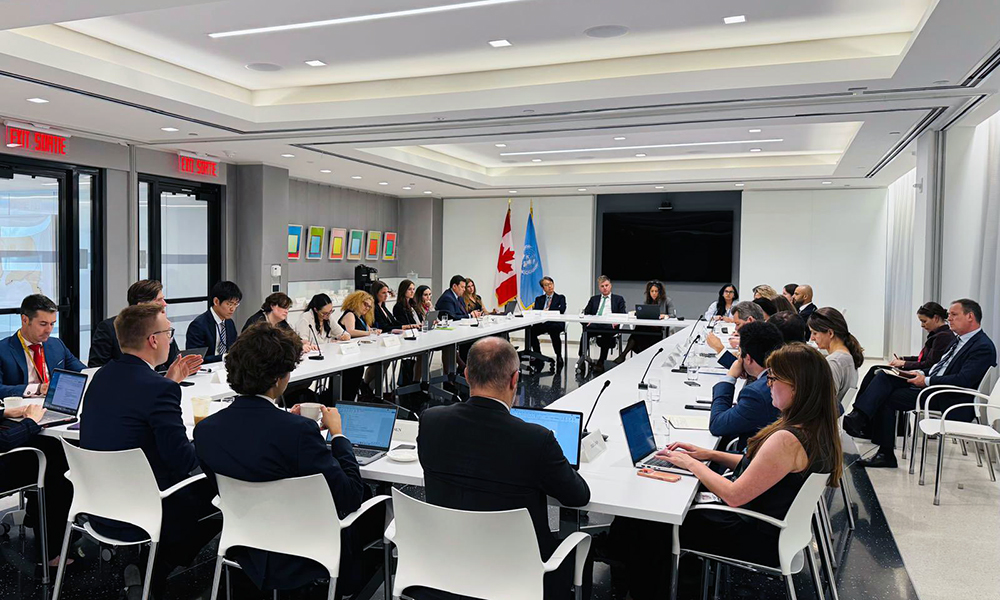
Canada has convened a meeting of the Group of Friends of Afghanistan at the United Nations, bringing together international partners to assess the country’s worsening political, humanitarian, security, and human rights situation ahead of a key UN Security Council review of the mission in Kabul.
Briefings from the United Nations Assistance Mission in Afghanistan (UNAMA) and the International Committee of the Red Cross (ICRC) highlighted the scale of Afghanistan’s ongoing crises, including severe humanitarian need, rising insecurity, and deepening restrictions on human rights.
UN officials warned that nearly 21.9 million people require humanitarian assistance in 2026, with millions facing acute food insecurity and a worsening child malnutrition crisis.
Funding shortfalls and restricted humanitarian access continue to limit relief operations, while large-scale returns from Iran and Pakistan are adding further pressure on already overstretched systems.
Security concerns remain acute, with UNAMA reporting continued cross-border tensions between Afghanistan and Pakistan, including intermittent clashes, airstrikes, and drone activity. These incidents have disrupted trade routes, heightened regional instability, and contributed to civilian casualties.
Human rights conditions, particularly for women and girls, were also raised as a central concern, with UN agencies warning that ongoing restrictions are deepening exclusion from education, work, and public life, and entrenching systemic discrimination.
The meeting comes as the UN Security Council prepares to renew UNAMA’s mandate before its expiry on 17 June, alongside its quarterly briefing on Afghanistan. Diplomats are expected to review the mission’s role amid calls from some members for a strategic reassessment of its priorities.
While Council members broadly agree on the need for an inclusive government and prevention of terrorism, divisions remain over international engagement, sanctions, and the linking of aid to human rights conditions.
Canada has continued to position the Group of Friends as a platform to sustain international attention on Afghanistan and coordinate responses to the country’s prolonged crisis.
Latest News
Uzbekistan advances feasibility study for Trans-Afghan Railway Project
The project gained momentum in July 2025 when Uzbekistan, Afghanistan and Pakistan signed a trilateral agreement in Kabul to jointly prepare the feasibility study for the railway.
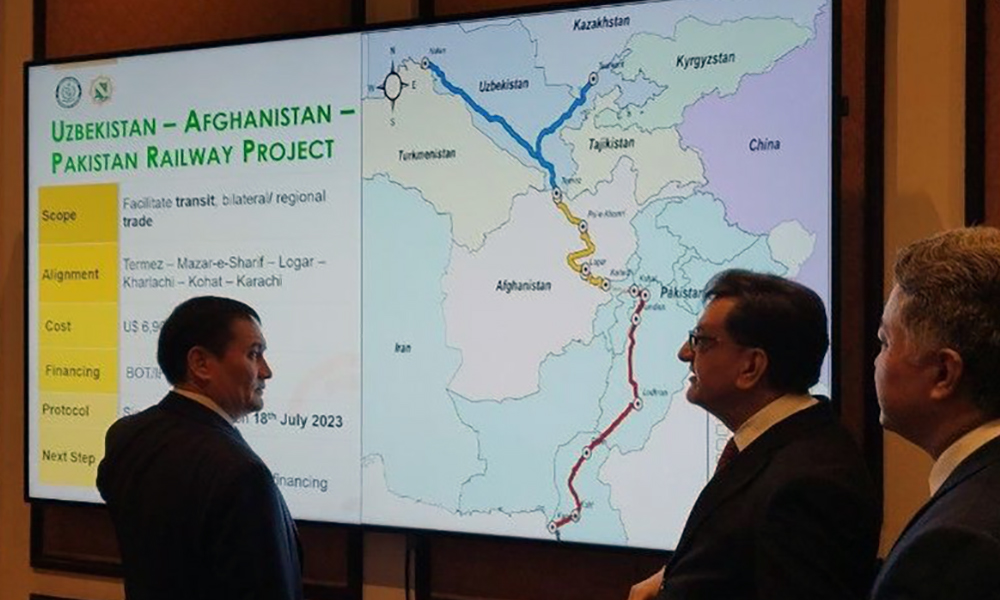
Uzbekistan has entered the active phase of preparing a feasibility study for the proposed Trans-Afghan Railway Project, a key regional initiative aimed at strengthening transport and trade links between Central and South Asia.
Speaking on the sidelines of the Termez Dialogue in Tashkent, Uzbekistan’s Deputy Minister of Investment, Industry and Trade, Shokhrukh Gulyamov, said field studies and technical assessments for the project are already underway.
“We have already begun the active phase of preparing the feasibility study for this project,” Gulyamov said, adding that authorities expect to have concrete figures by the end of the year to help determine the next stage of implementation.
The Trans-Afghan Railway Project is expected to connect Central Asian countries with Pakistani ports through Afghanistan, creating a shorter and more efficient trade route between Central and South Asia. Officials view the railway as one of the region’s most important connectivity initiatives.
Gulyamov said the project could eventually become part of a broader transport network across Afghanistan, further enhancing regional trade and transit opportunities.
He also noted that the railway complements wider regional infrastructure efforts, including cooperation with Kazakhstan and Kyrgyzstan and the China-Kyrgyzstan-Uzbekistan railway project.
According to Uzbek officials, growing trade volumes between Central and South Asia are increasing the need for expanded transport infrastructure and alternative transit corridors.
The project gained momentum in July 2025 when Uzbekistan, Afghanistan and Pakistan signed a trilateral agreement in Kabul to jointly prepare the feasibility study for the railway.
Once completed, the study is expected to provide key details on project costs, financing options, technical requirements and potential implementation timelines.
The proposed railway is widely seen as a strategic project that could boost regional connectivity, facilitate trade and strengthen economic integration across Central and South Asia.


Tahawol: Impact of Middle East crisis on aid transfers to Afghanistan

Saar: Calls to strengthen economic and trade cooperation discussed

Afghan ambassador in Moscow, Russian deputy PM discuss economic ties

Canada convenes UN Afghanistan meeting amid ongoing humanitarian crisis

Uzbekistan advances feasibility study for Trans-Afghan Railway Project

New Afghanistan-China transport corridor launched via Turkmenistan

Afghanistan signs $46 million deal to develop standard laboratory complexes

Large blast near Beit Shemesh part of pre-planned test: Israeli defense firm

Trump returns from China with stability but little progress

Afghanistan announce squad for India series
Tahawol: Impact of Middle East crisis on aid transfers to Afghanistan
Saar: Calls to strengthen economic and trade cooperation discussed

Tawsia: Signing of $20 million Herat salt mining deal discussed

Tahawol: Discussion on fear of internal disputes in Iran

Tahawol: Welcoming Qatar’s cooperation with Afghanistan discussed
-
 Business3 days ago
Afghanistan’s trade with Central Asia records sharp growth
-
 Latest News5 days ago
Russian business official proposes visa-free travel between Russia and Afghanistan
-

 Sport1 day ago
Gaikwad set to replace injured Kohli for Afghanistan ODI Series
-

 Latest News5 days ago
China and Pakistan’s special envoys for Afghanistan discuss Urumqi Process
-

 Sport4 days ago
Six Afghan cricketers selected for 2026 Lanka Premier League
-

 Latest News4 days ago
Three Afghans among four farmworkers burned alive in Italy; two Pakistanis arrested
-

 Sport3 days ago
Afghanistan name squad for A-team tri-series in Sri Lanka
-

 Latest News5 days ago
Russia-Afghanistan military deal focuses on repair of Soviet-made equipment, Kabulov says