
Latest News
Biden tackles issue of bounties on US troops in Afghanistan with Putin

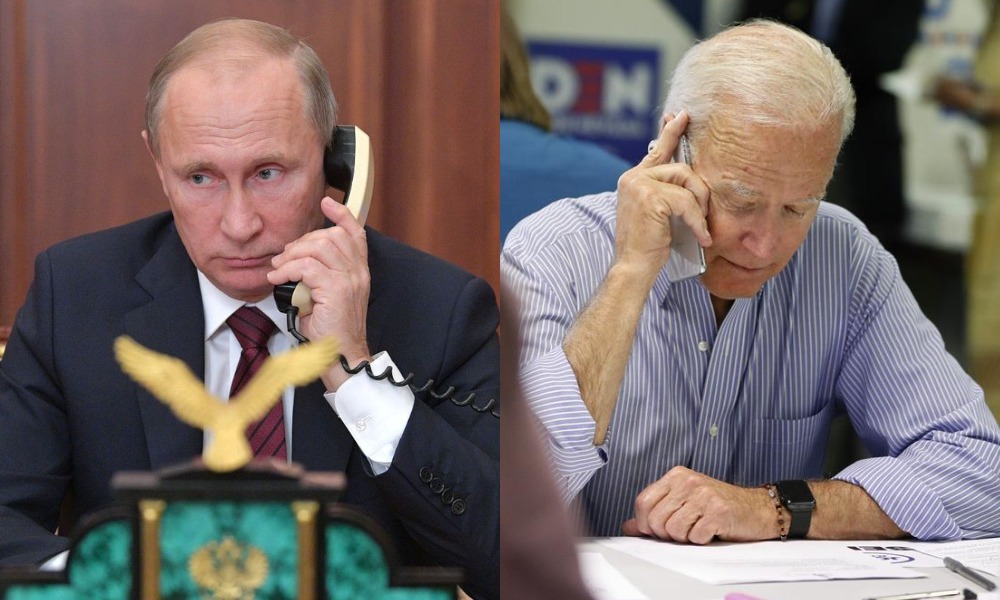
US President Joe Biden spoke on the phone on Tuesday night with Russian leader Vladimir Putin and raised the issue of bounties on US troops in Afghanistan.
This was Biden’s first discussion with Putin since his inauguration as US president.
According to VOA, Biden also expressed his concerns over the arrest of dissident Alexei Navalny, Moscow’s cyber-espionage campaign, and the bounties.
Two senior Biden administration officials told VOA that Biden’s stance appeared to mark another sharp break with that of former President Donald Trump, who often voiced delight at his warm relations with the Kremlin leader.
At the same time, according to US accounts of the call, Biden told Putin that Russia and the United States should complete a five-year extension of their nuclear arms control treaty before it expires in early February.
VOA reported that it was not immediately known how Putin responded to Biden raising contentious issues between the two countries.
But Biden told reporters Monday that despite disagreements with Moscow, he felt the US and Russia could both “operate in the mutual self-interest of our countries as a New START agreement and make it clear to Russia that we are very concerned about their behavior, whether it’s Navalny, whether it’s SolarWinds or reports of bounties on heads of Americans in Afghanistan.”
Shortly before his call with Putin, Biden spoke to NATO Secretary-General Jens Stoltenberg, reassuring him of the United States’s commitment to the Alliance.
During his White House tenure, Trump often quarreled with NATO allies, complaining they were not contributing enough money for their mutual defense.
The former president was often deferential to Putin, rejecting claims in the US from opposition Democrats that Russia had interfered in the 2016 US presidential election to help him win – a years-long saga that Trump derisively dismissed as “the Russia hoax.”
Last year, Trump also questioned whether Russia was involved in the hack of software manufactured by the US company SolarWinds that breached files at the departments of Commerce, Treasury and Energy.
Former Secretary of State Mike Pompeo said Russia was “pretty clearly” behind the cyberattack, but Trump claimed the attack was being overplayed by the US media and that perhaps China was responsible, VOA reported.
Before taking office, Biden said, “I will not stand idly by in the face of cyber assaults on our nation.”
Trump had also dismissed claims that Russia offered the Taliban bounties to kill US soldiers in Afghanistan, another issue Biden pressed Putin on.
Despite his conciliatory approach to Russia, Trump imposed sanctions on the country, Russian companies and business leaders over various issues, including Moscow’s involvement in Ukraine and attacks on dissidents.
The Biden-Putin call followed pro-Navalny protests in more than 100 Russian cities last weekend, with more than 3,700 people arrested across Russia.
Navalny is an anti-corruption campaigner and Putin’s fiercest critic. He was arrested January 17 as he returned to Russia from Germany, where he had been recovering for nearly five months after a nerve-agent poisoning he claims was carried out by Russian agents, an accusation the Kremlin has rejected.







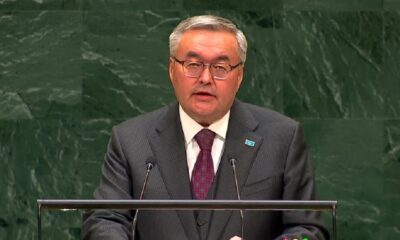




Kazakhstan’s Foreign Minister Mukhtar Tileuberdi has called for pragmatic and coordinated international engagement with Afghanistan, saying the country’s long-term stability is closely linked to the security and sustainable development of Central Asia.
Speaking during the general debate of the 81st session of the United Nations General Assembly in New York on Friday, Tileuberdi said humanitarian assistance to Afghanistan remains essential but alone cannot break the cycle of poverty, displacement and dependency.
He said Kazakhstan supports a “pragmatic, coordinated and step-by-step” approach to international engagement with Afghanistan, with the United Nations playing a central role.
Tileuberdi also said Kazakhstan is working with the UN to operationalize the United Nations Regional Centre for the Sustainable Development Goals for Central Asia and Afghanistan in Almaty.
He said the success of the centre should be measured by the results and assistance it delivers to the region.


Saar: Concerns over Pakistan’s political crisis discussed

Afghanistan Champions League: Omar Zawak Herat beat Toofan Herat 1-0

Blast in Pakistan’s Dera Ismail Khan kills 11, injures 30

Ariana Afghan Airlines increases Kabul-Delhi cargo flights

Khalilzad questions Pakistan’s commitment to Afghan welfare

Saudi energy group signs major Afghanistan deals covering gas exploration and pipeline plans

Trump floats idea of renaming Atlantic or Pacific Ocean

US hits Egyptian bank branches with Iran sanctions as war marks six months

Nepal flood rescue mission enters critical phase as thousands remain missing

Iranian clubs to face Gulf opponents at neutral venues in Asian Champions League Elite
Saar: Concerns over Pakistan’s political crisis discussed

Exclusive interview with Abdul Latif Mansoor, Minister of MRRD

Tawsia: Overview of Afghanistan’s iron mines

Tahawol: Discussion on fresh Pakistani airstrikes on Afghanistan

Saar: Calls for international support for Afghanistan discussed
-

 World5 days ago
CNN, MS NOW and Politico sue Trump, challenging White House ban
-

 Latest News4 days ago
UN reiterates call for respect for international law after Kunar airstrikes
-

 Latest News3 days ago
Ariana Afghan Airlines ranks seventh among 45 Central Asian airlines
-
 Latest News5 days ago
Khalilzad condemns Pakistan airstrikes, says current strategy is not working
-

 Regional3 days ago
US and Iran hold first talks since June after Trump’s ‘annihilation’ threat
-

 Latest News3 days ago
Silk Road highway in Wakhan corridor now reaches the China border
-

 Latest News4 days ago
Afghan Official: Pakistan’s airstrikes will not go unanswered
-

 Sport4 days ago
Afghan boxing referee heads to China for international festival