
Latest News
Leaving Afghanistan under US-Taliban deal could spur chaos: LA Times

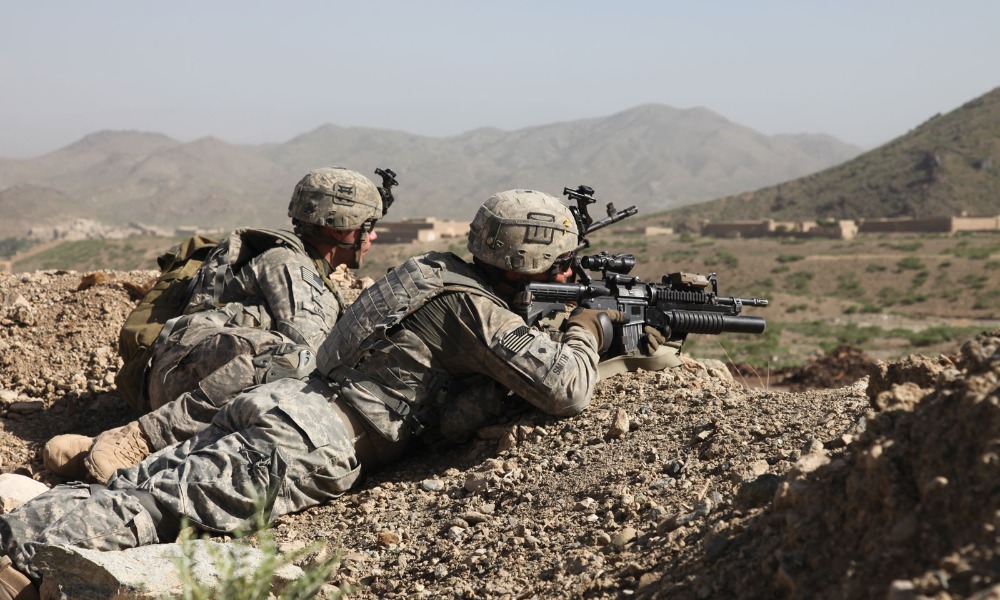
Fighting in Afghanistan will intensify sharply, and Taliban militants could threaten major cities unless the current push by Washington to end the 20-year conflict yields results in the next two months, Los Angeles Times reported citing two senior US commanders.
“If we withdraw and no deal was made with the Taliban, I think the government of Afghanistan is going to be in for a very stiff fight to retain possession of towns and cities,” said General Kenneth McKenzie, the commander of US Central Command.
This comes after McKenzie met with President Ashraf Ghani this week in Kabul.
“The two sides discussed the peace process, current security situation, and support to the Afghan National Security and Defense Forces (ANDSF),” the Presidential Palace (ARG) said in a statement.
The two sides also expressed concerns over the alarming violence across the country, the statement added.
Resolute Support commander General Scott Miller meanwhile warned that a U.S. withdrawal would leave the Afghan armed forces without vital support, especially for its fledgling air force, which relies on contractors to maintain its planes and helicopters.
“When you start talking about removing our presence … certain things like air, air support and maintenance of that air support becomes more and more problematic,” Miller was quoted by the LA Times as having said.
The Taliban has also carried out a large number of assassinations targeting activists, journalists and government officials, in recent months.
On this issue, Miller the Taliban is insistent that the U.S. abide by the May 1 deadline for leaving, he said.
“They are using violence and they are trying to put themselves in a position, if the things they want are not met … to force decisions in the political space,” Miller said in an interview.
US President Joe Biden’s administration has not decided yet on whether to extend troop presence in Afghanistan or withdraw by May 1 as per the US-Taliban deal which was signed in February last year.
According to the deal, the US has reduced its troops to 2,500 but in a report Sunday, the New York Times reported that there are in fact more American troops on the ground than the reported 2,500.
The New York Times reported that officials, both American and Afghan, have said the number is actually around 3,500. That’s 1,000 more than Washington has disclosed.
According to the NYT, one official said the “cloudy accounting” around troops numbers results from some Special Forces units having been put “off the books”.
According to him, the presence of some temporary and transitioning units also accounted for the additional troops.
A second official meanwhile told the NYT that these troops include Joint Special Operations Command units, some of them elite Army Rangers, who work under both the Pentagon and the CIA while deployed to Afghanistan.
Having more troops in a country than the Defense Department officially acknowledges is common practice, the NYT reported.
According to the report, the United States often details military troops to the CIA or other agencies, declares that information “classified” and refuses to publicly acknowledge their presence.


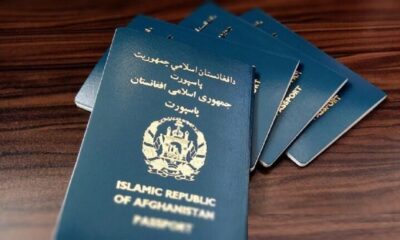


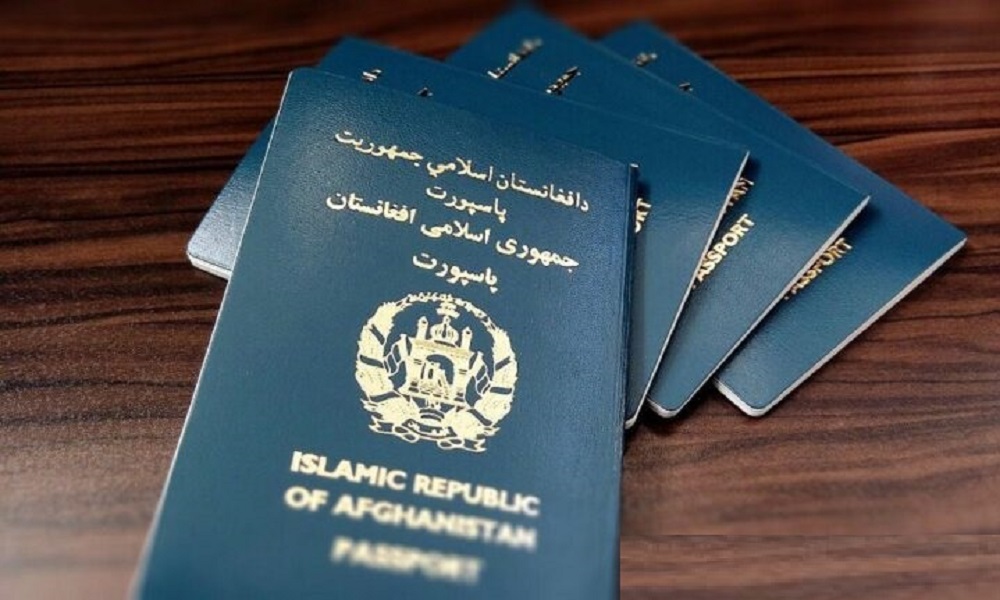
Zabihullah Mujahid, spokesperson for the Islamic Emirate, says more than 650,000 ordinary passports were issued across Afghanistan over the past Hijri year, while the visas of more than 16,000 foreign nationals were extended.
Mujahid made the remarks during the “Government in the Media Mirror” program, held under the theme “Public Services Week.”
According to him, the General Directorate of Statistics and Information also distributed nearly 2 million electronic national ID cards and around 1 million paper ID cards during the 1447 Hijri year.
Mujahid added that the agency provided hundreds of thousands of in-person and online services related to corrections and amendments to national ID cards over the past year.
The Islamic Emirate spokesperson said the General Directorate of Passports has sought to make services faster and easier by reducing the passport application form from nine pages to one page.
He also announced an expansion of services by the state-owned Afghan Post, saying the company delivered more than 5 million domestic mail items over the past year.
According to Mujahid, other measures to expand postal services included verifying and certifying hundreds of thousands of documents, launching express services, establishing a customer service center, and delivering documents directly to people’s homes.
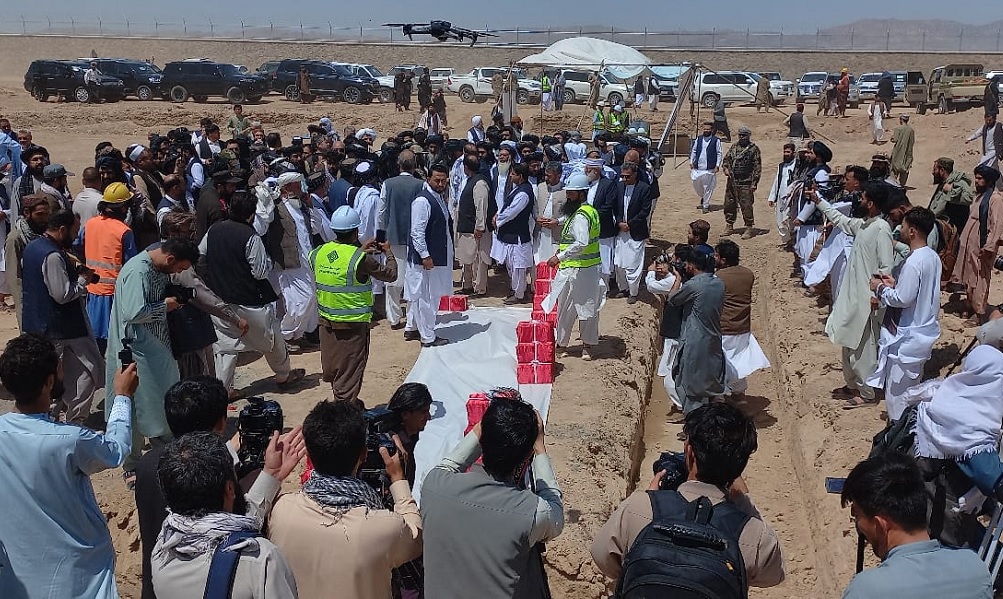
Construction of a major cement production plant has officially begun in Afghanistan’s western Herat province, with the project expected to receive $143 million in investment and create thousands of jobs.
The groundbreaking ceremony was held on Sunday in the presence of senior officials of the Islamic Emirate, including the Deputy Prime Minister for Economic Affairs, the Deputy Prime Minister for Administrative Affairs and several cabinet ministers.
Homayoun Afghan, spokesperson for the Ministry of Mines and Petroleum, said the project has been contracted to a local company and that construction is expected to be completed within two years.
Once operational, the plant is expected to produce around 3,000 tonnes of cement per day, according to the ministry.
Officials say the project will provide direct and indirect employment for approximately 5,000 people, creating jobs and supporting economic activity in the province.
The Herat cement project is considered one of Afghanistan’s major industrial projects. Its development has been anticipated for decades, with residents and officials repeatedly calling for the province’s cement resources to be developed locally.
The plant is located about 30 kilometers west of Herat city in Zinda Jan district.
The project is expected to increase domestic cement production and reduce reliance on imported cement once it becomes operational.
Latest News
Pakistan-backed armed groups in Balochistan using former Afghan government forces: report
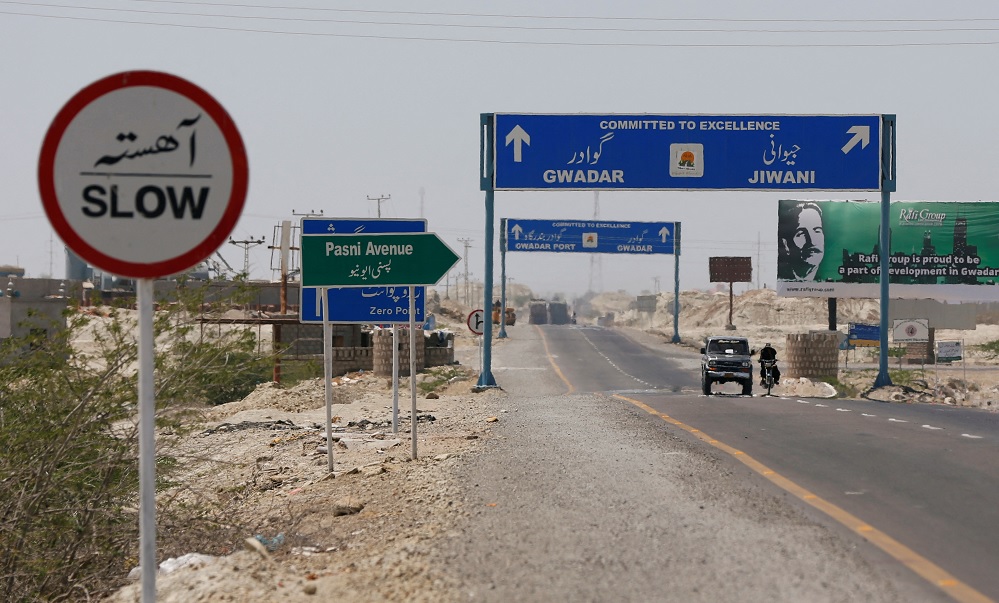
According to an investigative report by Parrhesia News, Pakistan’s security agencies are using state-backed armed groups in Balochistan to pursue security objectives and counter Baloch armed opposition, with some former members of Afghanistan’s security forces also recruited into these groups.
The report, published on August 6, claims that groups known as “Lashkars” operate in Balochistan with the support of Pakistan’s security agencies and play a role in security and counterinsurgency operations alongside the country’s army, border forces and intelligence agencies.
According to the investigation, these groups serve as proxies, allowing Pakistan to carry out some security and counterinsurgency operations through armed groups that are not formally part of the state structure.
Parrhesia News claims that some former members of Afghanistan’s security forces, who left the country after the fall of the republic in 2021, have also joined these groups. The report says their military training, combat experience and familiarity with border operations make them valuable to these networks.
The report says the use of former Afghan personnel allows Pakistan-backed armed groups to deploy experienced fighters in their operations without officially increasing the size of Pakistan’s security forces.
The outlet also claims that the former Afghan personnel are primarily motivated by financial needs and finding a way to make a living, and that they have no interest in participating in a potential conflict against Afghanistan.


Israel rejects Trump’s 15-point plan for Gaza, PM Netanyahu says

Afghanistan issues more than 650,000 passports in one year

Construction begins on major cement production plant in Herat

Pakistan-backed armed groups in Balochistan using former Afghan government forces: report

Afghanistan secure direct qualification for 2027 Men’s ODI World Cup

Pakistan’s governance system has ‘collapsed’: Mohsin Naqvi

India offers 1,000 online scholarships for Afghan students for 2026-27 academic year

Turkey spent over $120 million to prepare airport for Qatar-donated U.S. presidential aircraft

FIFA’s inaugural YouTube Creator Cup to stream live on Ariana Television and Ariana Sport YouTube channels

FIFA World Cup semi-final line-up confirmed

Tahawol: Escalating disputes over Iran war discussed

Saar: Turkey, Saudi Arabia and Pakistan defense pact reviewed

Tahawol: End of US sanctions waiver for Chabahar Port discussed

Saar: US warns of ISIL-K threat in Afghanistan discussed

Tahawol: Limited choices of small states in global politics discussed
-

 Sport5 days ago
Afghanistan aim to strengthen ODI ranking in Ireland series
-
 Latest News4 days ago
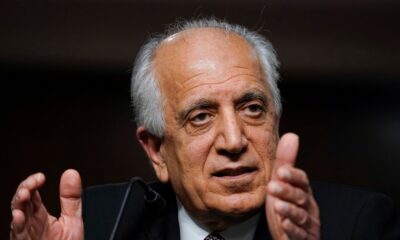
Khalilzad says Pakistan needs ‘reset’ amid economic crisis and rising instability
-

 Latest News4 days ago
First Afghanistan-Ireland ODI abandoned without a ball bowled
-

 Sport4 days ago
Afghanistan aim for winning start against Ireland
-

 Sport3 days ago
Afghanistan holds Russia to 3-3 draw, earns first point at Continental Futsal Championship
-

 Latest News4 days ago
Afghan boxer appears in Greek court over death of Scottish woman
-
 Business3 days ago
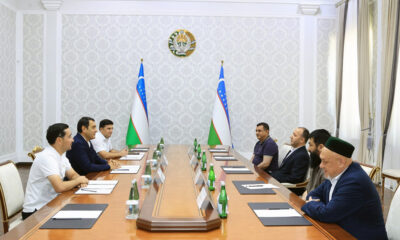
Uzbekistan’s Fergana region strengthens economic ties with Afghanistan
-
 Regional3 days ago
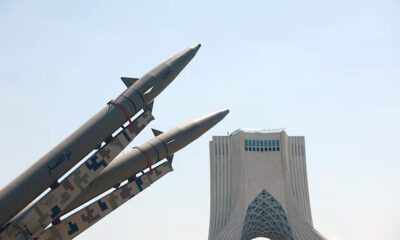
Iran threatens to hit Gulf states if US launches new strikes