
Latest News
US general says Taliban appear to have ‘strategic momentum’

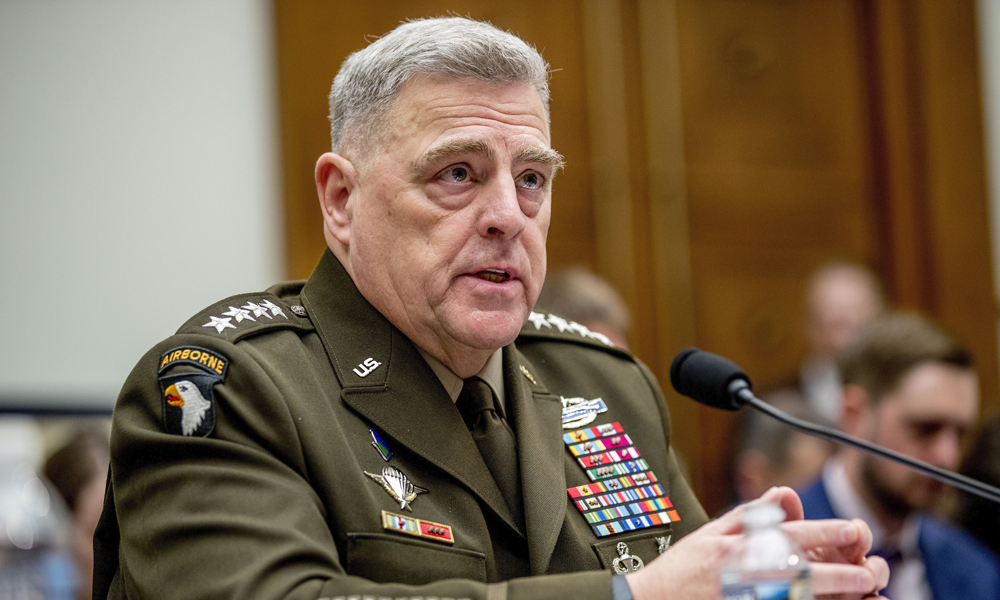
The Taliban appear to have “strategic momentum” in the fight for control of Afghanistan as they put increasing pressure on key cities, setting the stage for a decisive period in coming weeks, the top U.S. military officer General Mark Milley said Wednesday.
“This is going to be a test now of the will and leadership of the Afghan people — the Afghan security forces and the government of Afghanistan,” Milley, chairman of the Joint Chiefs of Staff, told a Pentagon press conference.
The Pentagon says the U.S. withdrawal is 95% finished and will be completed by August 31. AP reported that while the Biden administration has vowed to continue financial assistance and logistical support for Afghan forces after August, Defense Secretary Lloyd Austin said the focus of U.S. military efforts there will be countering terrorist threats, not the Taliban.
Speaking alongside Milley, Austin said the U.S. will “keep an eye on” al-Qaeda, whose use of Afghanistan as a haven for planning the 9/11 attacks on the United States was the reason U.S. forces invaded Afghanistan in 2001, AP reported.
“Our major focus going forward is to make sure that violence, terrorism, cannot be exported from Afghanistan to our homeland, and so we’ll maintain the capability to be able to not only observe that but also address that if it does emerge,” Austin said, adding that the Taliban pledged in 2020 to not provide a sanctuary for al-Qaeda in the future.
“We expect for them to meet that commitment. If they want legitimacy going forward, I think that’s something they’ll have to consider. That’s one way to earn it, so we’ll see what happens.” He reiterated his view that there is a “medium risk” of al-Qaeda regaining within about two years of the U.S. departure the capability to launch attacks against the West.
“But, again, there are a number of things that could happen to speed that up a bit or slow it down,” he added.
Milley said the Taliban now control about half of the 419 district centers in Afghanistan, and while they have yet to capture any of the country’s 34 provincial capitals, they are pressuring about half of them. As the Taliban seize more territory, the Afghan security forces are consolidating their positions to protect key population centers, including Kabul, he said.
“A significant amount of territory has been seized over the course of six, eight, 10 months by the Taliban, so momentum appears to be — strategic momentum appears to be — sort of with the Taliban,” Milley said.
Milley said that while the Taliban are attempting to create the impression that their victory over the U.S.-backed Kabul government is inevitable, he believes the Afghan military and police have the training and equipment to prevail. He said he would not rule out a negotiated political settlement with the Taliban, nor would he exclude “a complete Taliban takeover.”
“I don’t think the end game is yet written,” he said.












Kazakhstan’s Foreign Minister Mukhtar Tileuberdi has called for pragmatic and coordinated international engagement with Afghanistan, saying the country’s long-term stability is closely linked to the security and sustainable development of Central Asia.
Speaking during the general debate of the 81st session of the United Nations General Assembly in New York on Friday, Tileuberdi said humanitarian assistance to Afghanistan remains essential but alone cannot break the cycle of poverty, displacement and dependency.
He said Kazakhstan supports a “pragmatic, coordinated and step-by-step” approach to international engagement with Afghanistan, with the United Nations playing a central role.
Tileuberdi also said Kazakhstan is working with the UN to operationalize the United Nations Regional Centre for the Sustainable Development Goals for Central Asia and Afghanistan in Almaty.
He said the success of the centre should be measured by the results and assistance it delivers to the region.


Abu Muslim Farah defeat Khurasan Faryab 2-0 in ACL season six

Saar: Concerns over Pakistan’s political crisis discussed

Afghanistan Champions League: Omar Zawak Herat beat Toofan Herat 1-0

Blast in Pakistan’s Dera Ismail Khan kills 11, injures 30

Ariana Afghan Airlines increases Kabul-Delhi cargo flights

Saudi energy group signs major Afghanistan deals covering gas exploration and pipeline plans

Trump floats idea of renaming Atlantic or Pacific Ocean

US hits Egyptian bank branches with Iran sanctions as war marks six months

Nepal flood rescue mission enters critical phase as thousands remain missing

Iranian clubs to face Gulf opponents at neutral venues in Asian Champions League Elite
Saar: Concerns over Pakistan’s political crisis discussed

Exclusive interview with Abdul Latif Mansoor, Minister of MRRD

Tawsia: Overview of Afghanistan’s iron mines

Tahawol: Discussion on fresh Pakistani airstrikes on Afghanistan

Saar: Calls for international support for Afghanistan discussed
-

 World5 days ago
CNN, MS NOW and Politico sue Trump, challenging White House ban
-

 Latest News3 days ago
Ariana Afghan Airlines ranks seventh among 45 Central Asian airlines
-

 Latest News4 days ago
UN reiterates call for respect for international law after Kunar airstrikes
-

 Regional3 days ago
US and Iran hold first talks since June after Trump’s ‘annihilation’ threat
-

 Latest News3 days ago
Silk Road highway in Wakhan corridor now reaches the China border
-

 Latest News4 days ago
Afghan Official: Pakistan’s airstrikes will not go unanswered
-

 Sport4 days ago
Afghan boxing referee heads to China for international festival
-

 Regional3 days ago
Iran airlines cancel flights as US sanctions hit