
Regional
China, Russia launch joint air patrol, alarms South Korea

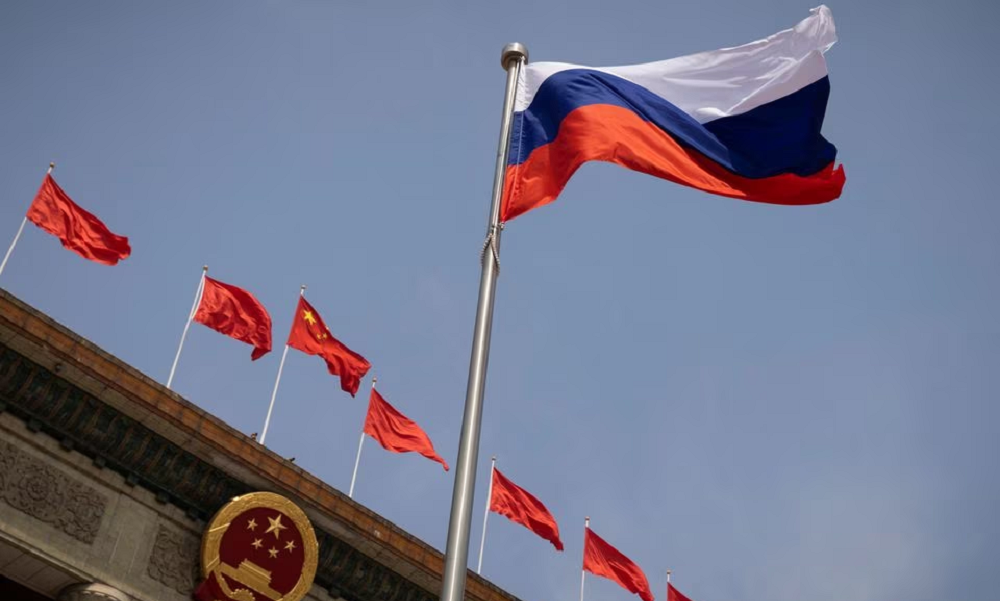
China and Russia conducted a joint air patrol on Tuesday over the Sea of Japan and East China Sea for a sixth time since 2019, prompting neighboring South Korea and Japan to scramble fighter jets.
China’s defense ministry said the patrol was part of the two militaries’ annual cooperation plan. South Korea scrambled fighter jets, according to its military, after four Russian and four Chinese military aircraft entered its air defense zone in the south and east of the Korean peninsula, Reuters reported.
Japan’s military said it had scrambled fighter jets after verifying that two Russian bombers had joined two Chinese bombers over the Sea of Japan and flown together as far as the East China Sea, where they were joined by two Chinese fighter planes.
In China’s last joint aerial patrol with Russia in November, South Korea also scrambled fighter jets after Chinese H-6K bombers and Russian TU-95 bombers and SU-35 fighter jets entered its Air Defence Identification Zone (KADIZ).
Japan similarly scrambled jets when Chinese bombers and two Russian drones flew into the Sea of Japan.
An air defense zone is an area where countries demand that foreign aircraft take special steps to identify themselves. Unlike a country’s airspace – the air above its territory and territorial waters – there are no international rules governing air defense zones.
The joint aerial patrols, which began before Russia sent its troops in Ukraine and Beijing and Moscow declared their “no-limits” partnership, are a result of long expanding bilateral ties built partly on a mutual sense of threat from the United States and other military alliances.
In their May 2022 patrols, Chinese and Russian warplanes neared Japan’s airspace as Tokyo hosted a Quad summit with the leaders of the United States, India and Australia, alarming Japan even though China said the flights were not directed at third parties.
China’s increasing military assertiveness in the region has coincided with an increase in military maneuvers and drills by the United States and its allies in the region.
Since last week, the coast guard of the United States, Japan and the Philippines have held their first trilateral naval exercise in the South China Sea.
The White House said on Monday that recent encounters between U.S. and Chinese forces in the Taiwan Strait and South China Sea reflect a growing aggressiveness by Beijing’s military that raises the risk of an error in which “somebody gets hurt.”
Over the weekend, a Chinese warship came within 137 meters of a U.S. destroyer while the U.S. and Canadian navies were conducting a joint exercise in the sensitive Taiwan Strait, prompting complaints about the safety of the maneuver.
Shortly before that, a video showed a Chinese fighter jet passing in front of a U.S. plane’s nose with the cockpit of the RC-135 shaking in the turbulence caused by the flight.
“U.S. military ships and aircraft have traveled thousands of miles to provoke China at its doorstep,” China’s foreign ministry spokesperson Wang Wenbin said during a regular news conference on Tuesday.
“Insisting on conducting close reconnaissance and flexing its muscles near China’s territorial waters and airspace is not safeguarding freedom of navigation, but promoting of navigation hegemony and is a blatant military provocation,” he said.






Regional
Iran, US continue escalating attacks, recriminations over peace deal
US Central Command said earlier that its forces had carried out fresh strikes after a Panama-flagged tanker was attacked by an Iranian drone on Saturday.
Iran and the US continued their attacks in the Gulf as each accused the other of violating an increasingly precarious interim deal signed less than two weeks ago to end their four-month-old war, Reuters reported.
Shortly after President Donald Trump warned the US might “militarily complete the job”, Iran early on Sunday launched missiles and drones on US military sites in Kuwait and Bahrain, continuing a series of escalating attacks.
Beyond the Gulf, Israel said it had struck Iran-backed Hezbollah militants in southern Lebanon as fighting continued in an area Tehran says is key to its peace deal with Washington.
The U.S. military said earlier it had struck Iran again, hours after a tanker was hit in the Strait of Hormuz, the world’s most important energy shipping route, which Iran had largely cut off for most of the conflict.
The 14-point U.S.-Iran interim agreement was meant to halt the fighting, which the US and Israel started on February 28, and reopen the strait to shipping while talks proceeded on more deep-seated issues, such as Iran’s nuclear programme.
One round of mediated talks, led by Vice President JD Vance and Iran’s parliamentary speaker, Mohammad Baqer Qalibaf, was held in Switzerland a week ago and Washington then waived sanctions on Tehran, but the fighting and recriminations have since resumed and intensified.
“There may come a point when we are no longer able to be reasonable, and will be forced to militarily complete the job that we very successfully started,” Trump posted on social media. “If that happens, the Islamic Republic of Iran will no longer exist!”
About an hour after Trump’s post, the Kuwaiti army said its air defences were responding to “hostile” missile and drone attacks, while sirens sounded in Bahrain, according to that country’s interior ministry.
Iran’s Islamic Revolutionary Guard Corps said its navy and air forces had launched missile and drone operations targeting US military sites in Kuwait and Bahrain in response to recent US strikes against Iran, read the report.
The Guards said in a statement the US strikes had violated the ceasefire and “will result in the complete halt of all diplomatic processes”, according to state-run Press TV. The IRGC navy command said American bases in the region “will experience hell in the coming days”.
A US official, confirming the attacks on US facilities, told Reuters there were no reported US casualties or major damage to US sites in the Middle East but that the situation was still unfolding.
Hours later, alarms sounded for a second time in Bahrain, and the foreign ministry there condemned the attacks as a deliberate and repeated violation of the kingdom’s sovereignty and security. It urged the U.N. Security Council to hold an urgent session to hold Iran accountable.
US Central Command said earlier that its forces had carried out fresh strikes after a Panama-flagged tanker was attacked by an Iranian drone on Saturday.
“Iran was given a chance to honor the ceasefire agreement but elected not to,” Central Command said in a statement, adding that its strikes were “in direct response to continued Iranian aggression against commercial shipping” and targeted Iranian military surveillance, communications, air defence, drone storage and mine-laying facilities.
Iranian state broadcaster IRIB said explosions were heard in Sirik in southern Iran, without providing details. The Guards said “America’s blind shots at Sirik will not resolve our dominance over the Strait of Hormuz. But our shots at violators will remind the rest of the vessels of the clear passage route.”
Saturday’s tanker attack in the strait followed one on a cargo ship on Thursday that triggered the latest escalation. Iran is seeking to assert control over the strait, which carried one-fifth of global oil and LNG supplies before the war and which had just begun to reopen after months of disruption, Reuters reported.
Hundreds of ships, including tankers laden with oil, have been blockaded inside the Gulf since war broke out. As they began leaving through the strait over the past two weeks, oil prices have tumbled close to pre-war levels on the surge in supply.
Washington has been promoting a southern lane along the coast of Oman, while Tehran, which ultimately aims to charge fees for use of the strait, wants ships to use a northern route through its waters and under its control.
In Lebanon, Israel said on Sunday it had killed Hezbollah militants armed with rocket-propelled grenades and struck a rocket launcher in the Nabatieh area.
Iran accuses the US of violating its commitment under the peace deal to sustaining a ceasefire in Lebanon, which US ally Israel invaded in March in pursuit of Hezbollah.
Israel, which is not a party to the US-Iran deal, and Lebanon have repeatedly agreed to US-brokered ceasefires, the latest on Friday. But these have had only limited effect, with Israel insisting it will not withdraw from Lebanese territory it has seized and Hezbollah repeatedly rejecting calls to give up its arms as long as Israeli troops remain in place.
Regional
US strikes Iran in response to attack on cargo ship in Strait of Hormuz
The U.S. did not immediately respond to Iran’s report of striking American targets, a tactic that has sought to undermine U.S. allies in the region during the conflict.
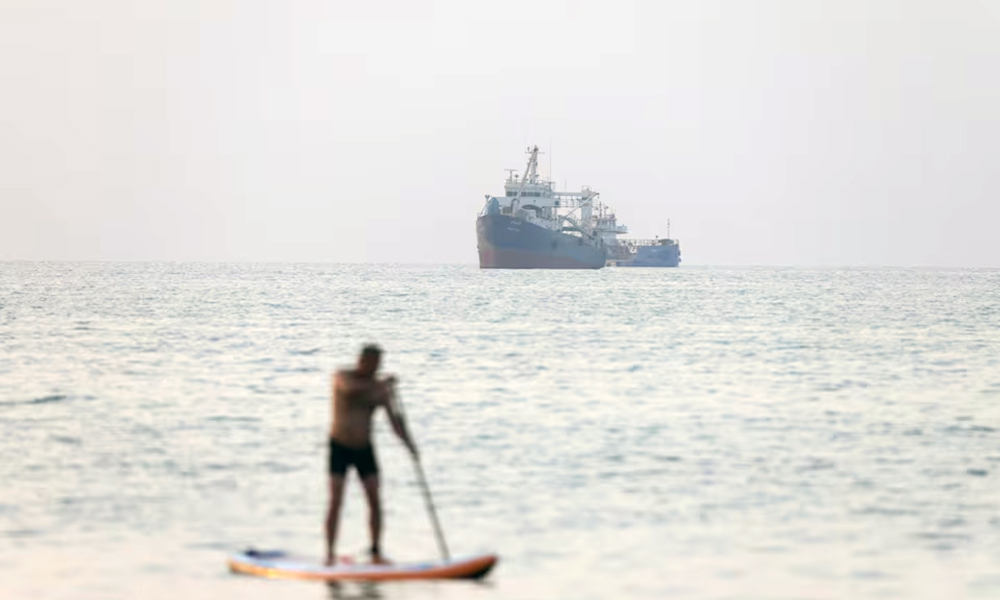
The U.S. military attacked Iran on Friday in response to an Iranian drone strike on a cargo ship in the Strait of Hormuz, with each country accusing the other of violating terms of a ceasefire agreed on last week, Reuters reported.
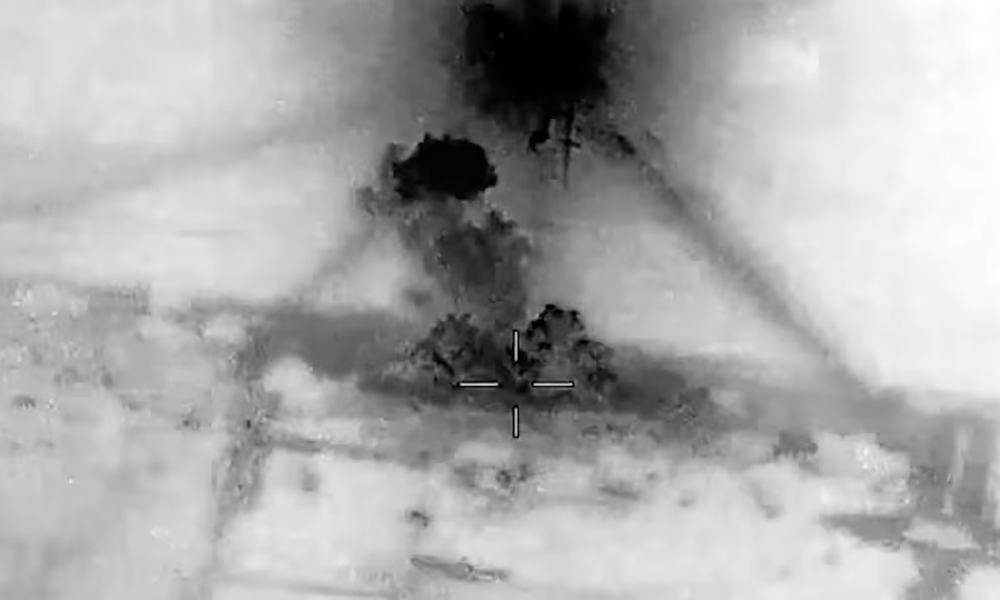
U.S. Central Command said aircraft struck missile and drone storage locations and coastal radar sites, later publishing a grainy black-and-white video of an explosion labeled “unclassified.” A U.S. official reported the operation had concluded.
Iran said a projectile struck the area around a pier in Sirik in southern Iran, and that Iranian naval forces responded by striking U.S. military targets in the region. Tehran did not provide details about what may have been hit.
Elsewhere, however, there were signs of progress in ending the four-month-old conflict, as Israel and Lebanon signed an agreement to end the fighting between Israel and Iran-backed Hezbollah. Both sides framed the deal as an initial step that calls for Hezbollah to disarm and Israel to withdraw troops from Lebanon, but it was not clear how it would be enforced. Hezbollah said it would not cooperate.
Tehran has said it would control the Strait of Hormuz and warned Gulf states not to side with Washington after Thursday’s attack on a cargo ship traveling near Oman’s coast. President Donald Trump blamed the attack on Iran and said it violated last week’s interim agreement.
“The unwarranted aggression against commercial shipping by Iranian forces clearly violated the ceasefire,” U.S. Central Command said in its statement announcing strikes, which it called “a powerful response to yesterday’s attack on a commercial ship that was transiting the Strait of Hormuz.”
The U.S. military said it would continue to provide “safe passage coordination and support” to commercial vessels transiting the strait.
Vice President JD Vance, once seen as a skeptic on U.S. intervention in Iran but now a Trump administration point person on the conflict, said the Americans have honored the ceasefire deal, also known as a memorandum of understanding.
“Iran signed a ceasefire agreement. We have honored it. If they have disagreements about how the MOU is being applied, they can pick up the phone. But violence will be met with violence,” Vance said on X.
Iranian state media, citing an unnamed military source, reported the strike at the port of Sirik after an explosion was heard there. The source said several warning shots had been fired from Sirik toward vessels that violated Strait of Hormuz regulations about five hours earlier, adding two warning missiles had also been launched from the nearby Karpan area toward the strategic waterway, read the report.
On Saturday, Iran’s Mehr news agency cited the head of ports at eastern Hormozgan as saying that there was no damage to the port of Sirik after the attack by the U.S. The official said the port was operating normally with no damage reported to facilities and equipment.
Iran’s Revolutionary Guards said that in response its navy “struck the locations where the terrorist U.S. military is stationed in the region” and warned that any further U.S. attacks would be met with a broader response, according to the statement carried on state media.
The ceasefire agreement gives Iran control over ship traffic in the strait, the Guards said.
“However, the United States, by provoking various fronts, sought to violate this commitment, and the necessary response was given and will continue to be given. If the aggression is repeated, our response will be broader than this,” the Revolutionary Guards said.
The U.S. did not immediately respond to Iran’s report of striking American targets, a tactic that has sought to undermine U.S. allies in the region during the conflict.
Ebrahim Azizi, the head of the Iranian parliament’s national security committee, said in response to the latest strikes that Trump has failed to show a commitment to the principles of negotiation or ceasefire.
“This reckless violation of the ceasefire will, as always, lead to retreat and regret on their part,” Azizi posted on X.
Before the renewed outbreak of violence, oil prices fell about 3% on Friday, on course for steep weekly losses, in response to oil tankers exiting the Strait of Hormuz, the conduit for one-fifth of global oil and LNG supplies before the U.S. and Israel launched the war on February 28, Reuters reported.
Saudi Aramco resumed crude loadings at its Ras Tanura terminal in the Gulf, the world’s biggest oil port, after a nearly four-month halt, shipping data showed.
Fertilizer shipments through the strait have also picked up, helping to assuage concerns about a spike in global food prices.
U.S. Secretary of State Marco Rubio — wrapping up a tour of the Gulf to reassure regional allies about the interim pact — issued a joint statement with the Gulf Cooperation Council calling for “free, unconditional, and unrestricted navigation” in the strait without tolls or “attempts to assert control.”
Iran’s foreign ministry said the strait should be governed by Iran and Oman, while Ali Akbar Velayati, top adviser to Iran’s supreme leader, warned Washington’s Gulf allies their survival depended on Tehran’s tolerance.
Regional
Iran’s Pezeshkian says without missiles his country would be ‘just like Gaza’
The Iranian president stressed that Tehran’s defensive capabilities are not open to negotiation.


Afghanistan summons Pakistani diplomat over airspace violations and civilian bombing

Karzai and Abdullah condemn Pakistani airstrikes, join calls for dialogue

Canada makes World Cup history with late goal to eliminate South Africa

Critically injured airstrike victims airlifted to Kabul for emergency treatment

Khalilzad condemns Pakistani airstrikes, questions Islamabad’s intentions

Norway’s Viking-inspired World Cup team photo goes viral

TAPI project advances in Afghanistan as 84kms of pipeline laid

Afghanistan’s trade with Central Asia records sharp growth

Afghanistan to play in Diamond Jubilee Tournament opener against Maldives

Gaikwad set to replace injured Kohli for Afghanistan ODI Series

Tahawol: Calls for diplomacy between Kabul, Islamabad

Saar: US and Iran exchanging attacks

Saar: Concerns over Afghan deportations from Europe discussed

Exclusive interview with Polleak Ok Serei, UNODC Representative for Afghanistan

Tahawol: Germany’s defense of engagement with IEA discussed
-
 Latest News3 days ago
TAPI project sees rapid progress in Afghanistan
-

 International Sports2 days ago
FIFA World Cup: Iran held by Egypt after controversial late goal Is disallowed
-
 Business23 hours ago
Afghanistan eyes direct Basmati rice imports from India amid tensions with Pakistan
-

 International Sports4 days ago
FIFA World Cup: Messi turns 39, shows no signs of stopping
-

 Latest News2 days ago
Delawar says Afghanistan has achieved security and unity after 47 years
-
 Latest News3 days ago
Ashura observed across Afghanistan with calls for unity and justice
-

 Latest News2 days ago
EU announces major funding to support Afghan small businesses
-
 Latest News4 days ago
Afghanistan ranks last in KidsRights Index 2026