
Latest News
Explainer: Gaza war after six months – what are the issues now?

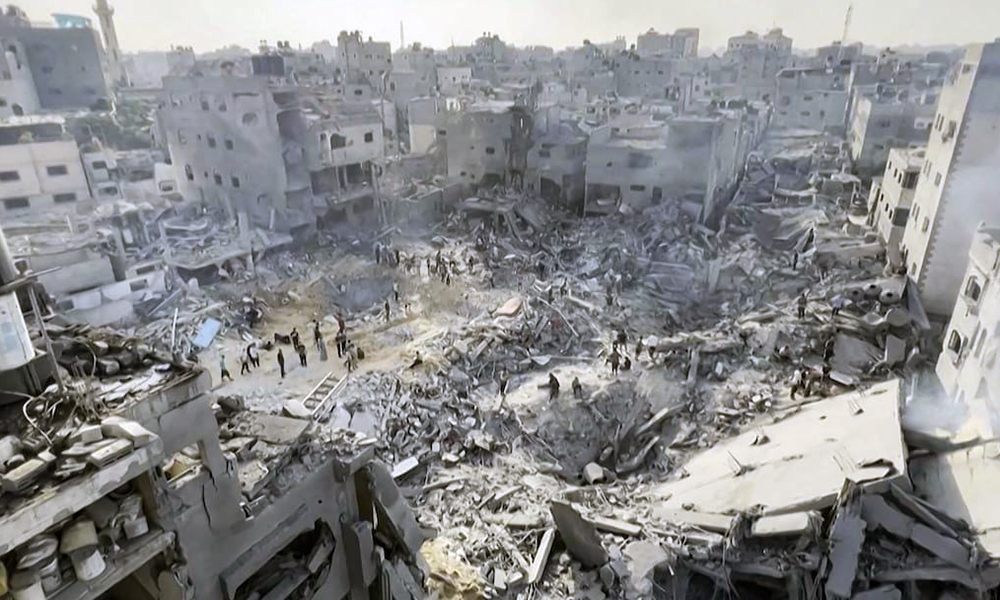
Six months since Hamas gunmen stormed into southern Israel on a killing spree, Israel’s ground campaign to annihilate the movement has turned much of the Gaza Strip into a wasteland with an unfolding humanitarian catastrophe.
Mediators have been trying to organize the first extended truce of the war to rush in aid to feed the Palestinian territory’s 2.3 million people and secure the release of some of the Israeli hostages still held by Hamas.
Here is a look at the issues raised by the war and the prospects for peace.
HOW DID THE WAR START?
On Oct. 7, hundreds of gunmen crossed a border fence that Israel had believed was impregnable, and stormed through communities, gunning down Israelis in homes, cars and at an all-night music festival. Israel says 1,200 people were killed in the deadliest day for Jews since the Holocaust. The attackers brought 253 hostages, including whole families with small children, back to Gaza. Although military bases were attacked, most of the dead were civilians.
Prime Minister Benjamin Netanyahu swore vengeance.
WHAT HAS HAPPENED IN GAZA?
Israel’s ground assault began in the northern half of the Gaza Strip and hundreds of thousands of residents were ordered to evacuate and flee south. After a week-long ceasefire at the end of November, Israeli forces turned their attention to the south, again ordering people to flee.
Since February, Israeli forces have patrolled nearly all of Gaza, apart from a small area in the center and the city of Rafah on the southern edge, where more than half of Gaza’s population is now sheltering.
Gaza’s health authorities say about 33,000 Palestinians have been confirmed killed, around 40 percent of them children, with thousands more bodies lost under rubble not recovered. More than 70,000 have been wounded, meaning around 5% of the population has been killed or injured, not counting deaths from hunger, unsanitary conditions and the collapse of health care.
Israel says it has killed more than 13,000 Hamas fighters, and blames militants for harm to civilians for operating among them, including from a network of underground bunkers and tunnels. Hamas denies its fighters operate among civilians.
CAN AID REACH GAZA?
At the outset of the war, Israel imposed a total blockade. Gradually it allowed in aid, first through a pedestrian checkpoint from Egypt, then also through a nearby road checkpoint from Israel itself.
Israel says it imposes no limits on food and humanitarian supplies, but aid agencies and donor countries say cumbersome Israeli inspections mean shipments can be held up for weeks, and only a fraction of the 500 trucks a day Gaza once relied on can get through. Supplies that cross are difficult to distribute or transport because of lawlessness with civil authorities dismantled.
Israel says it is now opening up additional land checkpoints and allowing air drops and sea deliveries. But Gaza has no proper seaport, and aid agencies say air drops are small-scale and dangerous. There is still no land route into northern Gaza where conditions are worst.
IS GAZA EXPERIENCING FAMINE?
Nearly. A famine has three stages – severe shortage of food, leading to pervasive malnutrition, and ultimately mass death from starvation and disease. The Integrated Food-security Phase Classification (IPC) global hunger monitor says Gaza has already surpassed the first two criteria – food shortage and malnutrition – and mass death will begin “imminently” without an immediate aid surge. It projects famine by May.
The IPC has said for months that Gaza is experiencing the most pervasive food insecurity it has ever seen.
In a report in March it said 100 percent of Gazans were experiencing severe food shortages, and for half of the population – far exceeding the 20% rate associated with famine – this had reached the highest level, category 5 or “catastrophe”.
In southern Gaza, where Reuters journalists operate, some residents have resorted to feeding their children boiled leaves. Reuters saw a number of children being treated for acute malnutrition in a hospital in Rafah, while conditions are reported to be far worse in the north.
Israel says the IPC report’s methodology is flawed and claims that there is no shortage of food in Gaza. It blames any hunger on aid agencies’ operations and on militants it says are hoarding food.
In addition to hunger, aid agencies worry about a lack of healthcare and sanitation. There are no fully functional hospitals left in the north, and only a handful in the south. Israel has repeatedly raided and besieged hospitals, saying Hamas fighters use them as bases, which medical staff deny.
Overcrowding fosters the spread of disease, and many people have little or no access to a sanitary toilet or place to wash.
WILL ISRAEL ATTACK RAFAH?
With half of Gazans now crammed into Rafah, residents say there is no place left to flee. Israel says the main Hamas armed units and commanders are sheltering there, and a ground assault is needed to defeat them. It has promised to coordinate with Egypt and to evacuate civilians further north inside Gaza, giving few details.
Washington has called the planned assault a mistake and says Israel can target militants with tactics that would cause less harm to civilians. The United Nations says an assault on Rafah would cause a humanitarian catastrophe. Many Palestinians say they fear Israel’s ultimate aim is to drive them from Gaza into Egypt, which Israel denies.
WHAT IS THE STATUS OF CEASEFIRE AND HOSTAGE TALKS?
Since the war’s only ceasefire so far at the end of November, when Hamas freed around half of its hostages, the sides have held talks mediated by Qatar and Egypt on a further truce.
Both sides have proposed a new ceasefire of around 40 days, including the release of around 40 hostages in return for hundreds of Palestinian detainees. Each has rejected the other’s proposals, but mediators say the talks remain productive.
Israel says it will discuss only a temporary pause in fighting and will not end the war until Hamas is annihilated. Hamas says it will not free its hostages without an agreement envisioning an end to war and Israeli withdrawal.
WHAT IS HAPPENING ON OTHER BATTLEFRONTS?
The war has been accompanied by surging violence in several other Middle East flashpoints, mainly involving armed groups that, like Hamas, are allied to Iran.
On Israel’s northern border it has exchanged regular fire with Hezbollah, a heavily-armed Iran-backed group, forcing the evacuation of tens of thousands of people from villages on both sides.
In the West Bank, where the internationally endorsed Palestinian Authority exercises limited self-rule under an Israeli military occupation, hundreds of people have been killed in the worst violence for decades.
In Syria, Israel has repeatedly targeted suspected bases of Iranian military advisers in air strikes. In Iraq, the United States retaliated against Iran-backed militia groups after strikes on U.S. bases, which have since subsided.
In Yemen, the Iran-aligned Houthi movement that controls the capital has attacked shipping in the Red Sea. Britain and the United States have retaliated with air strikes.
HOW HAS ISRAEL’S RELATIONSHIP WITH WASHINGTON EVOLVED?
As the war has ground on, it has brought increasing friction between Israel and the United States, with little precedent in the 75-year history of their close alliance.
U.S. President Joe Biden strongly endorsed Israel’s right to defend itself against Hamas following the Oct. 7 attacks, but in a speech in Tel Aviv also called on Israelis not to be overwhelmed by anger. Since then he and other administration officials have stepped up calls for Israel to do more to protect civilians and allow in aid.
Washington says its aim is a wider peace deal to normalize relations between Arab states and Israel, which requires prospects for an eventual Palestinian state, a central plank of U.S. policy for decades that Netanyahu has repudiated.
Israel’s plan to attack Rafah has provoked stronger criticism from Washington. In March, the Senate leader of Biden’s Democratic Party called for Israelis to vote Netanyahu out.
Washington later refrained from using its veto to block a U.N. Security Council resolution demanding a ceasefire. Netanyahu responded by canceling an Israeli delegation’s planned trip to Washington.
The United States has continued to supply Israel with arms and munitions. – Reuters






Sources told Ariana News that talks between the Islamic Emirate delegation and European Union representatives in Brussels concluded on Tuesday.
According to the sources, both sides discussed the resumption of consular services for Afghans across Europe, the need for confidence-building measures, the expansion of consular presence, and ensuring a dignified process for the return of Afghan citizens.
The delegation, led by Abdul Qahar Balkhi, spokesperson for the Ministry of Foreign Affairs, traveled to Brussels with representatives from the Ministry of Interior also included in the delegation.
This marks the first time that a delegation from the Islamic Emirate has been officially invited by the European Union to Brussels and engaged in direct talks with European representatives.
Participants described the discussions as constructive and expressed hope that the process will pave the way for positive developments and help safeguard the consular rights of Afghans living in Europe.
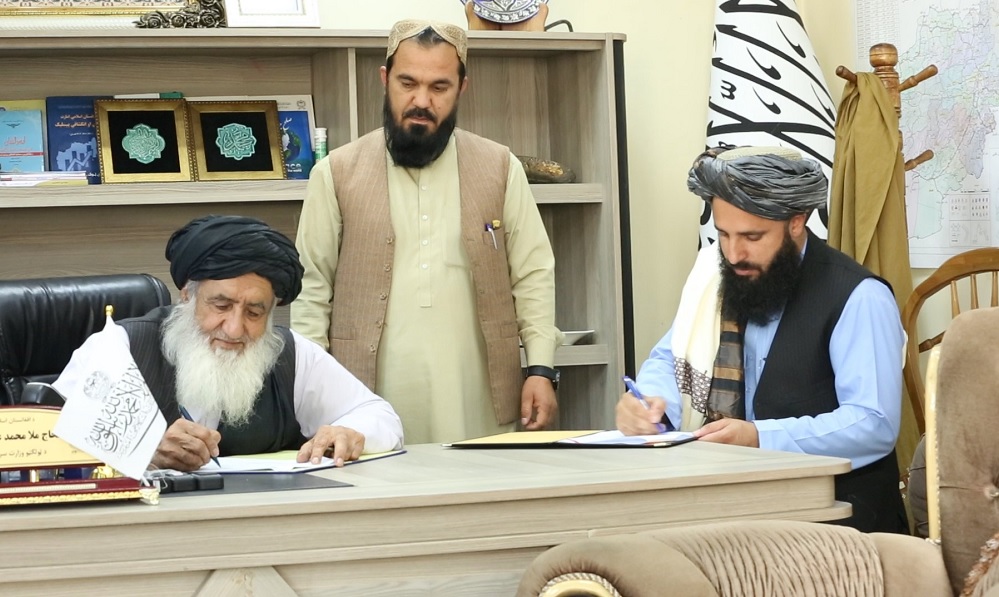
Afghanistan’s Ministry of Public Works has signed a contract worth more than AFN 1.25 billion for the reconstruction of a 15-kilometer section of the strategically important Salang Highway in Southern Salang, as part of ongoing efforts to rehabilitate one of the country’s most vital transport corridors.
The ministry said the project, valued at AFN 1.252 billion, will cover a section of the highway stretching from Olang to Jabal al-Siraj. Construction work is expected to begin in the near future.
Speaking at the contract signing ceremony, Minister of Public Works Mohammad Isa Sani described the Salang Highway as one of Afghanistan’s most important economic arteries, emphasizing the need for the project to be implemented on time and in accordance with technical standards and quality requirements.
According to the ministry, the 15-kilometer road section, which has a width of 12 meters, will undergo full rehabilitation and asphalt paving. The project also includes the construction of five new culverts, the widening of 33 existing culverts, and the construction of 600 meters of roadside drainage channels.
The ministry noted that reconstruction work on the Southern Salang section from the Salang Tunnel to Olang is being carried out using concrete pavement. A significant portion of that work has already been completed, while the remaining construction is still underway.
Officials added that the broader Salang Highway rehabilitation program is progressing across three sections: Southern Salang, Northern Salang, and the Khinjan–Doshi route. Major infrastructure, including the tunnel, galleries, and vulnerable sections of the highway, has already undergone extensive reconstruction using three layers of concrete.
The Salang Highway is one of Afghanistan’s most critical transportation and transit routes, linking the country’s northern provinces with Kabul. It plays a key role in facilitating the movement of people, commercial goods, and agricultural products across the country.
International Sports
Messi breaks World Cup scoring record as Argentina reach knockout stage
The record-breaking performance continued a remarkable run for the eight-time Ballon d’Or winner, who has now scored in six consecutive World Cup matches and leads the Golden Boot race with five goals.

Lionel Messi added another remarkable chapter to his legendary career on Monday, becoming the all-time leading scorer in FIFA World Cup history as Argentina secured a 2-0 victory over Austria and booked their place in the knockout rounds of the 2026 tournament.
The Argentine captain scored both goals in a hard-fought Group J encounter, taking his World Cup tally to 18 goals and surpassing Germany’s Miroslav Klose, who previously held the record with 16.
Just days before his 39th birthday, Messi delivered when it mattered most, despite seeing an early penalty saved. His brace ensured defending champions Argentina maintained their perfect start to the tournament and qualified for the Round of 32 with a game to spare.
The record-breaking performance continued a remarkable run for the eight-time Ballon d’Or winner, who has now scored in six consecutive World Cup matches and leads the Golden Boot race with five goals.
Nearly 20 years after making his World Cup debut, Messi is once again at the centre of football history, proving that age has done little to diminish his extraordinary influence on the game’s biggest stage.
As the race for the trophy heats up, fans across Afghanistan can tune in live to Ariana Radio and Television Network (ATN) to watch the thrilling event. For updated schedules, highlights and information, fans can follow Ariana Television and Ariana News’ social media platforms.


Saar: Islamic Emirate delegation’s trip to Brussels discussed

Kabul delegation, EU envoys conclude talks in Brussels

Contract signed for reconstruction of 15km section of Salang Highway

Messi breaks World Cup scoring record as Argentina reach knockout stage

UN warns life becoming ‘impossible’ in remote areas of Afghanistan as aid funding falls short

Norway’s Viking-inspired World Cup team photo goes viral

Afghanistan announce squad for India series

Afghanistan, Russia sign military cooperation agreement

Afghanistan expands oil production as investment in Amu Darya fields grows

TAPI project advances in Afghanistan as 84kms of pipeline laid
Saar: Islamic Emirate delegation’s trip to Brussels discussed

Tahawol: Iran-US talks make encouraging progress

Saar: Astana’s New Era of Engagement with Kabul

Saar: Iran vs US Talks Begin – Will Tensions Ease?

Tahawol: Discussion on reopening of Strait of Hormuz
-

 Saar5 days ago
Saar: Trump’s remarks on US military equipment in Afghanistan discussed
-
 Latest News1 day ago
Pakistani truckers return home after 9 months stranded in Afghanistan
-

 Latest News4 days ago
Khalilzad calls for Afghanistan-Pakistan dialogue after airstrikes
-
 Latest News4 days ago
Afghanistan moves to tackle housing shortage with new projects in Kabul
-
 Latest News4 days ago
IEA says Afghan air forces strike ISIS-K targets inside Pakistan
-

 Latest News2 days ago
Turkish report uncovers ISIS-K media unit in Pakistan’s Balochistan
-

 International Sports2 days ago
FIFA Fan Festival tops 2 million visitors so far during World Cup 2026
-

 Business2 days ago
Afghanistan and Kazakhstan seal 25 private sector MoUs for cooperation