
World
Israel’s Netanyahu expected to press Trump over Iran diplomacy
Iran says its nuclear activities are for peaceful purposes, while the U.S. and Israel have accused it of past efforts to develop nuclear weapons.

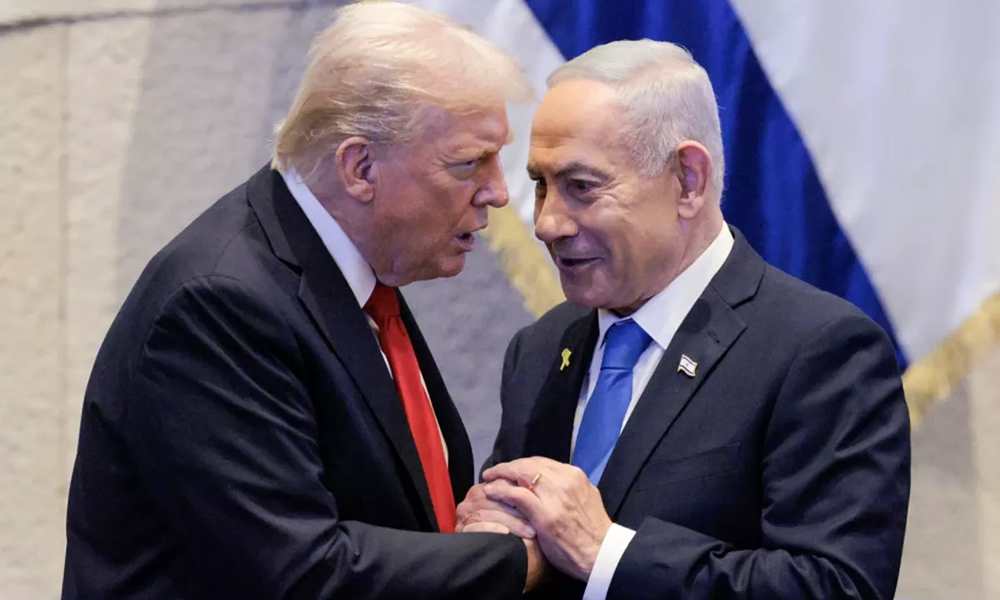
President Donald Trump will host Benjamin Netanyahu at the White House on Wednesday where the Israeli prime minister is expected to press him to widen U.S. talks with Iran to include curbs on Tehran’s missile arsenal and other security threats that go beyond its nuclear program, Reuters reported.
In his seventh meeting with Trump since the president returned to office nearly 13 months ago, Netanyahu will be looking to influence the next round of U.S. discussions with Iran following nuclear negotiations held in Oman last Friday amid heightened Middle East tensions.
Trump has threatened to carry out strikes on Iran if an agreement is not reached, and Tehran has responded with vows to retaliate, fueling fears of a wider regional war. He has repeatedly voiced support for a secure Israel, long a close U.S. ally in the Middle East and an arch-foe of Iran.
The president repeated his warning in a series of media interviews on Tuesday, saying while he believes Iran wants to make a deal, he would do “something very tough” if they refused. He told Axios he was considering sending a second aircraft carrier strike group as part of a massive buildup of U.S. forces near Iran, read the report.
Israel is concerned that the U.S. might pursue a narrow nuclear deal that does not include limitations on Iran’s ballistic missile program or an end to Iranian support for armed proxy groups such as Hamas and Hezbollah, according to people familiar with the matter.
“I will present to the president our perceptions of the principles in the negotiations,” Netanyahu told reporters before departing for the U.S.
The two men could also discuss potential military action in the event that U.S.-Iran diplomacy fails, according to one of the sources.
After arriving in Washington on Tuesday night, Netanyahu met U.S. special envoy Steve Witkoff and Trump’s son-in-law Jared Kushner, who led the U.S. team at the Iran talks, according to a post on X by Israel’s ambassador to Washington, Michael Leiter.
Also on the agenda will be Gaza, with Trump looking to push ahead with a ceasefire agreement he helped to broker. Progress on his 20-point plan to end the war and rebuild the shattered Palestinian enclave has stalled with wide gaps remaining over complex steps it envisions, including Hamas disarming as Israeli troops withdraw in phases.
“We continue to work closely with our ally Israel to implement President Trump’s historic Gaza peace agreement and to strengthen regional security,” White House spokeswoman Anna Kelly said when asked about U.S. priorities for the meeting.
Netanyahu’s visit, originally scheduled for February 18, was brought forward amid renewed U.S. engagement with Iran. Both sides at last week’s Oman meeting said it was positive and further talks were expected soon.
U.S. Secretary of State Marco Rubio said last week, ahead of the Oman meeting, that the talks would have to include the range of Iran’s missiles, its support for proxy groups and its treatment of its own people.
Iran, which has ruled out restrictions on its missiles, said Friday’s discussions had been limited to nuclear issues, Reuters reported.
Trump has been vague about broadening the negotiations. He was quoted as telling Axios on Tuesday that it was a “no-brainer” for any deal to cover Iran’s nuclear program, but that he also thought it possible to address its missile stockpiles.
Iran says its nuclear activities are for peaceful purposes, while the U.S. and Israel have accused it of past efforts to develop nuclear weapons.
Last June, the U.S. joined Israel’s strikes on Iranian nuclear facilities during a 12-day war.
Israel also heavily damaged Iran’s air defenses and missile arsenal. But, according to two Israeli officials, there have been signs of a push to restore those capabilities, which Israel sees as a strategic threat.
Trump had threatened last month to intervene militarily during a bloody crackdown on nationwide anti-government protests in Iran, but ultimately held off.
Tehran’s regional sway has been weakened by Israel’s attack in June as well as blows to Iranian proxies – from Hamas in Gaza to Hezbollah in Lebanon, the Houthis in Yemen and militias in Iraq – and by the ousting of Iran’s close ally, former Syrian President Bashar al-Assad.
But Israel has been wary of its foes rebuilding after they suffered heavy losses in the multi-front war sparked by Hamas’ October 2023 cross-border attack on southern Israel.
While Trump and Netanyahu have mostly been in sync and the U.S. remains Israel’s main arms supplier, Wednesday’s discussions have the potential for tensions to surface.
Part of Trump’s Gaza plan holds out the prospect for eventual Palestinian statehood – which Netanyahu and his coalition, the most far-right in Israel’s history, have long resisted.
Netanyahu’s security cabinet on Sunday authorized steps that would make it easier for Israeli settlers in the occupied West Bank to buy land while granting Israel broader powers in what the Palestinians see as the heartland of a future state. The Israeli decision drew international condemnation, read the report.
“I am against annexation,” Trump was quoted as telling Axios, reiterating his stance on the issue. “We have enough things to think about now.”








World
US and Denmark reach deal on Greenland, Trump says
In a separate statement, US Secretary of State Marco Rubio said that the deal “permanently and completely” addressed Washington’s national security concerns with respect to the island.

The United States, Denmark and Greenland have entered into an agreement for the US to develop a significant military presence on Greenland, while prohibiting US adversaries from building their own bases on the island, Donald Trump said on Friday.
In a Truth Social post, the US president wrote that no US enemies would be able to make sensitive investments on the island without the approval of the United States and that the agreement had no expiry date, Reuters reported.
“At my direction, we worked with representatives of Denmark and Greenland to guarantee that the United States will FOREVER have the complete ability to do what is necessary in Greenland in order to secure and defend the security of Greenland, and the United States of America,” Trump wrote.
Earlier on Friday, Reuters exclusively reported that the US and Denmark were closing in on a deal that would result in an increased US military presence in Greenland, an autonomous territory of Denmark, but would stop well short of Trump’s long-held dream of acquiring the island for the United States.
The US already has nearly total overflight and basing rights in Greenland due to a 1951 treaty.
Trump’s announcement suggests he was nonetheless pleased with the outcome of the negotiations and that he might not revive his territorial claims, at least in the near future. He said, without elaborating, that the US would soon be rolling out a large military presence on the island, which already hosts one Space Force base in its remote northwest.
“This is a dream come true for the United States of America,” Trump wrote.
EXTENT OF AGREEMENT REMAINS UNCLEAR
The Danish prime minister’s office said on Friday that the agreement would strengthen North Atlantic and Arctic security.
Greenland’s prime minister, Jens-Frederik Nielsen, said in a statement that the agreement recognized Greenland’s interests and the Arctic island’s place in international cooperation. “This benefits us all,” he said.
Much was unclear as of Friday night, including whether any new US bases would be constructed as a result of the agreement. Trump’s Truth Social posts about negotiations or agreements often lack context or specifics.
Imran Bayoumi, a former Pentagon official now with the Atlantic Council think tank, said it would be new if the US can build bases without the approval of Greenland or Denmark but that largely “it seems that Washington could have achieved a lot of these objectives through diplomacy and dialogue without straining the broader US-NATO relationship.”
It was also unclear how the agreement would be received in Greenland, an autonomous territory of Denmark. The island’s residents aspire to independence and have bristled at US attempts to assert control.
In a separate statement, US Secretary of State Marco Rubio said that the deal “permanently and completely” addressed Washington’s national security concerns with respect to the island.
“Greenland will forever be part of the strategic defense area of North America and exclude any adversary from it and the surrounding area,” he wrote.
A State Department official, speaking on condition of anonymity to discuss specific terms, said the deal prohibits non-NATO countries from building a base in Greenland and will allow only the US and its allies to make unspecified “sensitive investments.” The official said the agreement grants the US permanent access, basing and overflight rights, and would continue to apply even if Greenland becomes independent.
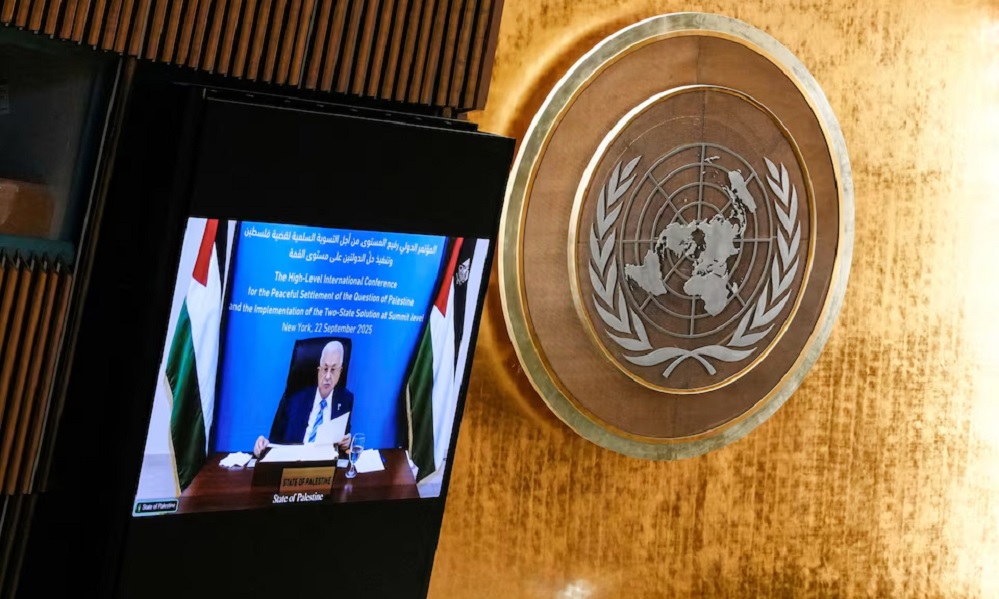
The United Nations General Assembly voted on Thursday to allow Palestinian President Mahmoud Abbas to address the annual gathering of world leaders next week via video – for the second year in a row – after the United States again denied him a visa to travel to New York.
The resolution received 152 votes in favor and three votes against, while four countries abstained. It also allows Abbas and any other high-level Palestinian officials to take part in U.N. meetings or conferences via video over the next year if they are prevented from traveling to the United State, Reuters reported.
The US said last year that Abbas and about 80 other Palestinians would be affected by its decision to deny and revoke visas from members of the umbrella Palestine Liberation Organization and the West Bank-based Palestinian Authority. Washington announced on Wednesday that it had extended the visa bans.
“If the PA wants to be treated as a partner, it must stop subsidizing terror and stop using diplomatic theater as a substitute for serious governance,” Deputy US Ambassador to the United Nations Tammy Bruce told the assembly before the vote.
Palestinian leaders rejected and condemned the move by the United States, Palestinian UN envoy Riyad Mansour told the General Assembly.
Without naming specific officials, the US State Department said on Wednesday it would extend visa sanctions against Palestinian officials over actions they took to “internationalize the Israeli-Palestinian conflict,” including pursuing cases against Israel at international tribunals.
A Palestinian official, who spoke on condition of anonymity, confirmed Abbas’ visa had been denied.
Under a 1947 U.N. “headquarters agreement,” the U.S. is generally required to allow access for foreign diplomats to the UN in New York. However, Washington has said it can deny visas for security, extremism and foreign policy reasons.
World
North Korea’s Kim vows to expand ties with Russia, backs victory in ‘sacred war’
Kim delivered a similar message to Chinese President Xi Jinping in a reply published by KCNA on Sunday.

North Korean leader Kim Jong Un said he would “expand and deepen” joint work with Russia in a message to Russian President Vladimir Putin, state media KCNA reported on Tuesday.
In a reply sent on Monday to Putin’s congratulations for North Korea’s 78th founding anniversary, Kim said Pyongyang’s government had a firm will to broaden cooperation with Russia “in a comprehensive way” based on friendship, mutual assistance, and what he described as the countries’ alliance relations.
Kim also said he was convinced of Russia’s victory in the current “sacred war for defending the security interests of the country and international justice”, language that appeared to refer to Russia’s war in Ukraine.
He pledged his “invariable support” for Putin and the Russian people.
The remarks come as Moscow and Pyongyang have drawn markedly closer, with North Korea sending troops to fight alongside Russian forces in Ukraine in 2024 and deepening military cooperation under a mutual defence pact.
Kim delivered a similar message to Chinese President Xi Jinping in a reply published by KCNA on Sunday, saying North Korea would work with China to further develop their traditional friendship and advance their shared socialist cause.
Both messages were responses to congratulatory letters sent by Putin and Xi on September 9, when North Korea marked the 78th anniversary of its founding.


Asian Games open in Japan’s Nagoya, Afghanistan sends 34 athletes

Seven Afghan migrants killed in traffic accident in Iran’s Sistan and Baluchestan

OIC to hold Afghanistan Contact Group meeting on sidelines of UN General Assembly

Flames, smoke seen near Riyadh airport; Houthis claim attacks on Saudi capital

Tahawol: Kabul’s warning over any threat from Pakistan discussed

Four mediators struggle to secure lasting Pakistan-Afghanistan ceasefire

Syria and Saudi Arabia condemn Kabul bombing, express solidarity with Afghanistan

Afghanistan’s trade diversification challenges Pakistan

Saudi energy group signs major Afghanistan deals covering gas exploration and pipeline plans

ATN secures exclusive rights to broadcast T20I series in India across Afghanistan
Tahawol: Kabul’s warning over any threat from Pakistan discussed

Debate on Afghanistan and New Investment Opportunities

Tahawol: Reasons behind Qatari, Turkish security officials’ Kabul visit discussed

Saar: Outcome of UN Security Council meeting on Afghanistan discussed

Tahawol: Afghanistan’s readiness for US relations discussed
-
 Latest News4 days ago
UN warns of mounting humanitarian and human rights pressures in Afghanistan
-

 Regional4 days ago
Saudi Arabia calls alleged Mecca attack a ‘red line’ as Houthis deny involvement
-
 Latest News5 days ago
UNICEF expands aid to millions of Afghan children after flash floods
-
 Latest News5 days ago
Petition filed in Islamabad High Court against PMDC directive affecting Afghan students
-
 Latest News4 days ago
Five Years On: IEA touts economic growth despite international isolation
-

 Sport4 days ago
India take 2-0 lead in 3-match series against Afghanistan
-

 Latest News5 days ago
Afghanistan, India explore cooperation on medical supplies, food and drug quality
-

 Sport5 days ago
Nabi reaches 2,500 T20I runs