
Business
Mps concern over privatization of New Kabul Bank

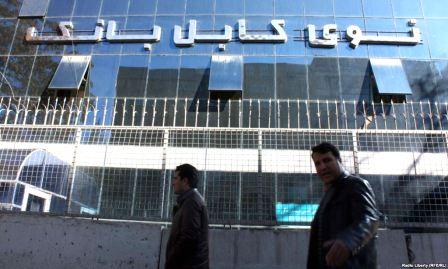

Members of the parliament have expressed their concerns over privatization of the New Kabul Bank which is probably to be sold to a Pakistani Bank called Muslim Commercial Bank, fearing that Pakistan intelligent office will have longer hands into Afghanistan confidential information.
Earlier last week officials in Ministry of Finance had announced that MCB and the local firm, Join-Stock, are eligible buyers, the announcement had provoked many reactions within the Afghan Government and economy expert’s level.
Afghan economical expert Sayed Masoud said,” Muslim Commercial Bank is one of the Military Bank of Pakistan, Afghan President should considerate over the issue, since the New Kabul Bank has 80 agencies Nationwide only for Afghan military forces if the following Bank is owned it will disclose all the secret information of Afghan military forces to Pakistan.”
“Countries in the world in order to gain secret information spend millions of dollars to meet their goals , but Afghanistan Government is allowing Pakistan to access confidential information free of charge economy expert Azarakhsh Hafizi said,”
Mp Ghulam Farooq Majroh said,” Pakistan has been continuously working against Afghanistan’s National interests, we should let Pakistan to have hands in our Banking system.”
Meanwhile Ministry of Finance Spokesman Ajmal Abdulrahimzai said,” if any banks doesn’t have criminal cases in the past and can meet our requirement will be eligible to be one of the buyers.”
Kabul Bank is a commercial bank in Afghanistan that has its main branch in the capital of Kabul. Established in 2004, from the beginning the following main bank used to pay the salaries of the army and security forces.
The bank provides facilities to maintain accounts in Current, Savings Bank and Fixed Deposits; and offers its consumers branch and automated teller machine services.
The bank was under the supervision of Da Afghanistan Bank (DAB), the central bank of Afghanistan.
The scandal has not only earned bad image for the country but also pushed investors away. Even the bailout failed to address the economic crunch and restore customers’ trust over the country’s largest private bank. It is a biggest scandal in Afghanistan’s banking sector history.
Kabul Bank was badly shaken and almost collapsed in one of “the worst banking scandals in history,” according to The Guardian newspaper in late 2012, according to the Los Angeles Times, independent investigators and journalists uncovered widespread corruption in Kabul Bank.
The New York Times, in 2012, headlines indicate “Audit Says Kabul Bank Began as ‘Ponzi Scheme’” following investigation and judicial action in the aftermath of the Bank’s crisis and scandal.
In 2010, it was disclosed that its Chairman Sherkhan Farnood and other insiders were spending the bank’s US$1 billion for their own personal lavish style living and lending money under the table to family, relatives and friends.
The bank scandal also involved members of Afghan President Karzai’s family, including one of his brothers, Mahmood Karzai. In September 2010, one of the principal owners of the bank, said that depositors had withdrawn $180 million in two days and predicted a “revolution” in the country’s financial system unless the Afghan government and the United States moved quickly to help stabilize the bank.
In November 2010, reports appeared that Farnood and chief executive Khalilullah Frozi both had been sacked from duties.
As of early 2011 both were effectively under house arrest and could not leave the country, and in July 2011 both were formally arrested and detained in Kabul.
DAB stated in February 2011, it would seek to sell Kabul Bank within three years once it was rehabilitated, but both the International Monetary Fund and US officials subsequently pressed for a rapid wind down of the institution.
Several influential people were involved in the scandal. Therefore, the government failed to catch and punish the bigwigs. Sadly, the authorities were not serious to build confidence to investors. They tried to rebuild the bank’s image by adding ‘New’ to its name though the bank has nothing new to offer.
A USAID inspector general report estimated that fraudulent loans diverted $850 million to bank insiders.[8] By October 2011, more than a year after the government seized control, officials had recovered less than 10 percent of the nearly $1 billion that went missing.
After the huge scandal of New Kabul Bank the Afghan Government decided to start bidding process to sell the following Bank to any firms that can meet the conditions.

Business
Etihad Airways to expand Kabul–Abu Dhabi flights to daily service amid surging demand
Etihad relaunched the route on March 20, 2026, initially operating four weekly flights.
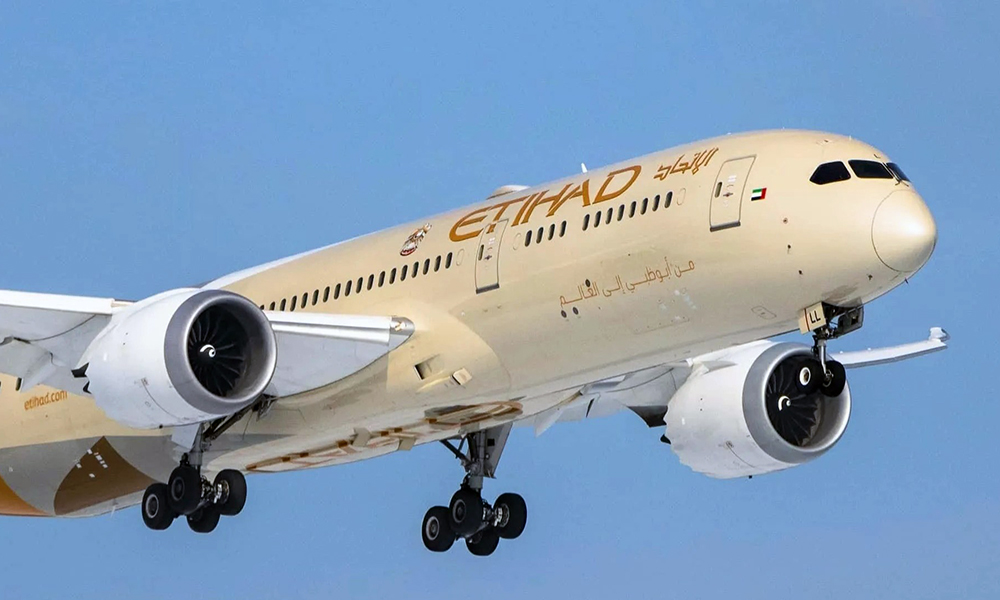
Etihad Airways has announced it will upgrade its Kabul–Abu Dhabi service to daily flights starting May 1, 2026, citing a sharp rise in passenger demand and improving international connectivity.
In a statement issued Thursday, the airline said the move follows a strong market response and higher-than-expected bookings, just weeks after operations on the route resumed. The Kabul–Abu Dhabi corridor has quickly re-emerged as a crucial air link for travelers seeking reliable international connections from Afghanistan.
Etihad relaunched the route on March 20, 2026, initially operating four weekly flights. The rapid shift to daily service underscores the route’s commercial viability and reflects growing confidence in sustained passenger demand.
Airline officials noted that the expanded schedule will offer greater flexibility and convenience for both business and leisure travelers between Afghanistan and the United Arab Emirates.
The increase in frequency is also expected to significantly boost onward connectivity, allowing passengers departing from Kabul to access major global destinations—including London, Frankfurt, Toronto, and Washington, D.C.—via Abu Dhabi.
The development is widely viewed as an important step toward strengthening Afghanistan’s air links with Europe and North America, amid signs of gradual recovery in regional and international travel.
Business
Afghanistan faces economic strains following a ‘series of shocks’ last year
These pressures have driven an estimated 11 percent population increase in the fiscal year 2025, largely due to returning migrants, the World Bank stated.
Afghanistan’s fragile economy is grappling with a series of shocks that intensified in 2025, according to a World Bank economic update report released on Wednesday.
The report noted that Afghanistan has been hit by reduced foreign aid, prolonged crossing closures along the disputed Durand Line with Pakistan, natural disasters, and a significant return of refugees from Iran and Pakistan.
These pressures have driven an estimated 11 percent population increase in the fiscal year 2025, largely due to returning migrants, the World Bank stated.
While Afghanistan’s aggregate GDP grew by around 4.8 percent last year, reflecting a rebound in nonagricultural activity and private consumption, the growth has not kept pace with population expansion. As such, per capita GDP contracted by 5.6 percent, as rising inflation and higher trade and transport costs eroded living standards.
“The influx of returnees has temporarily boosted domestic demand, but also places additional strain on labor markets, housing, and social services,” the report noted.
Looking ahead, Afghanistan’s economy is projected to grow by 4.0 percent in 2026, driven by strengthening domestic demand, higher private investment, and improved absorption of returnees into the workforce. However, the report warns that ongoing conflict in the Middle East and disruptions to trade routes, particularly the 60 percent of Afghan trade that passes through Iran, pose significant risks.
“Border closures or sudden surges in returnees could further depress per capita incomes and fuel inflation,” the World Bank said. Trade rerouting may mitigate some effects, but the country remains vulnerable to regional instability.
Despite these challenges, analysts highlight that modest growth and ongoing private-sector activity offer some hope for recovery. The World Bank emphasizes that sustained economic resilience will depend on peace, stable trade corridors, and the ability to productively integrate returning populations into the labor market.
Afghanistan’s experience underscores the broader regional pressures in the Middle East, North Africa, Afghanistan, and Pakistan (MENAAP), where conflict and humanitarian crises continue to ripple through economies, affecting inflation, trade, and social stability.
Business
Afghanistan, Uzbekistan sign $400 million trade deals in push to deepen ties
The agreements span multiple sectors, including textiles, raw materials, pharmaceuticals and other key industries.
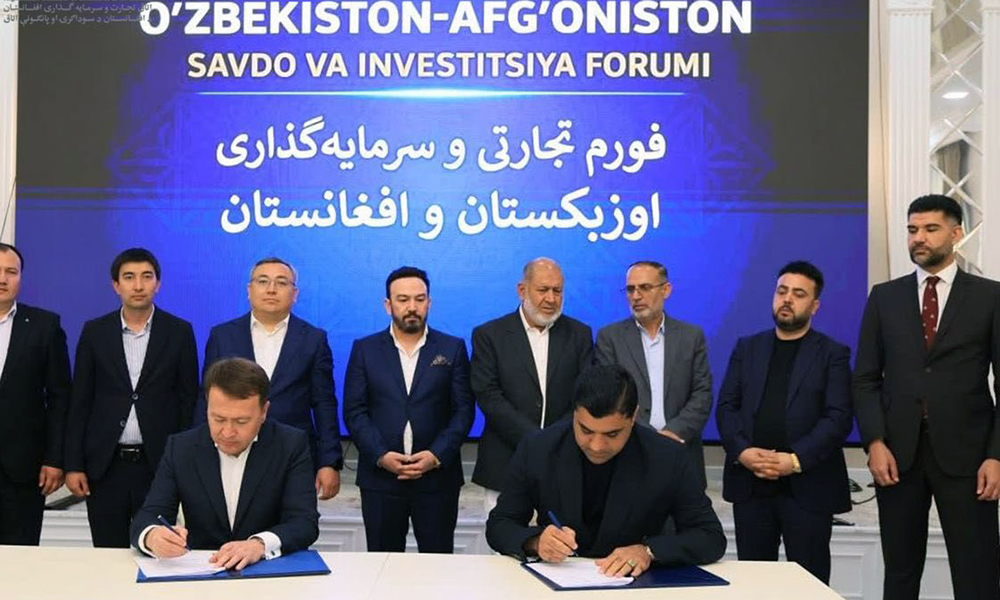
Afghanistan and Uzbekistan have signed 20 commercial agreements worth more than $400 million, marking a significant step toward expanding economic cooperation between the two neighboring countries.
The deals were finalized during a high-level business meeting in Uzbekistan’s Fergana Province, where Afghan and Uzbek private sector representatives gathered as part of an official Afghan trade delegation visit.
The agreements span multiple sectors, including textiles, raw materials, pharmaceuticals and other key industries.
The Afghan delegation was led by Zalgai Azimi, deputy for investment at the Afghan Chamber of Commerce, and included senior business figures such as Abdullah Rahimi, Syed Ahmad Noorzad, Ubaidullah Hotak, and Deputy Chief Executive Mirzaman Popal. Participants from both sides highlighted the importance of strengthening cross-border trade and building long-term commercial partnerships.
As part of the visit, Afghan delegates toured major industrial facilities in Fergana Valley to assess Uzbekistan’s manufacturing capacity and explore opportunities for future collaboration.
The agreements come as Afghanistan seeks to boost regional connectivity and revive its economy following years of conflict, isolation and economic disruption.
Trade with Central Asian neighbors—particularly Uzbekistan—has become increasingly important, with both sides investing in transport links, energy cooperation and cross-border markets.
Uzbekistan has positioned itself as a key economic partner for Afghanistan in recent years, supporting infrastructure projects and promoting trade corridors that connect South and Central Asia.
Analysts say deals of this scale could help generate jobs, increase exports and gradually integrate Afghanistan more deeply into regional supply chains.
The latest agreements signal growing momentum in bilateral relations, as both countries look to translate geographic proximity into stronger economic interdependence.


Vance warns Iran not to “play us” as he leaves for talks

Etihad Airways to expand Kabul–Abu Dhabi flights to daily service amid surging demand

UK backs Afghanistan–Pakistan talks, calls dialogue key to lasting peace

Iran war doubles Russia’s main oil revenue to $9 bln in April, Reuters calculations show

IEA defense minister meets Chinese envoy, emphasizes security and regional stability

IEA Supreme Leader issues Eid-ul-Fitr message urging unity and support for Islamic system

IEA supreme leader orders replacement of foreign terminology in official documents

14 Pakistani soldiers killed after military post falls along Durand line: MoD

Afghan airstrikes target Pakistani military sites in retaliation for air attacks

Turkmenistan, Afghanistan discuss steps to speed up land acquisition for TAPI pipeline

Tahawol: China to host 2nd round of Kabul–Islamabad talks discussed

Saar: Fragile ceasefire in the Middle East reviewed

Tahawol: Two‑week truce agreement between Iran-US reviewed

Saar: US–Iran two-week ceasefire agreement discussed

Tahawol: Ongoing negotiations between Kabul-Islamabad discussed
-
 Latest News5 days ago
IEA supreme leader orders replacement of foreign terminology in official documents
-
 Latest News3 days ago
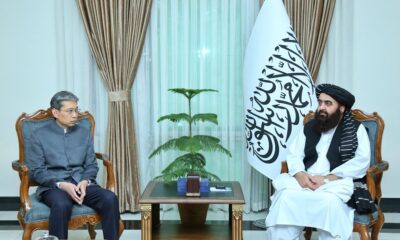
China seeking to build trust between Afghanistan and Pakistan
-
 Latest News4 days ago
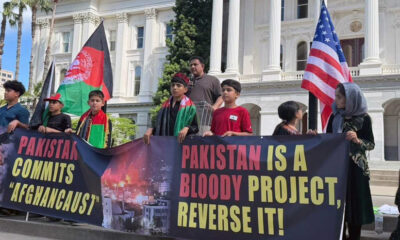
Afghan community in California condemns Pakistani strikes amid growing global protests
-

 International Sports4 days ago
IPL 2026: Lucknow hold nerve in final over to defeat Sunrisers
-
 Business3 days ago
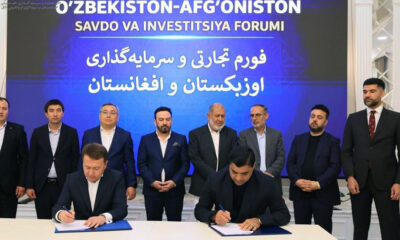
Afghanistan, Uzbekistan sign $400 million trade deals in push to deepen ties
-
 Regional4 days ago
IRGC intelligence chief killed as wave of strikes continues against Iran’s leadership
-

 International Sports3 days ago
IPL 2026: Rain scuppers KKR vs PBKS match
-
 World4 days ago
US, Iran and mediators make push for 45-day ceasefire, Axios reports