
Business
National Transportation Day marked in Kabul

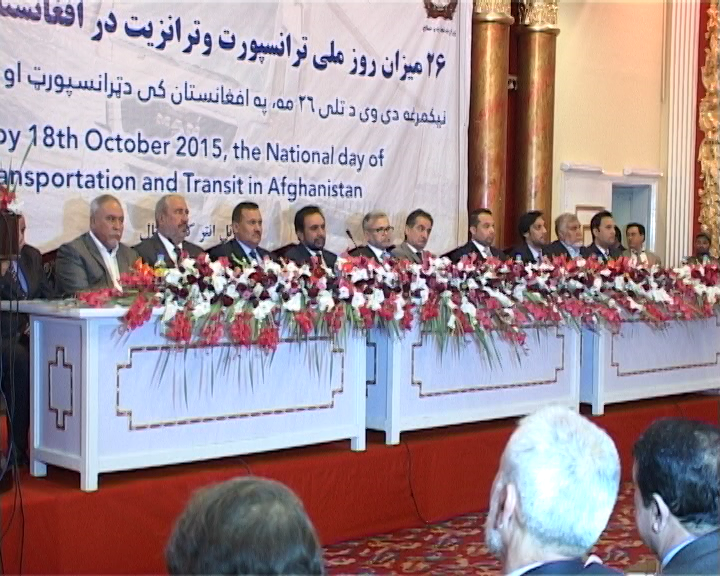


Presidential special envoy on Good Governance has stated that Transportation sector growth has not been acceptable with the baby steps in the past several years in Afghanistan.
Meanwhile Minister of Transportation and aviation has said,” there are effective programs are underway to grow transportation sector either by land or air in Afghanistan.”
Dozens of Afghan officials have gathered here to hold the National Transportation day in the capital city of Kabul.
Ahmad Zai Masoud the Presidential special envoy for the President on Good Governance during his speech has expressed his unsatisfactory on slow growing of Transportation sector in Afghanistan.
He said,” Transportation sector hasn’t grown significantly in the past several years,poor coordination,none standard transports in the country has caused severe economy problems.”
As concerns continue head of the chamber commerce Khanjan Alkozai said,”the reverse actions which are being implemented in transportation sector will do affect our activities, mostly Pakistan transportation is being benefited from it.”
Minister of transportation and aviation Mohammadullah Batash said,” despite of problems in land sector,it has always been for the Afghan Nation services,there has been some achievements on the sector as well, one big example 300 Kunduz residents whom were displaced due to war were sent back to Kunduz free of charge.”
Afghanistan is one of the countries in the region which could be used as good transit country among the region but insecurity has stopped other countries to use it for the further benefits.
Reported By Ali Asghari

Business
Trans-Afghan Railway cost surges to over $7 billion as regional interest grows
The project includes approximately 760 kilometers of new railway construction inside Afghanistan, between Mazar-e Sharif and Torkham.
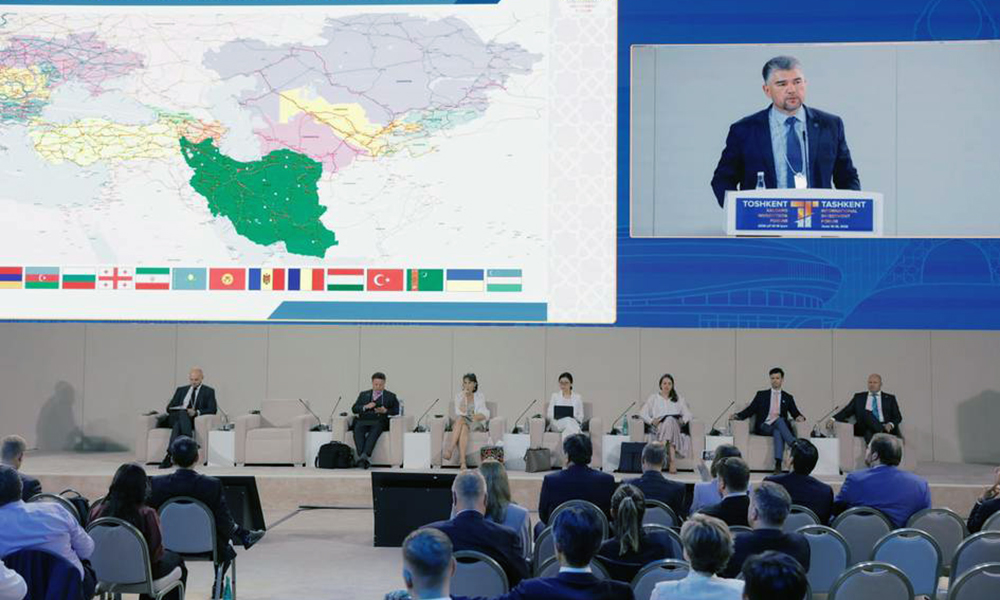
The estimated cost of the proposed Trans-Afghan Railway linking Uzbekistan, Afghanistan and Pakistan has risen to more than $7 billion, according to Uzbek Deputy Minister of Transport Jasurbek Choriyev.
Speaking at the Tashkent International Investment Forum on June 18, Choriyev said the updated figure reflects ongoing technical assessments and the evolving scope of the project. Earlier estimates had placed the cost at around $4.8 billion.
He noted that a detailed feasibility study for the strategic railway is currently underway and is expected to be completed by the end of 2026.
Strategic regional corridor
The Trans-Afghan Railway is planned to establish a direct rail link from Termez in Uzbekistan through Mazar-e Sharif, Logar, Kharlachi and Torkham in Afghanistan, before continuing into Pakistan and connecting with major ports including Karachi.
The project includes approximately 760 kilometers of new railway construction inside Afghanistan, between Mazar-e Sharif and Torkham.
According to officials, the railway is expected to significantly reduce transport time between Central Asia and Pakistan—from around 35 days to as little as three to five days—while also lowering logistics costs.
Trade and cargo capacity
Choriyev said the railway could handle up to 20 million tons of cargo annually, doubling earlier estimates of 10 million tons.
He added that the corridor would provide Central Asian countries with faster access to global maritime trade routes and strengthen economic links between South Asia, Central Asia and CIS states, where combined trade exceeds $700 billion.
Officials also estimate that container transport costs along the route could be reduced by nearly three times compared to existing logistics pathways.
Financing and international interest
The deputy minister confirmed that several countries, including the United Arab Emirates and Qatar, have expressed interest in participating in the project. The Eurasian Development Bank has also indicated readiness to support financing.
Uzbek officials have been promoting the railway as a long-term strategic infrastructure project aimed at boosting regional connectivity and trade integration. While feasibility work continues through 2026, final investment and construction decisions are expected to follow upon completion of the study.
The project is widely seen as a key component of efforts to transform Afghanistan into a transit hub linking Central and South Asia.
Business
High-level Kazakh delegation arrives in Kabul as Afghanistan, Kazakhstan eye $3 billion trade target
Azizi noted that annual trade between Afghanistan and Kazakhstan currently stands at nearly $600 million, but both governments are working toward increasing bilateral trade to $3 billion in the coming years.
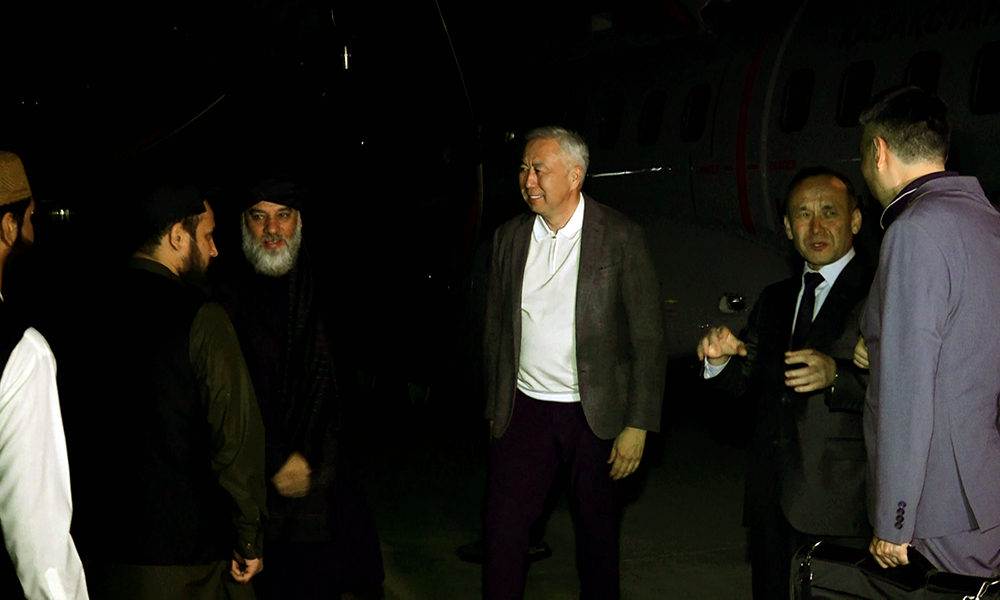
A high-level delegation from Kazakhstan, led by Deputy Prime Minister and Minister of National Economy Serik Zhumangarin, arrived in Kabul on Thursday night for talks aimed at expanding political, economic and trade cooperation between Afghanistan and Kazakhstan.
The visit is expected to focus on strengthening bilateral relations, increasing trade, promoting investment opportunities and enhancing regional economic connectivity.
Welcoming the delegation, Nooruddin Azizi, Afghanistan’s Minister of Industry and Commerce, said the visit reflects the growing partnership between Kabul and Astana and could play a significant role in deepening cooperation across multiple sectors.
According to Azizi, members of the Kazakh delegation are scheduled to meet with senior officials of the Islamic Emirate to discuss a broad range of political, economic and commercial issues. He described the visit as an opportunity to open a new chapter in bilateral relations.
“The presence of this high-level delegation demonstrates the commitment of both countries to expanding cooperation and strengthening long-term economic and political ties,” Azizi said.
Trade volume targeted to reach $3 billion
Azizi noted that annual trade between Afghanistan and Kazakhstan currently stands at nearly $600 million, but both governments are working toward increasing bilateral trade to $3 billion in the coming years.
He said Kazakhstan is currently one of Afghanistan’s major suppliers of wheat, flour and processed agricultural products, while Afghanistan has the potential to significantly expand exports of fresh and dried fruits to the Kazakh market.
According to the minister, Kazakhstan could become one of the most important alternative export destinations for Afghan traders as economic relations continue to develop.
Investment and business opportunities
The Kazakh delegation will also participate in a joint exhibition of Afghan and Kazakh products in Kabul, designed to showcase the production capabilities of both countries, strengthen commercial partnerships and create new opportunities for joint investment.
Azizi emphasized that Afghanistan has created favorable conditions for foreign investment and invited Kazakh businesses to invest in sectors including agriculture, industry, transport, transit and logistics.
He said the Afghan government is prepared to provide the necessary facilities and full support for foreign investors seeking opportunities in the country.
Experts see broader regional significance
Economic experts believe the visit extends beyond trade and investment, carrying important political and regional implications.
They say closer cooperation between Kabul and Astana could strengthen regional connectivity by expanding trade corridors, improving transit and transportation links, boosting agricultural exports and encouraging broader economic integration across Central and South Asia.
The visit comes as Afghanistan and Kazakhstan have steadily expanded cooperation in recent months in areas including trade, transit, cargo transportation, agricultural exports and regional economic initiatives.
Officials from both countries have repeatedly emphasized the importance of increasing bilateral trade, promoting joint investment projects and strengthening economic cooperation. Observers believe the current visit by the senior Kazakh delegation could mark another significant step toward achieving those objectives and advancing the two countries’ shared goal of expanding bilateral trade to $3 billion.


Afghanistan intensifies fight against synthetic drugs

Saar: Iran vs US Talks Begin – Will Tensions Ease?

Kazakh deputy PM calls for de-escalation between Afghanistan and Pakistan

Afghanistan, Uzbekistan move to expand cooperation in pharmaceutical sector

Germany could charter three deportation flights to Afghanistan a month

Norway’s Viking-inspired World Cup team photo goes viral

Afghanistan announce squad for India series

Afghanistan, Russia sign military cooperation agreement

Major pharma firms eye investment in Afghanistan

Afghanistan expands oil production as investment in Amu Darya fields grows
Saar: Iran vs US Talks Begin – Will Tensions Ease?

Tahawol: Discussion on reopening of Strait of Hormuz

Saar: Afghanistan-Pakistan tense relations disucssed

Tawsia: Last week’s key economic developments discsused

Tahawol: Afghanistan–UN ongoing engagement discussed
-
 Business4 days ago
Afghanistan signs $67 million contract for cement production in Samangan
-

 Saar3 days ago
Saar: Trump’s remarks on US military equipment in Afghanistan discussed
-

 Sport4 days ago
2nd ODI: India crush Afghanistan by 170 runs to seal series lead
-
 Latest News4 days ago
Trump says US may seek return of military equipment left in Afghanistan
-
 Health4 days ago
Polio cases in Afghanistan rise to six in 2026 as two new cases confirmed
-
 Latest News5 days ago
Afghan national pleads not guilty in deadly National Guard shooting near White House
-
 Latest News3 days ago
Khalilzad calls for Afghanistan-Pakistan dialogue after airstrikes
-
 World5 days ago
G7 leaders express optimism for peace after Trump’s ‘very good’ Zelenskiy meeting