
Latest News
New U.S. Envoy Calls for Peaceful Transition of Leadership in Balkh

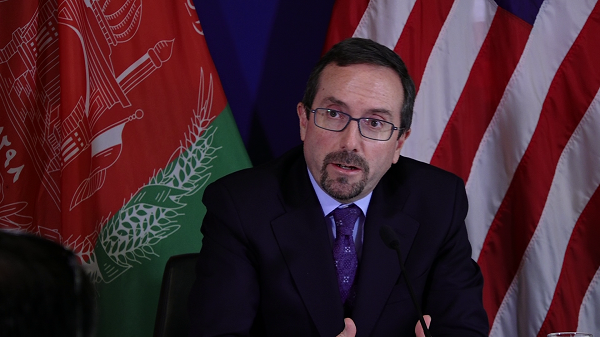
 The U.S. Ambassador to Kabul John R. Bass has called for a peaceful transition of power in the northern Balkh province and stressed for an urgent solution to end the dispute between President Ashraf Ghani and the ousted Balkh Governor Atta Mohammad Noor.
“It’s not an issue for the United States or any other member of the international community to decide. This is an issue for Afghans to decide within the framework of the constitution, in accordance with the rule of law and in accordance with the principle of a quality before the law; that principle that no individual is above the law,” said Ambassador John Bass at his first press conference in Kabul.
In December, President Ghani announced Atta Mohammad Noor had resigned as governor of Balkh province and a successor had been appointed.
But Noor refused to leave a post he has held for thirteen years and emphasized that President Ghani did not have the power to unilaterally remove him because his party had half of the seats in the coalition government.
In the meantime, the newly appointed Bass announced about an ongoing dialogue between U.S. and Pakistan for eliminating terrorist hideouts in the country.
“We have been pretty clear that we have expectation from Pakistani government about their commitment to dealing with the challenges that are created here by the Taliban’s ability to use parts of Pakistan for sanctuary and to plan and organize attacks here in Afghanistan. We have made clear that it is unacceptable and it needs to change,” Bass noted.
He further added that there is no peace option with the Islamic State (IS) group in Afghanistan.
“There is absolutely no way to workout peace or reconciliation with Daesh. The only way to deal with Daesh is through sustained efforts on the battlefield to either kill them or capture them and to prevent them from being able to conduct attacks,” he said.
This comes as the U.S. Vice President Mike Pence has also urged a peaceful resolution of power struggle between the president and the deposed governor of a northern province.


Germany is accelerating the admission of Afghan nationals currently in Pakistan, with Foreign Minister Johann Wadephul expecting arrivals by the end of the year for those with binding commitments to be accepted.
“I assume this is a priority,” Wadephul told the Evangelical Press Service. “Necessary checks and flights are now proceeding quickly,” he added. From the beginning of next year, Afghans still waiting in Pakistan face potential deportation to their country of origin.
For years, many of these individuals had been promised entry into Germany, but Federal Interior Minister Alexander Dobrindt (CSU) had questioned some of these commitments and ordered a renewed review of which of the original roughly 2,000 people should still be admitted. At the same time, numerous legal challenges arose regarding the validity of these promises and Germany’s obligation to accept certain refugees.
Wadephul emphasized that responsibility lies with the Interior Ministry. Following its review, it was determined that a significant portion of the group has legally binding commitments, while for another group of around 650 people, Dobrindt recently decided against admission. This decision has drawn criticism from opposition parties and human rights organizations.
The foreign minister noted that he had previously negotiated with Pakistan to extend asylum procedures by six months, allowing particularly those in the federal resettlement program to be admitted. “The Interior Ministry no longer sees this option for individuals from the bridging program and those on the human rights list,” he said.

Zakir Jalaly, Director of the Second Political Department at the Ministry of Foreign Affairs of Afghanistan, on Sunday highlighted the importance of moving beyond purely security-focused approaches and recognizing Afghanistan’s constructive role in regional connectivity, cooperation, and integration.
Jalaly noted in a post on X that Afghanistan prior to 2021, amid the presence of foreign military forces and interventions by regional and international actors, had become a serious security challenge not only for its people but for the entire region. Today, however, Afghanistan is no longer seen merely as a crisis to manage. With its geo-economic position, good intentions, and the current government’s economy-oriented foreign policy, the country has the potential to serve as an effective bridge between Central, South, and West Asia.
Under this approach, regional countries can effectively utilize Afghanistan’s transit, trade, and connectivity capacities, ultimately promoting shared interests and strengthening regional integration.
Jalaly praised the emphasis placed on these opportunities by Iran’s Foreign Minister Abbas Araqchi in his recent speech in Tehran meeting on Afghanistan. He said that over the past four years, tangible steps have been taken to enhance regional transit, connectivity, trade facilitation, and economic cooperation between Afghanistan and neighboring countries. These efforts demonstrate that a forward-looking, engagement-focused approach can foster stability, prosperity, and mutual regional benefits.
He concluded that cooperation with Afghanistan should be based on existing opportunities, on-the-ground realities, and available capacities. Afghanistan and the region possess extensive potential, and leveraging these resources effectively can create sustainable win–win outcomes for all parties involved.
Latest News
US intelligence chief warns of ‘direct threat’ from suspected terrorists inside the country

The U.S. director of national intelligence has warned of what she described as a “direct threat” from suspected terrorists living inside the country, accusing the Biden administration of failing to properly vet thousands of individuals who entered the United States in recent years.
Speaking to Fox News on Saturday, Tulsi Gabbard claimed that around 18,000 known or suspected terrorists were allowed into the country, alleging serious shortcomings in vetting procedures. “The Biden administration did not take their vetting responsibilities seriously,” she said, adding that authorities may still be unaware of additional cases.
Citing figures from the National Counterterrorism Center, Gabbard said approximately 2,000 of those individuals are Afghan nationals who entered the U.S. following the 2021 withdrawal from Afghanistan.
She said alleged whistleblowers told her that screening processes were rushed during that period. According to her account, officials were instructed to accelerate admissions and forego the thorough vetting normally required.
Gabbard described the situation as “devastating,” arguing that it has created security risks for Americans. She referenced a shooting just before Thanksgiving in which two U.S. National Guard members were shot, one fatally, with the suspect identified as an Afghan national.
However, reports and official reviews have previously pointed to broader circumstances surrounding the evacuation and resettlement effort. Following the chaotic U.S. withdrawal from Afghanistan, a review conducted under then-President Joe Biden concluded that the administration was constrained by a withdrawal agreement negotiated during President Donald Trump’s first term, as well as by inadequate planning for evacuations. The report cited a lack of preparation for removing remaining troops and assisting U.S. allies, despite an approaching deadline.
Media reports have also noted that the Trump administration had several years to expand Special Immigrant Visa programs for Afghan allies but instead slowed processing and weakened systems designed to support refugee admissions. Many Afghans who entered the U.S. after 2021 had worked alongside American forces and feared retaliation if they remained in Afghanistan.
Despite heightened political rhetoric following last month’s shooting, there is no evidence that the vast majority of Afghans resettled in the United States since 2021 pose a security threat, with most described by officials and community leaders as law-abiding.
Separately, authorities in the U.S. state of Rhode Island are investigating a mass shooting near Brown University in Providence that left at least two people dead and several others injured. Officials said the incident occurred shortly after 4 p.m. local time on Saturday, prompting a large-scale emergency response involving local police, state authorities, and federal agencies including the FBI and the Bureau of Alcohol, Tobacco, Firearms and Explosives.
Providence Mayor Brett Smiley said seven victims remain hospitalized in stable condition, one is in critical but stable condition, and another has been released. A suspect linked to the shooting was detained on Sunday, and the investigation remains ongoing.


IPL 2026 Auction set for Abu Dhabi with $28.6 million purse at stake

Germany speeds up admission of Afghans from Pakistan

IEA official applauds Iran FM’s focus on Afghanistan’s transit role

US intelligence chief warns of ‘direct threat’ from suspected terrorists inside the country

Father and son behind Bondi Jewish festival shooting that killed 15, Australian police say

Afghanistan records $580m in fruit exports in six months

Tashkent: Central Asian leaders say regional stability hinges on Afghanistan

Afghan Abdalyan beat Sri Lanka A by 3 wickets in Rising Stars Asia Cup opener

Afghanistan U19 cricket team defeats India A U19

Afghanistan economy under pressure as Pakistan shocks reshape trade flows

Tahawol: Intertwined interests of neighbors and Afghan security dynamics discussed

Saar: warning to those who disrupt Afghanistan’s stability

Saar: Iran’s regional meeting on Afghanistan discussed

Saar: Calls to avoid using Afghan soil against nations

Tahawol: UNSC meeting outcome regarding Afghanistan discussed
-
 Latest News2 days ago
Islamic Emirate declines to attend Tehran meeting on Afghanistan
-

 Latest News4 days ago
Muttaqi: Afghanistan’s progress requires both religious and modern education
-

 Latest News3 days ago
Dual-citizen Afghans don’t need a visa to enter the country: Foreign Ministry
-

 Sport5 days ago
Commanding wins for Arman FC and Sarsabz Yashlar in Afghanistan Champions League
-

 Sport4 days ago
Victories for Sorkh Poshan Khafi and Abu Muslim Farah in Afghanistan Champions League
-

 Latest News1 day ago
US delivers second batch of Afghan Black Hawk helicopters to Peru
-

 Latest News5 days ago
‘Media freedom is increasingly restricted’ in Afghanistan: Gagnon
-
 Latest News3 days ago
Pakistan PM: We need the international community to urge the IEA to curb terrorism