
Latest News
US gives 16 Mi-17 helicopters procured for Afghanistan to Ukraine: SIGAR

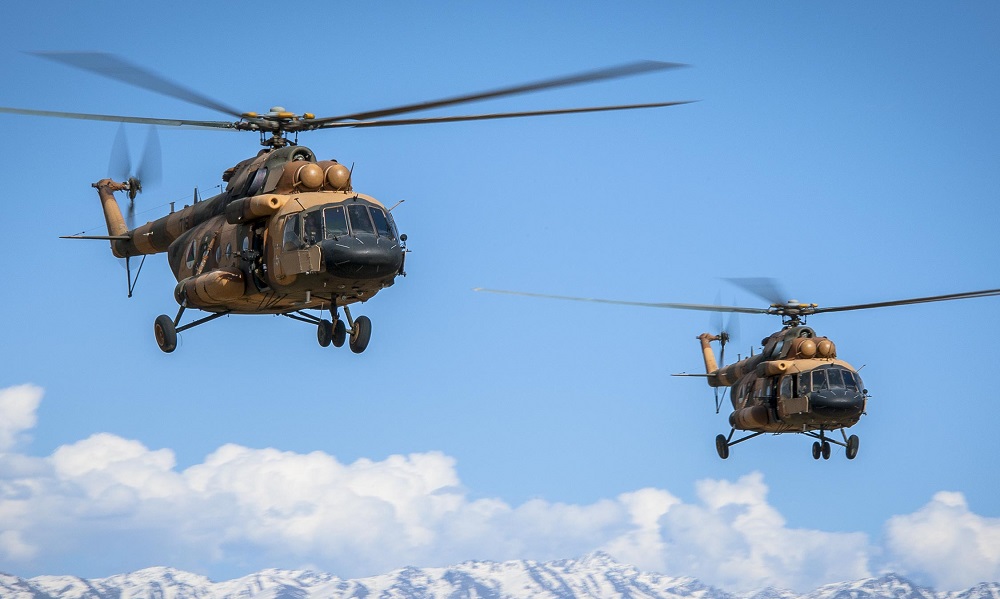
The United States is giving Ukraine 16 Mi-17 helicopters that Washington had procured for the former Afghanistan government, a US watchdog agency said Wednesday.
According to the latest Special Inspector General for Afghanistan Reconstruction (SIGAR) report, the US Department of Defense (DOD) notified Congress in January that it intended to give the Ukrainian government five of the Russian-built helicopters, which had been undergoing maintenance at a Ukrainian facility.
“Ukraine accepted these excess defense articles on March 11,”SIGAR stated in its quarterly report submitted to US lawmakers this week.
“In mid-April, President (Joe) Biden announced a military assistance package to Ukraine that included an additional 11 Mi-17 helicopters that had been scheduled for Afghanistan,” the report added.
This comes after Uzbekistan authorities said last week that dozens of aircraft flown into their country in August last year, during the collapse of the former government, belong to the United States and that these aircraft will not be returned to the Islamic Emirate of Afghanistan (IEA) government.
Afghan air force personnel flew almost 50 helicopters and fixed-wing aircraft to Uzbekistan in mid-August as former president Ashraf Ghani fled the country.
Several more aircraft and Black Hawk helicopters were also taken to neighboring Tajikistan.
The IEA has however repeatedly requested that these aircraft are returned to Afghanistan.
But in a recent interview, Ismatulla Irgashev, a senior presidential adviser, said the aircraft would not be going back to Kabul.
“The U.S. government paid for them,” said Irgashev, his nation’s most senior diplomat dealing with Afghan matters. “It funded the previous Afghan government. So, we believe it is totally up to Washington how to deal with them.
“We’ve kept this military equipment in agreement with the U.S. and have told the Taliban (IEA) so.”
Little has been said since about the issue, in part because of the sensitivity of the issue in Uzbek-Afghan relations and the reluctance of officials on all sides to discuss it, VOA reported last week.
But US defense officials confirmed to VOA that both Uzbekistan and Tajikistan have no plans to give the aircraft to the IEA.
In their latest report, SIGAR also confirmed reports that the fall of the Western-backed Afghan government last August gave the country’s new IEA rulers access to more than $7 billion worth of US Department of Defense equipment.
“DOD estimates that $7.12 billion worth of ANDSF equipment remained in Afghanistan in varying states of repair when US forces withdrew in August 2021,” the report said in reference to the US-trained and funded former Afghan National Defense and Security Forces.
SIGAR also stated, citing the Pentagon, that $18.6 billion worth of ANDSF equipment was procured through the US Afghan Security Forces Fund (ASFF) since 2005 — not the $80 billion reported by some media. Much of that equipment was destroyed during combat operation, it added.
The equipment includes aircraft, vehicles, munitions, guns and communication equipment, as well as other gear, “in varying states of repair,” according to Pentagon spokesperson Army Major Rob Lodewick.
“Nearly all equipment used by US military forces in Afghanistan was either retrograded or destroyed prior to our withdrawal,” Lodewick said in a statement last week.
The SIGAR report quoted the IEA air force commander and former Afghan Air Force (AAF) personnel as saying that about 4,300 members, half of the former AAF, have joined the IEA’s air force, including 33 pilots.
“Only a fraction of the 81 aircraft at the Kabul military airport are functional, including six repaired UH-60 Blackhawks,” the report said.












Kazakhstan’s Foreign Minister Mukhtar Tileuberdi has called for pragmatic and coordinated international engagement with Afghanistan, saying the country’s long-term stability is closely linked to the security and sustainable development of Central Asia.
Speaking during the general debate of the 81st session of the United Nations General Assembly in New York on Friday, Tileuberdi said humanitarian assistance to Afghanistan remains essential but alone cannot break the cycle of poverty, displacement and dependency.
He said Kazakhstan supports a “pragmatic, coordinated and step-by-step” approach to international engagement with Afghanistan, with the United Nations playing a central role.
Tileuberdi also said Kazakhstan is working with the UN to operationalize the United Nations Regional Centre for the Sustainable Development Goals for Central Asia and Afghanistan in Almaty.
He said the success of the centre should be measured by the results and assistance it delivers to the region.


Abu Muslim Farah defeat Khurasan Faryab 2-0 in ACL season six

Saar: Concerns over Pakistan’s political crisis discussed

Afghanistan Champions League: Omar Zawak Herat beat Toofan Herat 1-0

Blast in Pakistan’s Dera Ismail Khan kills 11, injures 30

Ariana Afghan Airlines increases Kabul-Delhi cargo flights

Saudi energy group signs major Afghanistan deals covering gas exploration and pipeline plans

Trump floats idea of renaming Atlantic or Pacific Ocean

US hits Egyptian bank branches with Iran sanctions as war marks six months

Nepal flood rescue mission enters critical phase as thousands remain missing

Iranian clubs to face Gulf opponents at neutral venues in Asian Champions League Elite
Saar: Concerns over Pakistan’s political crisis discussed

Exclusive interview with Abdul Latif Mansoor, Minister of MRRD

Tawsia: Overview of Afghanistan’s iron mines

Tahawol: Discussion on fresh Pakistani airstrikes on Afghanistan

Saar: Calls for international support for Afghanistan discussed
-

 World5 days ago
CNN, MS NOW and Politico sue Trump, challenging White House ban
-

 Latest News3 days ago
Ariana Afghan Airlines ranks seventh among 45 Central Asian airlines
-

 Latest News4 days ago
UN reiterates call for respect for international law after Kunar airstrikes
-

 Regional3 days ago
US and Iran hold first talks since June after Trump’s ‘annihilation’ threat
-

 Latest News3 days ago
Silk Road highway in Wakhan corridor now reaches the China border
-

 Latest News4 days ago
Afghan Official: Pakistan’s airstrikes will not go unanswered
-

 Sport4 days ago
Afghan boxing referee heads to China for international festival
-
 Regional5 days ago
G7 foreign ministers call on Iran to stop arming Houthis