
Latest News
Afghan Girl Makes Smart Voting Device For Presidential Election

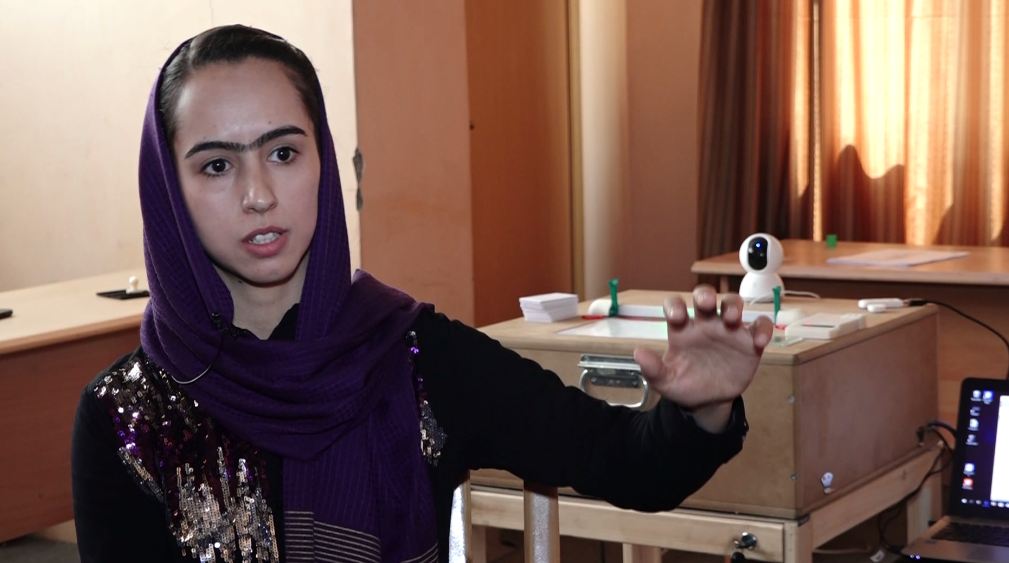
 Shabnam Meer, 24, an Afghan girl who is the alumna of psychology, has made a smart voting device that can help having a transparent and fair election.
The device took six months to be made.
Shabnam says that this device can prevent frauds in the election by saving the clean votes directly in the Independent Election Commission (IEC)’s server.
The smart voting device provides the facility to know the result of the election at the end of the polling day, Shabnam says.
“The device automatically sends the votes to the IEC; hereby, the commission can announce the preliminary result at the end of the polling day and the final result in the following day,” says Shabnam.
How does the device work?
According to Shabnam, each voting sheet has a barcode to prevent any fraud.
After recognizing the voter’s identity by using the biometric system, one more barcode will be stacked to the sheet, adds Shabnam.
She further says that the data on the voting sheet will be scanned by the two laser eyes once the sheet is put in the device.
All the data of the device can be sent out directly to the server of IEC from the polling station without the need to the internet, adds Shabnam
Shabnam says “the device uses receivers on it for the GSM sim-cards, which has the GPRS function in all over Afghanistan, for sending the votes to IEC”.
In addition to these all, Shabnam has used Closed Circuit TVs (CCTVs) in the polling station; one for capturing the voter’s image and the second for recording the entire voting process.
According to Shabnam, the CCTVs are connected to smartphones to monitor the polling station during the process.
This device is made in such a way that can work in the areas without electricity using solar power.
This comes as the IEC announced on Thursday that no biometric system will be used in the upcoming presidential election.







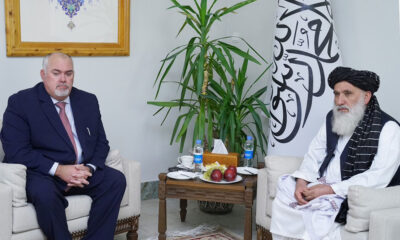



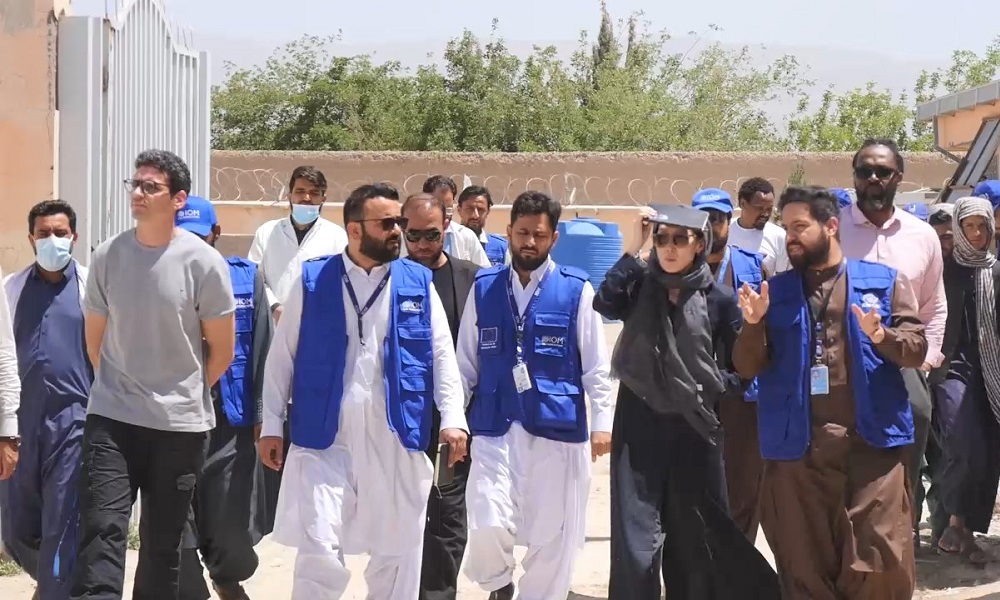
Mihyung Park, International Organization for Migration (IOM) Chief of Mission in Afghanistan, said during her visit to Kandahar that Afghanistan is still facing a serious humanitarian crisis in relation to returning migrants.
Mihyung Park made these remarks during a visit to a returnee center in the Spin Boldak district of Kandahar province, adding that the organization’s assistance to returnees will continue.
According to her, the current situation in the region shows that the flow of Afghan migrants returning from Iran and Pakistan is still increasing.
She added that although the needs of returnees have grown, aid resources are limited, and therefore the organization will focus on families that are in the greatest need of assistance.
ccording to IOM, around three million Afghans returned from Iran and Pakistan to the country in 2025 alone. This process is still ongoing, which has further increased the need for humanitarian assistance.
Latest News
Afghan goes on trial in US for Kabul airport bombing in 2021
The suicide bombing was carried out by Abdul Rahman al-Logari, who detonated an explosive device at approximately 5:36 p.m.
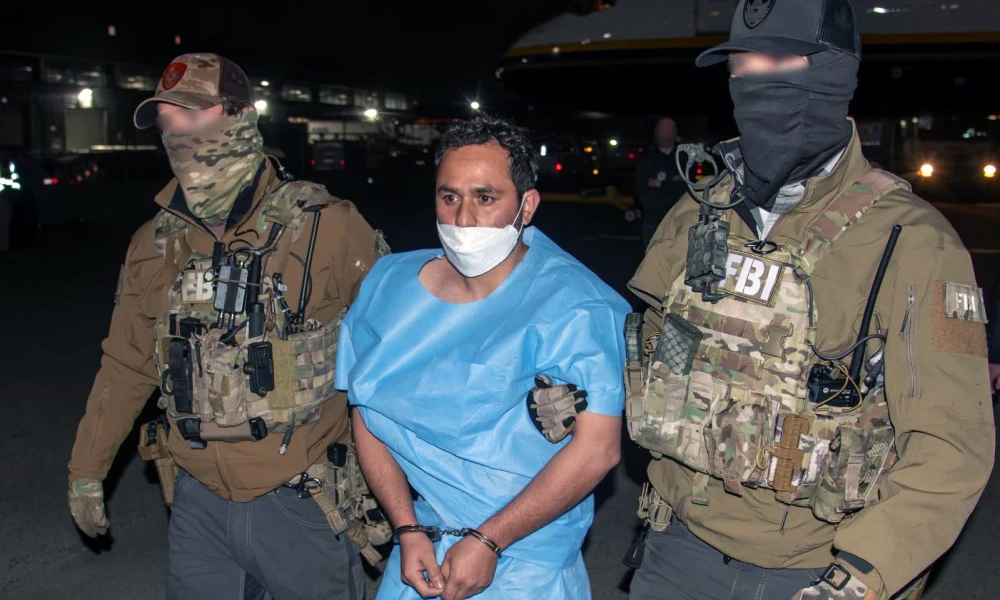
An Afghan national has gone on trial in a U.S. federal court over his alleged role in the deadly 2021 bombing at Kabul airport during the final days of the American withdrawal from Afghanistan.
Mohammad Sharifullah, also known as “Jafar,” faces a charge of providing and conspiring to provide material support to ISIS-K, the Afghan affiliate of the Islamic State group, resulting in death. He has pleaded not guilty.
The attack, which took place on August 26, 2021, at Kabul airport, killed more than 180 people, including 13 U.S. service members, as thousands of Afghans crowded the facility seeking evacuation amid the Islamic Emirate return to power.
A jury was selected on Monday, with opening statements and witness testimony beginning shortly thereafter. If convicted, Sharifullah could face life imprisonment.
Prosecutors allege that Sharifullah helped prepare for the bombing at Abbey Gate, the airport’s main entry point during the evacuation. According to court filings, he admitted during FBI interviews that he scouted a route for the attacker, checking for security presence and reporting back to other ISIS-K (Daesh) members that the route was clear.
The suicide bombing was carried out by Abdul Rahman al-Logari, who detonated an explosive device at approximately 5:36 p.m.
Sharifullah told investigators he had been released from prison about two weeks before the attack and was subsequently recruited, receiving a motorcycle and a mobile phone, prosecutors said.
Assistant U.S. Attorney John Gibbs told the court that the defendant spoke extensively with authorities, participating in multiple FBI interviews conducted in Pakistan, during transit to the United States, and after arrival.
“You will hear his words, and you will see a great deal of evidence of his guilt,” Gibbs said in his opening remarks.
However, defence attorney Geremy Kamens rejected the allegations, arguing that the wrong person had been charged and that any statements made by Sharifullah were obtained under duress.
“This man, Mohammad Sharifullah, had nothing to do with it,” Kamens told the court, adding that the central issue was identifying who was truly responsible.
Expert testimony from Bruce Hoffman provided jurors with context on ISIS operations and described the situation at the airport ahead of the bombing as “complete pandemonium.”
During cross-examination, the defence sought to shift attention toward the IEA’s control over Kabul at the time, highlighting their influence in the days leading up to the attack.
In April 2023, IEA authorities said they had killed an ISIS-K figure described as the mastermind behind the Abbey Gate bombing, an operation carried out without U.S. involvement, according to officials from the administration of Joe Biden.
The U.S. withdrawal from Afghanistan has faced sustained criticism over its execution, particularly in the wake of the airport attack.
Latest News
Aid agencies launch operation to assist conflict-affected communities in Nuristan
Humanitarian agencies said they are continuing to work closely with local communities to ensure aid reaches those most in need.

Humanitarian organisations have begun a multi-day operation to deliver urgently needed assistance to communities in eastern Nuristan Province, where ongoing conflict has left thousands without access to basic services for more than six weeks.
The effort is being coordinated by the International Committee of the Red Cross (ICRC), the Afghan Red Crescent Society (ARCS) and the World Food Programme (WFP), working together to reach previously inaccessible areas.
According to humanitarian agencies, around 136,000 people — representing roughly 17,000 households — in the districts of Kamdesh District and Barg-e-Matal District have faced severe shortages of food, healthcare and essential household items due to insecurity and restricted access over the past two months.
Since early April, aid organisations have engaged in ongoing dialogue with all parties to the conflict to secure safe and unimpeded access for neutral humanitarian operations. Following these discussions, delivery of assistance has now begun.
Initial efforts are focused on distributing food, medical supplies and other essential relief items. The reopening of access routes into Nuristan has also allowed markets to gradually restock, while medical evacuations have resumed.
Humanitarian agencies said they are continuing to work closely with local communities to ensure aid reaches those most in need. Early assessments indicate that significant needs remain, particularly in food security, healthcare and basic services.
The organisations involved reaffirmed their commitment to operating under principles of neutrality, independence and impartiality, and called for continued cooperation from all parties to ensure sustained access to vulnerable populations.


Afghanistan still facing humanitarian crisis regarding returnees: IOM chief

Saar: Islamic Emirate delegation’s visit to Brussels discussed

Trump warns of renewed strikes on Iran if talks fail, signals no ceasefire extension

Afghan goes on trial in US for Kabul airport bombing in 2021

Aid agencies launch operation to assist conflict-affected communities in Nuristan

IEA supreme leader orders replacement of foreign terminology in official documents

Russia deems US military presence in Afghanistan unacceptable

Afghanistan hosts inaugural Afghanistan–Central Asia Consultative Dialogue to strengthen regional cooperation

TAPI gas pipeline advances 25 km in Afghanistan

Russia backs Uzbekistan–Afghanistan trade hub, praises regional economic cooperation
Saar: Islamic Emirate delegation’s visit to Brussels discussed

Tahawol: Pakistan’s failed efforts to impose war in Afghanistan discussed

Saar: Demand for the country’s exports to Iran discussed

Tahawol: Fragile ceasefire between Iran and US discussed

Saar: Fate of Kabul–Islamabad talks in China reviewed
-
 Business4 days ago
Afghanistan moves toward self-sufficiency in car battery production
-

 Latest News2 days ago
Afghanistan launches media platform to improve access to information
-
 Regional4 days ago
China steps up Iran diplomacy while seeking smooth summit with Trump
-
 Business4 days ago
Uzbekistan launches exchange-based trade system with Afghanistan to boost bilateral commerce
-
 Latest News3 days ago
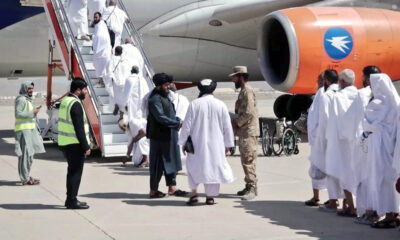
Afghanistan to airlift 30,000 pilgrims to Saudi Arabia in 96 flights for Hajj 2026
-

 Regional4 days ago
Ships crossing Hormuz need OK from IRGC, unfreezing funds part of deal, Iran official says
-
 Business3 days ago
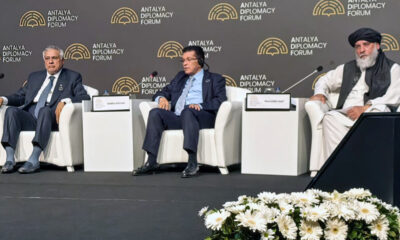
Afghan commerce minister highlights trade trust and market stability at Antalya Forum
-
 Tahawol5 days ago
Tahawol: Russia’s readiness to mediate between Kabul-Islamabad discussed