
World
US, Iran exchange attacks as Trump threatens further escalation

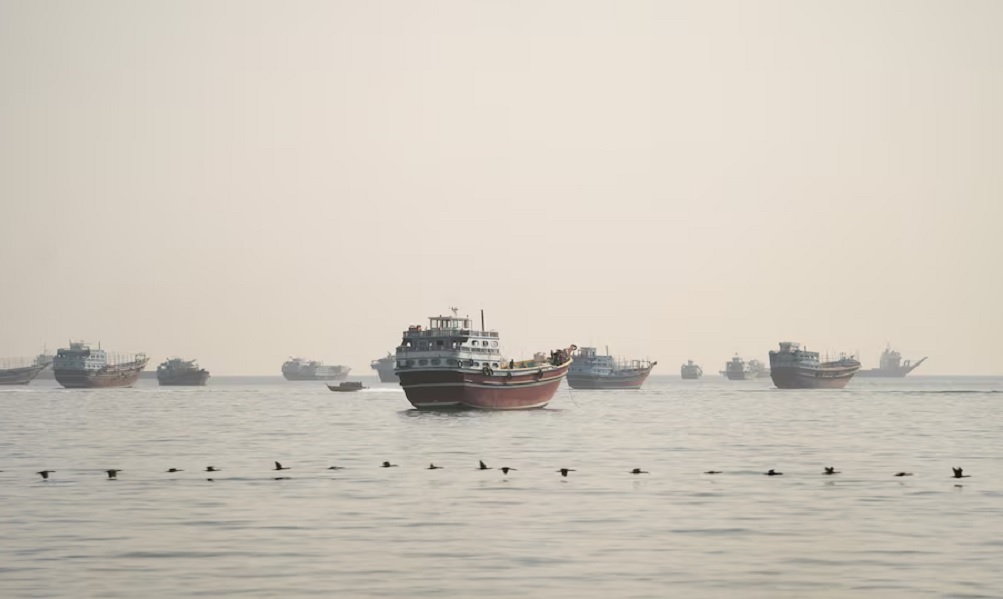
The United States launched new strikes against multiple targets overnight in Iran, the U.S. military said on Wednesday, as President Donald Trump vowed even more attacks if no peace deal is secured.
The military’s Central Command announced the strikes were complete about four hours after they began shortly after midnight in Tehran, saying in a post on X that the targets included “military surveillance capabilities, communication systems, and air defense sites across Iran.”
“The strikes are in response to Iran’s unwarranted and continued aggression,” Central Command said, Reuters reported.
The attacks were the latest development in an escalating exchange of strikes that threatens to reignite a full-scale war, which was paused in early April when the two sides agreed to a fragile ceasefire.
Iran’s Islamic Revolutionary Guard Corps said early on Thursday they had launched counter-attacks on 18 U.S. military targets at airbases in Kuwait and Bahrain, and Bahrain’s interior ministry said sirens were sounded.
Iran’s top joint military command also warned it would fire on any vessel attempting to pass through the Strait of Hormuz, which has been largely closed for months. Iranian media reported that two ships were fired upon.
U.S. Central Command denied that the strait was closed, saying commercial ships were still transiting the strait despite Iran’s threats. Trump said earlier in the day that vessels have been crossing the strait without Iran’s permission as part of a clandestine military mission.
Trump told Fox News reporter Trey Yingst on Wednesday evening that the strikes would stop shortly but that he would “bomb the shit out of them” if Iran’s leaders did not sign an agreement with the U.S. immediately, Yingst wrote on X.
Iranian news agencies reported explosions in several cities, including Sirik, Kargan, Bandar Abbas, Minab, Varamin and Karaj.
U.S. Defense Secretary Pete Hegseth presented the move as an effort to force Iran into a deal to end the conflict, telling reporters during a visit to Central Command in Florida that the strikes would “advance our military interests and also enhance our diplomatic position.”
“We will strike them hard tonight, and hopefully Iran makes a good decision,” he said. “If we need to negotiate with bombs, we’ll negotiate with bombs.”
The United States and Iran have traded fire several times since the tentative ceasefire took hold, even as negotiators have unsuccessfully sought an end to the war, now in its fourth month. Trump has repeatedly said a deal is close, though there has been no sign of a breakthrough, while also threatening to resume bombing.
The U.S. military earlier targeted air defenses and radar sites around the Strait of Hormuz after a U.S. attack helicopter was downed near the strategic waterway on Monday. Iran responded with missile and drone attacks on U.S. bases in Jordan, Kuwait and Bahrain. A U.S. official said there was no significant damage.
Iran accused the U.S. of striking reservoirs that supplied drinking water to 10 villages and violating international law.
“This is not collateral damage — it is a calculated war crime and a flagrant violation of human rights,” Foreign Ministry spokesperson Esmaeil Baghei said.
The Pentagon did not immediately respond to a request for comment.
Trump, who has threatened before to destroy Iran’s civilian infrastructure, did not say whether the coming strikes would target power plants and bridges.
Despite the belligerent language from both sides, there were signs of continuing diplomatic efforts.
A delegation from Qatar, which has been mediating between the United States and Iran, landed in Tehran on Wednesday to hold talks on the latest developments, Iranian media reported.
TRUMP CLAIMS A SECRET MISSION
The war has killed thousands and disrupted roughly one-fifth of the world’s supply of oil and natural gas, sending prices sharply higher. Iran has blocked traffic through the Strait of Hormuz, while the U.S. has maintained its own blockade on Iranian ports.
The conflict has become a political headache for the White House, with public polls showing Trump’s approval ratings sinking amid voter anger over high gasoline prices. Some Republicans have openly worried the war’s unpopularity could cost them control of Congress in November’s midterm elections.
Oil prices rose nearly $3 following Trump’s threat of escalation, and extended gains in early Asian trade on Thursday.
Trump told reporters at the White House on Wednesday that vessels carrying 100 million barrels of oil have defied Iran to travel through the strait as part of a secret military mission.
Hegseth said ships have been transiting the strait “in the middle of the night, protected by the United States in a way that Iran can’t stop, they can’t see it.”
Separately, the U.S. military said it disabled an oil tanker transporting Iranian crude in the Gulf of Oman on Tuesday for a second consecutive day.
FIGHTING IN LEBANON CONTINUES
Fighting in a parallel war between Israel and Iran-backed Hezbollah militants in Lebanon has continued. Israeli airstrikes in southern Lebanon killed at least 13 people on Wednesday, Lebanese security sources said, while Hezbollah claimed fresh attacks against Israeli forces.
Tehran’s demands include an end to Israel’s attacks in Lebanon, the lifting of sanctions on Iran, the release of billions of dollars in frozen assets, and recognition of its control of the strait.
Trump says Iran must end its restrictions on shipping through Hormuz. He also says any peace deal must ensure Iran cannot develop a nuclear weapon.
Iran denies any such ambition.
The U.N. nuclear watchdog’s 35-nation Board of Governors passed a U.S.-backed resolution on Wednesday telling Iran to declare its remaining enriched uranium stocks and let inspectors verify them. Iran branded the resolution as “political”.





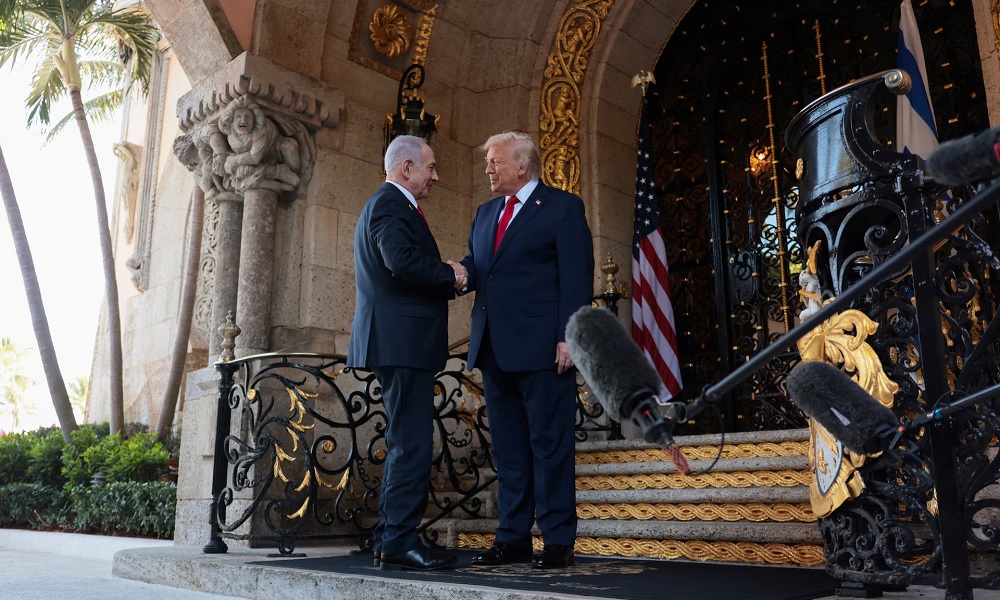
President Donald Trump said on Friday that Israeli Prime Minister Benjamin Netanyahu will visit the U.S. next week.
Trump’s comments came in his speech at the White House Correspondents’ Association Dinner on Friday, while he was falsely casting U.S. Senator Chuck Schumer as Palestinian, Reuters reported.
“I am going to send him (Schumer) a beautiful Palestinian outfit tomorrow, so he can greet Bibi Netanyahu when he comes to town next week,” Trump said.
“He turned Palestinian,” Trump said of Schumer, who is Jewish, while also joking that sharia law was Schumer’s “new founding.”
U.S. Muslim and Jewish advocacy groups have previously criticized Trump for calling Schumer, the top Senate Democrat, a Palestinian, with the rights groups saying Trump uses the term disrepectfully as a slur and as an insult.
Netanyahu’s office said earlier that he will travel to Washington on Monday and will meet with Trump on Tuesday. Netanyahu will also attend deceased U.S. Senator Lindsey Graham’s funeral, his office said.
The Trump-Netanyahu meeting will come as the U.S.-Israeli war on Iran completes five months.
World
Trump vows to punish Iran for Houthi attacks in Red Sea; oil surges over $100
After the Houthis said they had struck the two tankers on Thursday, Trump said he would hold Iran accountable for any further attacks by the fighters.
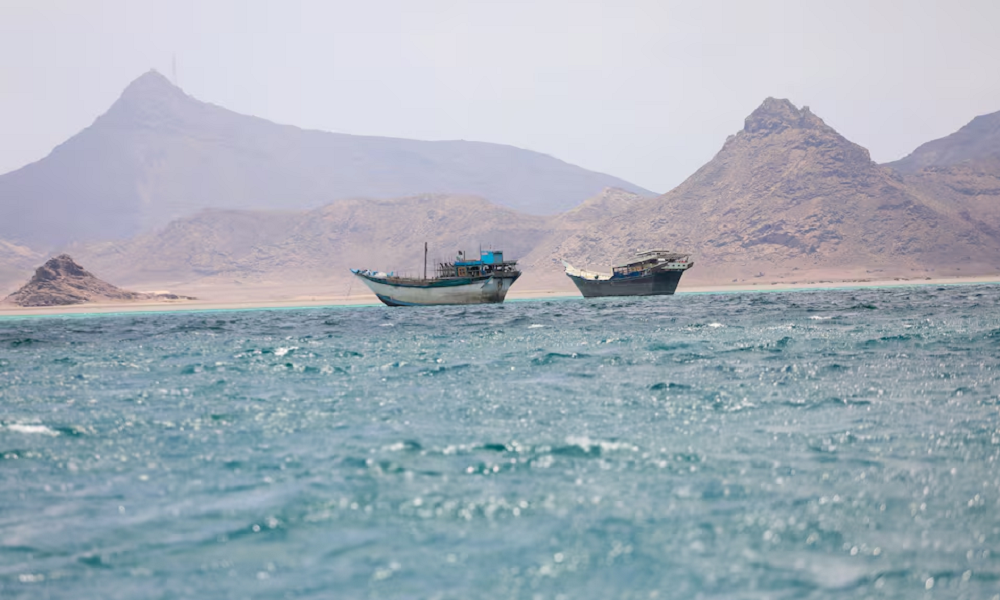
U.S. President Donald Trump promised “major military punishment” for Iran and its Houthi allies on Thursday after the Yemeni fighters struck two Saudi oil tankers in the Red Sea, extending the Middle East war to a second major shipping chokepoint.
Fears that disruption could widen further to block another sea route sent global oil prices surging in one of the steepest rises of the war. Brent crude rose more than 6%, breaking through $100 a barrel for the first time since May, Reuters reported.
Two weeks since the effective collapse of an interim truce meant to end the war, the U.S. military launched air strikes on Iran overnight into Thursday, prompting Iran to fire at neighbouring Arab countries that host U.S. bases. The U.S. military fired another round of missiles at Iran late Thursday and early Friday in the 13th consecutive night of attacks.
Iranian state media said on both nights that missiles struck Qeshm Island on the Strait of Hormuz, the virtually closed waterway that has become the focal point in a war well into its fifth month that has already killed thousands and raised fears of a global economic downturn.
TRUMP: IRAN HASN’T ‘RECEIVED ENOUGH PAIN YET’
After the Houthis said they had struck the two tankers on Thursday, Trump said he would hold Iran accountable for any further attacks by the fighters.
The Houthis, who control northern and western Yemen, said this week they were imposing a naval blockade on Saudi Arabia, which has diverted millions of barrels of oil per day by pipeline to the Red Sea to get around Iran’s blockade of Gulf oil through the Strait of Hormuz.
“If they do this again, the U.S. will hold Iran responsible, in that the Houthis are a Surrogate and/or Proxy of Iran, and major military punishment will be inflicted upon Iran and, of course, the Houthis, themselves,” Trump wrote on social media.
He told news outlet Axios he was considering relaunching major combat operations in Iran and was close to a decision. “They haven’t received enough pain yet,” Axios quoted Trump as saying.
On Thursday evening, Trump said on social media that “any and all damages done” to cargo ships would be paid for with “Iranian Money,” referring to frozen Iranian assets held by the U.S., but he did not say how this would work.
Sources in Iran and Yemen told Reuters that Iran had flown Revolutionary Guard commanders, military advisers and missile- and drone-related equipment into Yemen days before the Houthis announced their blockade. The Houthis dismissed the report.
The Houthis said their forces had carried out missile and drone strikes on Saudi oil tankers, the Encelia and the Layla.
A maritime security source said the Encelia had transmitted a distress call reporting it had been struck by a missile near the Saudi port of Jizan in the Red Sea just north of Yemen late on Wednesday. Saudi state news agency SPA said the strike had caused a fire at the bow.
Reuters could not immediately confirm the attack on the Layla, or other battlefield accounts, but Trump mentioned two attacks on Saudi tankers.
The insurance cost of shipping goods through the southern Red Sea doubled for some companies on Thursday, after the reported attacks, sources said.
Houthi attacks could close the strait known as the Bab el-Mandeb or “Gate of Tears” which controls access from the Red Sea to the Indian Ocean, the second most important route for energy shipments after the Strait of Hormuz at the mouth of the Gulf.
In the days since they announced their blockade in the Red Sea, several tankers have changed course to avoid the Bab el-Mandeb, heading north instead through the Suez Canal, potentially using a much longer and more expensive route to reach Asian customers by sailing around Africa.
IRAN REPORTS STRIKES ON JORDAN, KUWAIT
Iran said it attacked U.S. missile systems, weapons and fuel storage sites in Jordan, as well as U.S. military posts in Kuwait.
Jordan’s army said it engaged four Iranian missiles and six drones in the past day, intercepting all but one missile, which fell in an uninhabited area.
Iran’s Revolutionary Guards said it struck a U.S. electronic warfare unit at Al-Adiri base in Kuwait, causing unspecified casualties, in response to an overnight strike on Iran’s Shalamcheh border crossing with Iraq.
Neither the U.S. nor Kuwait has reported casualties at the base.
Iranian military spokesperson Brigadier General Mohammad Akraminia said Iran would keep retaliating as long as the U.S. continued to attack its infrastructure and coastal areas, Iranian state TV reported.
Since the U.S. and Israel began the war in February, Iran has demonstrated that it can hit U.S. targets in the region, despite Trump having said early on that the U.S. had wiped out Iranian military capabilities.
Four people familiar with U.S. intelligence said Iranian strikes on CIA targets in the Gulf earlier in the war had prompted U.S. intelligence to investigate whether Russia was assisting Iran with targeting information or drone technology.
CONGRESS
High oil prices are stoking inflation globally, and have put Trump’s Republican allies under pressure ahead of congressional elections in November.
The Republican-led U.S. House of Representatives backed legislation on Thursday directing Trump to halt U.S. military action against Iran, the latest rebuke of the Republican president from Congress, which the U.S. Constitution grants the exclusive power to “declare War.”
Lawmakers have passed similar resolutions repeatedly in recent months, but they have not led to cessation of the war. The Senate voted hours later to block a separate, similar measure.
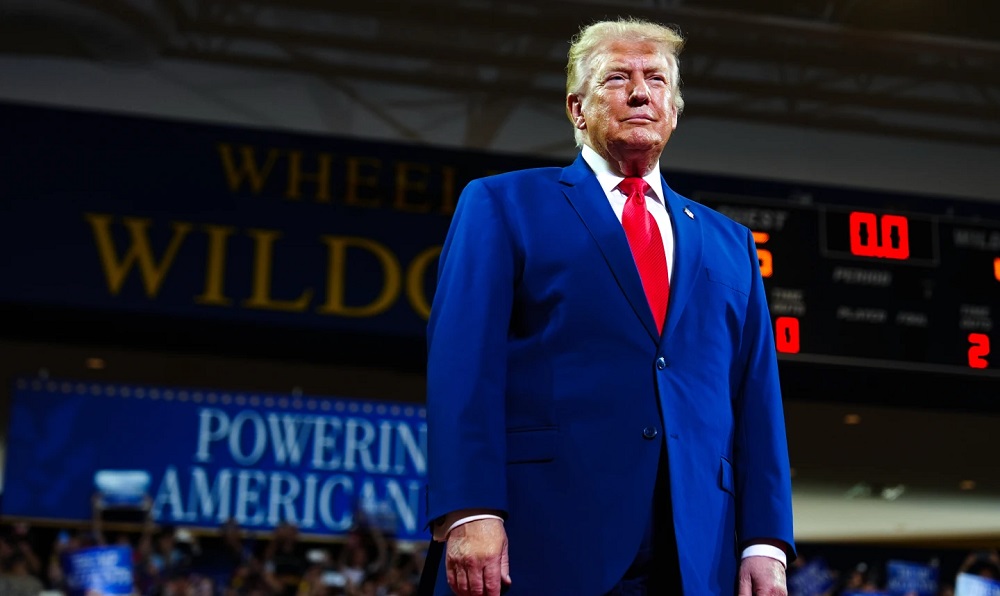
U.S. President Donald Trump said on Thursday that a newly agreed civilian nuclear cooperation deal with Saudi Arabia will only move forward if the kingdom normalizes relations with Israel by joining the Abraham Accords.
In a post on social media, Trump said the agreement does not permit uranium enrichment and stressed that approval of the deal is contingent on Saudi Arabia signing the Abraham Accords, the U.S.-brokered agreements that established diplomatic ties between Israel and several Arab states.
“The agreement will be approved, but is totally subject to Saudi Arabia joining the very respected and successful Abraham Accords,” Trump wrote, adding that the United States supports only civilian nuclear facilities that do not involve uranium enrichment.
Saudi Arabia has repeatedly stated that it will not normalize relations with Israel without a clear pathway toward the establishment of an independent Palestinian state. Israeli Prime Minister Benjamin Netanyahu has rejected Palestinian statehood, arguing it would pose unacceptable security risks to Israel.
The Saudi Embassy in Washington declined to comment on Trump’s remarks.
Netanyahu’s office welcomed the prospect of Saudi Arabia joining the Abraham Accords, describing it as a “historic leap forward for peace in the Middle East,” but did not address the nuclear agreement.
The civilian nuclear agreement, announced on Wednesday, is expected to run for 30 years and involve U.S. companies in developing Saudi Arabia’s nuclear energy sector. According to U.S. officials familiar with the agreement, it could eventually allow for the construction of a uranium
enrichment facility following a joint U.S.-Saudi feasibility study, although Trump has insisted the final arrangement will not include uranium enrichment.
The agreement will be submitted to the U.S. Congress for review.
The Saudi Energy Ministry said the deal would help diversify the kingdom’s energy sources, promote advanced technologies and expand investment opportunities between the two countries.
Secretary of State Marco Rubio defended the agreement during a visit to Manila, saying it would ensure Saudi Arabia partners with American companies rather than competitors such as China, Russia, France or South Korea in developing its civilian nuclear program.
“We’re not the only show in town, but we’re the best show in town,” Rubio told reporters.
The agreement has already drawn scrutiny from members of Congress and nuclear non-proliferation experts, who have raised concerns over reports that it does not include the International Atomic Energy Agency’s Additional Protocol, which provides for expanded inspections and verification measures.
Some lawmakers have also questioned whether Congress should have greater oversight of any nuclear cooperation agreement with Saudi Arabia, reviving debate over legislation first proposed in 2018 that would require congressional approval before such agreements take effect.
The Trump administration has made expanding the Abraham Accords a key foreign policy objective during the president’s second term, viewing Saudi Arabia’s participation as a major step toward broader regional normalization despite ongoing tensions stemming from the conflicts in Gaza and Iran.


Tahawol: Trump halting major Iran escalation

Saar: Afghanistan-Uzbekistan economic ties

Afghan team arrives in England for training camp ahead of Ireland ODI series

Afghanistan can link South and Central Asia through data transit: Baradar

Afghanistan, Uzbekistan discuss expanding economic, trade and investment cooperation

India offers 1,000 online scholarships for Afghan students for 2026-27 academic year

Afghanistan eyes direct Basmati rice imports from India amid tensions with Pakistan

Cricket world pays tribute to Afghanistan fast bowler Shapoor Zadran

Turkey spent over $120 million to prepare airport for Qatar-donated U.S. presidential aircraft

Afghanistan, Uzbekistan set for friendly cricket clash in Khost
Tahawol: Trump halting major Iran escalation
Saar: Afghanistan-Uzbekistan economic ties

Tahawol: New developments ahead in the Middle East discussed

Saar: Rising tensions between Kabul and Islamabad discussed

Tawsia: Factors behind rising fuel prices in Afghanistan discussed
-

 Latest News4 days ago
Germany defends Afghan deportation policy after fatal Trier knife attack
-

 Sport4 days ago
FIFA updates world rankings; Spain climbs to No. 1, Afghanistan ranked 171st
-
 Latest News4 days ago
Afghanistan and Uzbekistan advance railway cooperation, discuss Trans-Afghan project
-

 World5 days ago
War in Iran has cost the US $37.5 billion so far, Pentagon says
-
 Latest News5 days ago
Amnesty International calls for probe into Pakistan airstrike on Kabul rehabilitation centre
-
 Business4 days ago
Pakistan’s trade deficit with neighbours surges to nearly $16 billion as exports to Afghanistan plunge
-

 Sport4 days ago
Rahmat Shah Zurmati appointed Afghanistan’s new Test and ODI captain
-
 Latest News2 days ago
Five armed men killed while attempting to cross Durand Line into Badakhshan