
Latest News
Reforms in Electoral Law, Electoral Systems required: FEFA

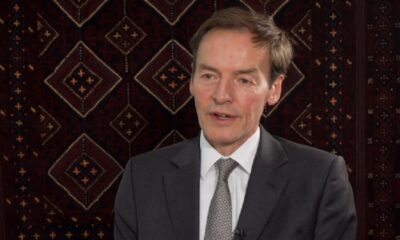
![FIFA _14_7_14_DARI_SOT.avi_snapshot_00.42_[2014.12.14_16.54.25]](https://ariananews.af/wp-content/uploads/2014/12/FIFA-_14_7_14_DARI_SOT.avi_snapshot_00.42_2014.12.14_16.54.25.jpg)
Electoral watch organizations and civil society activists believe if the government does not bring reforms in electoral commissions leadership, people will lose their trust in democracy and the upcoming parliamentary elections will face with new challenges.
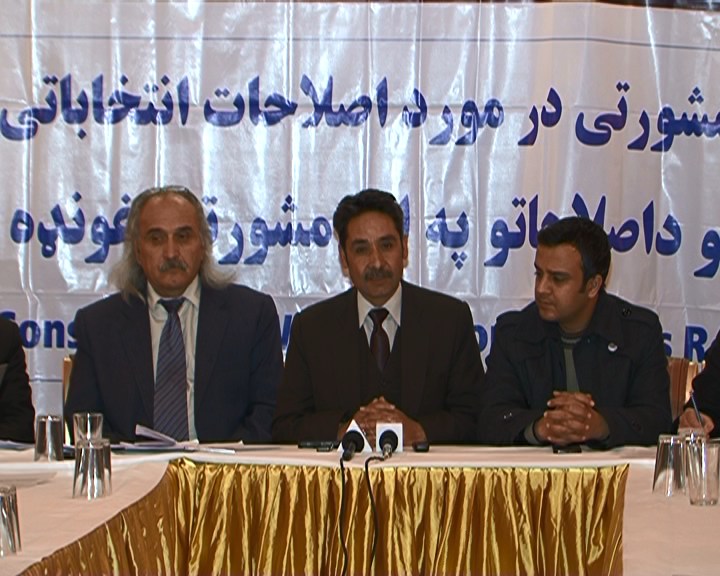
Free & Fair Election Forum of Afghanistan Organization (FEFAo) had organized consultation meetings with provincial council candidates, members of the Civil Society Organizations (CSOs), political parties, electoral commission’s representatives, women and youth groups in 8 regions in Afghanistan.
Mohammad Nayeem Asghari, FEFA program manager said that our findings show that most of Afghans would like to bring reforms in electoral system and the government must bring short and long term reforms in electoral commissions otherwise we will witness a weak participation of the people in polling stations.
In addition, a number of CSOs believe that weak administration of electoral commissions resulted to face with challenges in 2014 presidential and provincial elections.
Partaw Naderi, a member of the civil society said,” currently there is incapability to manage elections and it is a huge responsibility weighing too much on the current electoral commission shoulders, I think a great national value has been hurt somehow in Afghanistan, and the government has a duty to deal with this issue.”
After a disputable election the National Unity Government decided to form a commission to bring reforms in electoral law and electoral system, but no practical action has been taken so far by the government yet.

Latest News
China and Pakistan deepen Afghanistan cooperation after Beijing talks
In the joint declaration, China and Pakistan stressed that Afghan territory should not be used by militant organisations to threaten neighbouring countries or regional interests.
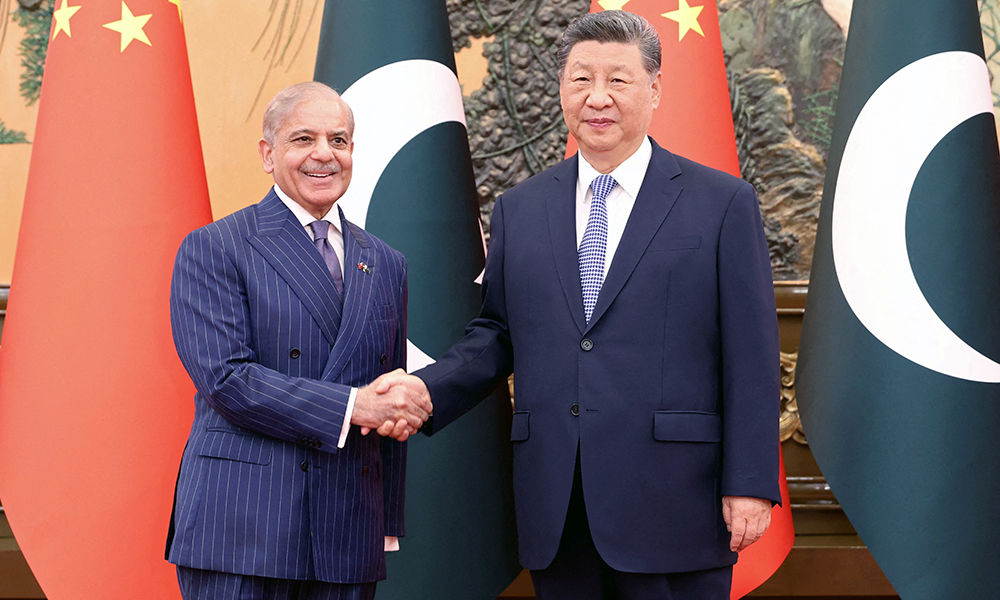
Following high-level talks in Beijing between China and Pakistan, the two allies have pledged closer coordination on Afghanistan and warned against militant groups using Afghan territory to threaten regional security,
The commitment came in a joint statement issued after Pakistani Prime Minister Shehbaz Sharif concluded a four-day official visit to China, where he met Chinese President Xi Jinping and Premier Li Qiang.
A significant section of the statement focused on Afghanistan and regional security, underlining growing concern from both Beijing and Islamabad about instability spilling across borders.
The two countries welcomed recent trilateral discussions involving Afghanistan, Pakistan and China held in Urumqi, Xinjiang, in April 2026. Pakistan praised China for facilitating dialogue between Islamabad and Kabul, while both sides agreed to maintain close coordination on Afghan-related issues.
In the joint declaration, China and Pakistan stressed that Afghan territory should not be used by militant organisations to threaten neighbouring countries or regional interests.
The statement specifically named the Tehreek-e-Taliban Pakistan (TTP) and the Eastern Turkistan Islamic Movement (ETIM), saying no individual or group should be allowed to carry out attacks or destabilising activities from within the region.
Security concerns linked to Afghanistan have become increasingly important for both countries. Pakistan has repeatedly accused militants of launching cross-frontier attacks from Afghan territory, while China has voiced concern about extremist networks operating near its western Xinjiang region.
Beyond Afghanistan, the joint statement reaffirmed the deepening strategic partnership between China and Pakistan, including cooperation on infrastructure, counter-terrorism, trade, artificial intelligence and regional connectivity under the China-Pakistan Economic Corridor (CPEC).
The two sides also agreed to strengthen military and counter-terrorism cooperation through what they described as a new China-Pakistan Security Partnership.
The visit coincided with celebrations marking 75 years of diplomatic relations between China and Pakistan.
Latest News
IEA defense minister arrives in Moscow for international security conference
The ministry added that participants are expected to exchange views on key international and regional security issues during the gathering.
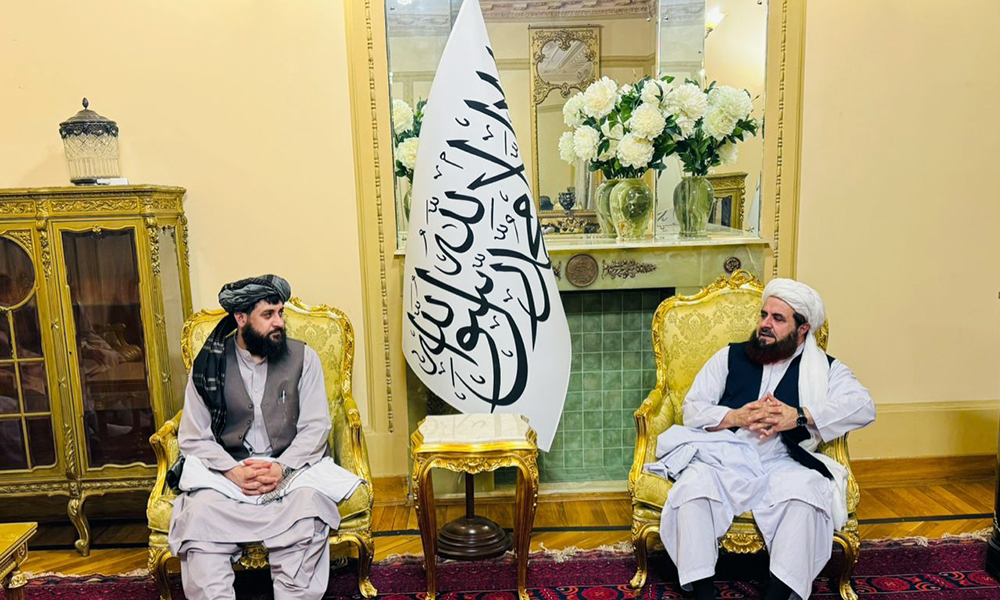
Afghanistan’s Ministry of Defense says Mawlawi Mohammad Yaqoob Mujahid, Defense Minister of the Islamic Emirate of Afghanistan, has arrived in Moscow to participate in the International Security Conference hosted by the Russian Federation.
According to the ministry, the conference will bring together defense and security officials from various countries to discuss regional security, shared challenges, and ways to strengthen cooperation.
The ministry added that participants are expected to exchange views on key international and regional security issues during the gathering.
International Sports
FIFA finalizes base camp venues for World Cup teams
Each team’s chosen Team Base Camp (TBC) Training Site will act as a “home away from home”, providing world-class facilities for players, coaches and staff

The footprint for the FIFA World Cup 2026 is expanding far beyond the 16 official host cities, with FIFA confirming the Team Base Camp Training Sites that will serve as home bases for all 48 participating nations during the tournament.
The announcement marks another major milestone ahead of the biggest FIFA World Cup in history, with teams now finalising where they will live and train throughout the group stage of the expanded tournament across Canada, Mexico and the United States.
Each team’s chosen Team Base Camp (TBC) Training Site will act as a “home away from home”, providing world-class facilities for players, coaches and staff to prepare, recover and travel from during the competition.
The selections are also expected to spread the economic and cultural impact of the tournament far beyond the match venues.
FIFA said 25 communities that are not hosting games will still welcome national teams, bringing fans, media attention and tourism to cities and towns across North America.
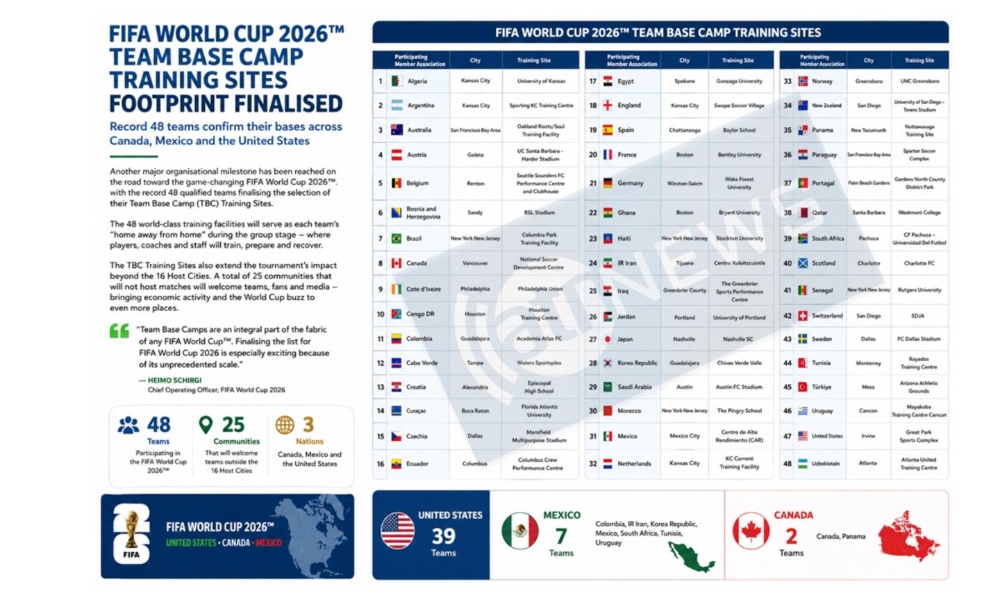
According to FIFA, 39 teams will base themselves in the United States, seven in Mexico and two in Canada.
Among the countries confirmed to be training in Mexico are Colombia, Iran, South Korea, Mexico, South Africa, Tunisia and Uruguay.
Canada and Panama will both be based in Canada.
“Team Base Camps are an integral part of the fabric of any FIFA World Cup,” said Heimo Schirgi, the Chief Operating Officer for FIFA World Cup 2026.
“They are where teams put down roots, train and recuperate, and experience the day-to-day rhythms of the tournament.”
He added that the expanded 48-team tournament creates an opportunity to involve more communities and fans than ever before.
The selection process began in 2024, when FIFA provided qualified and prospective teams with a list of more than 60 potential training base options across North America.
The final choices were refined after the tournament draw in December 2025, with teams considering travel logistics and the locations of their group-stage matches.
The non-host communities selected to welcome teams include Cancun, Tijuana and Pachuca in Mexico, as well as several cities across the United States including Austin, Charlotte, Nashville, Portland, San Diego and Tampa.
In Canada, New Tecumseth is among the communities set to host a national team during the tournament.
The FIFA World Cup 2026 will be jointly hosted by Canada, Mexico and United States, and will be the first edition of the tournament to feature 48 teams.


China and Pakistan deepen Afghanistan cooperation after Beijing talks

IEA defense minister arrives in Moscow for international security conference

FIFA finalizes base camp venues for World Cup teams

Rubio says Iran deal could take days as US launches fresh strikes

US military strikes Iranian boats, missile launch sites: CENTCOM

New Afghanistan-China transport corridor launched via Turkmenistan

Afghanistan signs $46 million deal to develop standard laboratory complexes

Bayat Power extends gas supply deal with Afghan Gas

Germany to launch online visa system for Afghan study and work applicants in Pakistan

Afghanistan launches first 5G trial in Kabul to boost telecom services

Tahawol: Afghanistan-Japan relations reviewed

Saar: Afghanistan’s relations with regional countries, incl Russia and China discussed

Saar: Shahbaz Sharif’s trip to China

Saar: Discussion on UN concerns over Afghan refugees’ challenges

Tahawol: Push for agreement between Iran and US discussed
-
 Latest News3 days ago
China restricts export of chemical substances to Afghanistan
-
 Business2 days ago
Major pharma firms eye investment in Afghanistan
-

 World3 days ago
One dead, 36 injured in explosion at New York dry dock
-

 Sport4 days ago
Mohammadi crowned champion of 2nd season of Ariana Snooker Championship
-
 Business5 days ago
Fifth section of Hairatan–Mazar-i-Sharif railway reopens in northern Afghanistan
-

 Sport4 days ago
Chennai Super Kings eliminated as Gujarat Titans register record IPL victory
-
 Latest News5 days ago
IEA says marriage separation regulation aligns with Sharia
-
 Latest News3 days ago
Britain says recognition of IEA conditional on women’s rights, counterterrorism