
Regional
Iran reopens airspace after temporary closure forced flights to reroute
At a similar time last week to the airspace closure there had been dozens of planes in the air over Iran, Flightradar24 said.

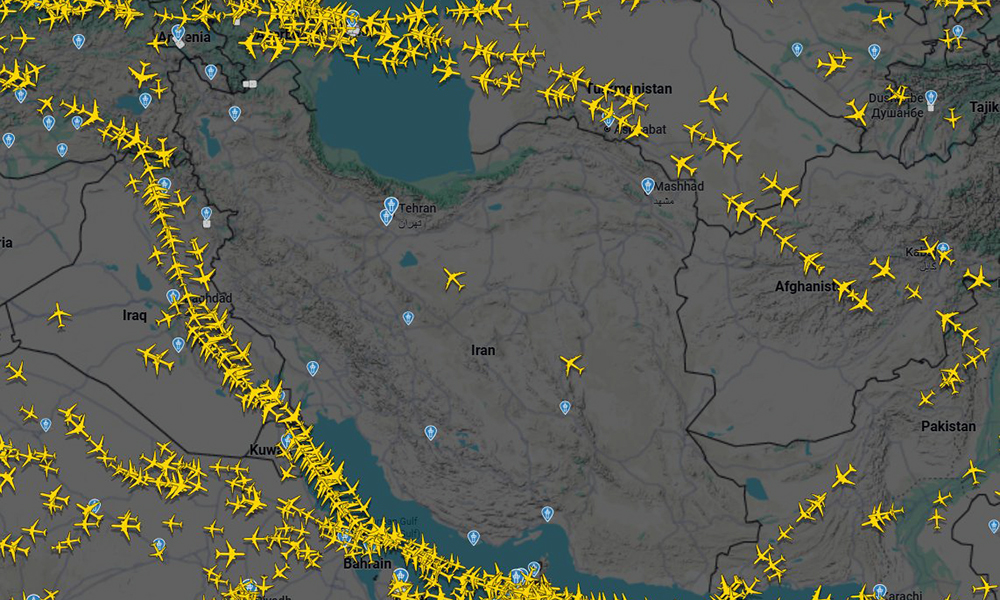
Iran reopened its airspace after a near-five-hour closure amid concerns about possible military action between the U.S. and Iran that forced airlines to cancel, reroute or delay some flights.
Iran closed its airspace to all flights except international ones to and from Iran with official permission at 5:15 p.m. ET (2215 GMT) on Wednesday, according to a notice on the U.S. Federal Aviation Administration website.
The notice was removed shortly before 10 p.m. ET, or 0300 GMT, according to tracking service Flightradar24, which showed five flights from Iranian carriers Mahan Air, Yazd Airways and AVA Airlines were among the first to resume over the country.
At a similar time last week to the airspace closure there had been dozens of planes in the air over Iran, Flightradar24 said.
The temporary closure came as President Donald Trump has been weighing a response to the situation in Iran, which is seeing its biggest anti-government protests in years.
The United States was withdrawing some personnel from bases in the Middle East, a U.S. official said on Wednesday, after a senior Iranian official said Tehran had warned neighbors it would hit American bases if Washington strikes.
Missile and drone barrages in a growing number of conflict zones represent a high risk to airline traffic.
India’s largest airline, IndiGo (INGL.NS), said some of its international flights would be impacted by Iran’s sudden airspace closure. Air India said its flights were using alternative routes that could result in delays or cancellations.
A flight by Russia’s Aeroflot (AFLT.MM), bound for Tehran returned to Moscow after the closure, according to Flightradar24 data.
Earlier on Wednesday, Germany issued a new directive cautioning the country’s airlines from entering Iranian airspace, shortly after Lufthansa (LHAG.DE), rejigged its flight operations across the Middle East amid escalating tensions in the region.
The United States already prohibits all U.S. commercial flights from overflying Iran and there are no direct flights between the countries.
Airline operators like flydubai and Turkish Airlines have canceled multiple flights to Iran in the past week.
“Several airlines have already reduced or suspended services, and most carriers are avoiding Iranian airspace,” said Safe Airspace, a website run by OPSGROUP, a membership-based organisation that shares flight risk information. “The situation may signal further security or military activity, including the risk of missile launches or heightened air defence, increasing the risk of misidentification of civil traffic.”
A Ukraine International Airlines jet was downed by Iran’s military in 2020, killing all 176 passengers and crew.
Lufthansa said on Wednesday that it would bypass Iranian and Iraqi airspace until further notice while it would only operate day flights to Tel Aviv and Amman from Wednesday until Monday next week so that crew would not have to stay overnight. Some flights could also be canceled as a result of these actions, it added in a statement.
Italian carrier ITA Airways, in which Lufthansa Group is now a major shareholder, said that it would similarly suspend night flights to Tel Aviv until Tuesday next week.



Regional
Iran launches widespread drone and missile strikes on Gulf states amid US-Israeli attacks
The attacks come after Israel and the US carried out airstrikes on Iranian territory Saturday, killing Ayatollah Ali Khamenei, Iran’s Armed Forces Chief of Staff Abdolrahim Mousavi, and other senior officials.
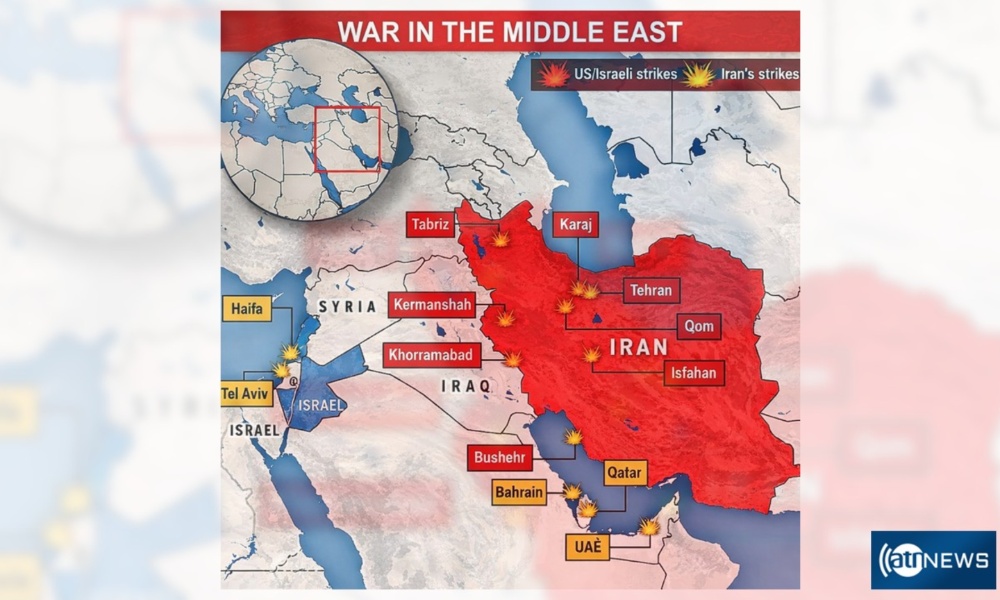
Iran carried out extensive drone and missile attacks across multiple Gulf countries on Sunday, March 1, marking a sharp escalation following a joint U.S.-Israeli operation that targeted Iranian leadership and military infrastructure.
The offensive has caused fatalities, injuries, and widespread structural damage, as regional tensions soar.
Gulf States Under Fire
United Arab Emirates: Authorities reported that drones struck Abu Dhabi and Zayed International Airports, killing one person and injuring 11. Additional drones were intercepted elsewhere, with debris causing injuries to two more people in Dubai. Loud explosions heard across the emirate were attributed to air-defense operations.
Bahrain: Drones targeted Bahrain International Airport, causing limited material damage but no casualties. The passenger terminal was evacuated, and emergency plans were activated to protect travelers.
Qatar: Civil defense teams extinguished a minor fire in an industrial area after debris from an intercepted missile fell there, with no reported injuries.
Oman: Two drones targeted Duqm Port on the southeastern coast, injuring one worker and causing minor damage near fuel tanks. Omani authorities condemned the attack and vowed to safeguard national facilities.
Saudi Arabia, Kuwait, and Jordan were also reportedly targeted in Iran’s coordinated missile and drone strikes, heightening fears of further escalation across the region.
Israel and U.S. attacks in Iran
The wave of attacks comes after Israel and the United States carried out airstrikes on Iranian territory Saturday, killing Supreme Leader Ayatollah Ali Khamenei, Iran’s Armed Forces Chief of Staff Abdolrahim Mousavi, and several senior officials.
The strikes were described by Israeli and U.S. sources as part of a campaign against Iran’s nuclear and ballistic missile programs.
US President Donald Trump warned that any Iranian retaliation would be met with “a force that has never been seen before,” while Iran’s security chief, Ali Larijani, vowed an unprecedented counterstrike.
The Iranian parliament speaker, Mohammad Baqer Qalibaf, condemned the U.S.-Israeli operation as crossing a “red line” and promised severe retaliation.
Regional and global impact
Air raid sirens sounded across Israel, with explosions reported in Tel Aviv as Iran targeted cities and U.S. bases. Gulf embassies have advised foreign nationals to shelter in place, and nearly all airports in the region have suspended flights, creating one of the largest aviation disruptions in recent years.
The ongoing strikes and counterstrikes have disrupted shipping and oil transport, with Iran briefly closing the Strait of Hormuz, which carries about 20% of global oil consumption. OPEC+ is reportedly considering a larger-than-planned output increase in response to market uncertainty.
Civilian impact and humanitarian concerns
The attacks on Gulf airports, ports, and residential areas have caused civilian casualties and forced mass evacuations. In Dubai, shrapnel from intercepted drones injured two civilians, while Oman reported one injured port worker. Analysts warn that escalating strikes on both civilian and military targets could widen the conflict, endangering populations across the region.
Many foreign embassies based in Gulf States have meanwhile advised their nationals to take shelter.
Outlook
With Iran forming a temporary leadership council following the death of Khamenei, and U.S. and Israeli forces maintaining offensive operations, the Middle East faces an unprecedented military escalation.
Experts warn that without immediate diplomatic intervention, the conflict could expand beyond the Gulf, with severe humanitarian and economic consequences.
This remains a rapidly evolving situation with high stakes for regional security, global energy markets, and civilian populations across multiple countries.
Regional
Iran to form interim leadership council as officials vow retaliation after Ayatollah’s death
Under Iran’s constitution, a temporary leadership structure can be formed in the event of a supreme leader’s death until a permanent successor is appointed by the Assembly of Experts.
Iran will establish an Interim Leadership Council on Sunday to manage state affairs following the death of Supreme Leader Ayatollah Ali Khamenei, senior officials announced, as the country braces for further confrontation after days of intense military escalation with the United States and Israel.
Ali Larijani, secretary of Iran’s Supreme National Security Council, said preparations for the new governing body were finalized during a high-level meeting on Saturday. He described the move as necessary to ensure political stability and continuity of command during what he called a “critical and historic period.”
Under Iran’s constitution, a temporary leadership structure can be formed in the event of a supreme leader’s death until a permanent successor is appointed by the Assembly of Experts. The creation of the council signals Tehran’s effort to project institutional control amid heightened uncertainty and internal and external pressures.
“We Will Respond”
Larijani issued a stern warning to what he described as Iran’s “aggressive enemies,” vowing decisive retaliation.
“You have burned the hearts of the Iranian people; we will burn your hearts,” he said, referring to the recent strikes that Iranian authorities say killed dozens, including civilians.
According to Larijani, Tehran had previously warned Washington — through diplomatic channels via the Swiss embassy, which represents U.S. interests in Iran — that any direct military action would result in American bases in the region becoming targets.
He said Iran’s armed forces have mobilized significant resources to sustain operations, while acknowledging that the coming days could bring both “challenges and progress.”
Parliament: “Red Line Crossed”
Parliament Speaker Mohammad-Bagher Ghalibaf said the United States and Israel had “crossed a red line” with their strikes and would face consequences.
He described the current confrontation as existential for Iran and a decisive moment in its decades-long standoff with its adversaries. “They will be held accountable,” he said, warning that retaliation would be severe.
High-Stakes Transition
The announcement of an Interim Leadership Council comes at a volatile moment. Joint U.S.-Israeli strikes targeting senior Iranian officials and military infrastructure have triggered missile exchanges across the region, disrupted air travel, and prompted emergency sessions at the United Nations.
Analysts say the leadership transition will be closely watched both inside and outside Iran. Domestically, authorities are seeking to maintain unity and prevent unrest. Internationally, governments are assessing whether the interim structure will pursue escalation or leave room for diplomacy.
For now, Iranian officials are signaling resolve rather than restraint, raising concerns that the conflict could widen before any political settlement is reached.
Regional
Iran’s Ali Khamenei, who based iron rule on fiery hostility to US and Israel, dies at 86
Ali Khamenei was born in Mashhad, northeast Iran, in April 1939. His religious commitment was clear when he became a cleric at the age of 11. He studied in Iraq and in Qom, Iran’s religious capital.
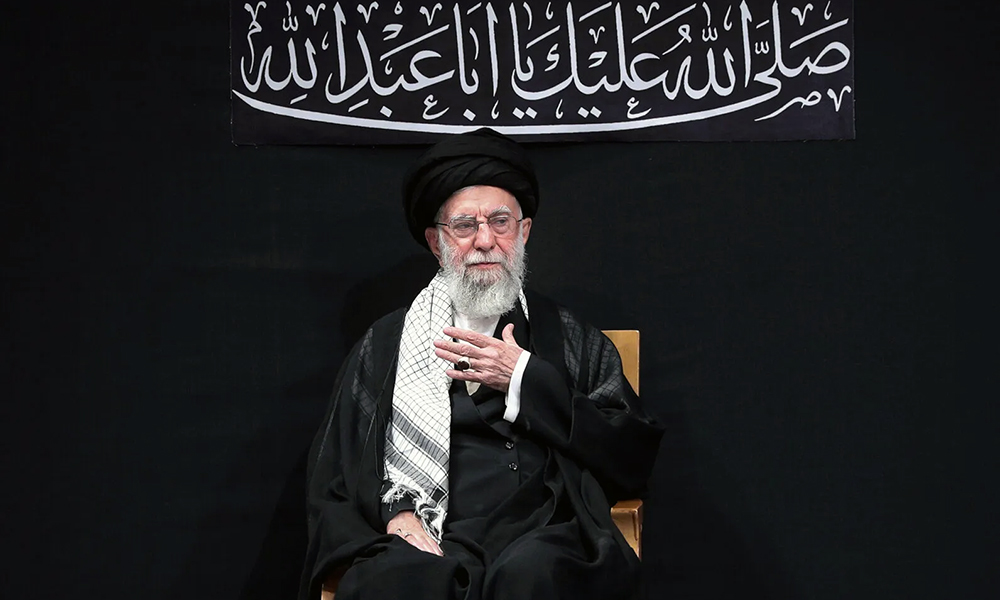
The 36-year rule of Ayatollah Ali Khamenei built Iran into a powerful anti-U.S. force, spreading its military sway across the Middle East, while using an iron fist to crush repeated unrest at home, Reuters reported.
He was killed on Saturday, aged 86, Iranian state media announced, in air strikes by Israel and the U.S. that pulverised his central Tehran compound, after decades of efforts to resolve the dispute over Iran’s nuclear program diplomatically failed.
At first dismissed as weak and indecisive, Khamenei seemed an unlikely choice for supreme leader after the death of the charismatic Ayatollah Ruhollah Khomeini, who founded the Islamic Republic of Iran. But Khamenei’s rise to the pinnacle of the country’s power structure afforded him a tight grip over the nation’s affairs.
Khamenei was “an accident of history” who went from “a weak president to an initially weak supreme leader to one of the five most powerful Iranians of the last 100 years”, Karim Sadjadpour at the Carnegie Endowment for International Peace told Reuters.
The ayatollah criticised Washington throughout his rule, continuing to deploy barbs after the start of Donald Trump’s second term as U.S. president in 2025.
As a new wave of protests spread through Iran, with slogans such as “Death to the dictator”, and as Trump threatened to intervene, Khamenei vowed in January that the country would not “yield to the enemy”.
The comment was typical of the ferociously anti-Western Khamenei, in office since 1989.
By maintaining the hardline stance of Khomeini, the Republic’s first supreme leader, Khamenei quashed the ambitions of a succession of independent-minded elected presidents who sought more open policies at home and abroad.
In the process, he ensured Iran’s isolation, critics say.
Khamenei long denied that Iran’s nuclear programme was aimed at producing an atomic weapon, as the West contended. In 2015 he cautiously supported a nuclear deal between world powers and the government of pragmatist President Hassan Rouhani that curbed the country’s nuclear programme in return for sanctions relief. The hard-won accord resulted in a partial lifting of Iran’s economic and political isolation, read the report.
But Khamenei’s hostility toward the U.S. was undimmed, intensifying in 2018 when Trump’s first administration withdrew from the nuclear agreement and reimposed sanctions to choke Iran’s oil and shipping industries.
Following the U.S. withdrawal, Khamenei sided with hardline supporters who criticised Rouhani’s policy of appeasement towards the West.
As Trump pressed Iran to agree to a new nuclear deal in 2025, Khamenei condemned “the rude and arrogant leaders of America”. “Who are you to decide whether Iran should have enrichment?” he asked.
Khamenei often denounced “the Great Satan” in speeches, reassuring hardliners for whom anti-U.S. sentiment was at the heart of the 1979 revolution, which forced the last shah of Iran into exile.
Iran saw major student-led protests in 1999 and 2002. But Khamenei’s authority was put to the test more profoundly in 2009, when the contested results of a presidential election that he had validated ignited violent street unrest, stoking a crisis of legitimacy that lingered until his death.
In 2022, Khamenei cracked down on protesters enraged by the death of Iranian-Kurdish woman Mahsa Amini, 22, who died in the custody of morality police in September of that year.
Faced with some of the most intense turmoil since the revolution, Khamenei blamed Western enemies then resorted to the hanging of protesters and the display of their bodies, suspended from cranes, after months of unrest.
As supreme leader, Khamenei’s word was law. He inherited enormous powers, including command of the armed forces and the authority to appoint many senior figures, among them the heads of the judiciary, security agencies and state radio and television.
He appointed allies as commanders of the elite Revolutionary Guards.
As the final authority in Iran’s complex system of clerical rule and limited democracy, Khamenei long sought to ensure that no group, even among his closest allies, mustered enough power to challenge him and his anti-U.S. stance.
Scholars outside Iran painted a picture of a secretive ideologue fearful of betrayal – an anxiety fuelled by an assassination attempt in 1981 that paralysed his right arm.
International organisations and activists repeatedly criticised violations of human rights in Iran. Tehran said it has the best human rights record in the Muslim world.
Ali Khamenei was born in Mashhad, northeast Iran, in April 1939. His religious commitment was clear when he became a cleric at the age of 11. He studied in Iraq and in Qom, Iran’s religious capital.
His father, a religious scholar of ethnic Azeri descent, was a traditionalist cleric opposed to mixing religion and politics. In contrast, his son embraced the Islamist revolutionary cause.
“He (Khamenei’s father) came across as a modernist or progressive cleric,” said Mahmoud Moradkhani, a nephew who opposes Khamenei’s rule and lives in exile. Unlike his son, “he was not a part of the fundamentalists”, Moradkhani said.
In 1963, Khamenei served the first of many terms in prison when at 24 he was detained for political activities. Later that year he was imprisoned for 10 days in Mashhad, where he underwent severe torture, according to his official biography.
After the shah’s fall, Khamenei took up several posts in the Islamic Republic. As deputy minister of defence, he became close to the military and was a key figure in the 1980-88 war with neighbouring Iraq, which claimed an estimated total of one million lives.
A skilled orator, he was appointed by Khomeini as a Friday prayer leader in Tehran.
There were questions about his rapid, unprecedented rise. He won the presidency with Khomeini’s support – the first cleric in the post – and was a surprise choice as Khomeini’s successor, given that he lacked both Khomeini’s popular appeal and superior clerical credentials, Reuters reported.
His ties to the powerful Guards paid off in 2009. That year, the force crushed protests after President Mahmoud Ahmadinejad won re-election amid opposition accusations of vote fraud.
He also presided over a vast financial empire through Setad, an organisation founded by Khomeini but expanded hugely under Khamenei, with assets worth tens of billions of dollars.
Khamenei expanded Iranian influence in the region, empowering Shi’ite militias in Iraq and Lebanon, and propping up then-President Bashar al-Assad by deploying thousands of soldiers to Syria.
He spent billions over four decades on these allies – the “Axis of Resistance”, which also included Hamas, the Palestinian Islamist group, and Yemen’s Houthis – to oppose Israeli and U.S. power in the Middle East.
But in 2024 Khamenei saw these alliances unravel, and Iran’s regional influence shrivel, with the ousting of Assad and a series of defeats inflicted by Israel on Hezbollah in Lebanon and on Hamas in Gaza, including the killing of their leaders.
Under Khamenei’s rule, Iran and Israel fought a shadow war for years, with Israel assassinating Tehran’s nuclear scientists and Revolutionary Guard commanders.
It exploded into the open during Israel’s war on Hamas in Gaza from 2023. In April 2024, Iran fired hundreds of missiles and drones at Israel after it bombed Tehran’s embassy compound in Damascus. Israel struck Iranian soil in response.
But that was only a prelude to June 2025, when Israel’s military unleashed hundreds of fighter jets to strike Iranian nuclear and military targets as well as senior personnel. The surprise attack provoked a barrage of missiles in both directions, transforming simmering conflict into all-out war. The U.S. joined the air offensive on Iran, which lasted 12 days.
The U.S. and Israel had warned they would strike again if Iran pressed ahead with its nuclear and ballistic missile programmes and, on Saturday, they launched the most ambitious attack on Iranian targets in decades.
Negotiations between U.S. and Iranian officials took place as recently as Thursday, but senior U.S. officials said that Iran had not been willing to give up its ability to enrich uranium, which the Iranians argued they wanted for nuclear energy but U.S. officials said would enable the country to build a nuclear bomb.
On the diplomatic front, Khamenei rejected any normalisation of ties with the United States. He argued that Washington had backed hardline groups like Islamic State to inflame a sectarian war in the region.
Like all Iranian officials, Khamenei denied any intent to develop nuclear weapons and went so far as to issue an Islamic ruling, or fatwa, in the mid-1990s on “production and usage” of nuclear weapons, saying: “It is against our Islamic thoughts.”
He also supported a fatwa issued by Khomeini in 1989, which called on Muslims to kill the Indian-born author Salman Rushdie after the publication of his novel “The Satanic Verses”.
Khamenei’s official website confirmed the ongoing validity of the death edict as recently as 2017. Five years later, Rushdie was stabbed while giving a public lecture in New York. The writer was gravely wounded, but survived. The perpetrator, who was sentenced to 25 years in prison in 2025 for attempted murder, did not testify at the trial.
The late ayatollah leaves an Islamic Republic wrestling with uncertainty amid the attacks from Israel and the United States, as well as growing dissent at home, especially among younger generations.
“I just want to live a peaceful, normal life … Instead, they (the rulers) insist on a nuclear programme, supporting armed groups in the region, and maintaining hostility toward the United States,” Mina, 25, told Reuters by phone from Kuhdasht in the western Lorestan province at the start of 2026, read the report.
“Those policies may have made sense in 1979, but not today,” the jobless university graduate added. “The world has changed.”


Afghanistan expresses deep concern as Middle East crisis intensifies

Afghanistan says Pakistani airspace violation over Kabul was thwarted

FIFA calls for ‘all teams to participate’ in 2026 World Cup amid US–Iran conflict

UNSC to convene meeting on Afghanistan in March 9

Pakistan’s night strikes hit residential areas in Afghanistan, civilian casualties reported

IEA releases three Pakistani soldiers to mark Ramadan

AFC Futsal Asian Cup: Afghanistan to face Iran in crucial Group D clash

Pakistani military jet downed in Afghanistan’s Jalalabad, pilot captured alive

Afghanistan’s Chief of Armed Forces underscores readiness and equipment for national defense

Afghanistan welcomes investment and technology partnerships with India

Tahawol: Joint Israeli-US attacks on Iran discussed

Saar: Afghan retaliatory operations against Pakistan discussed

Tahawol: Carrying out retaliatory operations against Pakistan discussed

Saar: Resumption of retaliatory operations against Pakistan discussed

Tahawol: IEA’s military response against Pakistan discussed
-
 Latest News1 day ago
Pakistani military jet downed in Afghanistan’s Jalalabad, pilot captured alive
-
 Latest News2 days ago
Afghan Air Force conducts airstrikes in Islamabad, other cities
-
 Latest News2 days ago
IEA: Special circle in Pakistan has launched mission to destabilize region
-

 Sport5 days ago
Richard Pybus appointed as head coach of Afghanistan’s national cricket team
-

 World3 days ago
India’s Modi backs Israel in address at Israeli parliament
-
 Latest News2 days ago
Turkey launches initiative to diffuse Afghanistan-Pakistan tension
-
 Regional3 days ago
Narendra Modi holds high-level talks after historic address to Knesset
-

 Latest News2 days ago
Afghans say they are united against Pakistan aggression