
Latest News
Israel targets Gaza tunnels, Palestinian rocket attacks persist

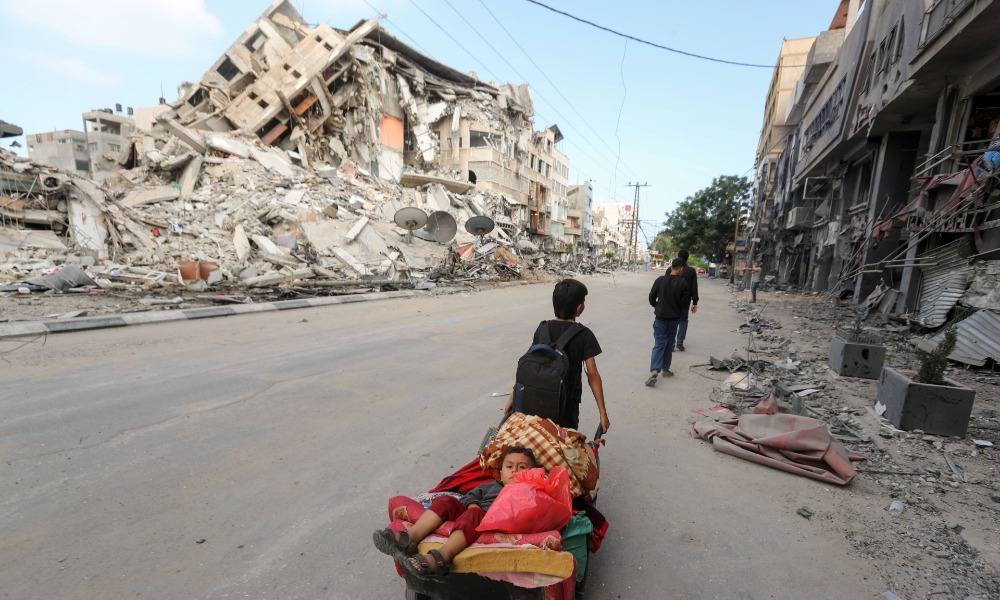
Israel fired artillery and mounted extensive air strikes on Friday against a network of Palestinian militant tunnels under Gaza, amid persistent rocket attacks on Israeli towns.
The largest Israeli operation against a specific target since the conflict began included 160 aircraft as well as tanks and artillery firing from outside the Gaza Strip, Israeli military spokesman Lieutenant Colonel Jonathan Conricus said.
Rocket barrages against southern Israel swiftly followed the 40-minute pre-dawn offensive on the fifth day of the most serious fighting between Israel and Gaza militants since 2014.
A woman and her three children were killed in Gaza, health officials in the north of the enclave said, and their bodies were recovered from the rubble of their home. An elderly woman in Israel died while on her way to a shelter to shield from the rocket attacks.
Gaza’s ruling Hamas group launched the rocket attacks at Jerusalem and Tel Aviv in retaliation for Israeli police clashes with Palestinians near Al-Aqsa Mosque in Jerusalem.
At least 119 people have been killed in Gaza, including 31 children and 19 women, and 830 others wounded, Palestinian medical officials said.
The death toll in Israel stood at eight: a soldier patrolling the Gaza border, six Israeli civilians – including two children – and an Indian worker, Israeli authorities said.
The head of the International Criminal Court warned that individuals involved in the bloodshed may be targeted by its investigation into alleged war crimes in earlier bouts of the conflict.
In northern and eastern parts of Gaza, the sound of artillery fire and explosions echoed early on Friday.
The U.N. Office for the Coordination of Humanitarian Affairs said there were reports of more than 200 housing units destroyed or severely damaged and hundreds of people seeking shelter in schools in northern Gaza.
Israel says it makes every effort to preserve civilian life, including warning in advance of attacks.
“What we were targeting is an elaborate system of tunnels that spans underneath Gaza, mostly in the north but not limited to, and is a network that the operatives of Hamas use in order to move, in order to hide, for cover,” Conricus told foreign reporters.
“We refer to (it) as the Metro,” he said, adding that a final assessment on the outcome of the operation was pending.
Israeli Prime Minister Benjamin Netanyahu said on Thursday the campaign “will take more time”. Israeli officials said Hamas, Gaza’s most powerful Islamist militant group, must be dealt a strong deterring blow before any ceasefire.
U.S. President Joe Biden called on Thursday for a de-escalation of the violence, saying he wanted to see a significant reduction in rocket attacks.
TENSIONS IN ISRAEL
The hostilities have fuelled tension between Israeli Jews and the country’s 21% Arab minority. Violence continued in mixed communities overnight after street fighting and tit-for-tat attacks that prompted Israel’s president to warn of civil war.
“They say Gaza is spiraling out of control, but what is happening here scares me more,” said Majd Abado, an Arab resident of the mixed city of Acre, where people from both communities said they were afraid to leave their homes.
Israel’s military said a Palestinian tried to stab a soldier near the West Bank city of Ramallah. The soldier shot the attacker. Palestinian health officials said the man was killed.
The Israeli military’s build-up of forces on the Gaza border has raised speculation about a possible repeat of ground invasions during the Israel-Gaza wars in 2014 and 2009. But an incursion looked unlikely, given Israel’s reluctance to risk a sharp increase in military casualties on Hamas turf.
The U.N. Security Council will publicly discuss the worsening violence on Sunday, diplomats said after the United States had objected to a meeting on Friday.
Truce efforts by Egypt, Qatar and the United Nations had yet to deliver a sign of progress.
The Israeli military has put the number of militants killed in Israeli attacks at between 80 and 90. It said that so far, some 1,800 rockets have been fired at Israel, of which 430 fell short in Gaza or malfunctioned.
On the Israeli political front, Netanyahu’s chances to remain in power after an inconclusive March 23 election appeared to improve significantly after his main rival, centrist Yair Lapid, suffered a major setback in efforts to form a government.












Kazakhstan’s Foreign Minister Mukhtar Tileuberdi has called for pragmatic and coordinated international engagement with Afghanistan, saying the country’s long-term stability is closely linked to the security and sustainable development of Central Asia.
Speaking during the general debate of the 81st session of the United Nations General Assembly in New York on Friday, Tileuberdi said humanitarian assistance to Afghanistan remains essential but alone cannot break the cycle of poverty, displacement and dependency.
He said Kazakhstan supports a “pragmatic, coordinated and step-by-step” approach to international engagement with Afghanistan, with the United Nations playing a central role.
Tileuberdi also said Kazakhstan is working with the UN to operationalize the United Nations Regional Centre for the Sustainable Development Goals for Central Asia and Afghanistan in Almaty.
He said the success of the centre should be measured by the results and assistance it delivers to the region.


Abu Muslim Farah defeat Khurasan Faryab 2-0 in ACL season six

Saar: Concerns over Pakistan’s political crisis discussed

Afghanistan Champions League: Omar Zawak Herat beat Toofan Herat 1-0

Blast in Pakistan’s Dera Ismail Khan kills 11, injures 30

Ariana Afghan Airlines increases Kabul-Delhi cargo flights

Saudi energy group signs major Afghanistan deals covering gas exploration and pipeline plans

Trump floats idea of renaming Atlantic or Pacific Ocean

US hits Egyptian bank branches with Iran sanctions as war marks six months

Nepal flood rescue mission enters critical phase as thousands remain missing

Iranian clubs to face Gulf opponents at neutral venues in Asian Champions League Elite
Saar: Concerns over Pakistan’s political crisis discussed

Exclusive interview with Abdul Latif Mansoor, Minister of MRRD

Tawsia: Overview of Afghanistan’s iron mines

Tahawol: Discussion on fresh Pakistani airstrikes on Afghanistan

Saar: Calls for international support for Afghanistan discussed
-

 World5 days ago
CNN, MS NOW and Politico sue Trump, challenging White House ban
-

 Latest News4 days ago
Ariana Afghan Airlines ranks seventh among 45 Central Asian airlines
-

 Latest News5 days ago
UN reiterates call for respect for international law after Kunar airstrikes
-

 Regional4 days ago
US and Iran hold first talks since June after Trump’s ‘annihilation’ threat
-

 Latest News4 days ago
Silk Road highway in Wakhan corridor now reaches the China border
-

 Regional3 days ago
Iran airlines cancel flights as US sanctions hit
-

 Latest News5 days ago
Afghan Official: Pakistan’s airstrikes will not go unanswered
-
 Regional5 days ago
G7 foreign ministers call on Iran to stop arming Houthis