
Business
Pakistan’s citrus export crisis deepens amid ongoing Afghanistan trade route closure
Afghanistan, which absorbs around 60% of Pakistan’s citrus exports, has remained closed to trade since mid-October.


Pakistan’s citrus sector is facing a worsening export crisis as the closure of the Afghanistan crossing continues to block access to its largest market.
Despite the start of the 2025 citrus season, exports are set to fall further from an already steep decline — dropping from $211 million in fiscal year 2021 to just $92.5 million in fiscal year 2025.
Afghanistan, which absorbs around 60% of Pakistan’s citrus exports, has remained closed to trade since mid-October.
This year alone, Pakistan shipped 153,683 tonnes of citrus to Afghanistan, while exports through the Afghan transit route also supply Russia, Kazakhstan, and Uzbekistan. With that corridor shut, exporters warn that the bulk of Pakistan’s kinnow harvest could go unsold.
A temporary policy exemption now allows citrus shipments to transit through Iran, but exporters say volumes to Central Asia and Russia cannot compensate for the loss of the Afghan market.
The crisis, however, goes deeper than the current crossing closure situation. Pakistan’s citrus industry continues to suffer from long-standing structural challenges — including reliance on the outdated, seeded kinnow variety that makes up over 90% of exports.
Climate change, rising pest pressure, shrinking yields, and declining A-grade fruit quality have all eroded competitiveness. Yields have fallen to about six tonnes per acre, and nearly half of kinnow processing units have closed.
Global competitors such as Egypt, China, Spain, Morocco, and Brazil have overtaken Pakistan by introducing new seedless, high-yielding varieties with longer harvest windows. As profits shrink, farmers are abandoning citrus orchards: the cultivated area has dropped 16% in the past five years.
Experts say Pakistan must urgently invest in developing seedless, climate-resilient varieties and strengthen existing research centres. At the same time, trade officials need to diversify export destinations by securing new sanitary and phytosanitary agreements to reduce dependence on a single market.
Without structural reforms and diversified access, Pakistan’s signature fruit risks losing its place in global markets — and its farmers risk losing their livelihoods.










Afghanistan has sent 20 kilograms of raw gold, valued at $2.9 million, to Uzbekistan’s Surkhandarya region for processing.
Termiz Gold Production, a jewelry manufacturing company based in the Termez International Trade Center free economic zone, has begun processing the imported gold, Kazakh media reported.
The project is expected to boost regional industrial capacity, advance the jewelry industry, and increase export volumes, while also improving the investment climate by creating favorable conditions for industrial development and higher value-added production.
Business
Russia signals interest in expanding investment and trade ties with Afghanistan
Afghanistan’s envoy to Moscow met with Russian officials this week where both sides highlighted the importance of strengthening bilateral ties.
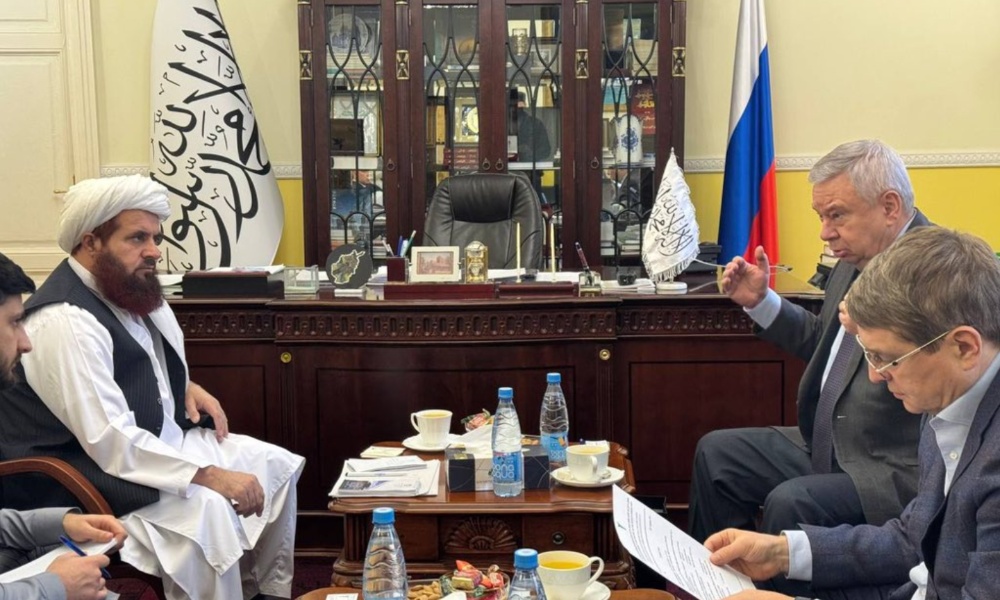
Russia has expressed strong interest in expanding investment and trade cooperation with Afghanistan during a meeting between Afghan and Russian officials in Moscow.
The Ambassador of the Islamic Emirate to Russia, Gul Hassan Hassan, met with Alexander Shkirando, Special Representative of the President of the Russian Chamber of Commerce, and Dmitry Antonov, Head of the Afghan–Russian Business Council.
During the talks, Russian officials highlighted their interest in increasing investment and commercial engagement with Afghanistan, noting that favorable conditions for investment have been established in the country.
Ambassador Gul Hassan Hassan briefed the meeting on Afghanistan’s current security and economic situation and urged greater access for Afghan products to Russian markets, as well as an expansion of imports from Afghanistan.
Both sides underscored the importance of strengthening bilateral cooperation and reaffirmed their commitment to enhancing economic and trade relations between Afghanistan and Russia.
Business
Afghan traders sign deal to import pharmaceuticals from Bangladesh
Under the agreement, Afghan traders will enter into direct contracts with Bangladeshi producers to supply medicines to the Afghan market.

Afghan traders have signed an agreement with major Bangladeshi pharmaceutical companies to import medicines directly from Bangladesh, a move that comes as Afghanistan prepares to halt the customs clearance of medicines imported from Pakistan.
The deal was reached during a visit to Dhaka by a delegation led by the Deputy Minister of Commerce and Industry, Mawlawi Ahmadullah Zahid, according to a statement from the Ministry of Commerce and Industry.
The delegation visited two of Bangladesh’s largest pharmaceutical manufacturers — BEXIMCO Pharmaceuticals Ltd and RENATA PLC — both of which export medicines to around 50 countries.
Under the agreement, Afghan traders will enter into direct contracts with Bangladeshi producers to supply medicines to the Afghan market.
During the visit, Mawlawi Zahid also invited Bangladeshi investors to establish pharmaceutical production facilities inside Afghanistan, stressing that nationwide security has been ensured and that the Islamic Emirate of Afghanistan supports industrial development and investment.
He said the government has provided all necessary facilities for investors and is committed to supporting domestic production.
Meanwhile, Dr. Naimullah Ayoubi, Director General of the Regulation of Medicines and Health Products at the Ministry of Public Health, assured Bangladeshi manufacturers of full cooperation in line with existing regulations.
The agreement follows an announcement by Afghan authorities that medicines imported from Pakistan will no longer be cleared through customs after the remaining 19-day grace period expires, prompting traders to seek alternative supply sources to ensure the continued availability of medicines in the country.


Afghanistan sends gold to Uzbekistan for processing

UK’s Starmer calls Trump’s remarks on allies in Afghanistan ‘frankly appalling’

Russia, Ukraine sit for tense talks on thorny territorial issue

Tawsia: Reducing Afghanistan’s Reliance on Pakistan Trade

Failed Afghan asylum seekers need to return home, Sweden’s migration minister says

Turkey withdraws from Afghanistan-Pakistan mediation amid rising tensions

Sharp drop in exports to Afghanistan drives Pakistan’s trade deficit surge

ICG report says Pakistan most impacted by IEA’s return in Afghanistan

Pakistan approves re-export of stranded Afghan transit trade cargo

Afghanistan–China joint market opens in Kabul
Tawsia: Reducing Afghanistan’s Reliance on Pakistan Trade

Tahawol: Pakistan’s membership in the Gaza peace board

Saar: Trump’s ‘move’ on Greenland discussed

Saar: Trump’s criticism of Afghanistan withdrawal

Tahawol: Pakistan PM’s complaint about Afghanistan
-

 Sport5 days ago
Tune in tomorrow to Ariana Television for AFC U23 Asian Cup semi-finals
-

 Latest News4 days ago
Ariana cargo aircraft arrives in Kabul, boosting trade and exports
-

 Regional4 days ago
Death toll in Karachi’s Gul Plaza fire rises to 27, dozens still missing
-

 Sport23 hours ago
China and Japan set for AFC U23 Asian Cup final showdown
-

 Business2 days ago
Afghan traders sign deal to import pharmaceuticals from Bangladesh
-

 Latest News5 days ago
One Chinese national and six Afghans killed in Kabul blast
-

 International Sports4 days ago
FIFA announces hosts and groups for expanded FIFA Series 2026
-

 Sport4 days ago
Afghanistan defeats West Indies by 38 runs, take early lead in T20I series